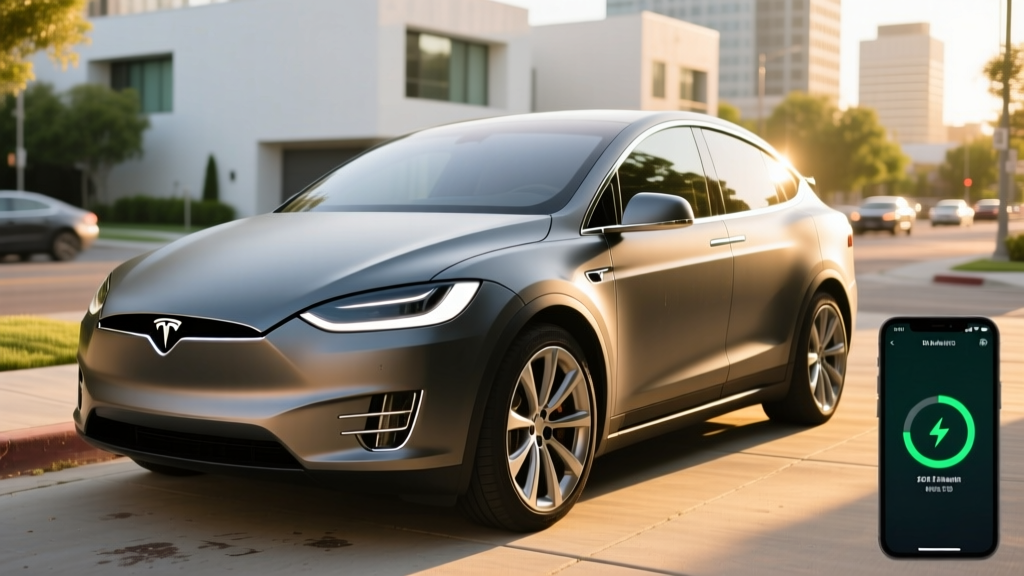
The 2017 Tesla Model X 75D at a Glance: A Used-EV Reality Check
If you're shopping the used electric-SUV market in 2026, the 2017 Tesla Model X 75D sits in a peculiar sweet spot: it's depreciated enough to be approachable (typically $22,000–$32,000 on the private-party market), yet it still carries the falcon-wing doors, Supercharger access, and over-the-air updates that define the Tesla ownership experience. But buying a nine-year-old EV requires a different calculus than buying a new one. Battery degradation, outdated charging architecture, and the discontinuation of the 75 kWh pack all factor into the equation.
This review breaks down exactly what the 2017 Model X 75D delivers — and where it falls short — so you can decide whether it's the right used EV for your garage.
| Spec | Value |
|---|---|
| EPA Range | 237 miles |
| Battery (Usable) | ~72.6 kWh (75 kWh nominal), NMC |
| Drivetrain | Dual-Motor AWD |
| Horsepower | ~328 hp (combined) |
| 0–60 mph | 6.0 seconds |
| MPGe (Combined) | 93 MPGe |
| Energy Consumption | 36 kWh/100 mi |
| Max DC Fast Charge | ~120 kW peak |
| Level 2 Charge Rate | 11.5 kW (48A) |
| Cargo (Behind 3rd Row) | 21.8 cu ft |
| Cargo (All Rows Folded) | 88.1 cu ft |
| Seating | 5, 6, or 7 passengers |
| Battery Warranty (Original) | 8 years / unlimited miles |
| Original Base MSRP | $79,500 (before incentives) |
| Typical 2026 Used Price | $22,000–$32,000 |
Range, Efficiency, and the Degradation Factor
The 2017 Model X 75D carries an EPA-estimated 237 miles of range when new. That figure was respectable for a three-row electric SUV in 2017, but it trails modern competitors like the Rivian R1S (up to 410 miles) and the current Tesla Model X Long Range (348 miles) by a wide margin.
EPA (when new): 237 miles
Expected with ~10–15% degradation: 200–215 miles at 100% SoC
Highway (70 mph, mild weather): ~180–195 miles
Cold weather (below 32°F, highway): ~150–170 miles
Practical daily range (80% SoC): ~155–170 miles
NMC batteries from this era typically lose 10–15% capacity over 80,000–100,000 miles. Always request a battery health reading from the car's service menu or a third-party diagnostic before purchasing.
Efficiency is rated at 93 MPGe combined (36 kWh/100 miles) per fueleconomy.gov. That's thirsty by modern EV standards — the 2025 Model Y Long Range achieves 122 MPGe — but it's typical for a heavy, aerodynamically challenged SUV from this generation. Expect to spend roughly $0.12–$0.14 per mile charging at home on a national-average electricity rate of $0.17/kWh, compared to $0.16–$0.18/mile for a gas SUV getting 22 mpg at $3.50/gallon.
Charging Speed: The 75D's Biggest 2026 Limitation
Charging architecture is where the 2017 Model X 75D shows its age most clearly. Tesla's 2017-era battery management system and cell chemistry limit DC fast-charging speeds well below what modern EVs deliver.
| Charging Level | Power / Rate | Speed | Notes |
|---|---|---|---|
| Level 1 (120V) | ~1.4 kW | ~3–4 mi/hr | Emergency/trickle only |
| Level 2 (240V, 48A) | 11.5 kW | ~29 mi/hr | Home Wall Connector; ~7.5 hr for full charge |
| DC Fast (Supercharger V2) | ~120 kW peak | 10–80% in ~40 min | Peak is brief; sustained ~70–80 kW above 50% SoC |
| DC Fast (Supercharger V3/V4) | Capped at ~120 kW | 10–80% in ~40 min | Vehicle cannot accept V3's 250 kW |
The 75 kWh pack peaks around 120 kW at a low state of charge (typically 10–20% SoC) and then tapers aggressively. By the time you hit 50% SoC, you're often seeing 70–80 kW, and above 80% it drops below 30 kW. A realistic 10–80% session at a V2 or V3 Supercharger takes roughly 40 minutes — acceptable for road trips but noticeably slower than the 15–20 minutes modern EVs with larger packs and better thermal management can achieve.
One advantage the 2017 Model X retains: native Tesla Supercharger access. No adapter is needed, and the Supercharger network remains the most reliable DC fast-charging infrastructure in the U.S. The car uses the proprietary Tesla connector (pre-NACS standardization), which is physically compatible with all Supercharger stalls.
For home charging, a Tesla Wall Connector on a 60-amp circuit delivers the full 11.5 kW (48 amps), adding roughly 29 miles of range per hour. A full charge from 10% takes about 7.5 hours — easily handled overnight. If your home electrical panel only supports a 40-amp circuit (32 amps / 7.7 kW), expect closer to 20 mi/hr and a 10+ hour full charge.
Performance, Ride Quality, and Drivetrain
The dual-motor all-wheel-drive powertrain in the 75D produces approximately 328 horsepower and propels the 5,000+ lb SUV from 0 to 60 mph in 6.0 seconds. That's quick by any SUV standard and remains genuinely fun in 2026. The instant torque delivery makes highway merging effortless, and the low center of gravity (battery pack under the floor) keeps body roll surprisingly controlled for a vehicle of this height.
Ride quality is firm but compliant. The air suspension (standard on the 2017 Model X) allows adjustable ride height — useful for clearing steep driveways or improving highway aero — but be aware that air strut replacements run $1,500–$2,500 per corner if they fail, which is not uncommon at this vehicle age.
Regenerative braking is aggressive in "Standard" mode and enables near one-pedal driving in city traffic. However, unlike newer Teslas, the 2017 model does not offer a user-selectable "Low" regen setting through the touchscreen — it was removed via a software update and later partially restored. Check the specific vehicle's software version for current behavior.
Interior, Cargo, and the Falcon-Wing Reality
The 2017 Model X interior is minimalist and tech-forward, dominated by a 17-inch portrait touchscreen that controls virtually every vehicle function. The digital instrument cluster is clean and legible. Materials quality is a mixed bag: the synthetic leather (Tesla's "vegan" interior) holds up well, but some hard plastics and panel gaps reflect the Fremont factory's 2017 production inconsistencies.
Cargo space is generous for a three-row SUV:
- Behind third row: 21.8 cu ft
- Third row folded: 44.0 cu ft
- All rear rows folded: 88.1 cu ft
- Front trunk (frunk): 6.6 cu ft
The falcon-wing rear doors are the Model X's signature feature — and its most polarizing. They open upward, providing excellent access to the second and third rows in tight parking spaces (they need only ~12 inches of lateral clearance). However, they are mechanically complex, rely on ultrasonic sensors to avoid overhead obstacles, and are prone to occasional software glitches and seal leaks. In heavy rain, water can pool in the door channels and drip into the cabin during opening. Budget-conscious buyers should have the door mechanisms inspected and check for water intrusion signs on the rear seat bolsters.
Seating configurations included 5-seat (two-row), 6-seat (captain's chairs in second row), and 7-seat (bench second row). The 6-seat layout is the most desirable for comfort; the third row is best suited for children in any configuration, with just 32.7 inches of legroom.
Tech, Driver Assistance, and Software in 2026
The 2017 Model X was built with Tesla's Hardware 2.0 (HW2) Autopilot suite, which includes 8 cameras, 12 ultrasonic sensors, and a forward-facing radar. This hardware supports:
- Basic Autopilot (standard): Traffic-aware cruise control and lane-centering on highways
- Enhanced Autopilot (paid option, ~$5,000): Auto lane change, Navigate on Autopilot, Summon, Autopark
- Full Self-Driving (FSD) Capability (paid option, ~$8,000 at the time): Traffic light/stop sign recognition, FSD (Supervised) city streets
All Tesla driver-assistance features on the 2017 Model X — including FSD (Supervised) — are SAE Level 2. The driver must remain fully engaged, hands on or near the wheel, and eyes on the road at all times. This is not autonomous or self-driving capability. Tesla's FSD (Supervised) in 2026 is more capable than the 2017 software, and Tesla has pushed updates to HW2 vehicles, but performance on HW2 is notably less refined than on HW3/HW4 cars.
A critical consideration for 2026 buyers: Tesla has progressively limited software updates for HW2 vehicles. While basic functionality continues, newer FSD features may not be fully supported on this hardware generation. If advanced driver assistance is a priority, verify the specific vehicle's current software capabilities before purchase.
The infotainment system still receives over-the-air updates in 2026, though the 2017-era processor is noticeably slower than current Tesla hardware. Navigation, Spotify, Netflix (while parked), and Sentry Mode all remain functional. The car lacks the newer Tesla UI refresh, but the core experience — app-based climate control, charging management, and remote access — works as well as ever.
Pricing, Tax Credits, and Ownership Economics
The 2017 Model X 75D originally started at $79,500 (before the $1,000 destination fee), with typical as-tested prices reaching $90,000–$105,000 after options like Enhanced Autopilot, premium interior, and larger wheels.
In 2026, used examples trade between $22,000 and $32,000 depending on mileage, condition, battery health, and Autopilot package. Low-mileage, single-owner examples with FSD purchased (and transferable) command the top of that range.
| Requirement | Rule | 2017 Model X 75D Status |
|---|---|---|
| Credit Amount | 30% of sale price, max $4,000 | Up to $4,000 on qualifying sales |
| Vehicle Price Cap | Sale price ≤ $25,000 | ⚠️ Only qualifies if purchased at or below $25,000 |
| Buyer Income Cap (AGI) | $75K single / $112.5K HOH / $150K MFJ | Varies by buyer |
| Vehicle Age | At least 2 model years old | ✅ Qualifies (2017 model year) |
| Battery Capacity | ≥ 7 kWh | ✅ Qualifies (75 kWh) |
| Dealer Requirement | Sold by licensed dealer | ⚠️ Private-party sales do NOT qualify |
| Transfer at Sale | Point-of-sale transfer allowed | ✅ If dealer participates |
Source: IRS §25E Used Clean Vehicle Credit. Consult a tax professional to confirm eligibility for your specific situation. Rules are subject to change.
Key tax credit takeaway: The used-EV credit (§25E) caps at a $25,000 sale price. Many 2017 Model X 75D listings exceed that threshold, meaning you'll need to find a deal at or below $25,000 — or buy from a private seller and forgo the credit entirely. The original $7,500 new-vehicle credit (§30D) no longer applies to this model year.
Ongoing ownership costs to budget for:
- Insurance: $2,400–$3,600/year (Model X premiums remain elevated due to repair costs)
- Tires: $1,200–$2,000 per set (20" or 22" tires, replaced every 25,000–35,000 miles due to vehicle weight)
- Home Level 2 charger install: $800–$2,000 (equipment + electrician, assuming 200-amp panel)
- Air suspension: $1,500–$2,500 per strut if replacement is needed
- Supercharger costs: This vehicle was sold with optional free unlimited Supercharging — if the specific car has it and it's transferable, it significantly reduces road-trip fuel costs. Verify in the Tesla app before purchase.
Battery Warranty and Longevity Outlook
Tesla's original battery and drive unit warranty for the 2017 Model X 75D was 8 years with unlimited miles, guaranteeing a minimum of 70% battery capacity retention. As of 2025, that warranty has expired for all 2017 vehicles (eight years from date of first delivery).
This is the single most important factor for used buyers. Without warranty coverage, a battery replacement would cost approximately $15,000–$22,000 at a Tesla Service Center (refurbished pack). A drive unit replacement runs $5,000–$8,000.
The good news: NMC cells in Tesla's 75 kWh pack have demonstrated strong longevity in fleet data. Most 2017 Model X 75D examples with 80,000–120,000 miles show 85–90% battery health (State of Health, or SoH). Degradation curves tend to flatten after the initial 10–15% loss in the first 50,000 miles. To maximize remaining battery life:
- Charge to 80–90% for daily use (set the limit in the Tesla app)
- Avoid frequent DC fast charging when Level 2 is available
- Don't let the car sit at 100% SoC for extended periods
- Keep the vehicle plugged in during extreme cold so the battery thermal management system can operate
2017 Tesla Model X 75D vs. Key Competitors
| Spec | 2017 Tesla Model X 75D | 2017 Jaguar I-PACE (2019 MY) | 2017 Audi e-tron (2019 MY) |
|---|---|---|---|
| EPA Range | 237 mi | 234 mi | 204 mi |
| Battery | 75 kWh NMC | 90 kWh NMC | 95 kWh NMC |
| 0–60 mph | 6.0 sec | 4.5 sec | 5.5 sec |
| Max DC Charge | ~120 kW | ~100 kW | ~150 kW |
| Third Row | ✅ Available | ❌ No | ❌ No |
| DC Fast Network | Tesla Supercharger | CCS (public networks) | CCS (public networks) |
| OTA Updates | ✅ Ongoing | Limited | Limited |
| Typical 2026 Price | $22K–$32K | $20K–$28K | $22K–$30K |
The Model X 75D's primary advantages over same-era competitors are three-row seating, Supercharger network access, and ongoing OTA updates. The Jaguar I-PACE is quicker and has more engaging driving dynamics but lacks a third row and relies on CCS public charging. The Audi e-tron charges faster (150 kW peak) and has a more premium interior, but its 204-mile EPA range is the weakest in this group and it also has no third row.
✅ Pros
- Three-row seating (5/6/7 passengers) — rare in used EVs
- Tesla Supercharger network access (most reliable DC charging)
- Over-the-air software updates still active in 2026
- Dual-motor AWD with quick 6.0-second 0–60
- Generous cargo space (88.1 cu ft max)
- Frunk adds secure front storage
- Air suspension with adjustable ride height
- Strong safety ratings (5-star NHTSA overall)
❌ Cons
- 237-mile EPA range is modest by 2026 standards
- DC fast charging capped at ~120 kW (slow vs. modern EVs)
- Falcon-wing doors: complex, expensive to repair, potential water leaks
- Battery warranty has expired (replacements cost $15K–$22K)
- HW2 Autopilot hardware limits future FSD capabilities
- Air suspension failures are costly out of warranty
- Insurance premiums remain high
- Used-EV tax credit requires ≤$25,000 purchase price
Who Should Buy the 2017 Tesla Model X 75D?
Choose the 2017 Model X 75D If:
- You need three-row seating in an EV and your budget is under $35,000
- You road-trip frequently and value Supercharger network reliability
- You find an example with free unlimited Supercharging transferred
- Your daily commute is under 80 miles round-trip (well within degraded range)
- You can charge at home with Level 2 and rarely need public fast charging
Look Elsewhere If:
- You regularly drive 200+ miles between charging stops
- You want the latest driver-assistance capabilities (HW2 is dated)
- You need a low-risk, low-maintenance vehicle (air suspension, falcon wings, and out-of-warranty battery add cost risk)
- Fast DC charging is essential to your routine (120 kW peak is slow for road-trip pace)
Frequently Asked Questions
What is the real-world range of the 2017 Tesla Model X 75D in 2026?
Expect 200–215 miles at full charge with typical battery degradation (10–15%). Highway driving at 70 mph reduces this to roughly 180–195 miles in mild weather and 150–170 miles in freezing temperatures. For daily driving with an 80% charge limit, plan on 155–170 usable miles.
How fast does the 2017 Model X 75D charge?
At a DC fast charger (Supercharger), it peaks around 120 kW and achieves a 10–80% charge in approximately 40 minutes. At home on a Level 2 Tesla Wall Connector (11.5 kW), it adds about 29 miles per hour, with a full charge taking roughly 7.5 hours. It cannot accept the 250 kW speeds of V3/V4 Superchargers.
Does the 2017 Tesla Model X 75D qualify for any federal tax credit?
The new-vehicle §30D credit no longer applies. The §25E Used Clean Vehicle Credit offers up to $4,000 (30% of sale price) if the car is purchased from a licensed dealer for $25,000 or less, and the buyer meets income caps ($75K single / $150K married filing jointly). Private-party sales do not qualify. Always verify current rules at irs.gov and consult a tax professional.
Is the 2017 Model X 75D reliable?
The powertrain (motors and battery) is generally robust, with many examples exceeding 150,000 miles without major issues. The main reliability concerns are the air suspension (strut and compressor failures), falcon-wing door mechanisms (sensor errors, motor failures, seal leaks), and interior trim (rattles, screen delamination on early builds). A pre-purchase inspection by a Tesla-qualified independent shop is strongly recommended.
Is the 2017 Model X 75D worth buying vs. competitors?
It's worth buying if you specifically need three-row EV seating under $35,000 and value Supercharger access. If you only need two rows, the Jaguar I-PACE and Audi e-tron offer more refined interiors and, in the e-tron's case, faster DC charging — all at similar used prices. For buyers who can stretch to $40,000+, a used 2020+ Tesla Model Y Long Range offers better range (316+ miles), faster charging, and HW3 Autopilot.
Does free Supercharging transfer with the 2017 Model X 75D?
It depends. Some 2017 Model X vehicles were sold with free unlimited Supercharging that is transferable to subsequent owners. However, Tesla changed this policy at various points, and some transfers require the car to be sold through Tesla's own used inventory. Always verify Supercharging status by checking the vehicle's Tesla app profile before purchase — do not rely on seller claims alone.
What battery chemistry does the 2017 Model X 75D use?
The 75 kWh pack uses NMC (nickel manganese cobalt) lithium-ion cells supplied primarily by Panasonic. NMC offers higher energy density than LFP (lithium iron phosphate) but degrades slightly faster and should not be routinely charged to 100% for daily use. Tesla did not offer LFP in the Model X during this model year.