The BYD and Tesla Rivalry in 2026: What Buyers Actually Need to Know
If you follow electric vehicles, the phrase "BYD and Tesla" has become shorthand for the global EV heavyweight fight. Tesla remains the default choice for most U.S. EV buyers, while BYD has surged past it in global plug-in volume by offering aggressively priced EVs and PHEVs across Asia, Europe, Latin America, and Australia. But for American shoppers, the comparison is more nuanced than headlines suggest: BYD does not currently sell passenger cars in the United States, and the two brands compete on very different battlefields.
This guide breaks down the real differences between BYD and Tesla in 2026 — range, charging, battery chemistry, pricing, tax-credit eligibility, and ownership value — so you can understand what each brand offers and how Tesla's U.S. lineup stacks up against the global benchmark BYD has set overseas.
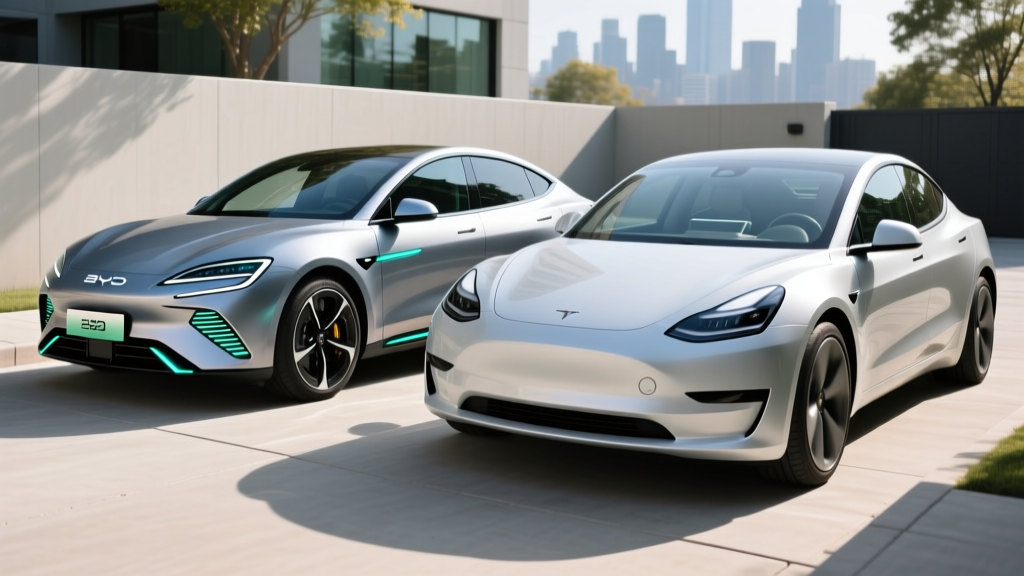
Side-by-Side: Tesla Model 3 vs BYD Seal (Global Flagship Sedan)
The closest apples-to-apples comparison between the two brands is Tesla's refreshed Model 3 ("Highland") against the BYD Seal — both mid-size electric sedans targeting the premium commuter segment. Below are 2026 model-year figures.
| Spec | 2026 Tesla Model 3 Long Range AWD | 2026 BYD Seal (Design AWD, EU/Global) |
|---|---|---|
| EPA / WLTP Range | 341 mi (EPA) | ~323 mi WLTP (~270 mi EPA est.) |
| Battery Capacity | 79 kWh usable (NMC) | 82.5 kWh usable (LFP Blade) |
| Battery Chemistry | NMC (Nickel Manganese Cobalt) | LFP (Lithium Iron Phosphate) |
| Drivetrain | Dual-motor AWD | Dual-motor AWD |
| Horsepower | 346 hp | 523 hp |
| 0-60 mph | 4.2 sec | 3.8 sec |
| Max DC Fast Charge | 250 kW (peak) | 150 kW (peak) |
| 10-80% DC Time | ~25 min | ~35 min |
| Level 2 Home Charge | 11.5 kW (~44 mi/hr) | 7 kW (~25 mi/hr) |
| Efficiency | 131 MPGe / 25 kWh/100mi | ~110 MPGe est. / ~30 kWh/100mi |
| Cargo Volume | 23 cu ft (trunk + frunk) | 14.1 cu ft (trunk) + 1.8 cu ft (frunk) |
| Base MSRP (U.S.) | $47,740 | Not sold in U.S. (~€48,000 EU) |
| Battery Warranty | 8 yr / 120,000 mi | 8 yr / 100,000 mi (global) |
Sources: EPA fueleconomy.gov, Tesla.com, BYD Europe spec sheets.
Real-World Range: EPA vs What You'll Actually Get
The EPA-rated 341 miles on the Tesla Model 3 Long Range is among the best in the sedan segment, but real-world results depend heavily on conditions. In 70-mph highway driving at moderate temperatures, expect roughly 280-300 miles before needing to stop. In freezing weather (below 30°F), range can drop 20-30%, bringing usable highway range closer to 220-250 miles.
BYD's Seal, tested under the more generous WLTP cycle, posts roughly 323 miles WLTP, which historically translates to about 15-20% lower under EPA methodology — an estimated 260-275 miles EPA-equivalent. Real-world highway driving in the Seal typically yields 220-240 miles at 70 mph, with cold-weather results falling to 180-200 miles. The Seal's LFP Blade battery is less energy-dense but far more thermally stable and tolerant of repeated 100% charging.
EPA: 341 mi | City/commute: ~310 mi | Highway 70 mph: ~285 mi | Cold-weather highway: ~230 mi
BYD Seal Real-World Expectation (Global):
WLTP: 323 mi (~270 EPA est.) | Highway 70 mph: ~230 mi | Cold-weather highway: ~185 mi
Charging Speed: Tesla's Supercharger Advantage vs BYD's LFP Trade-Off
Charging speed is where Tesla maintains a clear edge for road-trip buyers. The Model 3 Long Range peaks at 250 kW on V3 Superchargers, adding up to 175 miles in 15 minutes under ideal conditions. The 10-80% session takes roughly 25 minutes, though the charge curve tapers sharply above 60% SoC — the last 20% can take as long as the first 50%.
The BYD Seal tops out at 150 kW on DC fast chargers. Its LFP Blade battery is more conservative in charge acceptance to protect long-term cell health, meaning a 10-80% session runs about 35 minutes. On Level 2 home charging, the Seal is limited to 7 kW (adding roughly 25 miles per hour of charging), while the Model 3 accepts 11.5 kW for about 44 miles per hour — a significant difference if you need a full overnight replenishment.
| Charging Level | Tesla Model 3 LR | BYD Seal |
|---|---|---|
| Level 1 (120V / 1.4 kW) | ~5 mi/hr | ~5 mi/hr |
| Level 2 (240V home) | 11.5 kW / ~44 mi/hr | 7 kW / ~25 mi/hr |
| DC Fast Charge (peak) | 250 kW | 150 kW |
| 10-80% DC Time | ~25 min | ~35 min |
| Miles added in 15 min (DC) | ~175 mi | ~100 mi |
| Connector (U.S. / Global) | NACS (Tesla) | CCS2 (global) / GB/T (China) |
Tesla's NACS connector and 20,000+ North American Supercharger stalls give it an unmatched public-charging reliability advantage. BYD relies on third-party CCS networks (Ionity in Europe, regional operators elsewhere), which vary widely in uptime and availability.
Battery Chemistry: LFP Blade vs NMC — What It Means for Ownership
BYD's signature Blade battery uses LFP (lithium iron phosphate) chemistry, while Tesla's Model 3 Long Range uses NMC (nickel manganese cobalt). The RWD base Model 3 also uses LFP cells (sourced from CATL), so this divide is partly trim-dependent.
| Factor | LFP (BYD Blade / Tesla RWD) | NMC (Tesla LR/Performance) |
|---|---|---|
| Energy Density | Lower (~160 Wh/kg) | Higher (~250 Wh/kg) |
| Cycle Life | 3,000+ cycles | 1,000-2,000 cycles |
| Daily Charging to 100% | Recommended (BMS calibration) | Not recommended (80% daily limit) |
| Cold-Weather Performance | Weaker in freezing temps | Better low-temp output |
| Thermal Runaway Risk | Very low | Higher (managed by cooling) |
| Cost | Lower (no cobalt/nickel) | Higher |
For a commuter who charges nightly at home, LFP's tolerance for 100% daily charging and longer cycle life is a genuine advantage. For road-trippers needing maximum range per charge and better cold-weather output, NMC's energy density wins. Tesla's strategy of offering both chemistries across trims lets buyers self-select; BYD's all-LFP approach prioritizes safety and longevity over peak range.
Pricing, Tax Credits, and the U.S. Market Gap
This is where the BYD and Tesla comparison becomes decisive for American buyers. Tesla's U.S. lineup is priced, available, and eligible for federal incentives. BYD's passenger vehicles are not sold in the United States as of 2026 — the company has focused on commercial vehicles (electric buses, trucks) and has not announced a U.S. passenger-car launch, partly due to the 100% tariff on Chinese-made EVs imposed in 2024.
| Model | Base MSRP | Est. After §30D Credit | U.S. Availability |
|---|---|---|---|
| Tesla Model 3 RWD | $38,990 | ~$31,490* | Available now |
| Tesla Model 3 Long Range AWD | $47,740 | ~$40,240* | Available now |
| Tesla Model Y Long Range | $44,990 | ~$37,490* | Available now |
| BYD Seal (Design AWD) | N/A | N/A | Not sold in U.S. |
| BYD Atto 3 (global) | N/A | N/A | Not sold in U.S. |
*Estimated prices assume full $7,500 IRS §30D credit eligibility via point-of-sale transfer. Actual eligibility depends on buyer income caps ($150K single / $300K joint AGI), vehicle MSRP caps ($55K sedans / $80K SUVs), and battery critical-mineral and component sourcing requirements that change annually. Consult a tax professional before purchase.
In markets where both brands compete directly (Europe, Australia, Southeast Asia), BYD undercuts Tesla on price by 10-25% while offering competitive range and premium interior materials. The Seal starts around €48,000 in Europe versus the Model 3 at roughly €49,990, and the BYD Dolphin and Atto 3 compete in segments Tesla simply doesn't enter (sub-$35K equivalents).
Tech, Driver Assists, and Interior Experience
Tesla's technology advantage remains significant in software integration, over-the-air updates, and driver-assist capabilities. The Model 3 runs Tesla's latest infotainment with a 15.4-inch center display, ventilated front seats, ambient lighting, and rear-seat touchscreen (added in the Highland refresh). Autopilot (SAE Level 2) is standard; Full Self-Driving (Supervised) is a $8,000 add-on that enables automated lane changes, traffic-light recognition, and city-street navigation — but the driver must remain fully engaged at all times.
BYD's Seal features a 15.6-inch rotating center display (portrait or landscape), a 10.25-inch driver cluster, head-up display, and a suite of ADAS features branded as "DiPilot" — including adaptive cruise, lane-keep, and automated parking. DiPilot is competent but less refined than Tesla's Autopilot, with more frequent lane-centering corrections and less confident highway-ramp handling. BYD does not offer an FSD-equivalent product.
Interior build quality is a genuine BYD strength. The Seal uses quilted leatherette, soft-touch materials, and a more traditionally designed cabin that many reviewers rate above the Model 3's minimalist interior. Tesla's cabin is efficient and spacious but polarizing in its austerity.
Who Should Buy Tesla, and Who Should Watch BYD?
- You live in the U.S. and need a purchasable, warrantied EV today
- Supercharger access and road-trip charging reliability are priorities
- You want the longest EPA-verified range in the segment (341 mi)
- You value OTA software updates and advanced Level 2 driver assist
- You want federal §30D tax credit eligibility
- You live outside the U.S. (Europe, Australia, Southeast Asia, Latin America) where BYD is priced 10-25% below Tesla
- You prefer LFP battery chemistry for daily commuting and long-term durability
- Interior material quality and traditional cabin design matter to you
- You're considering a PHEV (BYD's DM-i lineup offers 60+ miles of electric range with gas backup)
- You want a sub-$35K EV (Dolphin, Atto 3) in a segment Tesla doesn't serve
Pros and Cons: Tesla Model 3 vs BYD Seal
Tesla Model 3 LR — Pros
- 341-mile EPA range (best in class)
- 250 kW DC fast charging + Supercharger network
- U.S. availability and §30D tax credit eligibility
- Industry-leading software and OTA updates
- Strong resale value and brand recognition
- Spacious 23 cu ft cargo (trunk + frunk)
Tesla Model 3 LR — Cons
- Minimalist interior not for everyone
- Higher starting price than global BYD equivalents
- NMC battery prefers 80% daily limit (range management needed)
- Insurance premiums above segment average
- FSD (Supervised) costs $8,000 extra, still Level 2
BYD Seal — Pros
- LFP Blade battery: safer, longer cycle life, 100% daily charging OK
- 523 hp AWD performance at a lower global price
- Premium interior materials and traditional cabin layout
- Competitive range (~270 mi EPA est.) for the price
- Strong global warranty and service network (outside U.S.)
BYD Seal — Cons
- Not available in the United States
- 150 kW peak DC charging (slower road-trip replenishment)
- 7 kW Level 2 limit (slow home charging)
- Less refined ADAS compared to Tesla Autopilot
- Smaller cargo volume (14.1 cu ft trunk)
- LFP weaker in freezing-weather range retention
Frequently Asked Questions
Does BYD sell cars in the United States in 2026?
No. BYD does not sell passenger vehicles in the U.S. as of 2026. The company sells electric buses and commercial trucks in North America but has not launched a consumer car lineup, partly due to the 100% tariff on Chinese-manufactured EVs. BYD has hinted at a future North American entry, potentially via a Mexico-based plant, but nothing is confirmed or imminent.
Is BYD better than Tesla on battery technology?
It depends on the metric. BYD's LFP Blade battery is widely regarded as the safest and most durable mass-market EV battery available, with excellent thermal stability and 3,000+ cycle life. Tesla's NMC packs deliver higher energy density (more range per kWh) and better cold-weather performance. Neither is universally "better" — they optimize for different priorities.
Does the Tesla Model 3 qualify for the $7,500 federal tax credit?
The Model 3 RWD and Long Range AWD currently qualify for up to $7,500 under IRS §30D, available as a point-of-sale transfer to the dealer. Eligibility requires buyer AGI below $150K (single) or $300K (joint), and the vehicle must meet critical-mineral and battery-component sourcing thresholds that tighten each year. Always verify current eligibility on IRS.gov before purchasing, as rules change annually.
How does BYD's global pricing compare to Tesla's?
In markets where both compete, BYD typically undercuts Tesla by 10-25%. The BYD Seal starts around €48,000 in Europe versus the Model 3 at ~€49,990, while the BYD Dolphin and Atto 3 target sub-$35K segments Tesla doesn't serve. In the U.S., Tesla's pricing (especially after the §30D credit) is more competitive globally because BYD is not present.
Which has better charging infrastructure: Tesla or BYD?
Tesla, decisively. The Supercharger network has over 20,000 stalls in North America with industry-leading uptime (~99%). BYD relies on third-party CCS networks in each market, which vary in reliability. As other automakers gain Supercharger access via NACS adapters in 2025-2026, Tesla's infrastructure moat is narrowing but still significant.
Should I wait for BYD to enter the U.S. market?
There is no confirmed timeline for BYD passenger vehicles in the U.S. If you need an EV now, Tesla, Hyundai, Kia, BMW, and others offer strong, warrantied options with tax-credit eligibility. Waiting for BYD means waiting indefinitely with no guarantee of market entry or pricing that would overcome current tariffs.