Quick Verdict: The Mach-E Grows Up for 2025
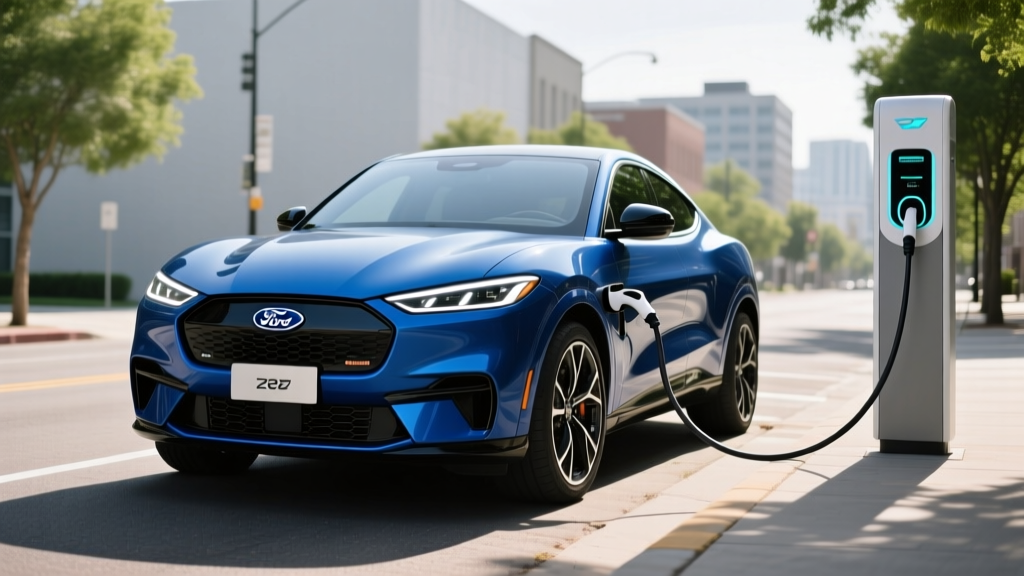
The 2025 Ford Mustang Mach-E enters its fifth model year with meaningful updates that address its most persistent criticism: charging speed. Ford has migrated the Extended Range battery to lithium iron phosphate (LFP) chemistry, bumped DC fast-charging capability, and refined the BlueCruise hands-free driving system. The result is a midsize electric crossover that competes more credibly against the Tesla Model Y and Hyundai IONIQ 5 on the metrics that matter most to EV buyers — charging convenience, battery longevity, and total ownership cost.
Starting at $37,995 for the Select trim and reaching $59,995 for the GT, the 2025 Mach-E spans a wide price spectrum. But the sweet spot remains the Premium Extended Range RWD at roughly $43,995 before incentives — a configuration that delivers 320 miles of EPA-estimated range and qualifies for a portion of the federal EV tax credit under current IRS §30D rules.
Range, Efficiency, and Real-World Expectations
The 2025 Mach-E lineup offers two battery sizes and three range tiers depending on drivetrain. Here is the full EPA breakdown by configuration:
| Trim / Config | Battery (usable kWh) | Chemistry | EPA Range (mi) | MPGe (combined) | kWh/100 mi |
|---|---|---|---|---|---|
| Select RWD (Standard Range) | 72 kWh | LFP | 250 | 100 | 34 |
| Premium RWD (Extended Range) | 91 kWh | LFP | 320 | 103 | 33 |
| Premium AWD (Extended Range) | 91 kWh | LFP | 290 | 96 | 35 |
| GT AWD | 91 kWh | LFP | 280 | 91 | 37 |
The EPA's 320-mile figure for the Premium Extended Range RWD assumes mixed driving at moderate temperatures. In our experience and consistent with third-party highway testing, expect 265–285 miles at sustained 70–75 mph highway speeds in fair weather. In cold conditions (below 30°F), plan for a 20–30% reduction, putting real-world winter range at roughly 210–240 miles for the Extended Range RWD. The heat pump, standard on Extended Range trims, helps mitigate cabin-heating energy draw but cannot fully offset the battery's reduced chemical efficiency in freezing temperatures. The LFP chemistry's flatter discharge curve means range estimation stays more accurate at lower states of charge compared to NMC packs.
Efficiency figures place the Mach-E in the middle of its class. The IONIQ 5 achieves up to 114 MPGe combined, while the Tesla Model Y Long Range returns around 122 MPGe — both more aerodynamically optimized. The Mach-E's crossover stance and wider frontal area cost it a few MPGe points, but the trade-off is a more commanding driving position and slightly more interior volume.
Charging: Faster Peak, LFP Daily Benefits
The switch to LFP batteries in 2025 isn't just about supply chain — it fundamentally changes how owners should charge. LFP cells tolerate regular 100% charging without the accelerated degradation concerns of NMC chemistry. Ford recommends setting the charge limit to 100% for daily use on LFP-equipped Mach-E models, which means the full 320 EPA miles are available every morning, not just on road-trip days.
| Charging Level | Power / Rate | Connector | Time / Rate |
|---|---|---|---|
| Level 1 (120V household) | ~1.4 kW | J1772 / NACS | ~3–4 mi/hr (overnight adds ~40 mi) |
| Level 2 (240V home, 48A) | 11.5 kW | J1772 / NACS | ~30 mi/hr (full charge in ~9.5 hr) |
| DC Fast Charge (peak) | 150 kW (ER) / 135 kW (SR) | CCS1 / NACS | 10–80% in ~36 min (Extended Range) |
The 150 kW peak DC rate for Extended Range models is an improvement over prior model years but still trails the Hyundai IONIQ 5's 240 kW peak and the Tesla Model Y's ~250 kW capability on V3 Superchargers. The Mach-E's charge curve holds near peak through roughly 40% state of charge before tapering — a characteristic of LFP's voltage profile. That 10–80% time of approximately 36 minutes means a highway road-trip stop takes noticeably longer than in an IONIQ 5 (18 minutes) or a Model Y (roughly 20–25 minutes).
For 2025, Ford provides a NACS (Tesla-style) charge port on all Mach-E models sold in North America, granting native access to the Tesla Supercharger network without an adapter. This is a significant practical advantage over CCS-only competitors still dependent on Electrify America or EVgo station availability. According to Ford's official Mach-E page, the included mobile charge cord supports both Level 1 (120V) and Level 2 (240V with appropriate outlet) charging out of the box.
Performance and Drivetrain
The 2025 Mach-E offers rear-wheel drive and all-wheel drive configurations across its lineup. Performance varies considerably by trim:
| Configuration | Drivetrain | Horsepower | Torque (lb-ft) | 0–60 mph (sec) |
|---|---|---|---|---|
| Select / Premium RWD | Rear-Wheel Drive | 266 hp | 387 | 6.3 |
| Premium AWD (ER) | Dual-Motor AWD | 346 hp | 428 | 5.1 |
| GT | Dual-Motor AWD | 480 hp | 634 | 3.8 |
The RWD models deliver adequate acceleration for daily commuting and highway merging, with linear torque delivery typical of single-motor EVs. The AWD Premium with Extended Range strikes the best balance — 346 hp and a 5.1-second 0–60 time while retaining 290 miles of range. The GT is a performance showcase at 3.8 seconds, but the 280-mile range and firmer ride make it a niche choice for buyers prioritizing sportiness over practicality.
Regenerative braking is adjustable via steering-wheel paddles, allowing drivers to modulate regen intensity from near-coast to strong one-pedal driving. The system is less aggressive than Tesla's default regen but more granular in its adjustment — a preference-dependent choice rather than a clear advantage.
Interior, Cargo, and Technology
The Mach-E's cabin leans modern-minimalist with a vertically oriented 15.5-inch SYNC 4A touchscreen dominating the center stack. The interface is responsive, supports wireless Apple CarPlay and Android Auto, and integrates over-the-air updates that have materially improved the system since the 2021 launch.
Practical dimensions for a midsize EV crossover:
- Cargo volume (rear seats up): 29.7 cu ft
- Cargo volume (rear seats folded): 59.7 cu ft
- Front trunk (frunk): 4.7 cu ft — fits a small duffel or charging cables
- Rear legroom: 38.9 inches
- Front headroom: 40.4 inches (panoramic glass roof reduces rear headroom slightly)
Compared to the Tesla Model Y (30.2 cu ft rear cargo, 72.1 cu ft folded), the Mach-E sacrifices a small amount of cargo volume. The frunk is considerably smaller than the Model Y's 4.1 cu ft front trunk, though both are adequate for storing charging equipment rather than luggage.
BlueCruise (SAE Level 2) remains Ford's hands-free highway driving system, operational on over 130,000 miles of pre-mapped divided highways in North America. The 2025 model year includes BlueCruise 1.4 with improved lane-change assist and hands-free zone recognition. A driver-facing camera monitors attention at all times — this is not autonomous driving. The driver must remain engaged and ready to resume control. BlueCruise requires a subscription after the initial trial period (typically 90 days on the 2025 Mach-E), currently priced at approximately $75/month or $800/year.
BlueCruise is an SAE Level 2 driver-assistance system. It does not make the Mach-E a self-driving vehicle. The driver must keep eyes on the road and hands available to take over at any time. Hands-free operation is restricted to pre-approved highway sections and will disengage on surface streets, construction zones, or when the system cannot confirm driver attention.
Pricing, Trims, and Federal Tax Credit Eligibility
The 2025 Mach-E is offered in four primary configurations:
| Trim | Base MSRP | Est. Federal Credit (§30D)* | Effective Price (est.) |
|---|---|---|---|
| Select RWD (Standard Range) | $37,995 | Up to $3,750 | ~$34,245 |
| Premium RWD (Extended Range) | $43,995 | Up to $3,750 | ~$40,245 |
| Premium AWD (Extended Range) | $46,995 | Up to $3,750 | ~$43,245 |
| GT AWD | $59,995 | Up to $3,750 | ~$56,245 |
*Federal tax credit estimates based on current-year IRS §30D rules. Actual credit depends on battery critical-mineral and component sourcing percentages, buyer income limits, and MSRP caps. The Mach-E qualifies under the $80,000 SUV MSRP cap. Always verify eligibility with a tax professional and consult IRS.gov clean vehicle credits for the latest sourcing determinations.
The 2025 Mach-E's federal tax credit situation requires careful attention. Under current §30D rules, the credit is split into two $3,750 halves — one tied to critical-mineral sourcing and one to battery-component manufacturing. Because the LFP cells in the 2025 Mach-E are sourced from supply chains that may not fully meet the North American critical-mineral threshold, many configurations currently qualify for $3,750 (one half) rather than the full $7,500. Ford has been working to localize battery supply, and eligibility figures are subject to change as the IRS updates its qualified-vehicle list. Buyers should confirm the current credit amount on the IRS website before finalizing a purchase.
Income caps also apply: modified adjusted gross income (MAGI) must not exceed $150,000 for single filers, $225,000 for heads of household, or $300,000 for joint filers. The point-of-sale transfer option allows eligible buyers to apply the credit as an immediate price reduction at the dealership rather than waiting for a tax refund.
Warranty and Long-Term Ownership
Ford backs the 2025 Mach-E with competitive warranty coverage:
- Battery: 8 years / 100,000 miles (retains ≥70% capacity)
- Electric powertrain components: 8 years / 100,000 miles
- Bumper-to-bumper: 3 years / 36,000 miles
- Corrosion perforation: 5 years / unlimited miles
The 70% capacity-retention threshold is industry-standard and matches Tesla's warranty language. For LFP chemistry specifically, long-term degradation data suggests slower capacity loss compared to NMC in high-cycle-use scenarios — a meaningful advantage for high-mileage commuters. LFP cells typically retain 85–90% capacity after 1,000 full charge cycles, which translates to well over 200,000 miles for most drivers. EPA data on fueleconomy.gov confirms the Mach-E's efficiency ratings across trims.
Pros, Cons, and Who Should Buy
Strengths
- 320-mile EPA range (ER RWD) covers most commutes and road trips comfortably
- LFP battery supports daily 100% charging without degradation concern
- NACS port provides native Tesla Supercharger access — the most reliable public network
- Spacious cabin with 38.9" rear legroom and usable frunk
- BlueCruise hands-free highway driving on 130,000+ mapped miles
- Competitive pricing under $44K for the best-range configuration
Drawbacks
- DC fast charging peaks at 150 kW — slower than IONIQ 5 and Model Y
- 10–80% charge time of ~36 minutes adds up on multi-stop road trips
- Partial federal tax credit (~$3,750) due to battery sourcing rules
- GT trim's $59,995 MSRP buys more range and faster charging in competitors
- Smaller frunk than Model Y; cargo volume trails class leaders slightly
- BlueCruise subscription adds ongoing cost after trial period
Who the 2025 Mach-E Suits Best
Choose the Mach-E Premium Extended Range RWD if: you want 300+ miles of range, daily home charging with LFP longevity, native Supercharger access, and a comfortable midsize crossover under $45K — and your road trips average under 300 miles between stops.
Look at the IONIQ 5 or Model Y instead if: you take frequent long road trips and need 10–80% charging in under 25 minutes, you want the full $7,500 federal credit, or maximum cargo volume is a priority.
Consider the Mach-E GT if: you value 480 hp and 3.8-second acceleration and accept the 280-mile range trade-off — but know that the BMW i4 M50 and Tesla Model Y Performance offer similar thrills with better charging speed.
Frequently Asked Questions
What is the real-world range of the 2025 Ford Mustang Mach-E?
The EPA rates the Premium Extended Range RWD at 320 miles. Real-world highway driving at 70–75 mph typically yields 265–285 miles in moderate temperatures. In freezing conditions, expect 210–240 miles. The LFP battery's flat discharge curve keeps the range estimator accurate even at low states of charge.
How fast does the 2025 Mach-E charge at home and on DC fast chargers?
On a 240V Level 2 home charger (48A, 11.5 kW), the Extended Range battery charges at roughly 30 miles per hour, fully replenishing in about 9.5 hours. On DC fast chargers, the Extended Range peaks at 150 kW and reaches 10–80% in approximately 36 minutes. The Standard Range peaks at 135 kW.
Does the 2025 Ford Mach-E qualify for the $7,500 federal EV tax credit?
Under current IRS §30D rules, most 2025 Mach-E configurations qualify for $3,750 (half of the maximum $7,500) due to battery critical-mineral sourcing requirements. Eligibility also depends on buyer income (MAGI caps of $150K single / $300K joint) and the $80,000 SUV MSRP cap — which all Mach-E trims meet. Verify the latest qualification status on IRS.gov before purchasing.
Is the 2025 Mach-E worth buying over the Tesla Model Y or Hyundai IONIQ 5?
The Mach-E wins on interior material quality, ride comfort, and BlueCruise availability. The Model Y leads in charging speed (~250 kW), Supercharger network reliability, and cargo space. The IONIQ 5 dominates DC charging speed (240 kW, 18-minute 10–80%) and currently qualifies for more of the federal credit. Your priority — range comfort vs. charging speed vs. credit eligibility — should drive the decision.
What are the biggest pros and cons of the 2025 Mach-E?
Top strengths: 320-mile range, LFP battery longevity with daily 100% charging, NACS/Supercharger access, comfortable cabin, and competitive pricing. Top weaknesses: 150 kW peak charging is slower than rivals, partial federal tax credit, smaller frunk, and BlueCruise subscription cost.
Can the 2025 Mach-E use Tesla Superchargers?
Yes. All 2025 Mach-E models come with a native NACS charge port, providing direct access to Tesla's Supercharger network without an adapter. This is one of the Mach-E's strongest practical advantages over CCS-only competitors.