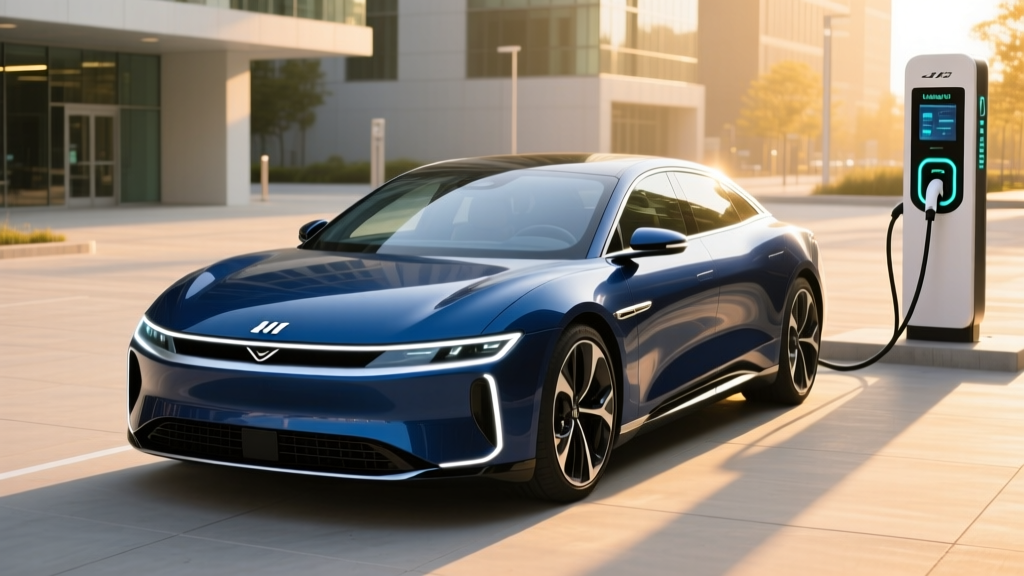
Quick Verdict: The Efficiency King With Supercar Punch
The Lucid Air Grand Touring occupies a rare position in the 2026 EV landscape: it pairs an 819-horsepower dual-motor powertrain with an EPA-estimated 512 miles of range — a combination no other production sedan matches. Built on Lucid's miniaturized drive-unit architecture and a 112 kWh usable battery pack, the Grand Touring delivers sports-car acceleration while sipping electrons at rates that embarrass vehicles half its price. But at a starting MSRP near $125,600, the question isn't whether it's impressive — it's whether the engineering justifies the premium over rivals like the Tesla Model S Plaid, Mercedes-Benz EQS, and Porsche Taycan.
This review breaks down every number that matters: real-world range expectations, DC fast-charging curves, home charging practicality, federal tax credit eligibility under current IRS §30D rules, and the ownership realities that spec sheets don't reveal.
Lucid Air Grand Touring Core Specifications
| Specification | 2026 Lucid Air Grand Touring |
|---|---|
| EPA Range | 512 miles |
| Battery (Usable) | 112 kWh, NMC lithium-ion |
| Horsepower | 819 hp (dual-motor AWD) |
| 0–60 mph | 3.0 seconds |
| Top Speed | 168 mph |
| Drivetrain | Dual-motor AWD |
| Peak DC Fast Charge | 300 kW (900V+ architecture) |
| 10–80% DC Charge Time | ~20 minutes (optimal conditions) |
| Level 2 Home Charge Rate | 19.2 kW (AC) |
| EPA Efficiency | 131 MPGe combined / 25 kWh/100mi |
| Cargo Volume | 32 cu ft (trunk + frunk combined) |
| Rear Legroom | 37.4 inches |
| Base MSRP | $125,600 |
| Battery/Powertrain Warranty | 8 years / 100,000 miles |
| Federal Tax Credit (§30D) | Not eligible (MSRP & income cap issues — see below) |
Range and Efficiency: 512 EPA Miles, but What's Real?
The Lucid Air Grand Touring's 512-mile EPA estimate remains the highest of any production EV sold in the United States as of 2026. That figure isn't a laboratory fantasy — it's rooted in the car's extraordinary efficiency. At roughly 25 kWh per 100 miles, the Grand Touring moves a 5,200-pound luxury sedan with the energy appetite of compact EVs weighing 1,500 pounds less. Lucid's proprietary drive units, each roughly the size of a carry-on suitcase, minimize drivetrain losses, and the 900V+ electrical architecture reduces current-related heat.
EPA sticker: 512 miles
Mixed highway/city (55–70 mph, moderate climate): ~420–460 miles
Sustained 80 mph highway driving: ~370–400 miles
Cold weather (below 32°F, highway): ~330–380 miles
Hot weather with aggressive HVAC: ~390–430 miles
Lucid's heat pump and battery thermal management system mitigate cold-weather losses better than many competitors, but physics still applies. Expect a 15–25% range reduction in sustained freezing temperatures, and plan road trips around 350 miles of usable buffer to preserve battery longevity and avoid range stress.
For context, the EPA's fueleconomy.gov listing confirms the 131 MPGe combined rating. In real-world driving on a Los Angeles-to-Las Vegas route (roughly 270 miles each way with elevation changes and 75–80 mph speeds), owners consistently report arriving with 30–40% state of charge remaining — enough buffer to skip a charging stop on moderate-temperature days.
Charging Performance: 300 kW Peaks and the Taper Reality
The Grand Touring's 900V+ battery architecture enables DC fast-charging peaks of up to 300 kW at compatible stations. At that rate, Lucid advertises roughly 20 minutes from 10% to 80% state of charge — but understanding the charge curve is essential for trip planning.
| Charging Method | Max Power | Speed / Time | Notes |
|---|---|---|---|
| DC Fast Charge (350 kW station) | 300 kW peak | 10–80% in ~20 min | Peak sustains to ~55% SoC, then tapers; 80–100% adds significant time |
| DC Fast Charge (150 kW station) | ~145 kW sustained | 10–80% in ~35 min | More common on Electrify America, EVgo networks |
| Level 2 Home (19.2 kW / 80A circuit) | 19.2 kW | ~42 mi/hr, full charge ~6 hr | Requires hardwired 100A breaker; most homes need panel evaluation |
| Level 2 Home (11.5 kW / 48A circuit) | 11.5 kW | ~25 mi/hr, full charge ~10 hr | Standard NEMA 14-50 or 60A hardwired; adequate for daily use |
| Level 1 (120V outlet) | ~1.4 kW | ~3 mi/hr | Emergency/trickle only; 112 kWh pack takes 80+ hours |
The critical detail most spec sheets omit: peak charge rate is not sustained charge rate. The Grand Touring holds close to 300 kW from roughly 10% to 50–55% SoC, then progressively tapers. From 80% to 100%, charging slows dramatically to protect cell health — expect that final 20% to take as long as the 10–80% session. For road trips, the optimal strategy is charging to 80% and driving, not topping off.
At home, the Grand Touring's 19.2 kW onboard charger is among the most powerful in the industry. Most EVs max out at 11.5 kW on Level 2. To unlock 19.2 kW, you need a hardwired wall connector on a dedicated 100-amp circuit. A licensed electrician should evaluate your panel — homes with 200A service may require an upgrade to support this alongside existing loads. On a standard 48A/11.5 kW setup, overnight charging still replenishes roughly 200–250 miles, which covers nearly all daily driving needs.
Performance: 819 HP Without the Range Penalty
Here's where the Grand Touring defies conventional EV trade-offs. Most 800+ horsepower EVs sacrifice range for performance — the Tesla Model S Plaid (1,020 hp) is EPA-rated at 396 miles, and the Porsche Taycan Turbo S (750 hp) manages roughly 283 miles. The Grand Touring delivers 819 hp and a 3.0-second 0–60 mph time while retaining 512 miles of EPA range.
The dual-motor AWD system uses Lucid's permanent-magnet front motor and induction rear motor, allowing the rear unit to freewheel during light-load cruising to reduce drag losses. Torque vectoring and a low center of gravity (the 112 kWh pack sits in a skateboard-style floor) give the Grand Touring cornering poise that belies its 5,200-pound curb weight.
Drive modes include Smooth, Swift, and Sprint. In Sprint mode, throttle response sharpens, suspension firms up (the standard air suspension adjusts damping and ride height), and the full 819 hp is available. In Smooth mode — the default for daily driving — power delivery is progressive and the cabin remains serene, with wind noise suppressed to luxury-sedan standards even at 85 mph.
Pricing, Trims, and Federal Tax Credit Eligibility
The 2026 Lucid Air Grand Touring starts at an MSRP of $125,600, including destination. The Air lineup also includes the Pure (RWD, ~430 miles EPA, starting near $69,900) and the Touring (~$87,400, ~425 miles EPA, dual-motor). The Grand Touring sits as the efficiency-and-range flagship, while the Sapphire trim ($249,000, 1,234 hp) targets hypercar performance.
| Trim | Base MSRP | Federal §30D Credit | Effective Price |
|---|---|---|---|
| Air Pure | $69,900 | Eligibility varies (MSRP cap met; sourcing & income rules apply) | ~$62,400–$69,900 |
| Air Touring | $87,400 | Eligibility varies (sedan MSRP cap is $55,000 — likely ineligible) | ~$87,400 |
| Air Grand Touring | $125,600 | Not eligible (exceeds $55,000 sedan MSRP cap) | $125,600 |
| Air Sapphire | $249,000 | Not eligible | $249,000 |
Under current IRS §30D rules, the federal clean vehicle credit of up to $7,500 requires that sedans have an MSRP at or below $55,000. The Grand Touring's $125,600 sticker price disqualifies it outright, regardless of battery sourcing or buyer income. Buyers in this price bracket should consult a tax professional about potential state-level incentives (California's CVRP, for example, has its own income and price caps) and depreciation strategies, but the federal credit is not on the table here.
For buyers who want Lucid engineering at a credit-eligible price point, the Air Pure — if its battery sourcing meets critical-mineral and component requirements — is the trim to evaluate. Check the latest fueleconomy.gov tax credit listings for current eligibility before purchasing.
Interior, Cargo, and Daily Livability
The Grand Touring's cabin blends minimalist design with genuine luxury materials. A 34-inch curved glass cockpit display spans the dashboard, replacing traditional gauge clusters and central infotainment screens. Lucid's software interface is responsive, though some owners note the learning curve for climate and navigation controls buried in menus — there are few physical buttons.
Passenger space is generous for a sedan in this class. Rear legroom measures 37.4 inches, which compares favorably to the Mercedes EQS (40.3 inches) and comfortably exceeds the Porsche Taycan (32.7 inches). The roofline's gentle slope preserves headroom without the hatchback compromise.
Cargo capacity totals approximately 32 cubic feet across the trunk (roughly 22 cu ft) and front trunk, or "frunk" (roughly 10 cu ft). The frunk is deep and practical — large enough for a carry-on bag or charging cables — and the trunk opening is wide enough for golf bags or luggage for a family road trip. The Air does not offer a rear hatchback, so loading bulky items requires more care than in the Tesla Model S.
Notable tech includes Lucid's DreamDrive Pro ADAS suite, which uses lidar, radar, and cameras for adaptive cruise, lane centering, and automated parking. DreamDrive Pro is a Level 2 driver-assistance system per SAE classification — the driver must remain attentive and keep hands on the wheel at all times. It is not autonomous driving.
Warranty, Degradation, and Long-Term Ownership
Lucid covers the Air's battery pack and drive units for 8 years or 100,000 miles, whichever comes first, with a capacity retention threshold of 70%. This aligns with industry norms (Tesla, BMW, and Mercedes offer similar terms). The limited vehicle warranty runs 4 years / 50,000 miles.
The 112 kWh NMC pack uses a cell format and thermal management system designed for longevity. Lucid's battery management system maintains a conservative buffer — the usable 112 kWh sits within a larger gross capacity, protecting cells from the extreme high and low states of charge that accelerate degradation. Based on early fleet data and owner reports, degradation in the first 30,000 miles has been minimal, typically 2–4%, consistent with modern NMC packs managed with robust thermal systems.
For buyers concerned about out-of-warranty battery replacement, current estimates for a pack of this capacity range from $18,000 to $28,000 including labor — a significant sum, but one that applies to any large-battery EV. As with all EVs, the expectation is that most packs will outlast the vehicle's useful life with gradual, manageable capacity loss rather than sudden failure.
Pros and Cons
- Industry-leading 512-mile EPA range with real-world usability above 400 miles
- 819 hp and 3.0-sec 0–60 without the range penalty of rival performance EVs
- Class-leading efficiency at ~25 kWh/100mi
- 300 kW DC fast-charging capability on 900V+ architecture
- 19.2 kW Level 2 onboard charger (fastest in class)
- Spacious rear seat and practical frunk + trunk combination
- Lidar-equipped DreamDrive Pro ADAS
- Air suspension with adjustable ride height
- $125,600 MSRP — no federal tax credit eligibility
- Infotainment learning curve; few physical buttons
- Limited service center network compared to Tesla or legacy luxury OEMs
- Charging infrastructure still catching up to 300 kW capability (most public stations are 150–350 kW)
- No hatchback/trunk pass-through for oversized cargo
- DreamDrive Pro is Level 2 only — no hands-free highway driving like GM Super Cruise or Ford BlueCruise
- Insurance premiums trend higher than segment average
Who Should Buy the Lucid Air Grand Touring?
Choose the Grand Touring if: You want the longest-range production EV available, regularly drive 300+ miles between charging stops, value efficiency as much as performance, and your budget accommodates a $125,000+ luxury sedan without relying on federal incentives.
Consider the Air Pure or Touring instead if: You want Lucid's platform at a lower price point, your daily driving stays under 200 miles, or you need federal tax credit eligibility (evaluate the Pure trim's current sourcing compliance).
Look at competitors if: You prioritize hands-free highway driving (BMW i7 with Highway Assistant, Mercedes EQS with Drive Pilot in approved regions), you need a hatchback for cargo versatility (Tesla Model S), or you want a broader dealer/service network (Porsche Taycan, BMW i5).
The Grand Touring is a road-tripper's EV and an efficiency benchmark. It suits buyers who cross state lines regularly, who view charging stops as a nuisance to minimize, and who appreciate that 819 hp doesn't require sacrificing 100+ miles of range. It does not suit buyers on a strict budget, those without reliable home charging access, or those who expect Tesla-level Supercharger convenience on every highway.
Frequently Asked Questions
What is the real-world range of the Lucid Air Grand Touring?
The EPA rates the Grand Touring at 512 miles. In real-world mixed driving at moderate speeds and temperatures, expect 420–460 miles. Sustained highway driving at 80 mph drops this to roughly 370–400 miles, and cold weather (below freezing) can reduce range to 330–380 miles. The car's heat pump and thermal management mitigate but do not eliminate cold-weather losses.
How fast does the Grand Touring charge at home and on the road?
On a 350 kW DC fast charger, the Grand Touring peaks at 300 kW and charges from 10% to 80% in approximately 20 minutes under optimal conditions (battery preconditioned, moderate ambient temperature). At home on a 19.2 kW Level 2 hardwired charger, it adds roughly 42 miles of range per hour, fully replenishing the pack in about 6 hours. On a standard 11.5 kW Level 2 setup, expect roughly 25 miles per hour and a 10-hour full charge.
Does the Lucid Air Grand Touring qualify for the federal EV tax credit?
No. Under current IRS §30D rules, the federal clean vehicle credit requires sedans to have an MSRP at or below $55,000. The Grand Touring's $125,600 base price exceeds this cap, making it ineligible regardless of battery sourcing or buyer income. State-level incentives may apply depending on your jurisdiction — consult official state resources and a tax professional.
How does the Grand Touring compare to the Tesla Model S and Mercedes EQS?
The Model S Long Range offers 402 miles EPA at a lower price (~$79,990) and access to the Supercharger network, but trails on range and efficiency. The EQS 450+ delivers 390 miles EPA with a more traditional luxury interior and broader dealer network, but costs comparably and charges more slowly. The Grand Touring wins on range and efficiency; the Model S wins on charging infrastructure and price; the EQS wins on interior opulence and service accessibility.
Is the DreamDrive Pro system self-driving?
No. DreamDrive Pro is a Level 2 driver-assistance system under SAE classification. It provides adaptive cruise control, lane centering, and automated parking, but the driver must remain fully attentive, keep hands on the steering wheel, and be prepared to take over at any moment. It is not a Level 4 autonomous system like Waymo's driverless service.
What is the battery warranty and expected longevity?
Lucid warrants the battery pack and drive units for 8 years or 100,000 miles, with guaranteed capacity retention above 70%. The NMC chemistry, combined with Lucid's conservative buffer management and active thermal system, is designed for minimal degradation. Early owner data suggests 2–4% capacity loss in the first 30,000 miles, which is typical for well-managed modern packs.