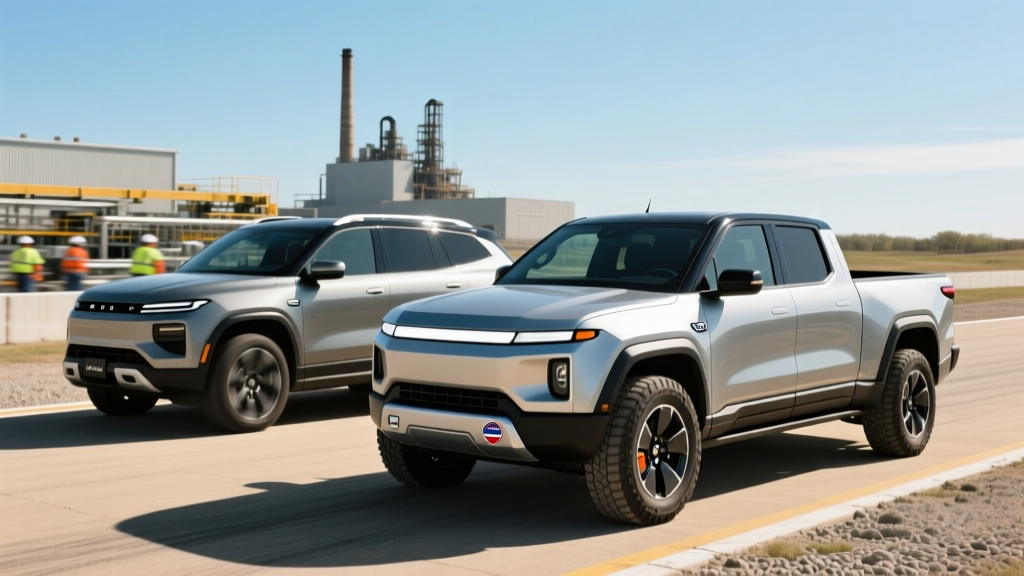
Rivian occupies a distinct space in the American EV market. Unlike most electric automakers that source vehicles from overseas assembly plants, Rivian designs, engineers, and builds every R1T truck and R1S SUV at its own facility in Normal, Illinois. That domestic manufacturing footprint isn't just a patriotic talking point — it directly affects supply-chain resilience, service logistics, and federal tax-credit eligibility under IRS §30D. This review covers the current-generation Rivian R1T and R1S with a focus on real-world range, charging performance, ownership costs, and what U.S. manufacturing means for buyers.
What Rivian Builds in Normal, Illinois
Rivian's production hub occupies the former Mitsubishi Diamond-Star Motors plant in Normal, Illinois — a facility the company acquired in 2017 and extensively retooled. As of early 2026, the Normal plant produces both the R1T (a mid-size four-door electric pickup) and the R1S (a three-row electric SUV sharing the same skateboard platform). Rivian also manufactures its Electric Delivery Van (EDV) for Amazon at the same site, though that commercial vehicle falls outside our consumer review scope.
The significance of U.S. manufacturing extends beyond geography. Rivian's domestic assembly qualifies its vehicles for the full $7,500 federal EV tax credit — provided buyers meet income and MSRP caps and the battery sourcing requirements are satisfied. Vehicles assembled outside North America are ineligible regardless of price. You can verify assembly location on the EPA's fueleconomy.gov database or the vehicle's window sticker (Monroney label).
Range, Efficiency, and Real-World Expectations
The current Rivian platform offers two primary battery packs: the Standard battery (approximately 95 kWh usable, LFP chemistry on base trims) and the Large battery (approximately 123 kWh usable, NMC chemistry). A Max Pack option (~149 kWh, NMC) is available for maximum range.
- R1T Dual-Motor Standard: EPA 270 mi — expect ~225–240 mi highway at 70 mph; ~200–215 mi in freezing temperatures
- R1T Dual-Motor Large: EPA 352 mi — expect ~295–315 mi highway; ~260–280 mi in cold weather
- R1T Dual-Motor Max Pack: EPA 420 mi — expect ~355–380 mi highway; ~310–340 mi in cold weather
- R1S figures: Generally 5–10 mi less than R1T equivalents due to taller, less aero-efficient body
Efficiency: ~73–79 MPGe combined depending on trim. Expect 42–48 kWh/100 mi in mixed driving.
These are large, heavy vehicles — the R1T Large Pack tips the scales near 7,150 lbs. That mass, combined with the pickup's boxy aerodynamics, means highway efficiency drops noticeably above 70 mph. If your typical commute involves sustained 80+ mph freeway driving, budget for 15–20% below EPA range. Cold-weather losses of 20–30% are typical for any EV without consistent garage preconditioning, and Rivian's heat pump mitigates but does not eliminate this.
Charging Speed and Infrastructure
Rivian's current-generation vehicles use a NACS (North American Charging Standard) charge port, granting native access to Tesla Supercharger stations via adapter-free connection on 2025+ models, plus the Rivian Adventure Network and third-party CCS stations with an included adapter.
| Charge Level | Power / Rate | 10–80% Time (Large Pack) | Miles Added per Hour |
|---|---|---|---|
| Level 1 (120V) | ~1.4 kW | N/A (trickle) | ~3–4 mi/hr |
| Level 2 (240V, 48A) | 11.5 kW | ~12–13 hours | ~25–28 mi/hr |
| DC Fast Charge | Peak 220 kW (Large/Max) | ~28–32 min (10–80%) | N/A |
Real-world DC charging nuance: the 220 kW peak applies only to the Large and Max packs and is sustained roughly between 10–40% state of charge. Above 60%, the charge curve tapers significantly — expect ~80–100 kW through the 60–80% range. If you're road-tripping and charging from 10–80%, plan for roughly 30–35 minutes at a capable 250+ kW station. The Standard Pack (LFP) peaks lower, around 180 kW, with a slightly flatter curve — typical of LFP chemistry, which tolerates higher states of charge better but charges somewhat slower at the top end.
For home charging, Rivian recommends a 60A circuit with a 48A Wall Connector for the full 11.5 kW Level 2 rate. Most owners adding 40–60 miles of daily driving will recover overnight easily. A full 200A electrical panel is generally sufficient, but older homes with 100A service may need a panel upgrade ($1,500–$3,000) — budget for this when planning installation.
Performance, Drivetrain, and Capability
| Configuration | Drivetrain | Horsepower | Torque (lb-ft) | 0–60 mph | Towing Capacity |
|---|---|---|---|---|---|
| Dual-Motor | AWD | 533 hp | 610 | 4.5 sec | 11,000 lbs |
| Performance Dual-Motor | AWD | 665 hp | 829 | 3.5 sec | 11,000 lbs |
| Quad-Motor | AWD (torque vectoring) | 1,025 hp | 1,198 | 2.7 sec | 11,000 lbs |
The R1S mirrors these powertrain options with marginally slower 0–60 times (~0.1–0.2 sec) due to its longer wheelbase and higher curb weight. All configurations include air suspension with adjustable ride height (up to 14.9 inches of ground clearance in Off-Road mode), a built-in air compressor, and a gear tunnel (R1T only) providing ~11 cu ft of lockable, pass-through storage between the cab and bed.
Towing at the 11,000-lb maximum will cut range roughly in half — expect 130–170 miles depending on pack size, trailer aerodynamics, and terrain. This is physics, not a Rivian limitation; all EV pickups experience severe range loss under heavy tow loads.
Pricing, Tax Credits, and Total Cost
| Trim | Base MSRP | Federal Credit (§30D) | Effective Price |
|---|---|---|---|
| Dual-Motor Standard | $69,900 | Up to $7,500 | ~$62,400 |
| Dual-Motor Large | $75,900 | Up to $7,500 | ~$68,400 |
| Performance Dual-Motor | $84,000 | Up to $7,500 | ~$76,500 |
| Quad-Motor Max | $99,000 | Up to $7,500 | ~$91,500 |
Tax credit eligibility is not automatic. Under current IRS §30D rules, buyers must meet all of the following:
- MSRP cap: Pickup trucks (R1T) must have an MSRP ≤ $80,000; SUVs (R1S) ≤ $80,000. This eliminates Quad-Motor and some fully optioned Performance trims from credit eligibility.
- Income cap: Modified AGI ≤ $150,000 (single), $225,000 (head of household), or $300,000 (joint).
- Battery sourcing: Critical minerals and battery component requirements phase in annually. Rivian's U.S. assembly helps, but specific battery-cell sourcing must meet the year's threshold. Check the EPA's credit-eligibility tool for your exact VIN before purchase.
- Point-of-sale transfer: You can elect to transfer the credit to the dealer at purchase, reducing your out-of-pocket cost immediately rather than waiting for tax filing.
R1S pricing tracks $2,000–$4,000 above equivalent R1T trims due to the enclosed three-row body. Both vehicles qualify under the $80,000 SUV/truck MSRP cap on their base and mid-tier configurations.
Interior Space, Tech, and Ownership Experience
R1T cargo: 54-inch bed (4.5 ft) with ~26 cu ft volume; 11-cu-ft gear tunnel; front trunk (frunk) ~11 cu ft. Total enclosed/lockable storage exceeds most mid-size pickups when combining bed, tunnel, and frunk.
R1S cargo: ~104 cu ft behind the first row (seats folded), ~58 cu ft behind the second row, ~14 cu ft behind the third row. Third-row legroom is tight at ~32 inches — suitable for children on short trips, not adults on road trips.
The infotainment runs on Rivian's proprietary software — a 15.6-inch center display and a 12.3-inch driver cluster. The system is responsive and receives regular over-the-air updates. Notable tech includes:
- Rivian Driver+: A Level 2 driver-assistance system with adaptive cruise, lane centering, and automatic lane changes on mapped highways. This is not autonomous driving — the driver must remain engaged and hands-on (or eyes-on with the latest camera-monitored trims).
- Camp Kitchen: Available slide-out galley for the gear tunnel (R1T) with induction cooktop and sink — a genuinely unique feature for overlanding.
- Vehicle-to-load (V2L): Powers external devices via bed outlets and the gear tunnel — useful for job-site tools or camping.
- OTA updates: Regular software improvements to drive modes, range optimization, and infotainment.
Drawbacks worth noting: The Rivian service network remains smaller than legacy automakers'. Mobile service handles many software and minor hardware issues, but body repair after a collision can involve multi-week waits for parts. Insurance premiums run 15–25% higher than comparable ICE trucks, reflecting repair costs and parts availability. The panoramic glass roof, while beautiful, contributes to cabin heat gain in summer — the tint helps but isn't a substitute for a retractable shade.
Warranty and Long-Term Battery Outlook
| Component | Coverage |
|---|---|
| Limited Vehicle Warranty | 5 years / 60,000 miles |
| Battery & Drive Units | 8 years / 175,000 miles (retains ≥70% capacity) |
| Corrosion Perforation | 12 years / unlimited miles |
| Roadside Assistance | 5 years / 60,000 miles |
The 8-year/175,000-mile battery warranty with a 70% capacity retention threshold is competitive with the industry standard. Rivian's NMC packs (Large and Max) have demonstrated modest degradation in early fleet data — most owners report 3–6% loss over the first 30,000 miles, which is typical. The LFP Standard pack is expected to show even slower degradation given LFP's inherent cycle-life advantage, though long-term Rivian-specific data is still accumulating. LFP also allows routine charging to 100% without the longevity concerns associated with NMC — a practical advantage for daily commuters who need every mile.
Who Should Buy a Rivian?
- You need a genuine mid-size pickup with 11,000-lb towing and off-road capability
- You value U.S. manufacturing and domestic supply-chain resilience
- You want the gear tunnel and camp-kitchen ecosystem for overlanding
- Your daily commute is under 200 miles round-trip with home charging access
- You need three rows and enclosed cargo space for family hauling
- You want an EV SUV with legitimate off-road chops (not just a crossover)
- Third-row use is occasional and primarily for children
- Budget is under $60,000 — Rivian does not compete in this segment
- You need a long-bed truck for construction materials (the 4.5-ft bed is short)
- You live in a region with no Rivian service presence and cannot tolerate mobile-only service
- Maximum range is your only priority — the Chevy Silverado EV or Tesla Cybertruck offer 400+ mi EPA at lower price points (with trade-offs)
Frequently Asked Questions
What is the real-world range of the Rivian R1T?
EPA ratings range from 270 mi (Standard Pack) to 420 mi (Max Pack). In real-world highway driving at 70 mph, expect 225–240 mi for the Standard, 295–315 mi for the Large, and 355–380 mi for the Max. Cold weather (below 32°F) reduces these figures by 20–30% unless the vehicle is preconditioned while plugged in.
How fast does the Rivian charge at home and on the road?
At home on a 48A Level 2 charger, the R1T adds ~25–28 miles per hour — a full overnight charge is routine. On DC fast chargers, the Large Pack peaks at 220 kW, reaching 10–80% in roughly 28–32 minutes. The Standard (LFP) pack peaks around 180 kW with a slightly longer 10–80% time of ~35–38 minutes.
Does the Rivian R1T qualify for the $7,500 federal tax credit?
Yes — if you meet all IRS §30D requirements. The R1T must have an MSRP at or below $80,000 (eliminating Quad-Motor and heavily optioned trims). Your modified adjusted gross income must not exceed $150K (single) / $300K (joint). Battery critical-mineral and component sourcing must meet the current year's thresholds. Rivian's U.S. assembly in Normal, Illinois satisfies the North American final-assembly requirement. Always verify eligibility with a tax professional and the EPA's credit tool before purchasing.
Is Rivian worth buying over the Ford F-150 Lightning or Chevy Silverado EV?
Rivian wins on off-road capability (air suspension, quad-motor torque vectoring), premium interior quality, and the unique gear-tunnel/camp-kitchen ecosystem. The F-150 Lightning offers a longer bed (5.5 ft), Pro Power Onboard, and a wider service network at a lower starting price. The Silverado EV leads on maximum range and price-per-mile of range. If lifestyle features (overlanding, V2L, premium fit-and-finish) matter more than bed length or lowest cost, Rivian is the stronger choice.
What are the biggest pros and cons of Rivian ownership?
- Genuine off-road capability with 14.9" ground clearance
- U.S.-built with strong §30D credit eligibility
- Unique gear tunnel and camp kitchen (R1T)
- Over-the-air updates continuously improve the vehicle
- Class-leading acceleration (Quad-Motor: 0–60 in 2.7 sec)
- 11,000-lb towing capacity
- Starting price above $69,000 — premium segment only
- Short 4.5-ft bed limits utility for long cargo
- Service network still growing; collision repair delays possible
- Insurance premiums 15–25% above ICE truck averages
- Towing cuts range ~50%
- R1S third row is tight for adults
Where are Rivian vehicles manufactured?
Every Rivian R1T and R1S is manufactured at the company's own plant in Normal, Illinois, USA. This facility also produces the Rivian Electric Delivery Van. Domestic manufacturing means Rivian vehicles satisfy the North American final-assembly requirement for the federal EV tax credit and benefit from a shorter, more controllable supply chain compared to vehicles assembled overseas.