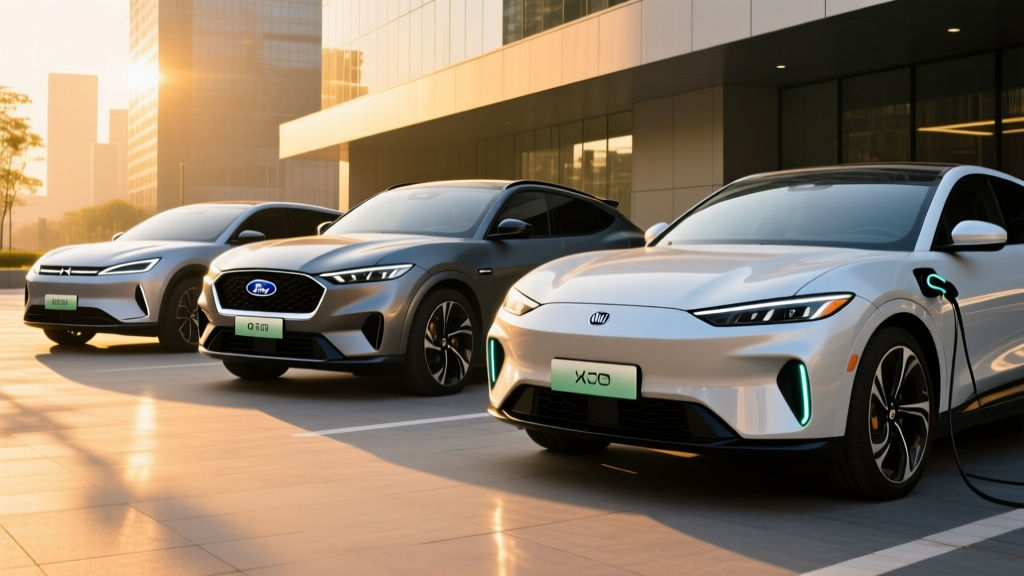
The global EV market is no longer a two-horse race between American legacy automakers and Tesla. Chinese manufacturers — led by BYD, NIO, and Geely — are producing vehicles with competitive range, aggressive pricing, and advanced battery technology. For US-based EV shoppers, the Ford, GM, and China EV competition matters because it directly influences the price you pay, the range you get, and the technology available in American-market vehicles, even if Chinese-branded EVs aren't sold stateside.
Quick Answer
Chinese EVs like the BYD Seal ($33,000 equivalent) undercut comparable Ford and GM models by $5,000–$12,000 globally, forcing US automakers to accelerate cost cuts and LFP battery adoption. For American buyers, this competition means better pricing on models like the 2026 Chevy Equinox EV (starting ~$33,600) and the Ford Mustang Mach-E, plus wider availability of longer-lasting, lower-cost LFP batteries. Chinese EVs remain unavailable in the US due to 100%+ tariffs, but their pricing pressure benefits you.
The State of the Ford, GM, and China EV Competition in 2026
China produces over 60% of the world's EVs and dominates battery supply chains. BYD alone sold more than 3 million new-energy vehicles globally in 2025, surpassing Tesla in total volume. Meanwhile, Ford and GM have restructured their EV strategies — Ford's Model e division has cut costs to reach profitability targets, and GM's Ultium platform now underpins over a dozen models across Cadillac, Chevrolet, and GMC.
The competitive gap shows up in three areas that matter to buyers:
- Price per kWh of battery: Chinese manufacturers pay roughly $95–$110/kWh for LFP packs (BYD's in-house Blade cells). Ford and GM pay approximately $115–$135/kWh for NMC packs, though LFP adoption is narrowing this gap.
- Vertical integration: BYD owns its battery, motor, and semiconductor supply chains. Ford and GM rely on joint ventures (LG Energy Solution, SK On, CATL licensing) with less cost control.
- Model rollout speed: Chinese OEMs bring new models from concept to market in 18–24 months. Ford and GM typically require 36–48 months.
For the US buyer, this means Ford and GM are under intense pressure to deliver more range at lower prices — and they're responding.
Spec Showdown: How US and Chinese EVs Compare
While you can't buy a BYD or NIO in the US, understanding the spec gap explains why American pricing is shifting. Here's how comparable models stack up in the midsize electric sedan and crossover segments:
| Spec | 2026 Chevy Equinox EV 3RS | 2026 Ford Mustang Mach-E Premium | BYD Seal (China/EU) | 2026 Tesla Model 3 Long Range |
|---|---|---|---|---|
| Base MSRP | $33,600 | $42,995 | ~$33,000 (not sold in US) | $42,490 |
| EPA Range | 319 mi | 320 mi | ~354 mi (WLTP / ~300 EPA est.) | 363 mi |
| Battery (usable) | 85 kWh (NMC) | 91 kWh (NMC) | 82.5 kWh (LFP Blade) | 79 kWh (NMC) |
| Peak DC Charge Rate | 190 kW | 150 kW | 150 kW | 250 kW |
| 10–80% DC Fast Charge | ~28 min | ~34 min | ~35 min | ~25 min |
| 0–60 mph | 7.6 sec | 5.1 sec | 5.9 sec | 4.2 sec |
| Horsepower | 288 hp | 312 hp | 313 hp | 346 hp |
| §30D Tax Credit Eligible | Up to $7,500 (check IRS sourcing) | Up to $7,500 (check IRS sourcing) | N/A | Up to $7,500 (check IRS sourcing) |
| Battery Warranty | 8 yr / 100,000 mi | 8 yr / 100,000 mi | 8 yr / 150,000 km (non-US) | 8 yr / 120,000 mi |
Sources: fueleconomy.gov, Chevrolet.com, Ford.com. BYD figures based on EU/WLTP specs converted to approximate EPA equivalents. Tax credit eligibility per IRS §30D — verify current-year battery sourcing and income requirements before purchase.
What This Competition Means for Your Wallet
The Ford, GM, and China EV competition isn't abstract — it shows up in MSRP stickers, tax credit eligibility, and total cost of ownership. Here's a concrete five-year cost breakdown comparing a competitively-priced American EV against a gas equivalent:
| 5-Year Cost Category | 2026 Chevy Equinox EV 3RS (with $7,500 credit) | 2026 Chevy Equinox Gas (1.5T, FWD) | 2026 Toyota RAV4 Hybrid |
|---|---|---|---|
| Purchase Price (after credit) | $26,100 | $29,200 | $32,500 |
| Fuel / Electricity (60,000 mi) | $3,900 (home L2, $0.14/kWh avg) | $7,800 ($3.50/gal, 28 MPG avg) | $5,400 ($3.50/gal, 40 MPG avg) |
| Maintenance (5 yr) | $1,200 | $3,600 | $2,800 |
| Insurance (5 yr avg) | $9,500 | $7,200 | $7,800 |
| Depreciation (est. 5 yr) | $12,000 | $11,500 | $10,800 |
| Total 5-Year Cost | $52,700 | $59,300 | $59,300 |
Real-World Range Reality Check
The Equinox EV's EPA rating is 319 miles. Expect approximately 260–280 miles in sustained highway driving at 70+ mph, and as low as 210–230 miles in sub-freezing winter conditions (below 30°F). LFP batteries in Chinese EVs like BYD models show slightly less cold-weather loss (~15%) compared to NMC packs (~20–25%), but LFP's lower energy density limits total range. Always plan road trips around 80% of EPA range to account for terrain, HVAC use, and charge-curve taper above 80% SoC.
Key takeaways from the cost data:
- The EV wins on total cost when the §30D credit applies and you charge primarily at home. Without home charging, public DC fast charging at $0.35–$0.50/kWh erodes fuel savings by $1,500–$3,000 over five years.
- Insurance is the EV's Achilles heel. EV premiums run 15–25% higher due to battery replacement costs and specialized repair requirements. Shop quotes from GEICO, Progressive, and EV-specialty insurers before committing.
- Maintenance savings are real: No oil changes, no transmission fluid, fewer brake pad replacements (regen braking extends pad life to 80,000+ miles). Budget only for tire rotation, cabin air filters, and coolant checks.
How LFP Batteries Are Reshaping the Competition
One of the most consequential outcomes of the Ford, GM, and China EV competition is the mainstreaming of LFP (lithium iron phosphate) battery chemistry. BYD pioneered LFP at scale with its Blade cell, and now Ford and Tesla are adopting LFP for standard-range models.
| Factor | LFP (BYD Blade, Ford LFP models) | NMC (GM Ultium, most long-range EVs) |
|---|---|---|
| Cost per kWh | $95–$110 | $115–$135 |
| Energy Density | Lower (~160 Wh/kg cell-level) | Higher (~250–280 Wh/kg cell-level) |
| Cycle Life | 3,000–5,000 cycles | 1,000–2,000 cycles |
| Cold-Weather Range Loss | ~15% (0°C / 32°F) | ~20–25% (0°C / 32°F) |
| Charging to 100% SoC | Recommended regularly (no degradation penalty) | Limit to 80% daily for longevity |
| Cobalt/Nickel Content | None (lower supply-chain risk) | Contains cobalt and nickel |
| Best For | Daily commuting, cost-conscious buyers, high-mileage drivers | Maximum range, road-trip-heavy drivers, performance models |
Ford's 2026 LFP-equipped models (select trims of the F-150 Lightning and Mustang Mach-E) benefit directly from BYD and CATL technology licensing. This means US buyers get Chinese battery innovation inside American-built vehicles — at lower prices and with longer projected lifespans.
Common Misconceptions About the China EV Threat
| Myth | Fact |
|---|---|
| "Chinese EVs are low quality and unsafe." | BYD, NIO, and XPeng vehicles have scored 5-star Euro NCAP ratings. Build quality on the BYD Seal and NIO ET7 matches or exceeds comparable European sedans in panel fit and interior materials. |
| "Chinese EVs will flood the US market and undercut everything." | US tariffs on Chinese-built EVs exceed 100% as of 2025, effectively blocking direct imports. Chinese OEMs are building plants in Mexico, Thailand, and Europe — but US market entry remains years away at best. |
| "American EVs can't compete on technology." | GM's Ultium platform supports 800V architecture and up to 350 kW charging (Hummer EV). Ford's software-defined vehicle architecture enables OTA updates competitive with Tesla. The gap is narrowing in software and closing in battery tech. |
| "Buying an American EV means no Chinese components." | Most EV batteries — regardless of brand — contain cathode materials processed in China. The §30D tax credit's "foreign entity of concern" (FEOC) rules restrict this, but supply chains remain deeply interconnected. |
Real-World Ownership: What First-Time EV Buyers Must Know
The Ford, GM, and China EV competition drives better products, but ownership fundamentals remain the same regardless of badge. Here's what first-time buyers need to plan for:
Home Charging Access Is the Deciding Factor
If you can install a Level 2 home charger (240V, 32–48A), EV ownership is dramatically simpler and cheaper. A typical Level 2 installation costs $800–$2,500 including a hardwired ChargePoint Home Flex or Wallbox Pulsar Plus unit, electrician labor, and permits — assuming your electrical panel has capacity. A panel upgrade from 100A to 200A adds $1,500–$3,500.
Without home charging, you'll rely on public Level 2 ($0.20–$0.35/kWh) and DC fast charging ($0.35–$0.55/kWh), which adds 2–3x the per-mile energy cost and significant time overhead. Plan at least 30 minutes per DC session for a 10–80% charge.
Climate Matters More Than You Think
If you live in a region where winter temperatures regularly drop below 30°F, budget for 20–30% range loss. A 319-mile Equinox EV becomes a ~225-mile vehicle in January in Minnesota. Preconditioning (warming the battery while plugged in) mitigates charging-speed loss but doesn't fully restore range. Consider a heat pump-equipped model — standard on most 2026 GM Ultium vehicles and available on select Ford trims — which reduces HVAC energy draw by 30–40% in cold weather.
Driving Patterns Determine EV Suitability
The EV-vs-hybrid decision comes down to your daily mileage and trip structure:
Decision Framework: EV, PHEV, or Hybrid?
Choose a full EV (Ford Mach-E, Chevy Equinox EV) if:
- Your daily round-trip commute is under 100 miles
- You have reliable home Level 2 charging
- You take road trips fewer than 6 times per year (or are willing to plan DC fast-charging stops)
- You want the lowest per-mile fuel cost (~$0.04–$0.06/mi at home)
Choose a PHEV (Toyota RAV4 Prime, Jeep Wrangler 4xe) if:
- Your daily commute is under 40 miles (covers most PHEV electric-only ranges of 35–42 mi)
- You lack home charging but want some electric driving
- You frequently drive 300+ miles in a single day without wanting to plan charging stops
- You want EV-like commuting without range anxiety on road trips
Choose a conventional hybrid (Toyota RAV4 Hybrid, Honda CR-V Hybrid) if:
- You cannot charge at home or at work
- You regularly drive in areas with limited DC fast-charging infrastructure (rural routes, cross-country corridors)
- You want lower upfront cost (~$3,000–$6,000 less than an equivalent EV)
- Your annual mileage exceeds 20,000 miles and charging logistics would be disruptive
Federal Tax Credit: What the Competition Means for Eligibility
The §30D federal tax credit — up to $7,500 for new EVs — is a direct policy response to the Ford, GM, and China EV competition. Congress designed the credit to incentivize North American battery sourcing and reduce dependence on Chinese supply chains. Here's what you need to verify before assuming you qualify:
- MSRP caps: Vans, SUVs, and pickups must be under $80,000 MSRP. Sedans must be under $55,000.
- Income limits: Modified AGI cannot exceed $150,000 (single), $225,000 (head of household), or $300,000 (married filing jointly).
- Battery sourcing: Increasing percentages of critical minerals and battery components must be sourced from the US or FTA partners — not from a "foreign entity of concern" (primarily targeting Chinese firms like CATL and BYD). This requirement tightens annually.
- Point-of-sale transfer: As of 2024, you can transfer the credit to the dealer at purchase, reducing your out-of-pocket cost immediately rather than waiting for a tax refund.
Always verify eligibility at fueleconomy.gov for the specific trim and model year, and consult a tax professional. Sourcing rules change frequently, and a vehicle that qualified in 2025 may not in 2026.
Bottom Line: How to Use This Competition to Your Advantage
The Ford, GM, and China EV competition is producing tangible benefits for American buyers right now: lower MSRPs, broader LFP battery options, faster technology adoption, and more aggressive tax-credit-eligible pricing. Here's how to act on it:
- Time your purchase around model-year refreshes. When Ford or GM announces a price cut or range bump (often in Q3–Q4 for next-year models), it's frequently a direct response to global competitive pressure. The 2026 Equinox EV's sub-$34K starting price didn't happen in a vacuum.
- Ask about LFP options. If you're a high-mileage commuter who charges to 100% nightly, an LFP-equipped model will outlast an NMC pack in cycle life while saving $2,000–$4,000 upfront.
- Run your own total-cost calculation. Use the cost table above as a template. Plug in your local electricity rate, your annual mileage, and your insurance quotes. The EV math works for most home-charging owners — but verify with your numbers, not marketing claims.
- Don't wait for Chinese EVs to arrive. Tariff barriers and FEOC sourcing rules mean BYD and NIO won't be in US showrooms anytime soon. The competitive pressure they create is already baked into current Ford and GM pricing.
Are Chinese EVs available to buy in the United States?
No. As of 2026, US tariffs on Chinese-built electric vehicles exceed 100%, making them economically non-viable for import. Brands like BYD, NIO, and XPeng sell in China, Europe, Southeast Asia, and Latin America, but have no US retail presence. Some Chinese-made vehicles from non-Chinese brands (e.g., certain Volvo and Polestar models built in China) have faced tariff adjustments, but no Chinese-branded EV is sold in the US market.
Does the Ford-GM-China EV competition mean American EVs are getting cheaper?
Yes, measurably. The 2026 Chevy Equinox EV starts at approximately $33,600 — roughly $10,000 less than GM's initial EV pricing from 2022–2023. Ford has cut Mustang Mach-E pricing on select trims and adopted LFP batteries to reduce costs. This downward pressure is a direct response to global competition, particularly from Chinese OEMs offering 300+ mile EVs at $25,000–$35,000 equivalent in other markets.
Should I wait for EV prices to drop further before buying?
Prices are likely to continue declining modestly (3–5% annually) as battery costs fall and competition intensifies. However, waiting means forgoing current §30D tax credit eligibility, which could change with legislation, and missing out on current fuel savings. If a vehicle meets your needs and budget today — especially with the point-of-sale credit transfer — the math typically favors buying now rather than speculating on future price drops.
Will a Ford or GM EV hold its resale value against future Chinese competition?
EV depreciation has been steeper than gas-car depreciation — averaging 40–50% over three years for some models vs. 30–35% for comparable gas vehicles. However, as the market matures and battery longevity data improves, depreciation is stabilizing. Buying a competitively-priced model (under $40K after credit) reduces your absolute depreciation exposure. Chinese EV entry to the US market is unlikely before 2029–2030 at the earliest, so near-term resale impact is minimal.
How does the §30D tax credit's battery sourcing rule affect which EVs qualify?
The FEOC (foreign entity of concern) rule disqualifies vehicles whose batteries contain critical minerals or components sourced from Chinese companies like CATL, BYD, or Ganfeng Lithium above threshold percentages. This requirement tightens each year. Some models that qualified in prior years may lose eligibility. Always check the current qualification list at fueleconomy.gov and verify with your dealer before purchase — do not assume a model qualifies based on prior-year information.