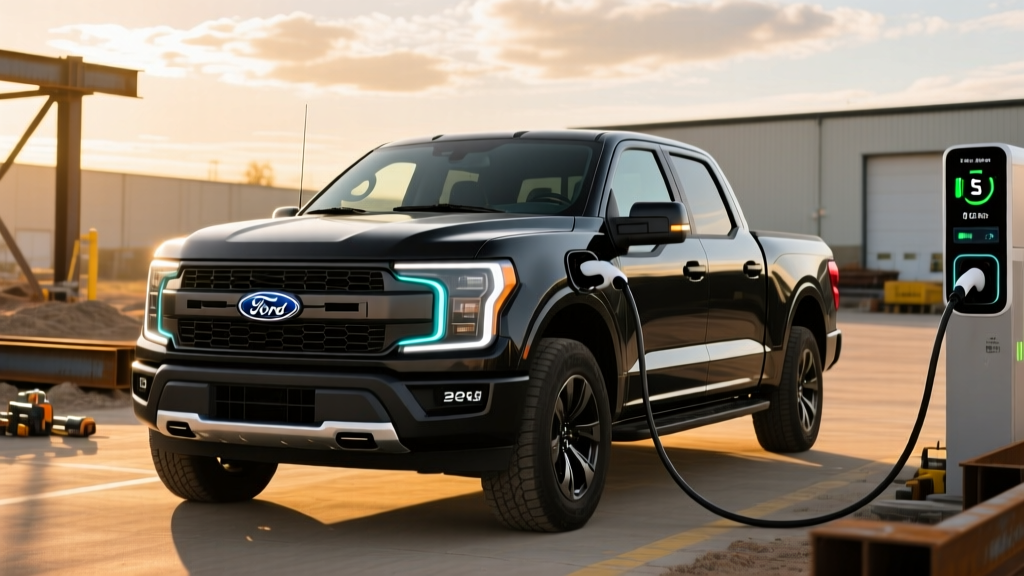
The Ford F-150 Lightning Pro remains the work-oriented entry point into Ford's full-size electric truck lineup. Built on the same dedicated EV platform as its higher-trim siblings, the Pro trim strips away luxury add-ons to deliver a no-nonsense electric pickup aimed at fleet buyers, tradespeople, and cost-conscious commercial operators. But with a 2026 starting MSRP near $60,000, is the Lightning Pro still the value play it debuted as in 2022? This review examines real-world range, charging behavior, payload and towing capability, and total cost of ownership to answer that question with data.
2026 Ford F-150 Lightning Pro: Core Specifications
| Specification | Value |
|---|---|
| EPA Estimated Range | 230 miles |
| Usable Battery Capacity | 98 kWh (Standard Range) |
| Battery Chemistry | NMC (Nickel Manganese Cobalt) |
| Drivetrain | Dual-motor AWD |
| Horsepower | 580 hp |
| Torque | 775 lb-ft |
| 0–60 mph | ~4.0 seconds |
| Max Payload | 2,235 lbs |
| Max Towing (w/ Max Trailer Tow Pkg) | 7,700 lbs |
| Combined MPGe | 68 MPGe |
| Energy Consumption | 49 kWh/100 mi |
| Base MSRP (Pro Trim) | $59,990 |
| Battery Warranty | 8 years / 100,000 miles |
Real-World Range: What to Expect Beyond the EPA Sticker
Real-World Highway (70 mph, moderate temps): ~185–205 miles
Real-World Highway (cold weather, <30°F): ~155–175 miles
City/Commuter Driving: ~210–225 miles
The 230-mile EPA figure for the Standard Range battery assumes a mix of city and highway driving at moderate temperatures. In practice, the F-150 Lightning Pro's boxy aerodynamics and 6,000-plus-pound curb weight penalize highway efficiency significantly. On a flat, 70-mph cruise at 65°F, expect to extract roughly 190–205 miles before hitting a 10% State of Charge buffer. Push that speed to 75–80 mph on an interstate run, and usable range drops further.
Cold weather compounds the loss. Lithium-ion NMC cells suffer reduced efficiency below freezing, and the Lightning's resistive cabin heating (on the Pro trim, a heat pump is not standard) draws substantial energy. In sustained sub-30°F highway driving, plan for 155–175 miles of practical range. Preconditioning the battery while plugged in mitigates some of this loss and is essential for preserving DC fast-charge speeds in winter.
For urban delivery routes and stop-and-go commuting, regenerative braking recovers energy effectively, and the Pro's range approaches its EPA rating. If your daily route is under 150 miles round-trip with depot charging, the Standard Range battery covers it comfortably year-round.
Charging Performance: DC Fast and Level 2 Breakdown
Charging speed is where commercial EV buyers need precision, not marketing claims. The F-150 Lightning Pro with the Standard Range 98-kWh battery supports the following charge rates:
| Charge Level | Power (kW) | Rate (mi/hr) | Notes |
|---|---|---|---|
| Level 1 (120V household) | ~1.4 kW | ~3 mi/hr | Emergency/trickle only |
| Level 2 (240V, 32A mobile charger) | 7.7 kW | ~16 mi/hr | Included Ford Mobile Charger |
| Level 2 (240V, 48A Ford Charge Station Pro) | 11.5 kW | ~24 mi/hr | Recommended home/depot setup |
| Level 2 (240V, 80A Ford Charge Station Pro) | 19.2 kW | ~40 mi/hr | Requires 100A circuit; Extended Range only achieves full benefit |
| DC Fast Charge (peak) | 120 kW | — | 10–80% in ~44 min (Standard Range) |
The Standard Range Lightning Pro peaks at roughly 120 kW on a DC fast charger — significantly less than the Extended Range model's 150 kW capability. Ford's charge curve on the 98-kWh pack holds near peak rate from roughly 10% to 50% SoC, then tapers progressively. The 10–80% session takes approximately 44 minutes at a 150 kW or higher station. Above 80%, charging slows dramatically to protect cell longevity; a 80–100% top-off can add another 35–40 minutes.
For home or depot Level 2 charging, the 48-amp Ford Charge Station Pro delivers 11.5 kW, replenishing the 98-kWh pack from empty to full in roughly 9–10 hours. This is the practical sweet spot for overnight charging. The 80-amp station requires a 100-amp dedicated circuit — a significant electrical upgrade that may cost $1,500–$3,000 beyond the charger itself, depending on panel capacity. Consult a licensed electrician to assess your panel's headroom before committing.
On the public charging front, the Lightning Pro uses the CCS1 connector on models produced before late 2024 and the NACS (Tesla-style) connector on current-production units. Ford provides Supercharger network access via the built-in adapter or native NACS port. EPA data on fueleconomy.gov confirms the 49 kWh/100 mi combined consumption figure, which translates to roughly $0.14–$0.18 per mile on public DC fast chargers at current national average rates of $0.35–$0.48/kWh.
Performance, Payload, and Towing
The dual-motor all-wheel-drive powertrain delivers 580 horsepower and 775 lb-ft of torque across all Lightning trims with the Standard Range battery. The 0–60 mph sprint clocks in around 4.0 seconds — sports-sedan quick for a truck that weighs over three tons. Instant torque delivery makes merging and passing effortless, and the low center of gravity from the under-floor battery pack reduces body roll compared to the gas F-150.
Payload capacity peaks at 2,235 lbs for the Pro trim, and towing reaches 7,700 lbs with the Max Trailer Tow package. However, towing at max capacity cuts range roughly in half. In real-world testing with a 5,000-lb enclosed trailer at highway speeds, expect 100–120 miles of range before needing a charge stop. For fleet operators running predictable routes under 100 miles with trailer loads, this is manageable; for long-haul towing, it remains a significant constraint.
The Lightning Pro includes Ford's Pro Power Onboard with 2.4 kW of onboard power (two 120V bed outlets). This powers job-site tools, lighting, or small equipment directly from the truck's battery — a genuine differentiator for tradespeople. The 9.6 kW Extended Power option is available on higher trims but not the Pro.
Pricing, Trims, and Federal Tax Credit Eligibility
| Item | Amount |
|---|---|
| Pro Trim Base MSRP | $59,990 |
| Destination Charge | $2,095 |
| As-Tested (Pro w/ Tow Pkg, BlueCruise) | ~$64,500 |
| Federal §30D Tax Credit (max) | Up to $7,500 |
| Point-of-Sale Transfer | Available (reduces purchase price at dealer) |
| Effective Price After Max Credit | ~$54,585 (before state incentives) |
The F-150 Lightning qualifies as a light truck under IRS §30D rules, meaning the MSRP cap is $80,000 — well above the Pro's $59,990 base. However, eligibility for the full $7,500 credit depends on three factors that change periodically:
- Buyer income limits: Modified adjusted gross income must not exceed $150,000 (single), $225,000 (head of household), or $300,000 (joint filers).
- Battery component sourcing: A percentage of battery components must be manufactured or assembled in North America, and critical minerals must be sourced from the U.S. or free-trade-agreement countries. These thresholds tighten annually. Check the latest requirements at IRS qualified vehicle lists.
- Final assembly: The Lightning is assembled at Ford's Rouge Electric Vehicle Center in Dearborn, Michigan, satisfying the North American final-assembly requirement.
The point-of-sale transfer option allows dealers to apply the credit as an immediate price reduction rather than waiting for a tax refund at filing. Confirm current eligibility with your dealer and a tax professional before purchase, as battery-sourcing compliance can shift with model-year production changes.
Interior, Tech, and Driver Assistance
The Pro trim uses a 12-inch touchscreen running SYNC 4 — a functional, responsive interface with wireless Apple CarPlay and Android Auto. Unlike the XLT and Lariat's available 15.5-inch portrait screen, the Pro's horizontal layout is simpler and less distracting. Physical knobs for climate control remain, which is a practical advantage for gloved job-site use.
The digital instrument cluster is 12 inches and displays range, energy flow, and navigation clearly. Ford Co-Pilot360 2.0 comes standard, including automatic emergency braking with pedestrian detection, lane-keeping assist, blind-spot monitoring, and rear cross-traffic alert. BlueCruise (Ford's hands-on-wheel Level 2 highway driving assist) is available as an option but is not standard on the Pro trim.
Interior space mirrors the gas F-150 SuperCrew: 43.9 inches of front legroom, 43.4 inches rear, and seating for five adults comfortably. The front trunk ("frunk") adds 14.1 cubic feet of lockable, drainable storage — large enough for toolboxes, groceries, or a week's worth of gear. The 5.5-foot bed offers 52.8 cubic feet of volume.
Pros, Cons, and Who Should Buy the Lightning Pro
Pros
- 580 hp / 775 lb-ft standard across all trims — exceptional performance for a work truck
- Pro Power Onboard (2.4 kW) eliminates job-site generator needs
- Frunk adds 14.1 cu ft of secure, weatherproof storage
- Federal §30D credit eligibility reduces effective cost significantly
- Dual-motor AWD standard — no RWD penalty for commercial buyers
- Low center of gravity improves handling vs. gas F-150
- Quiet, vibration-free operation reduces driver fatigue on long work days
Cons
- 230-mile EPA range is tight for highway-heavy or long-distance routes
- 120 kW peak DC charging lags competitors (Rivian R1T: 200+ kW; Silverado EV: 350 kW)
- Cold-weather range loss of 25–35% is significant in northern climates
- Towing at max capacity cuts range to ~100–120 miles
- Pro trim lacks heat pump (reduces cold-weather efficiency vs. higher trims)
- BlueCruise not standard — adds cost for highway-commute convenience
- Insurance premiums run 15–25% higher than gas F-150 equivalents
Who the F-150 Lightning Pro Suits Best
Choose the Lightning Pro if: You run a predictable daily route under 150 miles, have depot or home Level 2 charging, need job-site power (Pro Power Onboard), and want to reduce fuel and maintenance costs. It's ideal for electricians, plumbers, fleet delivery, and municipal use.
Look elsewhere if: You regularly tow over 4,000 lbs on highway routes, live in a region with extreme winters and no reliable charging infrastructure, or need 300+ miles of range for road trips. Consider the Extended Range battery ($10,000+ upcharge, 320-mi EPA) or a diesel truck for heavy towing.
Competitor Comparison: Lightning Pro vs. Rivian R1T and Silverado EV
The Lightning Pro's closest competitors occupy different niches. The Rivian R1T Dual-Motor starts around $75,000, offers 270+ miles of EPA range, charges at over 200 kW, and provides superior off-road capability — but costs $15,000+ more and lacks the Pro's fleet-oriented simplicity. The Chevrolet Silverado EV Work Truck targets a similar commercial buyer with a larger battery (up to 350-mile range on higher trims) and 350-kW peak DC charging, but base pricing and availability have been volatile.
For buyers prioritizing lowest acquisition cost, established dealer service networks, and proven fleet integration, the Lightning Pro remains the most accessible electric full-size truck. Its range and charging limitations are real trade-offs, but for the right use case — short daily routes with overnight charging — the operating cost savings over gas are substantial. At $0.14 per mile (electricity) versus $0.22–$0.28 per mile (gas at $3.50–$4.00/gallon and 18 MPG), a fleet truck driving 20,000 miles annually saves roughly $1,600–$2,800 per year in fuel alone, with additional savings from eliminated oil changes and reduced brake wear via regenerative braking.
Frequently Asked Questions
What is the real-world range of the Ford F-150 Lightning Pro?
The EPA rates it at 230 miles. Real-world highway driving at 70 mph yields approximately 185–205 miles in moderate temperatures and 155–175 miles in cold weather below 30°F. City driving with regenerative braking approaches the EPA figure.
How fast does the F-150 Lightning Pro charge?
On a DC fast charger, the Standard Range pack peaks at 120 kW, achieving a 10–80% charge in approximately 44 minutes. At home on a 48-amp Level 2 station (11.5 kW), a full charge takes 9–10 hours, adding roughly 24 miles of range per hour.
Does the F-150 Lightning Pro qualify for the $7,500 federal tax credit?
It can, subject to IRS §30D rules. The truck meets the MSRP cap ($80,000 for light trucks), North American assembly requirement, and — depending on current production sourcing — battery component and critical mineral thresholds. Buyer income caps also apply. Verify current eligibility at IRS.gov and with a tax professional.
Is the Lightning Pro worth buying over a gas F-150?
For daily routes under 150 miles with home or depot charging, yes — fuel and maintenance savings offset the higher purchase price within 3–5 years for most commercial users. For long-haul towing, remote-area work, or routes without reliable charging access, a gas or hybrid F-150 remains more practical.
What is the battery warranty on the F-150 Lightning Pro?
Ford covers the high-voltage battery for 8 years or 100,000 miles, whichever comes first, against defects and excessive capacity loss (typically defined as dropping below 70% of original capacity). The powertrain carries the same 8-year/100,000-mile coverage.
Can the F-150 Lightning Pro power my home during an outage?
Not on the Pro trim as standard. Ford Intelligent Backup Power (9.6 kW bi-directional charging) requires the 80-amp Charge Station Pro and a home integration system, and is available on XLT and higher trims. The Pro trim's 2.4-kW Pro Power Onboard can power individual appliances or tools via bed outlets but does not support whole-home backup.