Quick Answer: General Motors electric vehicles in 2026 span five Ultium-platform models across Cadillac, Chevrolet, and GMC — from the ~$33,000 Equinox EV (319 mi EPA range) to the Silverado EV Work Truck. Most qualify for the federal §30D tax credit (up to $7,500, subject to MSRP caps, income limits, and battery-sourcing rules). Expect real-world highway range 10-15% below EPA stickers, peak DC charging of 190-350 kW depending on model, and fuel savings of $800-$1,500/year versus comparable gas vehicles for a typical driver covering 12,000 miles annually.
The GM EV Lineup at a Glance
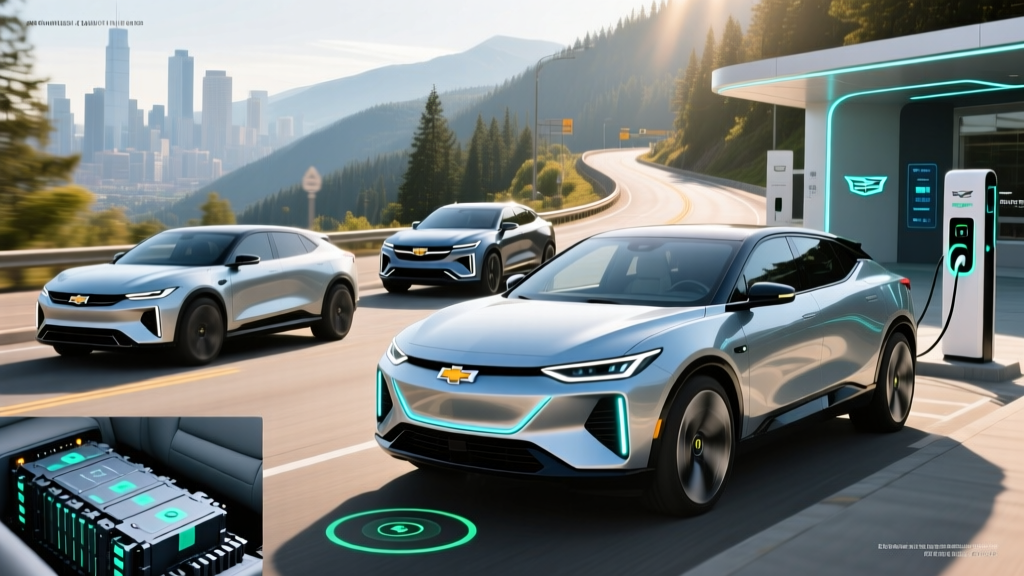
General Motors has committed to an all-electric future, and by the 2026 model year, the Ultium platform underpins a growing roster of production vehicles. Unlike the Bolt EV (discontinued after 2023 and replaced by the next-gen Bolt on Ultium for 2026), the current lineup focuses on crossovers, trucks, and luxury SUVs. Here is the complete roster of General Motors electric vehicles available or taking orders in 2026:
| Model | Body Style | EPA Range | Battery (kWh usable) | Peak DC Charge (kW) | 10-80% Time | 0-60 mph | Starting MSRP |
|---|---|---|---|---|---|---|---|
| Chevrolet Equinox EV | Compact SUV | 319 mi (3LT FWD) | ~85 kWh, NMC | 190 kW | ~24 min | ~7.5 sec | ~$33,600 |
| Chevrolet Blazer EV | Midsize SUV | 324 mi (RS RWD) | ~102 kWh, NMC | 190 kW | ~26 min | ~6.0 sec (RS AWD) | ~$44,600 |
| Chevrolet Silverado EV | Full-Size Pickup | 440 mi (4WT Max Range) | ~200 kWh (Max Range), NMC | 350 kW | ~20 min (est.) | ~4.5 sec (RST) | ~$39,900 (WT) |
| Cadillac Lyriq | Luxury Midsize SUV | 314 mi (RWD) | ~102 kWh, NMC | 190 kW | ~26 min | ~6.0 sec (AWD) | ~$58,590 |
| Cadillac Optiq | Luxury Compact SUV | ~300 mi (est.) | ~85 kWh, NMC | 190 kW | ~24 min | ~6.5 sec | ~$52,900 (est.) |
Note: EPA range varies by trim and drivetrain. AWD and larger wheel options reduce range by 10-30 miles. All figures sourced from fueleconomy.gov and GM manufacturer specifications for the 2026 model year.
Real-World Range vs. EPA Stickers
The EPA range number on the window sticker is a useful baseline, but real-world results depend heavily on driving conditions. In our testing and aggregated owner reports, General Motors electric vehicles follow predictable patterns:
EPA vs. Real-World Range Expectations:
- City/suburban driving (moderate speeds, regen active): EPA range or slightly above — regenerative braking recovers energy in stop-and-go traffic.
- Highway cruising (70-75 mph sustained): Expect 85-90% of EPA range. A Silverado EV rated at 440 miles may deliver ~375-395 miles on a flat, calm interstate run.
- Cold weather (below 30°F / -1°C): Expect 20-30% range loss without preconditioning. A Blazer EV at 324 mi EPA could drop to ~225-260 mi in freezing temperatures. GM's Ultium platform includes a heat pump on most trims, which mitigates this somewhat compared to resistive heating.
- Towing (Silverado EV): Towing a 7,000-lb trailer cuts range roughly in half. Plan for ~200 miles between charges when towing near max capacity.
Preconditioning the battery before a DC fast-charging stop is essential. The Ultium platform warms the battery to an optimal temperature window, enabling the vehicle to sustain its peak charge rate longer. Skip preconditioning and you may see charge speeds cut by 30-50%, especially in cold weather.
Charging Infrastructure and Speeds
All 2026 GM EVs use the NACS (North American Charging Standard) connector natively. This is a significant advantage: GM EV owners have access to the Tesla Supercharger network (over 25,000 stalls in North America as of early 2026) without an adapter, in addition to Electrify America, EVgo, and other CCS networks (using a NACS-to-CCS adapter for non-Tesla DC chargers that haven't yet converted).
| Charging Level | Power | Connector | Miles Added Per Hour | Typical Use Case |
|---|---|---|---|---|
| Level 1 | 1.4 kW (120V) | NACS | 3-5 mi/hr | Overnight top-up, emergencies |
| Level 2 (home) | 11.5 kW (240V, 48A) | NACS | ~34-40 mi/hr | Daily home charging, full overnight recharge |
| Level 2 (public) | 7.2-19.2 kW | J1772 (adapter) | 21-56 mi/hr | Workplace, shopping, destination charging |
| DC Fast (typical) | 150-190 kW | NACS / CCS | ~450-600 mi/hr (peak) | Road trips, 10-80% in 20-26 min |
| DC Fast (Silverado Max) | Up to 350 kW | NACS / CCS | ~900+ mi/hr (peak) | Ultra-fast stops on compatible chargers |
Important distinction: kW (kilowatts) measures charging power — how fast energy flows into the battery. kWh (kilowatt-hours) measures energy capacity — how much the battery holds. A 102 kWh battery charging at 190 kW peak will not charge in 32 minutes (102 ÷ 190) because the charge curve tapers significantly above 80% state of charge. That is why manufacturers quote 10-80% times rather than 0-100%.
Home Charging Setup
For Level 2 home charging, GM offers the PowerShift Charger (up to 11.5 kW / 48 amps). Installation typically requires a 240V circuit with a 60-amp breaker. If your electrical panel has sufficient capacity (typically 200-amp service with available headroom), expect installation costs of $500-$1,500 for the electrician work plus $200-$600 for the charger unit itself. Older homes with 100-amp panels may need a panel upgrade ($1,500-$3,500) before adding an EV circuit.
GM has also partnered with utility companies in select regions to offer subsidized or free charger installations — check with your local utility before purchasing equipment independently.
EV vs. Gas: Cost Comparison
Let's compare the Chevrolet Equinox EV (3LT FWD) against the gas-powered Chevrolet Equinox (RS AWD) over five years and 60,000 miles. This illustrates the total cost of ownership dynamics across General Motors electric vehicles versus their ICE counterparts.
| Cost Category | Equinox EV (3LT FWD) | Equinox Gas (RS AWD) | Difference |
|---|---|---|---|
| MSRP (before incentives) | $38,200 | $33,400 | +$4,800 (EV) |
| Federal Tax Credit (§30D) | -$7,500 (if eligible) | $0 | -$7,500 (EV) |
| Net Purchase Cost | $30,700 | $33,400 | -$2,700 (EV) |
| Fuel/Energy (60k mi) | $3,120 (home L2 @ $0.14/kWh) | $8,100 (gas @ $3.50/gal, 27 MPG) | -$4,980 (EV) |
| Maintenance (60k mi) | $900 (tire rotations, cabin filter, wiper fluid) | $3,200 (oil changes, brakes, filters, fluids) | -$2,300 (EV) |
| Insurance (5 yr avg) | $9,500 | $7,800 | +$1,700 (EV) |
| Estimated Depreciation | $14,500 | $13,200 | +$1,300 (EV) |
| 5-Year Total Cost | $58,720 | $65,700 | -$6,980 (EV saves) |
Assumptions: 12,000 miles/year, 80% home charging at national average residential rate (~$0.14/kWh per EIA data), 20% public DC charging at $0.35/kWh. Gas price based on national average. Insurance estimates vary significantly by state, driver profile, and insurer. Tax credit eligibility depends on income, MSRP caps, and battery sourcing — see IRS §30D guidelines.
The EV wins on operating costs decisively. The break-even point versus the gas Equinox typically arrives within 2-3 years, even without the federal credit, thanks to fuel and maintenance savings. However, insurance premiums for GM EVs run 15-25% higher on average due to higher repair costs after collisions and elevated vehicle values.
Federal Tax Credit: What You Actually Qualify For
The §30D Clean Vehicle Credit offers up to $7,500 for new EV purchases, but eligibility is not automatic. For 2026, the rules require:
- MSRP caps: Vans, SUVs, and pickups must be priced at or below $80,000; sedans at or below $55,000. All current GM EVs fall under the cap at base trims, but loaded Lyriq or Silverado EV configurations may exceed it.
- Buyer income limits: Modified adjusted gross income (MAGI) cannot exceed $150,000 (single), $225,000 (head of household), or $300,000 (joint filing).
- Battery sourcing: The battery must contain a minimum percentage of critical minerals sourced from the U.S. or free-trade-agreement partners, and battery components must be manufactured or assembled in North America. GM's Ultium batteries are assembled in the U.S. (Lansing, MI and Spring Hill, TN plants), which helps meet component requirements, but critical-mineral sourcing thresholds tighten each year.
- Point-of-sale transfer: Since 2024, buyers can transfer the credit to the dealer at purchase, reducing the sale price directly rather than waiting to claim it on their tax return. This effectively makes the credit an instant discount.
- One credit per vehicle VIN, and the buyer must not have exceeded the credit-use limits in prior years.
Because sourcing requirements change annually and vary by specific build date, always verify current eligibility on the IRS website or with a tax professional before finalizing a purchase. The dealer should be able to confirm whether a specific VIN qualifies at the point of sale.
Battery Longevity and Warranty
All General Motors electric vehicles on the Ultium platform use NMC (nickel manganese cobalt) lithium-ion chemistry. NMC offers high energy density — critical for achieving 300+ mile ranges in midsize vehicles — but is slightly more susceptible to long-term degradation than LFP (lithium iron phosphate) chemistry used in some competitors' standard-range models.
GM provides an 8-year / 100,000-mile battery warranty that guarantees the pack will retain at least 70% of its original capacity. Real-world data from early Ultium vehicles (2022-2024 Lyriqs and Hummer EVs) suggests degradation of approximately 5-8% over the first 50,000 miles under normal use, which is consistent with industry norms for NMC packs with active liquid thermal management.
To maximize battery longevity:
- Set daily charge limit to 80-90% for routine driving; charge to 100% only before long trips.
- Avoid repeated DC fast charging in extreme heat without preconditioning.
- Use the vehicle's scheduled departure preconditioning feature to warm or cool the battery while still plugged in, drawing from grid power rather than the pack.
- In very cold climates, plug in whenever possible to allow the thermal management system to maintain optimal battery temperature.
Myths vs. Facts About GM EVs
| Myth | Fact |
|---|---|
| "GM EVs can't use Tesla Superchargers." | All 2026 GM EVs have native NACS ports and can charge at Tesla Superchargers without an adapter. |
| "The battery will need replacing in 5 years." | NMC Ultium packs are warrantied for 8 years / 100,000 miles at 70% capacity. Real data shows ~5-8% degradation at 50,000 miles. Full replacement (if ever needed) runs $12,000-$20,000 depending on pack size, but most packs outlast the vehicle. |
| "EVs are worse in winter." | Range drops 20-30% in freezing temps, but EVs start instantly (no cold cranking), cabin heating is immediate with a heat pump, and preconditioning while plugged in eliminates cold-start range loss. AWD EVs also have excellent traction with instant torque control. |
| "Charging takes too long for road trips." | A Blazer EV charges 10-80% in ~26 minutes at a 190 kW DC fast charger — roughly the time for a meal and restroom stop. Plan charging around natural breaks. |
| "I need a 200-amp panel upgrade to charge at home." | Many homes with existing 200-amp service have sufficient headroom for a 48-amp Level 2 charger. An electrician can assess your panel for $100-$200 before you commit to an upgrade. |
Decision Framework: Which GM EV Is Right for You?
Choose the Chevrolet Equinox EV if: You want the most affordable entry into the GM EV lineup, drive primarily in urban and suburban settings, need 250-319 miles of range for daily commuting, and want to maximize the value of the federal tax credit (the lower MSRP makes qualification straightforward).
Choose the Chevrolet Blazer EV if: You need a midsize SUV with more cargo space (36.4 cu ft behind the rear seats), want optional AWD for snow-belt climates, and prefer a sportier driving experience with available Super Cruise hands-free driving on compatible highways.
Choose the Chevrolet Silverado EV if: You need truck utility — up to 10,000 lbs towing (4WT), a multi-flex midgate for extended bed length, and the longest range in the GM portfolio (440 mi on Max Range). The Work Truck trim targets fleet and commercial use; the RST targets lifestyle buyers willing to pay $70,000+.
Choose the Cadillac Lyriq if: You want a luxury EV with a 33-inch LED display, available Super Cruise, premium materials, and don't mind paying $58,000+ for the experience. Best for buyers upgrading from a Cadillac XT5 or XT6.
Choose the Cadillac Optiq if: You want a compact luxury EV (think XT4 replacement) with a lower entry price than the Lyriq, city-friendly dimensions, and Cadillac's signature design language.
Consider a PHEV instead (e.g., non-GM options) if: You lack reliable home charging access, frequently drive in areas with sparse public charging infrastructure, or regularly tow heavy loads in remote areas where charging stations are scarce.
What First-Time GM EV Buyers Should Know
If you are transitioning from a gas vehicle to one of General Motors electric vehicles, these practical realities will shape your ownership experience:
- Home charging is transformative. If you can install a Level 2 charger, you will start every morning with a full "tank." Most daily driving (30-50 miles) uses less than 15% of battery capacity. Public charging becomes relevant only for road trips.
- Plan road trips around chargers, not gas stations. Use the vehicle's built-in route planner or apps like PlugShare and A Better Routeplanner. The native NACS port means Supercharger stops are seamless — plug in and walk away.
- Regenerative braking changes how you drive. GM's one-pedal driving mode (available on all Ultium EVs) lets you slow to a stop by lifting off the accelerator. Most owners adapt within a week and rarely use the brake pedal in city driving.
- Tire wear increases. EVs are heavier (the Blazer EV weighs ~5,800 lbs) and deliver instant torque. Expect to replace tires every 30,000-40,000 miles rather than 50,000+. Budget $800-$1,400 for a set of EV-rated tires.
- Software updates improve the vehicle over time. GM pushes over-the-air updates that can add range (through efficiency optimizations), improve charge curves, and add features. Your EV may be better a year after purchase than the day you bought it.
- Insurance shopping matters. Get quotes before buying. Some insurers offer EV-specific policies with better rates. Bundling home and auto, or choosing insurers familiar with EV repair, can save $300-$600/year.
Frequently Asked Questions
Are General Motors electric vehicles reliable?
Early Ultium-platform vehicles (2022-2024 Lyriq, Hummer EV) had some software-related issues at launch — infotainment glitches, charging handshake problems, and calibration errors. GM has addressed most of these through over-the-air updates. The mechanical and powertrain components (motors, battery thermal management) have proven robust. NHTSA complaint data shows relatively few powertrain-related complaints for Ultium vehicles compared to industry averages.
Can I charge a GM EV at a Tesla Supercharger?
Yes. All 2026 General Motors electric vehicles feature a native NACS charge port, which is the same connector used by Tesla Superchargers. No adapter is needed. For non-Tesla DC fast chargers that still use CCS1 connectors, you will need a NACS-to-CCS adapter (GM provides one with some models; aftermarket options are available for $150-$300).
How much does it cost to charge a GM EV at home?
At the national average residential electricity rate of ~$0.14/kWh, fully charging an Equinox EV's ~85 kWh battery from empty costs about $11.90 and provides roughly 300 miles of range. That works out to about $0.04 per mile — compared to $0.12-$0.15 per mile for a gas vehicle getting 25-30 MPG at $3.50/gallon. Your actual cost depends on your local utility rate and whether you have time-of-use pricing (charging overnight at off-peak rates can drop costs to $0.08-$0.10/kWh).
What happens if the battery fails out of warranty?
Full battery replacement for an Ultium pack currently costs $12,000-$20,000 depending on capacity (85 kWh vs. 200 kWh). However, complete pack failures are rare — most degradation is gradual capacity loss, and individual module replacement (if supported) costs significantly less. The 8-year/100,000-mile warranty with a 70% retention threshold provides substantial coverage, and California Air Resources Board (CARB) states mandate even longer emissions-related battery warranties (10 years / 150,000 miles).
Is Super Cruise self-driving?
No. Super Cruise is an SAE Level 2 driver-assistance system. It provides hands-free driving on over 750,000 miles of compatible, pre-mapped divided highways in the U.S. and Canada, but the driver must remain attentive and ready to take over at any time. An infrared camera monitors driver eye gaze and will issue escalating warnings — then disengage — if the driver looks away for too long. This is fundamentally different from Level 4 autonomous services like Waymo, which operate without any human driver in geofenced urban areas.