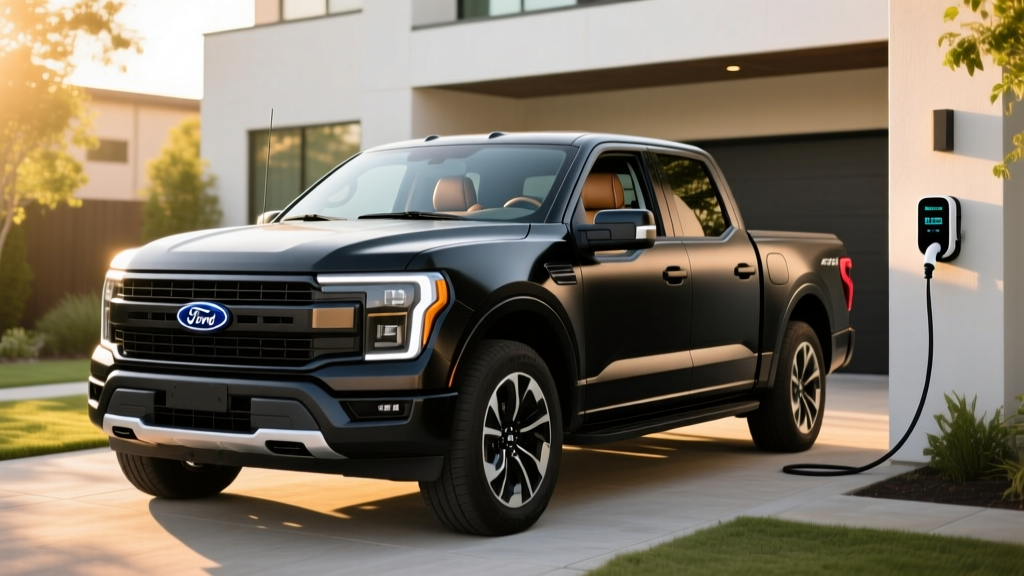
If you're researching the all electric F-150, you're almost certainly looking at the Ford F-150 Lightning. For 2026, the Lightning remains the only mainstream all-electric full-size pickup, and it's a compelling option for buyers who can charge at home, don't regularly tow over 8,000 pounds, and want truck utility without the fuel bill. Base pricing starts around $52,000 before incentives, EPA range runs from 240 to 320 miles depending on battery pack, and home Level 2 charging is a near-requirement for practical ownership. Below, we break down the exact numbers, real-world trade-offs, and whether the Lightning makes financial sense versus the gas F-150 you're cross-shopping.
Quick Verdict: Who Should Buy the All Electric F-150 Lightning?
Buy it if: You have home Level 2 charging access, drive under 250 miles daily, rarely tow over 7,500 lbs, and want to eliminate gas costs while keeping truck capability (frunk, bed, 775 lb payload).
Skip it if: You tow heavy trailers regularly (range drops 40-60%), live in an apartment without charging access, or need the 400+ mile range of a gas tank for remote work sites.
Ford F-150 Lightning: 2026 Specs at a Glance
| Spec | Standard Range | Extended Range |
|---|---|---|
| EPA Range | 240 mi | 320 mi |
| Real-World Range (highway/cold) | ~190-210 mi | ~250-280 mi |
| Battery Capacity (usable) | 98 kWh (LFP) | 131 kWh (NMC) |
| Peak DC Fast Charge | ~150 kW | ~190 kW |
| 10-80% DC Fast Charge | ~38 min | ~41 min |
| Level 2 Home Charge Rate | 11.3 kW | 19.2 kW (with 80A charger) |
| Horsepower | 452 hp | 580 hp |
| 0-60 mph | ~5.0 sec | ~4.0 sec |
| Max Towing | 7,700 lbs | 10,000 lbs |
| Payload | 2,235 lbs | 1,800 lbs |
| Base MSRP (Pro trim) | ~$52,000 | ~$62,000 |
| Battery/Powertrain Warranty | 8 years / 100,000 miles (≥70% capacity retention) | |
The Standard Range pack uses LFP (lithium iron phosphate) chemistry, which trades energy density for longer cycle life and less degradation anxiety—you can charge it to 100% daily without penalty. The Extended Range uses NMC (nickel manganese cobalt), which offers more range but benefits from daily charging limits around 80-90% to preserve long-term health.
Real-World Range: What the EPA Sticker Doesn't Tell You
The EPA's 320-mile figure for the Extended Range is achievable under ideal conditions: mild weather, mixed city/highway driving, and moderate speeds. Real-world testing consistently shows lower numbers:
- Highway driving at 70+ mph: Expect 250-280 miles (Extended Range). Aerodynamic drag hits trucks hard, and the Lightning's boxy profile is no exception.
- Cold weather (below 32°F): Range drops 20-35% depending on severity. A 320-mile truck becomes a 210-250 mile truck in January in Minnesota. The heat pump helps, but battery chemistry is physics.
- Towing a 5,000 lb trailer: Range roughly halves. Plan for 130-160 miles between charges (Extended Range).
If your daily driving stays under 200 miles and you charge at home overnight, the Standard Range's 240 EPA miles is plenty. The Extended Range is worth the $10,000 premium primarily for road-trip flexibility and cold-weather buffer.
Charging the Lightning: Home, Public, and Costs
The all electric F-150 Lightning's practicality hinges on your charging setup. Here's the reality:
| Level | Power | Miles Added/Hour | Use Case |
|---|---|---|---|
| Level 1 (120V outlet) | ~1.4 kW | ~3-4 mi/hr | Emergency/trickle only |
| Level 2 (240V, 32A) | 7.7 kW | ~20 mi/hr | Minimum practical home setup |
| Level 2 (240V, 48A) | 11.5 kW | ~30 mi/hr | Standard Range overnight fill |
| Level 2 (240V, 80A)* | 19.2 kW | ~50 mi/hr | Extended Range overnight fill |
| DC Fast (150-190 kW) | 150-190 kW | ~200-250 mi in 30 min | Road trips |
*80A charging requires the Ford Charge Station Pro and a 100-amp dedicated circuit—many homes need a panel upgrade.
Home charging cost: At the U.S. average electricity rate of $0.16/kWh, fully charging the Extended Range (131 kWh) costs about $21. That's roughly $0.065/mile. Compare that to a gas F-150 at 20 MPG combined and $3.50/gallon gas: $0.175/mile. You're saving ~$0.11/mile on fuel, or about $1,650/year at 15,000 miles.
Public DC fast charging: Networks like Electrify America and EVgo typically charge $0.35-$0.50/kWh. A 10-80% fill on the Extended Range (~85 kWh added) costs $30-$43—comparable to a gas fill-up. Road-trip economics are not a slam-dunk win for EVs; the savings come from home charging.
All Electric F-150 vs Gas F-150: The Numbers
| Factor | F-150 Lightning (Extended Range) | F-150 Gas (2.7L EcoBoost, 4WD) |
|---|---|---|
| Base MSRP | ~$62,000 | ~$42,000 |
| Fed. Tax Credit (§30D) | Up to $7,500* | $0 |
| Effective Price | ~$54,500 | $42,000 |
| Fuel/Energy Cost (15k mi/yr) | ~$975 (home charging) | ~$2,625 (20 MPG, $3.50/gal) |
| Annual Maintenance | ~$300 | ~$800 |
| 5-Year Fuel + Maint. | ~$6,375 | ~$17,125 |
| Range | 320 mi (EPA), ~250 real-world | ~550 mi (26-gal tank) |
| Refuel/Recharge Time | 10-80% in ~41 min (DCFC) | 5 min at gas station |
| Max Towing | 10,000 lbs | ~12,000 lbs |
5-year total cost delta: The Lightning costs ~$12,500 more upfront (after tax credit) but saves ~$10,750 in fuel and maintenance over five years. You're roughly breaking even at year 5-6, assuming home charging. The math improves if gas prices rise or you drive more than 15,000 miles annually.
*The §30D federal tax credit has income caps ($150k single / $300k joint), MSRP caps ($80k for trucks), and battery-sourcing requirements that change annually. Verify eligibility at IRS.gov and confirm the specific VIN qualifies before purchase. The credit can be transferred to the dealer as a point-of-sale discount.
Real-World Ownership Considerations
Home Charging Access Is Non-Negotiable
If you can't install a Level 2 charger at home (or at a dedicated workplace charger), the Lightning becomes a burden. Public DC fast charging is expensive, time-consuming, and unreliable in some regions. Apartment dwellers and street-parkers should seriously consider a PHEV or gas truck instead.
Electrical Panel Upgrades
The 80A Ford Charge Station Pro requires a 100A dedicated circuit. Many homes have 100A or 150A main panels already near capacity. Budget $1,500-$4,000 for a panel upgrade if needed. A licensed electrician should assess your home before purchase.
Towing and Payload Trade-Offs
The Lightning tows up to 10,000 lbs, but towing eviscerates range. If you tow a boat or camper 200 miles one-way, you'll need to DC fast-charge mid-trip (assuming chargers exist on your route). Gas trucks still win for heavy, long-distance towing. For occasional light towing under 5,000 lbs, the Lightning handles it fine.
Insurance Costs
EV insurance runs 15-25% higher than comparable gas vehicles due to repair costs and battery replacement exposure. Budget $200-$400 more annually. Get quotes before committing.
Common Misconceptions About the All Electric F-150
| Myth | Fact |
|---|---|
| "EV batteries need replacing every 5 years" | Ford warrants the battery for 8 years/100,000 miles at ≥70% capacity. Real-world degradation data shows most EV batteries retain 85-90% capacity at 100k miles. |
| "The Lightning can't do truck work" | 775 lb payload (Extended Range) and 10,000 lb towing handle most jobsite and recreational needs. The 400-lb frunk adds lockable, weatherproof storage. |
| "Charging takes forever" | Home Level 2 charging happens while you sleep (8-10 hours for a full charge). Road-trip DC fast charging adds 150-200 miles in 30 minutes—longer than gas, but you're eating or using the restroom anyway. |
| "EVs are worse in cold weather" | Range drops 20-35%, yes. But EVs start instantly in cold (no cranking), and preconditioning while plugged in means you leave with a warm cabin and full battery. |
| "The tax credit is guaranteed" | §30D eligibility depends on your income, the vehicle's MSRP, and battery-sourcing requirements that change yearly. Always verify the specific VIN at IRS.gov or with a tax professional. |
Decision Framework: Should You Buy the All Electric F-150 Lightning?
Choose the Lightning if:
- You have (or can install) Level 2 home charging
- Daily driving is under 200-250 miles
- You tow under 7,500 lbs or only occasionally
- You want to eliminate gas costs and reduce maintenance
- You qualify for the §30D tax credit (or value the instant torque and frunk)
Stick with the gas F-150 if:
- You can't charge at home reliably
- You regularly tow 8,000+ lbs over long distances
- You drive remote routes with sparse DC fast-charging infrastructure
- Upfront cost is a primary concern and you drive under 12,000 miles/year
Consider a PHEV alternative (like the F-150 PowerBoost hybrid) if:
- You want some electric driving but need gas flexibility for towing or remote work
- You can't install home charging yet but may in the future
Frequently Asked Questions
What's the real-world range of the all electric F-150 Lightning?
The Extended Range EPA sticker says 320 miles, but expect 250-280 miles in real-world highway driving, and 210-250 miles in cold weather. Standard Range is 240 EPA, ~190-210 real-world. Towing cuts range roughly in half.
How much does it cost to charge the F-150 Lightning at home?
About $16 for the Standard Range (98 kWh) and $21 for the Extended Range (131 kWh) at the U.S. average rate of $0.16/kWh. That's $0.05-$0.07 per mile, versus $0.17-$0.20 per mile for a gas F-150.
Does the F-150 Lightning qualify for the $7,500 federal tax credit?
It may, but eligibility depends on your income (≤$150k single / $300k joint), the truck's MSRP (≤$80k for trucks), and battery-sourcing requirements that change annually. Verify at IRS.gov or with a tax professional. The credit can be applied as a point-of-sale discount.
How long does the Lightning's battery last?
Ford warrants the battery for 8 years or 100,000 miles, guaranteeing ≥70% capacity retention. Real-world data from similar EVs suggests 85-90% capacity at 100k miles is typical. Replacement cost (if out of warranty) is estimated at $15,000-$25,000, but full replacements are rare.
Can I tow a camper with the F-150 Lightning?
Yes, up to 10,000 lbs (Extended Range). But towing slashes range by 40-60%, so a 320-mile truck becomes a 130-190 mile truck when towing. Plan charging stops carefully and verify DC fast-charger availability on your route.
Do I need to upgrade my electrical panel for home charging?
Maybe. The 80A Ford Charge Station Pro requires a 100A dedicated circuit. If your home has a 100A or 150A main panel near capacity, you'll need an upgrade ($1,500-$4,000). A 48A charger on a 60A circuit is more forgiving. Have a licensed electrician assess your panel before purchase.
Is the Lightning good in snow and cold weather?
Yes, with caveats. Dual-motor AWD provides excellent traction, and the low center of gravity (battery under the floor) helps stability. Range drops 20-35% in cold weather, so plan accordingly. Preconditioning while plugged in mitigates this.
For official EPA range and efficiency data, see fueleconomy.gov. For safety ratings, check NHTSA.gov.