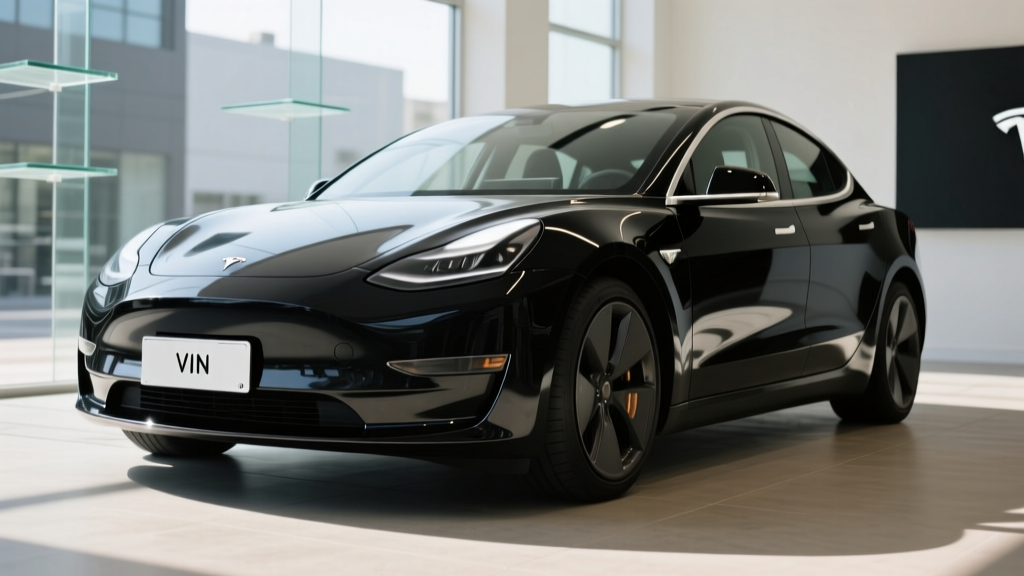
Your Tesla Model 3's 17-character Vehicle Identification Number (VIN) is more than a registration formality — it's a fingerprint that reveals where the car was built, what battery chemistry it carries, and which powertrain configuration left the factory. For buyers evaluating used or new inventory, understanding Tesla Model 3 VIN numbers can be the difference between landing an LFP-equipped Standard Range and accidentally purchasing an older NMC variant with different charging and longevity characteristics.
This guide decodes the Tesla Model 3 VIN structure, then pairs that knowledge with a complete 2026 model-year review covering real-world range, DC fast-charging speed, efficiency, pricing, and federal tax credit eligibility under current IRS §30D rules.
How to Read Tesla Model 3 VIN Numbers
Every road-legal vehicle sold in the United States carries a standardized 17-character VIN. Tesla's Model 3 VIN follows the SAE/NHTSA format but uses Tesla-specific codes in several positions. Here's how to break it down:
| VIN Position | Character(s) | Meaning for Tesla Model 3 |
|---|---|---|
| 1–3 (WMI) | 5YJ | World Manufacturer Identifier — Tesla, Inc. (US-built) |
| 4 (Model) | 3 | Model 3 designation |
| 5 (Body/Trim) | E, S, etc. | Body type and restraint system configuration |
| 6 (Battery/Motor) | Varies | Powertrain and battery pack code (RWD vs AWD, LFP vs NMC) |
| 7 (Safety) | Varies | Occupant protection and airbag configuration |
| 8 (Model Year Code) | Letter | Model year (e.g., S = 2025, T = 2026 per standard encoding) |
| 9 (Check Digit) | 0–9 or X | Calculated validation digit |
| 10 (Model Year) | Letter | Official model year identifier |
| 11 (Plant) | F or C | F = Fremont, CA; C = Gigafactory Shanghai (non-US market) |
| 12–17 | Numeric | Sequential production number |
Why position 6 matters most: This is where Tesla encodes the battery chemistry and drivetrain. A Model 3 RWD with an LFP (lithium iron phosphate) pack will have a different character here than a Long Range AWD with an NMC (nickel manganese cobalt) pack. When shopping used inventory or verifying a new delivery, cross-reference this position with Tesla's build documents or the window sticker.
2026 Tesla Model 3: Range, Battery, and Real-World Efficiency
The 2026 Tesla Model 3 lineup continues with three primary configurations: the RWD base model, the Long Range AWD, and the Performance AWD. Battery chemistry splits along trim lines — the RWD uses an LFP pack while Long Range and Performance variants use NMC chemistry for higher energy density.
| Spec | RWD | Long Range AWD | Performance AWD |
|---|---|---|---|
| EPA Range | 272 mi | 363 mi | 320 mi |
| Battery (usable) | ~57.5 kWh (LFP) | ~75 kWh (NMC) | ~75 kWh (NMC) |
| Drivetrain | Rear-Wheel Drive | Dual-Motor AWD | Dual-Motor AWD |
| Horsepower | 271 hp | 384 hp | 510 hp |
| 0–60 mph | 5.8 sec | 4.2 sec | 2.9 sec |
| Efficiency (MPGe) | 142 MPGe combined | 134 MPGe combined | 121 MPGe combined |
| kWh/100 mi | 24 kWh | 25 kWh | 28 kWh |
Efficiency is where the Model 3 continues to lead the segment. At 24–28 kWh per 100 miles depending on trim, it extracts more miles per kilowatt-hour than nearly every competing electric sedan. This matters directly for your electricity bill: at a national average of $0.16/kWh, the RWD costs roughly $3.84 per 100 miles to fuel at home — about one-third the cost of a 30-MPG gas car at $3.50/gallon.
Charging Speed: DC Fast Charge and Home Level 2
Charging speed is often the deciding factor for road-trip viability. The Model 3's Highland refresh (carried into 2026) improved thermal management, allowing sustained fast-charging rates that outperform most rivals in its price class.
| Charging Level | RWD (LFP) | Long Range / Performance (NMC) | Miles Added per Hour |
|---|---|---|---|
| Level 1 (120V, 12A) | 1.4 kW | 1.4 kW | ~4–5 mi/hr |
| Level 2 (240V, 48A) | 11.5 kW | 11.5 kW | ~38–44 mi/hr |
| DC Fast Charge (peak) | 170 kW | 250 kW | ~180 mi in 15 min (LR) |
| 10–80% DCFC Time | ~28 min | ~22 min | — |
Understanding the charge curve: The 250 kW peak on Long Range/Performance models is not sustained across the entire session. The pack pulls maximum power between roughly 10% and 40% State of Charge (SoC), then tapers progressively. From 80% to 100%, charging slows dramatically to protect cell longevity — expect an additional 25–35 minutes for that final 20%. For road trips, plan to charge from 10% to 80% and skip the top-off unless you're ending the day.
The RWD's LFP pack tops out at 170 kW, but LFP chemistry tolerates regular 100% charging without the degradation concerns that NMC packs face. Tesla recommends charging LFP Model 3s to 100% at least weekly for optimal battery calibration — a practical advantage for commuters who want the full 272 miles available every morning.
All 2026 Model 3 vehicles ship with the NACS (North American Charging Standard) connector natively. This means direct access to Tesla's Supercharger network (20,000+ stalls in North America) without adapters, plus growing compatibility with third-party networks like Electrify America and EVgo that have deployed NACS cables.
Pricing, Trims, and Federal Tax Credit Eligibility
The 2026 Model 3 pricing structure remains aggressive within the premium electric sedan segment, especially after accounting for the federal EV tax credit.
| Trim | Base MSRP | Est. After §30D Credit | Federal Credit Eligible |
|---|---|---|---|
| RWD | $38,990 | ~$31,490 | Yes (up to $7,500) |
| Long Range AWD | $45,990 | ~$38,490 | Yes (up to $7,500) |
| Performance AWD | $52,990 | ~$45,490 | Yes (up to $7,500) |
Federal tax credit rules (IRS §30D) — critical caveats:
- Income caps: Modified adjusted gross income must not exceed $150,000 (single), $225,000 (head of household), or $300,000 (joint filing).
- MSRP cap: Sedars must have an MSRP at or below $55,000. The RWD and Long Range qualify; the Performance may exceed the cap depending on options — verify the final sticker price.
- Battery sourcing: The full $7,500 requires meeting both critical-mineral and battery-component sourcing thresholds set by the IRS. Tesla's US-built packs have largely met these requirements for 2026, but partial credit ($3,750) may apply if one threshold is missed. Check the latest IRS clean vehicle credit page before purchasing.
- Point-of-sale transfer: As of 2024, buyers can transfer the credit to the dealer at purchase, reducing the upfront cost rather than waiting for a tax refund. This option remains available for 2026.
Destination fees ($1,390), paint upgrades ($1,000–$2,500), and FSD Supervised ($8,000 one-time or $99/month) add to the final transaction price. Configure carefully to stay under the $55,000 MSRP cap if targeting the credit on Long Range trims.
Interior, Cargo, and Daily Practicality
The Model 3's minimalist interior continues to polarize — there are virtually no physical buttons, with climate, mirrors, and glovebox controls all routed through the 15.4-inch center touchscreen. The 2026 Highland interior is materially improved over pre-2024 models: ventilated front seats, ambient lighting, a rear-seat touchscreen, and significantly better sound insulation.
| Dimension | Measurement |
|---|---|
| Front Headroom | 40.3 in |
| Front Legroom | 42.7 in |
| Rear Headroom | 37.8 in |
| Rear Legroom | 35.2 in |
| Trunk (rear cargo) | 21.0 cu ft |
| Frunk (front trunk) | 3.1 cu ft |
| Total Cargo Volume | 24.1 cu ft |
Rear-seat space is adequate for adults on shorter trips but tight for anyone over 6 feet on long drives — the floor-mounted battery raises the floor, creating a knees-up seating position. The 21 cu ft trunk is competitive with a BMW 3 Series but smaller than a Hyundai Ioniq 6's 25.3 cu ft. No hatchback or liftgate means loading bulky items requires more maneuvering.
Tech and driver assistance: Every Model 3 includes Tesla's basic Autopilot (lane centering + adaptive cruise) as standard. The optional Full Self-Driving (Supervised) package adds automated lane changes, traffic-light recognition, and city-street navigation — but this remains a SAE Level 2 system. The driver must maintain steering-wheel contact and full attention at all times. FSD Supervised is not autonomous driving.
Warranty, Battery Longevity, and Ownership Costs
Tesla's warranty structure is straightforward but has some limitations compared to Hyundai/Kia's 10-year coverage:
| Coverage | Terms |
|---|---|
| Basic Vehicle | 4 years / 50,000 miles |
| Battery & Drive Unit | 8 years / 100,000 miles (RWD) 8 years / 120,000 miles (LR/Perf) |
| Battery Capacity Threshold | 70% retention over warranty period |
Real-world battery degradation data from Tesla's fleet reports and third-party tracking (including TeslaFi community data) shows most Model 3 packs retain 88–93% capacity after 100,000 miles. LFP packs in RWD models show particularly strong cycle life — many owners report less than 5% degradation after 60,000 miles, attributed to LFP's inherent chemical stability and tolerance for 100% SoC storage.
Out-of-warranty battery replacement remains a significant cost: $12,000–$16,000 for the pack alone depending on chemistry and labor. However, the failure rate within the first 150,000 miles is low based on current fleet data.
Tesla Model 3 vs. Key Competitors: Is It Worth Buying?
Pros
- Class-leading efficiency (24 kWh/100 mi on RWD)
- Native NACS connector — full Supercharger access
- Over-the-air updates continuously add features
- Strong resale value relative to EV segment average
- LFP option with excellent cycle life and 100% SoC tolerance
- 250 kW peak DCFC on Long Range (10–80% in ~22 min)
Cons
- No physical buttons — all controls via touchscreen
- Rear seat space tight for tall adults
- No hatchback — trunk-only cargo loading
- FSD Supervised costs $8,000 extra and remains Level 2
- Ride quality firm on 19" wheels over rough pavement
- Service center wait times can be lengthy in some metro areas
Competitive positioning:
- vs. Hyundai Ioniq 6: The Ioniq 6 offers comparable range (361 mi EPA on Long Range) with an 800V architecture enabling faster 10–80% charging (~18 min at 350 kW). However, it requires a NACS adapter for Supercharger access (standard CCS) and has a smaller charging network advantage. The Ioniq 6 also has a more conventional interior with physical buttons.
- vs. BMW i4: The i4 delivers superior build quality and a more traditional luxury cabin, but at $52,200+ for the eDrive40 (307 mi EPA), it costs significantly more. The i4 uses CCS and charges at up to 200 kW — slower than the Model 3 Long Range.
- vs. Polestar 2: Polestar 2's 2026 refresh offers 320 mi EPA and a more premium interior, but at a higher entry price and with CCS charging limited to 200 kW.
- Choose the Model 3 RWD if: You commute under 50 miles daily, want the lowest entry price with full Supercharger access, and value LFP battery longevity.
- Choose the Model 3 Long Range if: You take regular road trips exceeding 250 miles, need AWD for snow-belt climates, and want the fastest DC charging in the lineup.
- Look at the Ioniq 6 instead if: You prioritize the fastest possible DC charging (800V/350 kW) and prefer physical buttons and a conventional instrument cluster.
- Look at the BMW i4 instead if: Build quality, dealer service infrastructure, and a traditional luxury experience outweigh charging speed and network access.
Who the 2026 Tesla Model 3 Suits Best
The Model 3 is optimized for tech-comfortable commuters and road-trippers who value charging-network access above all else. If you have home Level 2 charging and live within the Supercharger network's coverage (which is nearly universal across the US interstate system as of 2026), the Model 3 delivers the lowest-friction EV ownership experience available.
It is less ideal for families needing easy rear-seat child-seat installation (tight door openings and limited rear legroom), buyers who distrust touchscreen-only interfaces, or those in rural areas far from Supercharger corridors where CCS networks may be more convenient.
For buyers cross-referencing VIN numbers on used inventory: prioritize confirming the battery chemistry (LFP vs NMC) via VIN position 6, as this affects your daily charging routine, long-term degradation expectations, and cold-weather range behavior.
Frequently Asked Questions
What is the real-world range of the 2026 Tesla Model 3?
The EPA rates the Long Range AWD at 363 miles, the Performance at 320 miles, and the RWD at 272 miles. In real-world highway driving at 70–80 mph, expect 290–320 miles from the Long Range, 260–280 from the Performance, and 220–240 from the RWD. In sub-freezing temperatures, subtract 15–20% for NMC trims and 10–12% for the LFP RWD.
How fast does the Model 3 charge at home and on DC fast chargers?
On a 240V/48A home Level 2 charger, all trims add approximately 38–44 miles of range per hour (11.5 kW). On DC fast chargers, the Long Range and Performance peak at 250 kW, reaching 10–80% in roughly 22 minutes. The RWD peaks at 170 kW, with 10–80% taking about 28 minutes. Charging slows significantly above 80% SoC.
How much does the Model 3 cost after the federal tax credit?
The RWD starts at $38,990 MSRP and can drop to approximately $31,490 after the maximum $7,500 §30D credit. The Long Range at $45,990 drops to ~$38,490. The Performance at $52,990 may or may not qualify depending on options pushing it above the $55,000 sedan MSRP cap. Income limits ($150K single / $300K joint) and battery-sourcing requirements apply — verify with the IRS before purchase.
Does the 2026 Tesla Model 3 qualify for the federal EV tax credit?
Yes, all three trims are expected to qualify for up to $7,500 under IRS §30D, provided the buyer meets income limits and the vehicle's MSRP stays at or below $55,000. Battery-component and critical-mineral sourcing thresholds must be met; Tesla's Fremont-built packs have generally satisfied these for 2026. The credit can be transferred to the dealer at point of sale to reduce the purchase price directly.
What can Tesla Model 3 VIN numbers tell me about the battery?
VIN position 6 encodes the powertrain and battery configuration, which distinguishes LFP (RWD) from NMC (Long Range/Performance) packs. Position 11 confirms the build plant (F = Fremont). Cross-reference the VIN with NHTSA's decoder and Tesla's build documentation to confirm chemistry before purchasing used inventory, as LFP and NMC packs have different charging recommendations and degradation profiles.
Is the Tesla Model 3 worth buying over the Hyundai Ioniq 6 or BMW i4?
The Model 3 wins on Supercharger network access, efficiency, and software updates. The Ioniq 6 wins on maximum DC charging speed (800V architecture) and conventional interior controls. The BMW i4 wins on build quality and dealer service. For most buyers prioritizing hassle-free road-trip charging and long-term software support, the Model 3 Long Range remains the segment benchmark in 2026.