When Ford first announced it would electrify America's best-selling pickup, skeptics wondered whether an EV could wear the F-150 badge convincingly. Half a decade later, the 2026 Ford F-150 Lightning has matured into a full-size electric truck that actually delivers on the work-truck promise — while retaining enough of its internal-combustion DNA that even legacy F-150 loyalists (yes, the ones who still remember the 95 Ford F150 bolt pattern by heart: 5×139.7 mm / 5×5.5 inches) are crossing over. This review covers everything you need to know: real-world range, charging curves, tax-credit math, and whether Lightning is the right truck for your driveway.
Quick Verdict: The Electric F-150 That Works
The 2026 Lightning is the most practical full-size electric pickup on the market for buyers who actually use their truck for truck things — towing, hauling, job-site power. It isn't the longest-range EV in its class (that crown goes to the Silverado EV with its 400-mile Max Range pack), but it trades some of that range for a usable bed, a genuine frunk, and Pro Power Onboard that can run a job site or back up your house during an outage. If you've been wrenching on Fords since the '95 F-150 era and know the value of the 5×5.5-inch bolt pattern, Lightning carries that lineage forward with the same 6-lug pattern and plenty of aftermarket wheel support.
Range, Battery & Real-World Expectations
Ford equips the 2026 Lightning with two battery options:
- Standard Range: 101 kWh usable, NMC (nickel-manganese-cobalt) chemistry — EPA-rated 240 miles
- Extended Range: 131 kWh usable, NMC chemistry — EPA-rated 320 miles
For 2026, Ford has not switched the Lightning to LFP chemistry, unlike some competitors. NMC offers higher energy density (critical in a heavy truck) but demands more careful state-of-charge management for longevity — Ford recommends daily charging to 80% unless you're prepping for a road trip.
EPA Sticker: 320 miles (Extended Range) / 240 miles (Standard Range)
Real-world highway (70 mph, 75°F): ~265–280 miles — expect roughly 12–15% below EPA at sustained interstate speeds, typical for a 6,500-lb aerodynamic brick.
Cold weather (30°F, highway): ~210–230 miles — the battery's thermal management helps, but resistive cabin heat and cold-cell chemistry still bite hard on a big pack.
Towing (5,000-lb trailer, mixed driving): ~140–170 miles — towing halves range. Plan charging stops accordingly.
| Spec | Standard Range | Extended Range |
|---|---|---|
| EPA Range | 240 mi | 320 mi |
| Battery (usable) | 101 kWh (NMC) | 131 kWh (NMC) |
| Peak DC Fast Charge | 150 kW | 190 kW |
| 10–80% DC Time | ~44 min | ~41 min |
| Level 2 Home Rate | 11.5 kW (32 mi/hr) | 19.2 kW (52 mi/hr) w/ 80A charger |
| Horsepower | 452 hp | 563 hp |
| Torque | 775 lb-ft | 775 lb-ft |
| 0–60 mph | ~5.0 sec | ~4.5 sec |
| Drivetrain | Dual-motor AWD | Dual-motor AWD |
| Max Towing | 7,700 lb | 10,000 lb (Max Tow Pkg) |
| Payload | 2,235 lb | 1,952 lb |
| MPGe (combined) | 68 MPGe | 70 MPGe |
| Efficiency | 49 kWh/100mi | 48 kWh/100mi |
Charging: DC Fast, Home Level 2 & The 95 F150 Bolt Pattern Note
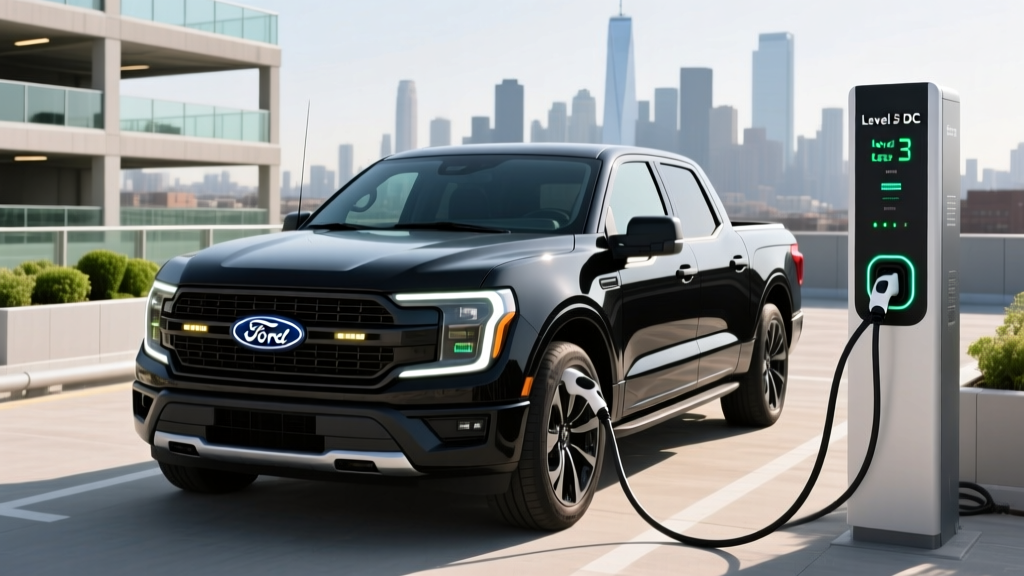
Charging is where Lightning shows both its strengths and its compromises versus newer architectures (Rivian R1T and Silverado EV both push closer to 350 kW peaks).
| Level | Power | Miles Added / Hour | Notes |
|---|---|---|---|
| Level 1 (120V) | 1.4 kW | ~2–3 mi/hr | Emergency trickle only |
| Level 2 (240V, 32A) | 7.7 kW | ~21 mi/hr | Included Mobile Charger |
| Level 2 (240V, 48A) | 11.5 kW | ~32 mi/hr | Standard wall connector |
| Level 2 (240V, 80A) | 19.2 kW | ~52 mi/hr | Requires 100A circuit + extended-range onboard charger |
| DC Fast Charge | 150–190 kW peak | — | 10–80% in ~41–44 min; tapers sharply above 80% |
Charging curve reality: Lightning's peak rate holds only between roughly 15% and 40% SoC. After 60%, the curve tapers noticeably, and above 80% you're watching single-digit kW. On a road trip, plan 25–30 minute stops to 80%, not full fills. The truck uses a NACS port natively, so Tesla Superchargers are plug-and-play — a big advantage over CCS-only trucks.
On the wheel-and-tire side, the 2026 Lightning retains the classic 95 Ford F150 bolt pattern lineage: 6-lug, 6×139.7 mm (6×5.5 inches). This is not the same as the 1995 truck's 5-lug 5×5.5 pattern — Ford moved the F-150 to 6-lug in the late '90s — but the modern Lightning's 6-lug spec still opens up a massive aftermarket wheel catalog shared with current F-150 trims.
Performance, Drivetrain & What 775 lb-ft Feels Like
Every 2026 Lightning is dual-motor all-wheel drive. Even the base Standard Range model puts out 452 hp and 775 lb-ft of instant torque, and the Extended Range bumps that to 563 hp. The 0–60 run in 4.5 seconds feels surreal in a truck that weighs 6,500+ pounds — stomp the throttle from a stoplight and the Lightning squats and launches with a sports-sedan urgency that never stops being funny.
Where the performance story gets more interesting is Pro Power Onboard. Available in 2.4 kW or 9.6 kW output, the latter can run circular saws, welders, air compressors, or — via the available Intelligent Backup Power system and Ford Charge Station Pro — feed your entire house during a grid outage. This is the Lightning's killer app for tradespeople and rural owners. A fully charged Extended Range pack can power an average home for roughly three days.
Handling is competent for a solid-rear-axle truck (yes, it's still a live axle, unlike the independent rear on the gas F-150), but the low center of gravity from the underfloor battery keeps body roll surprisingly tame. Ride quality is firm unladen but improves markedly with a few hundred pounds in the bed.
Pricing, Trims & Federal Tax Credit Eligibility
The 2026 Lightning lineup spans four trims. Pricing below reflects base MSRP before destination:
| Trim | Battery | MSRP | Est. §30D Credit | Effective Price |
|---|---|---|---|---|
| Pro | Standard Range | $54,995 | Up to $7,500* | ~$47,495 |
| XLT | Standard / Extended | $62,995 | Up to $7,500* | ~$55,495 |
| Lariat | Extended Range | $72,995 | Up to $7,500* | ~$65,495 |
| Platinum | Extended Range | $87,995 | Up to $7,500* | ~$80,495 |
*§30D Tax Credit Reality Check (2026 rules): The federal EV tax credit under IRS §30D offers up to $7,500, but eligibility depends on three gating rules:
- MSRP cap: Trucks/vans/SUVs must be ≤ $80,000 MSRP. This rules out the Platinum trim; Pro, XLT, and Lariat qualify on price.
- Buyer income cap: MAGI ≤ $150,000 (single), $225,000 (head of household), $300,000 (joint).
- Battery sourcing: Critical minerals and battery components must meet escalating domestic/free-trade-partner thresholds. Ford has been transparent that Lightning packs use a mix of North American and allied-source materials, but exact eligibility shifts by build date — confirm the VIN on the IRS portal before purchase.
The credit is now transferable at point of sale as a discount, so you don't need to wait until tax filing. Always verify with your tax professional and the fueleconomy.gov tax credit tool for the specific VIN.
Cargo, Passenger Space & The Mega Power Frunk
Lightning keeps the 5.5-foot or 6.5-foot bed (depending on cab config) with payload ratings up to 2,235 lb on Standard Range Pro models. But the real cargo story is the Mega Power Frunk — a 14.1-cubic-foot lockable, drainable, weatherproof front trunk that replaces the engine bay. It's genuinely the most useful storage space on any pickup: groceries, tools, muddy gear, or a cooler for tailgating, all with power outlets (120V and USB) inside.
Interior passenger space is unchanged from the gas SuperCrew:
- Front legroom: 43.9 in
- Rear legroom: 43.6 in
- Rear headroom: 40.4 in
- Behind-rear-seat storage: 52.8 cu ft (with seats folded)
The SYNC 4A infotainment system runs on a 12-inch touchscreen (15.5-inch portrait screen on Lariat and Platinum) with wireless CarPlay/Android Auto, over-the-air updates, and a configurable digital cluster. BlueCruise hands-free driving (an SAE Level 2 system — driver supervision required) is available on divided highways and continues to improve in 2026 with lane-change assist and better curve handling.
Warranty & Long-Term Ownership
Ford's EV warranty package is competitive with the segment:
- Battery & Electric Components: 8 years / 100,000 miles (whichever comes first), with a capacity-retention threshold of 70% — if the pack degrades below 70% within the warranty window, Ford will repair or replace it.
- Powertrain (motors, inverters): 8 years / 100,000 miles
- Bumper-to-Bumper: 3 years / 36,000 miles
- Rust-Through: 5 years / unlimited miles
For long-term ownership, the NMC chemistry means you'll want to follow the 80% daily charge rule and avoid extended periods at 100% SoC. Real-world degradation data from 2022–2024 Lightnings suggests roughly 5–8% capacity loss over the first 60,000 miles, which is typical for liquid-cooled NMC packs.
Pros, Cons & Who Should Buy
- Pro Power Onboard (9.6 kW) is unmatched job-site/home-backup utility
- Mega Power Frunk is genuinely transformational for daily use
- NACS port = native Tesla Supercharger access
- Competitive towing (10,000 lb) with integrated Pro Trailer Hitch Assist
- Strong real-world acceleration and confident AWD traction
- 6-lug bolt pattern opens wide aftermarket wheel options
- DC fast charging peaks at 190 kW — slower than Rivian R1T and Silverado EV
- Towing range drops sharply; ~150 mi realistic with a heavy trailer
- Platinum trim exceeds §30D MSRP cap
- Live rear axle rides firm when empty
- Extended Range battery adds ~400 lb, eating into payload
- No LFP option yet for buyers who prefer daily 100% charging
Who it's best for: Tradespeople who need on-site power, suburban families who want a truck that doubles as a commuter (with home Level 2 charging), rural homeowners who value Intelligent Backup Power for outages, and F-150 loyalists ready to go electric without giving up the bed, the frunk, or the familiar driving position.
Who should look elsewhere: Long-distance tower who regularly hauls 8,000+ lb trailers over 200-mile stretches (Silverado EV's 400-mile pack is a better fit), or buyers who prioritize the fastest possible DC charging (Rivian R1T Dual-Motor peaks closer to 220+ kW).
Frequently Asked Questions
What is the real-world range of the 2026 Ford F-150 Lightning?
The Extended Range is EPA-rated at 320 miles, but expect roughly 265–280 miles on highway trips at 70 mph, and as low as 210–230 miles in cold weather. Towing a 5,000-lb trailer cuts that to about 140–170 miles. The Standard Range model delivers ~200 real-world highway miles.
How fast does the Lightning charge at home and on the road?
At home on a 48A Level 2 charger, you'll add about 32 miles per hour (~11 hours for a full Standard Range charge, ~13 hours for Extended Range). With the available 80A Ford Charge Station Pro, that jumps to ~52 mi/hr. On DC fast chargers, the Extended Range peaks at 190 kW and reaches 10–80% in about 41 minutes, though the curve tapers sharply above 80% SoC.
Does the 2026 Lightning qualify for the federal EV tax credit?
The Pro, XLT, and Lariat trims (MSRP ≤ $80,000) qualify on the vehicle-price side of §30D. The Platinum exceeds the cap. Buyer income must be ≤ $300,000 (joint) / $150,000 (single), and battery sourcing must meet 2026 critical-mineral and component thresholds — confirm by VIN on the IRS portal before buying. The credit can now be transferred at point of sale.
Is the Lightning worth buying versus the Silverado EV or Rivian R1T?
Yes, if you value Pro Power Onboard, the Mega Power Frunk, native NACS/Supercharger access, and a traditional pickup bed layout. Choose the Silverado EV if maximum range (400 mi) is your priority, or the Rivian R1T if you want a more car-like independent rear suspension, faster DC charging, and a quad-motor option. The Lightning wins on job-site utility and mainstream serviceability.
What is the bolt pattern on the 2026 F-150 Lightning, and does it match the 1995 F-150?
The 2026 Lightning uses a 6-lug, 6×139.7 mm (6×5.5-inch) bolt pattern, shared with the current F-150 lineup. The 1995 F-150 used a 5-lug, 5×139.7 mm (5×5.5-inch) pattern — so wheels are not cross-compatible, but the Lightning's 6-lug spec has enormous aftermarket support.
How much can the 2026 Lightning tow?
Up to 10,000 lb on Extended Range models with the Max Trailer Tow Package. Standard Range models are rated for 7,700 lb. Plan for roughly 50% range reduction under heavy towing loads.
What's the battery warranty?
8 years / 100,000 miles with a 70% capacity-retention threshold. If the pack falls below that benchmark within the warranty period, Ford covers repair or replacement.
Sources: fueleconomy.gov, IRS §30D guidance, Ford Motor Company 2026 F-150 Lightning specifications.