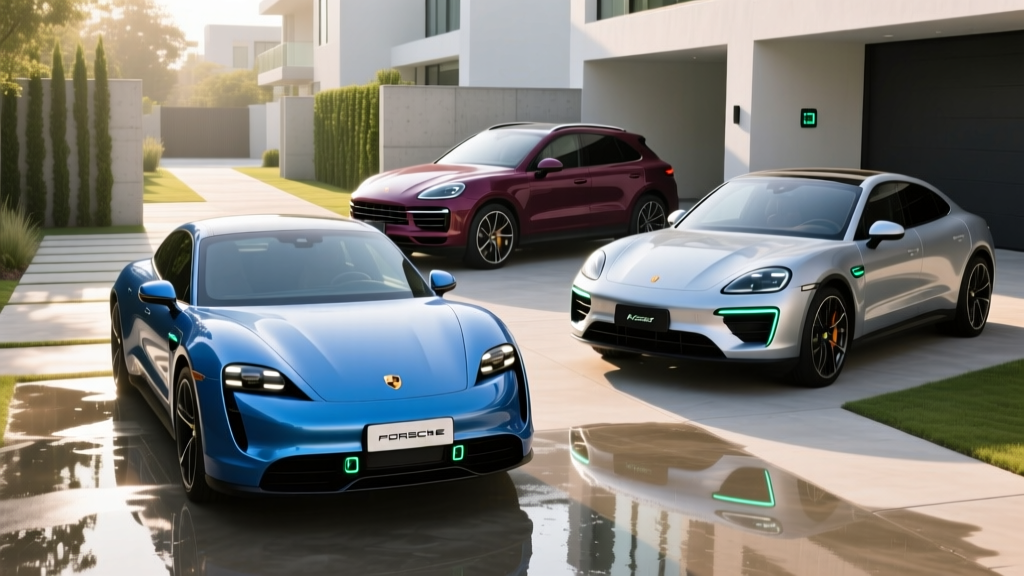
If you're researching a Porsche EV in 2026, you're choosing among three core models: the Taycan (sedan/wagon, EPA up to 318 miles, starting ~$92,000), the Macan Electric (compact SUV, EPA up to 308 miles, starting ~$78,000), and the newly arriving Cayenne EV (midsize SUV, preliminary EPA ~310 miles, starting ~$85,000). All three use 800-volt architectures for class-leading DC fast charging (peak 270–350 kW), but none qualify for the $7,500 federal §30D tax credit due to MSRP caps and battery-sourcing rules. Real-world highway range typically lands 15–25% below EPA stickers, and insurance premiums run 20–35% higher than equivalent gas Porsches.
Quick Verdict: Which Porsche EV Fits You?
Taycan: Best for driving dynamics and daily commuting. Choose the Sport Turismo (wagon) for cargo. Fastest-charging sedan in its class.
Macan Electric: Best for buyers who want Porsche performance in a practical crossover footprint. Lower entry price.
Cayenne EV (announced): Best for families needing three-row-adjacent space and towing. Preliminary specs; deliveries expected late 2026.
The 2026 Porsche EV Lineup at a Glance
Porsche has committed fully to electrification across its core lineup. Here's how the three models stack up on the numbers that matter most to buyers:
| Spec | 2026 Taycan (Base RWD) | 2026 Macan 4 Electric | 2026 Cayenne EV (Prelim.) |
|---|---|---|---|
| EPA Range | 318 mi | 308 mi | ~310 mi (est.) |
| Battery (usable) | 97.0 kWh (NMC) | 95.0 kWh (NMC) | ~100 kWh (NMC) |
| Horsepower | 402 hp | 402 hp | ~440 hp (est.) |
| 0–60 mph | 4.5 sec | 4.9 sec | ~4.7 sec (est.) |
| Peak DC Charge Rate | 320 kW | 270 kW | ~350 kW (est.) |
| 10–80% DC Fast Charge | ~18 min | ~21 min | ~17 min (est.) |
| Level 2 (AC) Rate | 19.2 kW | 11 kW (22 kW optional) | ~19.2 kW |
| MPGe (Combined) | 83 MPGe | 87 MPGe | TBD |
| Base MSRP | $92,000 | $78,800 | ~$85,000 (est.) |
| Battery Warranty | 8 yr / 100,000 mi | 8 yr / 100,000 mi | 8 yr / 100,000 mi |
Sources: EPA / fueleconomy.gov, Porsche USA. Cayenne EV specs are preliminary and subject to change.
Real-World Range Reality Check
EPA sticker vs. what you'll actually see: The Taycan's 318-mile EPA rating is among the best Porsche has ever achieved, but real-world testing on 70-mph highway loops consistently yields 245–270 miles in moderate temperatures. In sub-30°F winter conditions, expect 200–230 miles. The Macan Electric tracks similarly: ~240–265 miles highway in fair weather, dropping to ~210 in deep cold. Porsche's thermal management system is excellent, but physics still wins in winter. Always plan road trips around 200-mile charging intervals to preserve a safety buffer.
Charging Speed: Porsche's 800V Advantage
Porsche was an early adopter of 800-volt battery architecture (debuted on the original Taycan in 2020), and this remains a tangible advantage at DC fast chargers. Here's what that means in practice:
| Charging Level | Power (kW) | Miles of Range Added per Hour | Typical Use Case |
|---|---|---|---|
| Level 1 (120V household) | ~1.4 kW | ~3–4 mi/hr | Emergency / overnight trickle |
| Level 2 (240V home) | 11–19.2 kW | ~28–55 mi/hr | Daily home charging |
| DC Fast (public) | 270–320 kW peak | ~800+ mi/hr (peak) | Road trips, 10–80% in 18–21 min |
Charging curve reality: The Taycan peaks at 320 kW only between roughly 10–40% state of charge (SoC). From 40–80%, the rate tapers to 150–200 kW. The 10–80% time of ~18 minutes assumes a CCS or NACS station capable of 350 kW and proper battery preconditioning (which Porsche initiates automatically when you navigate to a charger). At older 50–150 kW stations, expect 30–45 minutes for the same 10–80% session.
Home charging setup: With the Taycan's optional 19.2 kW onboard charger, a full charge from 10% to 100% takes roughly 5 hours on a properly wired 80-amp circuit (240V). The Macan Electric's standard 11 kW charger needs about 9 hours — fine for overnight, but consider the 22 kW upgrade ($1,200+) if your electrical panel supports it. Most buyers will need a licensed electrician to install a NEMA 14-50 outlet or hardwired wall connector; expect $800–$2,500 for installation depending on panel proximity and local permit requirements.
Porsche EV vs. Gas Porsche: The Cost Breakdown
Let's compare a 2026 Taycan (base RWD, $92,000) against a gas-powered 2026 Porsche Panamera (base, ~$102,000) over five years and 75,000 miles. This is where EV ownership economics either shine or sting, depending on your situation.
| Cost Category (5 yr / 75k mi) | Taycan EV | Panamera (Gas) |
|---|---|---|
| Purchase Price (MSRP) | $92,000 | $102,000 |
| Federal Tax Credit (§30D) | $0 (exceeds MSRP cap) | $0 |
| Fuel / Electricity | $4,200 (home L2 at $0.14/kWh avg.) | $10,500 (premium at $4.20/gal, 22 mpg) |
| Maintenance | $2,800 (no oil, fewer brake pads) | $5,500 (oil, filters, brakes, spark plugs) |
| Insurance (avg.) | $18,500 ($3,700/yr) | $14,000 ($2,800/yr) |
| Estimated Depreciation | $42,000 | $38,000 |
| 5-Year Total Cost | ~$159,500 | ~$170,000 |
Key takeaways:
- Fuel savings are real: ~$6,300 less over 5 years if you charge primarily at home. Public DC fast charging at $0.40–$0.60/kWh erodes this advantage significantly.
- Insurance costs more: EV-specific insurance premiums run 20–35% higher for Porsches due to repair costs and battery replacement risk. Get quotes before buying.
- Depreciation is steeper: Porsche EVs have depreciated faster than their gas counterparts in recent years. A 3-year-old Taycan may retain 45–50% of value vs. 55–60% for a Panamera.
- Maintenance is cheaper: No oil changes, fewer brake pad replacements (regen braking does most of the work), and no transmission fluid. Budget for cabin air filters, wiper fluid, tire rotations, and brake fluid flushes only.
Federal Tax Credit: Why Porsche EVs Don't Qualify
This is the most common misconception among Porsche EV shoppers. Under current IRS §30D rules, no new Porsche EV qualifies for the $7,500 federal tax credit. Here's why:
§30D Credit Requirements (2026)
- MSRP Cap: Sedans must be under $55,000; SUVs/pickups under $80,000. The Taycan ($92,000+) exceeds the sedan cap. The Macan Electric ($78,800 base) technically fits the SUV cap, but higher trims push past $80,000.
- Buyer Income Cap: AGI ≤ $150,000 (single) / $300,000 (joint). Many Porsche buyers exceed this.
- Battery Sourcing: Critical minerals and battery components must meet escalating domestic/free-trade-agreement thresholds. Porsche's supply chain (largely European and Asian) has not consistently met these thresholds.
- Point-of-Sale Transfer: Available for qualifying vehicles — but moot if the vehicle itself doesn't qualify.
The Macan Electric base trim ($78,800) is the closest to eligibility on price alone, but battery-sourcing rules remain the primary blocker. Always check the latest IRS qualified vehicle list before assuming credit eligibility.
Common Porsche EV Misconceptions — Corrected
| Myth | Fact |
|---|---|
| "The Taycan gets its full EPA range on the highway." | Expect 245–270 miles at 70 mph in moderate temps. The EPA test cycle includes significant city/regen driving that boosts the number. |
| "I can charge to 100% at a DC fast charger in 20 minutes." | DC fast charging peaks at 10–40% SoC and tapers sharply above 80%. Plan for 10–80% in ~18 min; 80–100% adds another 20–30 min. Charge to 80% on road trips and move on. |
| "The battery will need replacing in 5 years." | Porsche warranties the battery for 8 years/100,000 miles against dropping below 70% capacity. Real-world degradation data from 2020–2024 Taycans shows ~5–8% loss at 60,000 miles. Replacement, if ever needed out of warranty, runs $20,000–$30,000. |
| "Porsche EVs are self-driving with InnoDrive." | Porsche InnoDrive is a SAE Level 2 system — it handles adaptive cruise and lane centering on highways, but you must keep your hands on the wheel and eyes on the road at all times. It is not autonomous. |
| "Any home outlet will charge my Porsche EV overnight." | A standard 120V outlet adds ~3–4 miles per hour — roughly 36–48 miles over 12 hours. That works only if your daily driving is under 40 miles. A Level 2 (240V) home charger is strongly recommended. |
SAE Automation Level: Porsche InnoDrive
Level 2 — Driver Assistance, NOT Self-Driving. Porsche InnoDrive with Active Lane Keeping can manage speed, following distance, and steering on marked highways. However, the driver must remain fully engaged. This is the same SAE level as Tesla Autopilot, Ford BlueCruise, and GM Super Cruise. Porsche does not currently offer any Level 3 or Level 4 system on production vehicles.
Real-World Ownership: What First-Time Porsche EV Buyers Must Know
Home charging is nearly essential. Public DC fast charging a Taycan or Macan Electric exclusively will cost $0.35–$0.60/kWh at Electrify America or EVgo stations — translating to $0.12–$0.18 per mile, which erases most of the fuel-cost advantage over gas. Home Level 2 charging at the national average of $0.14/kWh drops that to ~$0.04–$0.05 per mile. If you cannot install a home charger (apartment, condo, street parking), factor in 2–3x higher fueling costs and the time burden of public charging.
Cold-weather range loss is real. Lithium-ion batteries lose efficiency in cold temperatures, and cabin heating draws significant energy. Expect 20–30% range reduction below 30°F. Porsche's heat pump (standard on most 2026 trims) mitigates this somewhat but doesn't eliminate it. If you live in the upper Midwest or Northeast, plan around 200 miles of usable winter range.
Tires wear faster. EVs are heavier (the Taycan weighs ~4,700 lbs) and deliver instant torque. Expect tire replacement every 25,000–35,000 miles vs. 40,000–50,000 on a gas sedan. Budget $1,200–$2,000 per set for Porsche-spec rubber.
Service network is limited. Porsche has ~190 dealerships in the US. If you're more than 60 miles from one, EV-specific service (high-voltage diagnostics, battery module replacement) becomes a logistical challenge. Independent EV shops are growing but remain scarce for Porsche-specific work.
Decision Framework: Should You Buy a Porsche EV?
Choose a Porsche EV If:
- You have home Level 2 charging access (garage or driveway with 240V capability)
- Your daily commute is under 150 miles round-trip
- You value driving dynamics and want a performance EV that handles like a Porsche
- You're prepared for $3,500+ annual insurance premiums
- You can absorb steeper depreciation without needing to maximize resale value
- You understand the federal tax credit won't apply
Consider a Gas Porsche or Competitor EV If:
- You live in an apartment/condo without charging access and rely on public infrastructure
- You regularly drive 300+ miles in a single day in cold weather
- You want to minimize total cost of ownership — a BMW i5 or Mercedes EQE offers similar luxury at lower insurance and depreciation
- You need the federal tax credit to make the math work — look at sub-$55,000 sedans or sub-$80,000 SUVs from brands with qualifying supply chains
- You're in a region with sparse DC fast charging infrastructure (rural Mountain West, parts of the South)
Frequently Asked Questions
Does any Porsche EV qualify for the $7,500 federal tax credit?
No. As of 2026, no Porsche EV meets the combined MSRP cap, battery-sourcing, and buyer-income requirements under IRS §30D. The Macan Electric base MSRP fits the SUV cap, but battery component sourcing disqualifies it. Check the IRS qualified vehicle list for updates, as sourcing rules can shift.
How long does it take to charge a Porsche Taycan at home?
With the optional 19.2 kW onboard charger and a hardwired Level 2 station on an 80-amp circuit, a 10–100% charge takes about 5 hours. With the standard 11 kW charger, expect ~9 hours. Both easily refill overnight.
What is the real-world highway range of the Macan Electric?
The EPA rates the 2026 Macan 4 Electric at 308 miles. Real-world highway driving at 70 mph in moderate temperatures yields approximately 240–265 miles. In winter (below 30°F), expect 200–220 miles.
Is the Porsche Cayenne EV available to order now?
The Cayenne EV has been officially announced with expected deliveries in late 2026. Specs are preliminary (~310 miles EPA, ~100 kWh battery, ~350 kW peak charging). Porsche has not opened final orders as of early 2026. Check Porsche USA for the latest availability.
How much does it cost to replace a Porsche EV battery?
Out-of-warranty battery replacement for a Taycan is estimated at $20,000–$30,000 depending on the module configuration. However, Porsche's 8-year/100,000-mile battery warranty covers capacity loss below 70%, and real-world data from early Taycans shows degradation of only 5–8% at 60,000 miles. Most owners will never need a full replacement.
Can I use Tesla Superchargers with a Porsche EV?
Yes, with an adapter. Porsche EVs sold in 2026 use the NACS (North American Charging Standard) connector natively or come with a CCS-to-NACS adapter. Tesla has opened its Supercharger network to non-Tesla EVs at many locations via the Tesla app. Charge speeds on Superchargers are typically limited to 150–250 kW depending on the station, below Porsche's peak capability.
Is Porsche InnoDrive self-driving?
No. InnoDrive is an SAE Level 2 driver-assistance system. It manages adaptive cruise control and lane centering on highways but requires the driver to remain fully attentive with hands on the wheel. It does not handle city streets, construction zones, or unmapped roads autonomously.