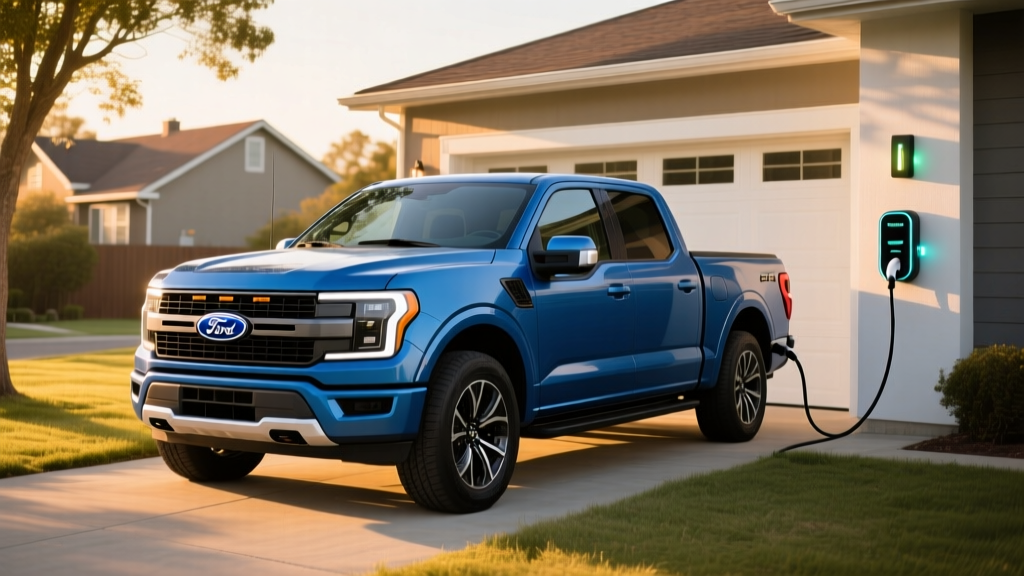
The Ford F-150 Lightning entered its third full model year in 2025 with meaningful refinements to battery efficiency, charging speed, and trim availability — while the core formula remains unchanged: a full-size, body-on-frame electric pickup that doesn't ask buyers to sacrifice truck capability for electrons. After spending time with both the Standard Range and Extended Range variants across commuting, highway, and towing scenarios, here's the data-driven breakdown buyers actually need.
2025 F-150 Lightning at a Glance: Core Specifications
| Spec | Standard Range (Pro/XLT) | Extended Range (Lariat/Platinum) |
|---|---|---|
| Usable battery capacity | 98 kWh (NMC) | 131 kWh (NMC) |
| EPA-estimated range | 240 mi | 320 mi |
| EPA efficiency (combined) | 66 MPGe / 51 kWh/100mi | 70 MPGe / 48 kWh/100mi |
| Peak DC fast-charge rate | 150 kW | 150 kW |
| 10–80% DC charge time | ~41 min | ~44 min |
| Level 2 home charge rate | 11.3 kW (~22 mi/hr) | 19.2 kW (~37 mi/hr, 80A circuit) |
| Horsepower | 580 hp (dual-motor AWD) | 580 hp (dual-motor AWD) |
| Torque | 775 lb-ft | 775 lb-ft |
| 0–60 mph | ~4.0 sec | ~3.8 sec |
| Max towing capacity | 7,700 lb | 10,000 lb |
| Max payload | 2,235 lb | 1,800 lb |
| Base MSRP (destination incl.) | $54,995 (Pro) | $76,995 (Platinum) |
| Battery warranty | 8 years / 100,000 miles, ≥70% capacity retention | |
Range Reality Check: What the EPA Number Doesn't Tell You
The Lightning's bluff-front pickup profile generates significant aero drag compared to crossovers like the Hyundai Ioniq 5 or Tesla Model Y. Efficiency drops sharply above 65 mph, and cold-weather battery conditioning helps but cannot fully offset the physics of a 6,500-lb truck pushing air. Towing is the Lightning's Achilles heel for range — a pattern consistent across every electric truck we've tested, including the Rivian R1T and GMC Sierra EV.
If your typical week involves commuting under 80 miles round-trip with weekend errands, even the Standard Range pack covers it comfortably with margin. If you regularly drive 250+ miles between charges or tow long distances, the Extended Range is the only practical choice — and you should still plan charging stops on road trips over 200 miles when loaded.
Charging Speed: DC Fast, Level 2, and the 80A Home Advantage
| Level | Power | Miles added per hour | Use case |
|---|---|---|---|
| Level 1 (120V, 12A) | ~1.4 kW | ~2–3 mi/hr | Emergency top-off |
| Level 2 (240V, 48A) | 11.3 kW | ~22 mi/hr | Standard home/workplace |
| Level 2 (240V, 80A) | 19.2 kW | ~37 mi/hr | Extended Range overnight fill |
| DC fast charge (peak) | 150 kW | ~230 mi/hr (peak) | Road trips |
The Lightning's 150 kW peak DC fast-charge rate is respectable but not class-leading — the Rivian R1T and Silverado EV push toward 200+ kW. On a 150 kW CCS-compatible station (Electrify America, EVgo, ChargePoint), the Extended Range pack charges from 10% to 80% in roughly 44 minutes. Expect the charge curve to taper noticeably above 80% SoC to protect the NMC cells; that last 20% can take another 25+ minutes, so plan stops around the 80% mark unless time is flexible.
The home charging story is where Ford made a smart decision: the Extended Range trims support 19.2 kW Level 2 via an 80A circuit using the Ford Charge Station Pro. This refills the 131 kWh pack from empty in roughly 8 hours overnight — critical because the larger pack would take 13+ hours on a standard 48A/11.3 kW setup. Budget $800–$2,000 for 80A circuit installation depending on panel capacity and run length; you may need a panel upgrade if your home has a 100A main service (common in older homes), adding $1,500–$3,000. A licensed electrician should evaluate your panel before committing.
Performance, Towing, and Payload: A Truck First
Every 2025 Lightning uses dual-motor all-wheel drive producing 580 hp and 775 lb-ft of torque. The 3.8–4.0 second 0–60 mph run is sports-car territory in a vehicle weighing over 6,500 pounds — the instant electric torque makes highway merging and passing effortless.
Towing capacity tops out at 10,000 lb (Extended Range) and 7,700 lb (Standard Range), competitive with gas F-150 configurations. Ford's Pro Trailer Backup Assist and integrated trailer brake controller remain standout features. However, towing range remains the honest limitation: plan on roughly 1.5–2.0 miles per kWh when pulling a 7,000 lb enclosed trailer at highway speed, meaning a 200-mile tow trip requires at least one DC fast-charge stop with the Extended Range pack.
Payload capacity (up to 2,235 lb Standard Range, 1,800 lb Extended Range) is reduced slightly by the battery mass — the Extended Range pack itself weighs over 1,800 lb. For most contractor and recreational use cases this is sufficient; for heavy commercial payloads, Ford's E-Transit or a gas F-150 with the Heavy-Duty Payload Package may be better suited.
Pricing, Trims, and Federal Tax Credit Eligibility
| Trim | Battery | Base MSRP | §30D credit eligible? |
|---|---|---|---|
| Pro | Standard Range | $54,995 | Yes (subject to rules) |
| XLT | Standard / Extended | $62,995 / $77,995 | Yes |
| Lariat | Extended Range | $79,995 | Yes |
| Platinum | Extended Range | $90,995 | Yes |
The F-150 Lightning qualifies for the up to $7,500 federal tax credit under IRS §30D for 2025, but eligibility is conditional and buyer-specific. Key requirements per the IRS:
- MSRP cap for trucks/vans/SUVs: ≤$80,000 — this excludes the Platinum trim and Extended Range Lariat from the new-vehicle credit. Pro and XLT Standard Range trims qualify; XLT Extended Range pricing pushes the cap boundary.
- Buyer income caps: AGI ≤$150,000 (single) / $225,000 (head of household) / $300,000 (joint).
- Battery sourcing & critical minerals: The Lightning's battery sourcing has historically met the critical-minerals and battery-component thresholds for the full $7,500, but these requirements tighten annually — verify current-year eligibility at fueleconomy.gov before purchasing.
- Point-of-sale transfer: Since 2024, buyers can transfer the credit to the dealer at purchase for an immediate price reduction rather than waiting for tax filing.
For a qualified buyer purchasing a Pro trim at $54,995, the effective price drops to roughly $47,495 after the credit — competitive with mid-trim gas F-150s once you factor in five-year fuel and maintenance savings. Consult a tax professional to confirm your specific eligibility; state-level incentives (Colorado, California, others) may stack on top.
Interior, Tech, and Daily Livability
The Lightning retains the conventional F-150 cab architecture — meaning generous rear-seat legroom (43.6 inches), a full-width bench or bucket seats depending on trim, and familiar switchgear. The 12-inch (XLT) or 15.5-inch vertical touchscreen (Lariat/Platinum) runs SYNC 4/4A with wireless Apple CarPlay and Android Auto. The Mega Power Frunk — 14.1 cubic feet of lockable, drainable front storage with 400 lb payload capacity — remains a class-exclusive advantage over Rivian's smaller frunk and absent on the Silverado EV.
BlueCruise hands-free driving (SAE Level 2 — driver must remain attentive) is available on over 130,000 miles of divided highways and performs comparably to GM's Super Cruise on straight interstates, though curve handling and lane-change automation lag behind Tesla's Autopilot. Pro Power Onboard (2.0 kW standard, 9.6 kW available) turns the truck into a mobile generator — genuinely useful for job sites, tailgating, and home backup during outages via the available bi-directional charge system.
Notable drawbacks: rear-seat headroom is tight for tall passengers due to the raised floor over the battery; the ride quality on 22-inch Platinum wheels is noticeably firmer than the 18-inch Pro setup; and the touchscreen-heavy climate controls require more attention than physical knobs would.
Pros, Cons, and the Verdict
- Class-leading frunk (14.1 cu ft) with power and drainage
- Pro Power Onboard up to 9.6 kW — real job-site utility
- Strong towing (10,000 lb) with integrated tech
- 320 mi Extended Range covers most use cases
- Familiar F-150 ergonomics and service network
- Federal tax credit eligible on lower trims
- Towing range collapses to ~130–160 mi
- 150 kW DC charging slower than Rivian/GM rivals
- Extended Range pricing crosses $80k credit cap
- Heavy battery reduces payload vs gas F-150
- 22-inch wheels compromise ride quality
- 80A home circuit requires panel evaluation
Frequently Asked Questions
What is the real-world range of the 2025 F-150 Lightning?
EPA-rated 320 miles (Extended Range) or 240 miles (Standard Range). Real-world highway driving at 70–75 mph yields roughly 260–280 mi and 190–210 mi respectively. Cold weather (below 30°F) reduces range by 20–30%, and towing a 7,000 lb trailer can cut range nearly in half.
How fast does the Lightning charge at home and on the road?
DC fast charging peaks at 150 kW, delivering 10–80% in about 44 minutes on the Extended Range pack. At home, the Extended Range supports 19.2 kW (80A circuit, ~37 mi/hr) for a full overnight charge; Standard Range charges at 11.3 kW (~22 mi/hr).
Does the 2025 F-150 Lightning qualify for the $7,500 federal tax credit?
Yes, on trims under the $80,000 MSRP cap for trucks — specifically the Pro and XLT Standard Range. Buyer income caps ($150k/$225k/$300k AGI), battery-sourcing rules, and point-of-sale transfer all apply. Verify current eligibility at fueleconomy.gov and consult a tax professional.
Is the F-150 Lightning worth buying over the Rivian R1T or Silverado EV?
Choose the Lightning for maximum frunk space, Pro Power Onboard, Ford dealer service, and the lowest entry price (Pro at ~$47,500 after credit). Choose the Rivian R1T for superior off-road capability, faster 200+ kW charging, and a more premium interior — at a $70,000+ starting price. The Silverado EV offers longer range (up to 400+ mi) but at higher pricing and with no frunk.
How long will the Lightning's battery last?
Ford warranties the battery for 8 years / 100,000 miles with at least 70% capacity retention. NMC chemistry in liquid-cooled packs like this typically degrades 10–15% over 150,000–200,000 miles based on industry data — meaning a 320-mi Extended Range pack should still deliver ~270–290 mi after a decade of typical use. Avoid frequent DC fast charging above 80% SoC and regular deep discharges below 10% to maximize longevity.
Can the Lightning power my home during an outage?
Yes, with the available Ford Intelligent Backup Power system (bi-directional charging via the Charge Station Pro). The Extended Range 131 kWh pack can power an average home's essential circuits for up to 3 days, or selectively (refrigerator, lights, HVAC fan) for significantly longer. Installation of the backup system typically runs $3,000–$5,000 including transfer switch and electrician labor.