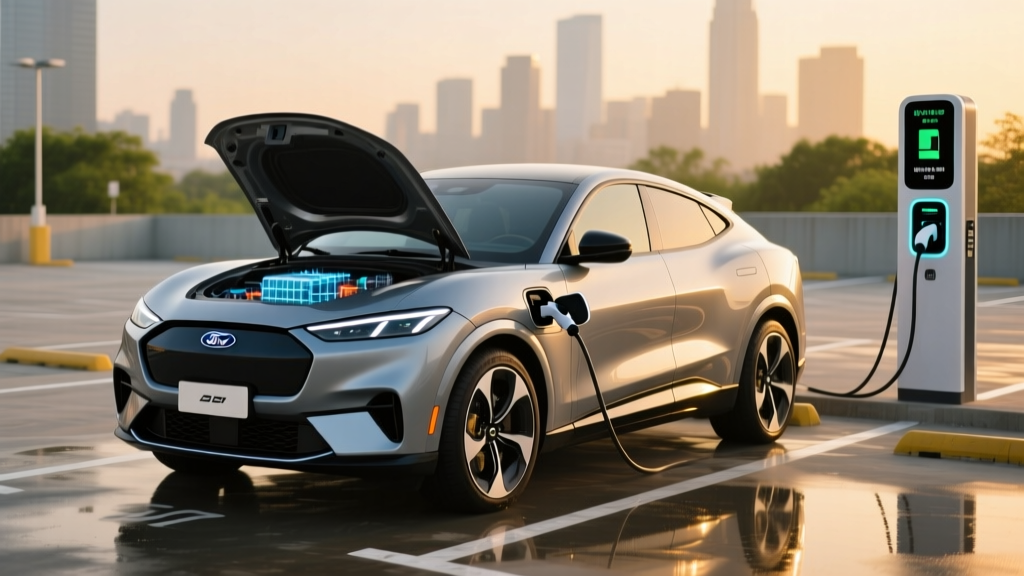
Ford's electric lineup — the Mustang Mach-E, F-150 Lightning, and E-Transit commercial van — sits at the center of one of the most confusing questions in EV shopping right now: Do you actually qualify for the Ford EV tax credit? The answer depends on a web of IRS rules around your income, the vehicle's MSRP, and where the battery minerals were sourced. This guide breaks down the 2026 eligibility requirements, the point-of-sale transfer option, and what a Ford EV actually costs to own over five years once you factor in charging, insurance, maintenance, and depreciation.
Which Ford EVs Qualify for the Federal Tax Credit?
Under the current IRS §30D Clean Vehicle Credit, qualifying new Ford EVs can earn buyers up to $7,500 in federal tax credits — split into two components worth $3,750 each:
- $3,750 if the battery's critical minerals were extracted or processed in the U.S. or a free-trade-agreement country
- $3,750 if the battery components were manufactured or assembled in North America
As of the 2026 model year, Ford has worked to shift battery sourcing for the Mach-E and F-150 Lightning toward North American suppliers. However, the exact credit amount — whether you get the full $7,500, a partial $3,750, or nothing — varies by model year, trim, and battery pack configuration. Ford publishes a dedicated EV page listing current credit eligibility by model, and your dealer should confirm the specific VIN's status before purchase.
§30D Eligibility Checklist — All Must Be Met
- Buyer income cap: Modified AGI ≤ $300,000 (joint filers), ≤ $225,000 (head of household), ≤ $150,000 (single)
- Vehicle MSRP cap: ≤ $80,000 for SUVs, pickups, and vans (F-150 Lightning, E-Transit); ≤ $55,000 for sedans and other body styles (Mach-E classified as SUV — qualifies under $80K cap)
- Final assembly: Must occur in North America (all current Ford EVs are assembled in the U.S.)
- Battery sourcing: Critical minerals and component manufacturing must meet IRS thresholds for the applicable model year
- Vehicle use: Must be purchased for personal use, primarily in the U.S.
- One credit per buyer: The §30D credit applies once per taxpayer per year (not per vehicle)
Point-of-sale transfer (2026): You no longer need to wait until tax filing to benefit. Under current rules, you can transfer the credit to the dealer at purchase, reducing the vehicle's sale price by the credit amount on the spot. This works even if you have no federal tax liability that year — the transfer functions as an upfront discount. The dealer handles the IRS reporting, and you'll need to provide income attestation at the time of sale.
5-Year Total Cost of Ownership: Ford Mach-E vs. Gas SUV Baseline
To understand whether the Ford EV tax credit meaningfully changes the math, we need to look beyond the sticker price. Below is a 5-year / 75,000-mile ownership projection for a 2026 Ford Mustang Mach-E Premium AWD (Extended Range, 91 kWh usable battery, EPA 290 miles) compared against a comparably equipped gas AWD midsize SUV averaging 25 MPG combined.
| Cost Category | Mach-E Premium AWD (ER) | Gas AWD SUV (25 MPG) |
|---|---|---|
| Base MSRP | $50,875 | $42,000 |
| Federal Tax Credit (§30D) | −$7,500 (if eligible) | $0 |
| Effective Purchase Price | $43,375 | $42,000 |
| Fuel / Charging (75K mi) | $4,725 (home L2, $0.16/kWh) | $9,900 ($3.30/gal, 25 MPG) |
| Maintenance (5 yr) | $1,800 | $4,200 |
| Insurance (5 yr) | $11,500 | $8,750 |
| Estimated Depreciation | $22,000 | $17,500 |
| Total 5-Year Cost | $83,400 | $82,350 |
Assumptions: 15,000 miles/year; home charging at national average $0.16/kWh; Mach-E efficiency ~3.0 mi/kWh; gas at $3.30/gal; insurance based on national EV average premium; depreciation estimated from current resale trends. Your actual numbers will vary by state, utility rate, driving habits, and market conditions.
The Mach-E with the full $7,500 credit essentially reaches cost parity with the gas SUV over five years — and that's before accounting for any state incentives or utility rebates. Without the credit, the Mach-E costs roughly $8,500 more over the same period.
Charging vs. Gas: The Per-Mile Cost Breakdown
The single largest ongoing savings for Ford EV owners comes from fuel. Here's the math at current national averages:
| Vehicle | Energy Source | Rate | Efficiency | Cost Per Mile |
|---|---|---|---|---|
| Mach-E Premium AWD | Home Level 2 | $0.16/kWh | 3.0 mi/kWh (97 MPGe) | $0.053 |
| Mach-E Premium AWD | DC Fast Charging | $0.48/kWh | 3.0 mi/kWh | $0.160 |
| Mach-E Premium AWD | Public Level 2 | $0.30/kWh | 3.0 mi/kWh | $0.100 |
| Gas AWD SUV | Unleaded | $3.30/gal | 25 MPG combined | $0.132 |
At home on Level 2, the Mach-E costs roughly 60% less per mile than the gas SUV. The savings shrink if you rely heavily on DC fast charging — at $0.48/kWh (common at Electrify America and EVgo stations), the per-mile cost actually exceeds gas. This is why home charging access is the single biggest financial variable in EV ownership. If you can install a Level 2 home charger and charge overnight at residential rates, the fuel savings are substantial and consistent. If you're entirely dependent on public fast charging, the cost advantage largely evaporates.
For the F-150 Lightning, efficiency drops to roughly 2.0 mi/kWh due to the truck's size and weight, pushing the home-charging cost to about $0.08/mile — still well below gas, but less dramatic than the Mach-E's advantage.
Maintenance Savings: Fewer Parts, Lower Bills
EVs eliminate the maintenance categories that generate the most recurring dealer visits for gas vehicles. Ford's electric powertrains have far fewer moving parts, and regenerative braking dramatically reduces brake pad wear.
| Maintenance Item | Gas SUV (5 yr / 75K mi) | Ford EV (5 yr / 75K mi) |
|---|---|---|
| Oil Changes | $750 (15 changes) | $0 |
| Transmission Fluid | $250 | $0 (single-speed reducer) |
| Brake Pads | $600 (1-2 replacements) | $0–$200 (regen extends life 2-3×) |
| Spark Plugs | $300 | $0 |
| Cabin Air Filter | $200 | $200 |
| Tire Rotation / Replacement | $1,200 | $1,400 (EVs are heavier; tires wear faster) |
| Coolant / Misc. | $400 | $200 |
| Battery Coolant Check | — | $200 |
| Total Estimated | $3,700–$4,200 | $1,800–$2,200 |
The net maintenance savings for a Ford EV runs approximately $1,900–$2,400 over five years. The main offset is tire cost — EVs are heavier (the Mach-E AWD tips the scales around 4,900 lbs) and deliver instant torque, which accelerates tire wear. Budget for a tire replacement around the 40,000–50,000 mile mark.
Ford's battery warranty covers 8 years or 100,000 miles against capacity loss below 70% of original — a meaningful backstop if you plan to keep the vehicle long-term.
Insurance: The Hidden EV Premium
Here's where the EV ownership story gets less rosy. Insurance for the Mach-E and F-150 Lightning typically runs 20–35% higher than for comparable gas vehicles. Industry data from major carriers places average annual EV insurance premiums around $2,200–$2,400 nationally, versus $1,700–$1,800 for gas equivalents.
Why the gap?
- Higher repair costs: EV battery packs and power electronics are expensive to replace after a collision, and fewer shops have certified EV repair technicians
- Higher vehicle values: Insurers base comprehensive and collision coverage on replacement cost, and EVs carry higher MSRPs
- Specialized labor: High-voltage system repairs require specific training and certification, driving up labor rates
The insurance gap varies significantly by state, carrier, and driver profile. Always get a quote from your insurer before purchasing — some carriers have narrowed the EV premium gap, while others haven't. Over five years, expect to pay roughly $2,500–$3,000 more in insurance premiums for a Ford EV versus a gas alternative.
Depreciation and Resale Value Trends
EV depreciation has been volatile. In 2023–2024, aggressive Tesla price cuts and rapid market expansion hammered used EV values across the board. The Mach-E and F-150 Lightning were not immune — both saw steeper-than-expected depreciation in that period.
As of 2026, the market has stabilized somewhat. Current estimates suggest the Mach-E retains roughly 50–55% of its value after five years / 75,000 miles, while the F-150 Lightning holds slightly better at 55–60% thanks to sustained demand in the truck segment. For comparison, a gas midsize SUV typically retains 55–62% over the same period.
Key depreciation factors for Ford EVs:
- Battery health perception: Buyers of used EVs scrutinize State of Health (SoH) reports; well-maintained batteries command premiums
- Technology obsolescence: Rapid advances in charging speed and range can make older EVs feel dated faster than gas cars
- Market saturation: As more used EVs flood the market, downward pressure on prices continues
- Tax credit effect: The point-of-sale credit lowers the effective purchase price, which can compress the depreciation base — you depreciate from a lower starting number
State, Local, and Utility Incentives Beyond the Federal Credit
Important: State and local EV incentives vary dramatically by jurisdiction and change frequently. The examples below are illustrative — always verify current programs through your state's energy office, your utility provider, and the AFDC incentive database.
Depending on where you live, additional incentives can stack on top of the federal §30D credit:
- State purchase rebates: States like California (CVRP, up to $7,000 for income-qualified buyers), Colorado (up to $5,000), and Massachusetts (MOR-EV, up to $3,500) offer direct rebates
- Utility charging rebates: Many utilities offer $250–$1,000 toward home Level 2 charger purchase and installation, or provide discounted off-peak charging rates
- HOV lane access: Several states grant single-occupant HOV lane access for EVs — a non-monetary benefit worth real time savings
- Registration fee offsets: Some states waive or reduce annual EV registration surcharges for credit-eligible vehicles
- Home electrical upgrades: A few utilities and states offer rebates for panel upgrades needed to support Level 2 charging — relevant if your home has a 100-amp panel that needs upgrading to 200 amps ($1,500–$3,000 out of pocket without rebates)
These incentives can add $1,000–$10,000+ in total value depending on your location and income level. Check the Alternative Fuels Data Center for a state-by-state breakdown before finalizing your purchase.
Key Specs: 2026 Ford EV Lineup at a Glance
| Spec | Mustang Mach-E Premium AWD (ER) | F-150 Lightning Lariat (ER) |
|---|---|---|
| EPA Range | 290 mi (real-world ~245–265 mi hwy/cold) | 320 mi (real-world ~260–285 mi hwy/cold) |
| Battery (usable) | 91 kWh, NMC | 131 kWh, NMC |
| Peak DC Fast Charge | 150 kW (10–80% in ~38 min) | 150 kW (10–80% in ~44 min) |
| Level 2 Charge Rate | 10.5 kW (~30 mi/hr) | 19.2 kW (~50 mi/hr) w/ 80A charger |
| Horsepower | 365 hp | 580 hp |
| 0–60 mph | 5.1 sec | 3.8 sec |
| MSRP (base trim shown) | $50,875 | $69,995 |
| Federal Tax Credit | Up to $7,500 (verify by VIN) | Up to $7,500 (verify by VIN) |
| Battery Warranty | 8 yr / 100,000 mi (≥70% SoH) | 8 yr / 100,000 mi (≥70% SoH) |
Frequently Asked Questions
How much does it really cost to own a Ford EV over 5 years?
For a 2026 Mach-E Premium AWD with the full $7,500 federal credit, expect roughly $83,000 over five years / 75,000 miles — including purchase price, charging, insurance, maintenance, and depreciation. Without the credit, that figure climbs to about $91,000. The largest variable is whether you charge at home (cheap) or rely on public DC fast charging (expensive).
Do I qualify for the Ford EV tax credit?
You qualify if your modified AGI is ≤ $300K (joint), ≤ $225K (head of household), or ≤ $150K (single), AND the vehicle's MSRP is ≤ $80,000 (SUVs/trucks), AND the battery meets current-year critical-mineral and component-sourcing requirements. All current Ford EVs are assembled in North America, satisfying the assembly requirement. Verify battery sourcing with your dealer for the specific VIN you're purchasing, as eligibility can shift with supply-chain changes.
How much do I save on fuel and maintenance?
Home-charging a Mach-E saves roughly $5,175 over 75,000 miles compared to a 25-MPG gas SUV at $3.30/gallon. Maintenance savings add another $1,900–$2,400. Combined, that's approximately $7,000–$7,600 in operational savings over five years — enough to offset much of the EV price premium even before tax credits.
Are Ford EVs more expensive to insure?
Yes, typically 20–35% more than comparable gas vehicles. Expect to pay roughly $2,200–$2,400 annually for a Mach-E versus $1,700–$1,800 for a gas SUV. Over five years, that's an additional $2,500–$3,000. Get a firm quote before buying — the gap varies significantly by insurer and state.
How well do Ford EVs hold their value?
The Mach-E currently retains an estimated 50–55% of its value after five years, and the F-150 Lightning retains 55–60%. This trails most gas SUVs by 3–7 percentage points, driven by technology obsolescence concerns and a growing used-EV supply. The point-of-sale credit partially offsets this by lowering your effective purchase price, meaning you have less capital to depreciate.
Can I transfer the tax credit to the dealer at purchase?
Yes. Under current §30D rules, you can transfer the credit to the dealership as a point-of-sale reduction. This applies even if you owe no federal income tax in that year — it functions as an immediate discount on the vehicle price. The dealer processes the transfer through the IRS Energy Credits Online portal, and you'll sign an income attestation at closing.
What happens if my income exceeds the cap in the year I buy?
If your modified AGI exceeds the applicable threshold ($300K/$225K/$150K) in the tax year you take delivery, you are not eligible for the credit — even if you received it as a point-of-sale transfer. In that case, the IRS will require you to repay the credit amount when you file your return. If your income is near the cap, consult a tax professional before committing.