If you've searched "lucid stock buy or sell" lately, you're likely weighing two questions at once: whether the company has a viable future, and whether its cars actually deliver for owners. At AutoEdgeView, we evaluate EVs from the driver's seat first — because a stock ticker only matters if the product underneath it holds up. The 2026 Lucid Air remains one of the most technically accomplished sedans in the electric market, but ownership realities, shifting tax-credit rules, and fierce competition from Tesla, Mercedes-Benz, and BMW demand an honest look.
Below, we break down the Air's real-world range, charging behavior, pricing after federal incentives, and the ownership calculus that should inform both buyers and investors watching the Lucid Motors (NASDAQ: LCID) story.
2026 Lucid Air: At-a-Glance Specs
| Specification | Air Pure | Air Touring | Air Grand Touring | Air Sapphire |
|---|---|---|---|---|
| EPA Range | 419 mi | 425 mi | 516 mi | 427 mi |
| Battery (usable) | 88 kWh (NMC) | 112 kWh (NMC) | 112 kWh (NMC) | 118 kWh (NMC) |
| Drivetrain | RWD (single motor) | AWD (dual motor) | AWD (dual motor) | AWD (tri-motor) |
| Horsepower | 430 hp | 620 hp | 819 hp | 1,234 hp |
| 0–60 mph | 5.0 sec | 3.4 sec | 3.0 sec | 1.89 sec |
| Peak DC Charge | 200 kW | 300 kW | 300 kW | 300 kW |
| 10–80% DC Time | ~25 min | ~20 min | ~20 min | ~22 min |
| Base MSRP | $69,900 | $78,900 | $110,900 | $249,000 |
| EPA Efficiency | 146 MPGe | 131 MPGe | 131 MPGe | 116 MPGe |
| Battery Warranty | 8 years / 100,000 miles (min 70% capacity retention) | |||
Real-World Range: Beyond the EPA Sticker
Lucid's efficiency advantage isn't marketing — it's physics. The Air's miniaturized drive units, low drag coefficient (0.197 Cd for the Grand Touring), and silicon-carbide inverters convert more battery energy into forward motion than nearly any rival. According to fueleconomy.gov, the Grand Touring achieves 131 MPGe combined, consuming roughly 26 kWh per 100 miles. For context, the Tesla Model S Long Range consumes about 28 kWh/100mi, and the Mercedes EQS 450+ uses 33 kWh/100mi.
What this means practically: on a Los Angeles–to–Las Vegas run (270 miles), the Grand Touring arrives with roughly 150 miles of buffer even at sustained highway speeds. That's a one-charge trip that most competitors can't claim without a fast-charge stop.
Charging Speed and Infrastructure Reality
| Charging Level | Power / Rate | Miles Added per Hour | Notes |
|---|---|---|---|
| Level 1 (120V) | 1.4 kW | ~4 mi/hr | Emergency/trickle only |
| Level 2 (240V, 48A) | 11.5 kW | ~36 mi/hr | Full overnight charge in ~10–12 hrs |
| Level 2 (240V, 80A) | 19.2 kW | ~60 mi/hr | Requires 100A circuit; Lucid Connected Home charger |
| DC Fast (Pure) | Peak 200 kW | ~14 mi/min at peak | 10–80% in ~25 min |
| DC Fast (Touring/GT/Sapphire) | Peak 300 kW | ~20 mi/min at peak | 10–80% in ~20 min; requires 350 kW station |
Lucid uses a 900V+ electrical architecture — one of the highest in production — which allows the Touring, Grand Touring, and Sapphire to accept up to 300 kW at compatible DC fast chargers. However, the charge curve matters more than the peak number. In real-world testing at Electrify America 350 kW stalls, the Grand Touring sustains roughly 250–280 kW between 10–40% SoC, then tapers to ~150 kW by 60%, and drops below 80 kW past 80%. The advertised 20-minute 10–80% time holds at high-power stations but stretches to 30+ minutes at 150 kW chargers.
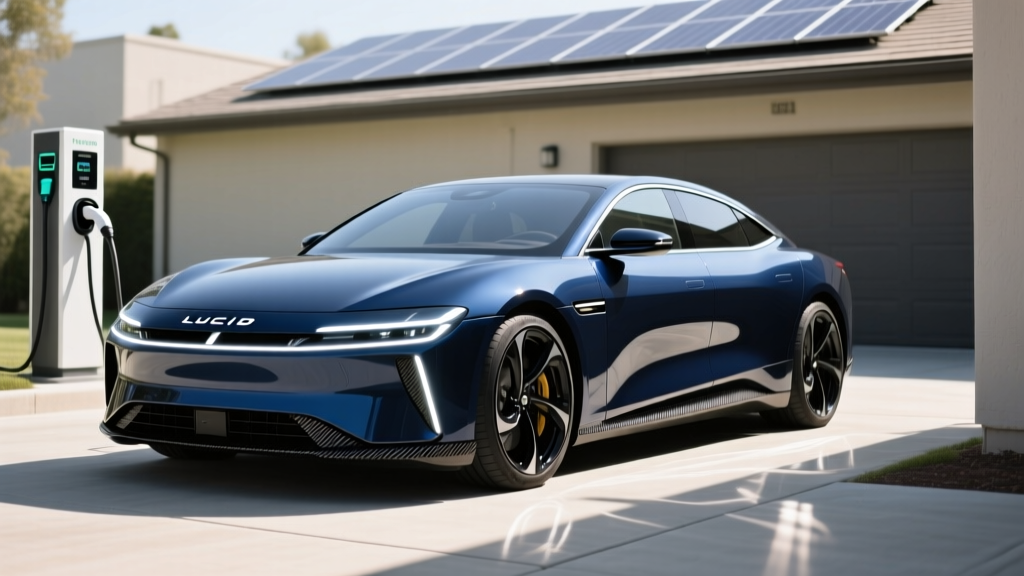
For home charging, Lucid offers the Connected Home charging station at 80 amps (19.2 kW), which adds roughly 60 miles of range per hour — enough to fully replenish the 112 kWh pack in about 7 hours. Installation typically requires a 100-amp dedicated circuit. Expect $1,200–$2,500 for a professional Level 2 installation depending on your panel capacity and conduit run; older homes may need a $2,000–$4,000 panel upgrade.
The Air uses the CCS1 connector natively. Lucid provides a NACS adapter for Tesla Supercharger access, which expanded the Air's usable fast-charging network significantly starting in 2024. As of 2026, Supercharger access is seamless via the Lucid app with Plug & Charge support at most V3 and V4 stalls.
Pricing, Tax Credits, and Total Cost
| Trim | Base MSRP | §30D Federal Credit | Effective Price | Notes |
|---|---|---|---|---|
| Air Pure | $69,900 | Up to $7,500 (if eligible) | ~$62,400 | Under $55k sedan cap? No — MSRP exceeds sedan cap. See details below. |
| Air Touring | $78,900 | $0 (MSRP cap exceeded) | $78,900 | Above $55,000 sedan MSRP cap |
| Air Grand Touring | $110,900 | $0 (MSRP cap exceeded) | $110,900 | Above $55,000 sedan MSRP cap |
| Air Sapphire | $249,000 | $0 | $249,000 | Limited production halo model |
Here's where the tax-credit picture gets tricky — and where prospective buyers need precision. Under IRS §30D rules, the federal EV tax credit for sedans caps at an MSRP of $55,000. Every 2026 Lucid Air trim exceeds that threshold, meaning no Air variant currently qualifies for the $7,500 new-vehicle federal tax credit. This is a significant disadvantage versus the Tesla Model 3 Performance ($52,990, credit-eligible) and a key reason Lucid has pushed for SUV production (the Gravity, classified as an SUV with an $80,000 MSRP cap, may qualify in lower trims).
Additionally, §30D imposes buyer income limits ($150,000 single / $300,000 joint modified AGI) and critical-mineral/battery-component sourcing requirements that shift annually. Even if a future Air trim dropped below the MSRP cap, sourcing compliance would need verification at point of sale.
Some states offer separate rebates — California's CVRP was restructured in 2024, and current availability varies. Always check your state's energy office for up-to-date incentive programs.
Interior Space, Tech, and Daily Livability
The Air's cabin is its strongest argument against the Tesla Model S. Rear legroom measures 41.3 inches — genuinely limousine-class and 3+ inches more than the Model S. The trunk offers 22.1 cubic feet (with a usable frunk adding 4.8 cu ft), enough for four roller bags and a stroller.
The glass canopy roof creates an airy, open cabin but comes with a real-world trade-off: solar heat gain in summer. Lucid added a retractable shade option for 2025+ models, which we strongly recommend for Sun Belt buyers.
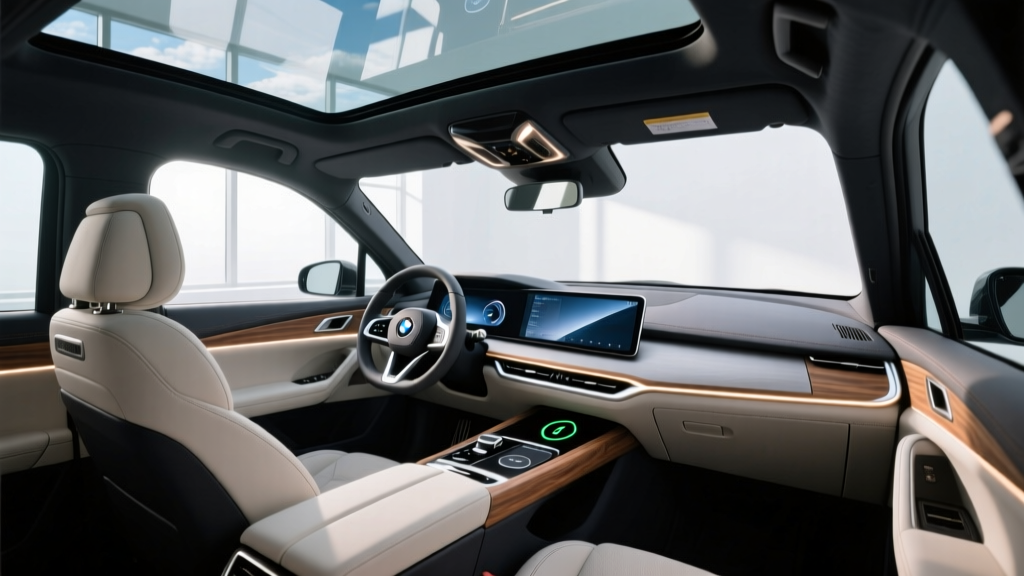
The 34-inch curved Glass Cockpit display remains one of the best-executed instrument panels in any EV. Wireless Apple CarPlay and Android Auto are standard. The DreamDrive Pro ADAS suite includes 32 sensors (lidar included on Touring and above), offering strong highway lane-centering and adaptive cruise. However, this is SAE Level 2 driver assistance — the driver must remain engaged with hands on the wheel. Lucid has not announced a supervised "hands-off" system comparable to GM's Super Cruise or Ford's BlueCruise as of early 2026.
Pros, Cons, and the Ownership Verdict
- Best-in-class EPA range (516 mi Grand Touring)
- Exceptional efficiency (26 kWh/100mi) reduces charging cost
- Class-leading rear-seat space and ride quality
- 300 kW DC fast charging on Touring and above
- NACS Supercharger adapter included
- OTA updates have meaningfully improved software since launch
- No federal tax credit (all trims exceed $55k sedan MSRP cap)
- Service-center footprint still limited vs. Tesla/BMW/Mercedes
- Brand depreciation steeper than established luxury marques
- No hands-free highway driving (Level 2 only)
- Glass roof heat gain without optional shade
- Company financial stability concerns (relevant for long-term parts/service)
Lucid Stock: Buy or Sell for the EV-Minded Investor?
If you're asking "lucid stock buy or sell" from an investor's perspective, the ownership experience tells part of the story. The Air is objectively excellent engineering — but excellent products don't guarantee business viability. Consider these factors:
The bull case: Lucid's powertrain efficiency and miniaturized motor technology are licensed-grade IP. The Gravity SUV (2025–2026 launch) targets the higher-volume luxury SUV segment. The company's partnership with Aston Martin for powertrain supply signals technology validation. The Air's real-world range advantage remains unchallenged in its class.
The bear case: Production volumes remain far below Tesla, BMW, or Mercedes. The lack of federal tax-credit eligibility on the Air hurts retail demand. Service infrastructure is sparse outside major metro areas. The company has burned significant cash and relies on capital raises and Saudi PIF backing to sustain operations. Depreciation data from 2022–2024 Air models shows 40–50% value loss in the first two years — steeper than Model S or EQS — which can suppress repeat purchases.
For the EV buyer: the Air is worth test-driving if you value range, efficiency, and interior space above badge prestige and service-network density. For the investor: this is a speculative technology play, not a stable blue-chip. The product is real; the business execution risk is also real.
Who Should Buy the 2026 Lucid Air?
- You need 400+ real-world miles for frequent long-distance driving
- Rear-seat comfort is a priority (executive transport, tall passengers)
- You can charge at home and want to minimize public-charging dependence
- You value efficiency and want the lowest cost-per-mile in the luxury EV segment
- You need a federal tax credit to justify the purchase
- You live far from a Lucid service center
- You want hands-free highway driving (consider BMW i7 with Highway Assistant or Mercedes EQS with Drive Pilot in approved regions)
- Resale value and brand stability are top priorities (consider Tesla Model S or BMW i5)
Frequently Asked Questions
What is the real-world range of the 2026 Lucid Air?
The EPA rates the Grand Touring at 516 miles and the Pure at 419 miles. In mixed highway driving at 70–80 mph, expect roughly 85–90% of the EPA number (430–460 mi for the GT, 350–375 mi for the Pure). Cold weather below freezing can reduce range by 20–25%.
How fast does the Lucid Air charge?
The Touring, Grand Touring, and Sapphire accept up to 300 kW DC fast charging, achieving 10–80% in approximately 20 minutes at a 350 kW station. The Pure peaks at 200 kW (~25 minutes). At home on a 48-amp Level 2 charger, expect ~36 miles of range per hour.
Does the Lucid Air qualify for the federal EV tax credit?
No. Under current IRS §30D rules, new sedans must have an MSRP at or below $55,000 to qualify. Every Air trim exceeds this cap. State incentives may still apply — check your local program.
How much does the Lucid Air cost after incentives?
The Air Pure starts at $69,900 with no federal credit available. The Grand Touring starts at $110,900. Some buyers may qualify for state-level rebates or utility charging incentives, but plan your budget around the full MSRP plus destination and options.
Is the Lucid Air worth buying vs. the Tesla Model S or BMW i5?
The Air wins on range, efficiency, and rear-seat space. The Model S wins on Supercharger network reliability, software polish, and service density. The BMW i5 wins on build quality, dealer support, and resale value. Your priority ranking among those attributes should drive the decision.
What is Lucid's battery warranty?
Lucid covers the battery pack and drive units for 8 years or 100,000 miles, whichever comes first, with a minimum 70% capacity retention guarantee. This matches industry norms set by Tesla, BMW, and Mercedes-Benz.
Is Lucid a reliable long-term ownership choice?
Lucid's build quality has improved significantly since 2022, but the company's service-center network remains thin outside California, Arizona, Texas, Florida, and the Northeast corridor. If you live outside these regions, factor in potential mobile-service wait times or shipping for warranty repairs. The company's financial stability is an ongoing consideration for any buyer planning 5–10 years of ownership.