Ford is leaning hard into a powertrain format that many assumed was a stepping-stone technology: the extended-range electric vehicle (EREV). Unlike a plug-in hybrid, where both the engine and electric motor can drive the wheels, an EREV uses its gasoline engine strictly as a generator to recharge the battery. The wheels are always driven by electricity. For truck buyers who need genuine payload and towing capability but aren't ready to rely entirely on charging infrastructure, the Ford EREV truck lineup—anchored by the next-generation F-150 program expected for the 2027 model year—represents a compelling middle ground.
But middle grounds come with trade-offs. This review breaks down everything we know about Ford's EREV truck strategy heading into 2026, including preliminary specifications, real-world range expectations, charging behavior, and how the economics stack up against pure BEV and traditional hybrid competitors.
Ford has indicated a target combined electric-only range of approximately 40 miles on battery power before the onboard generator engages. Once the range-extender kicks in, total system range is projected to exceed 700 miles. Real-world expectation: highway driving at 70+ mph will reduce electric-only range to roughly 30–35 miles, and cold weather (below 32°F) can cut that figure by an additional 20–30%. The generator-extended total range, however, remains largely unaffected by temperature since the engine provides thermal energy to the cabin.
What Is a Ford EREV Truck—and How Does It Differ From a PHEV?
The distinction matters for buyers cross-shopping powertrains. In a conventional plug-in hybrid like the Toyota RAV4 Prime or the upcoming Ramcharger (which is itself an EREV), the architecture determines how power reaches the wheels:
- PHEV (Plug-In Hybrid): Both the engine and electric motor can mechanically drive the wheels. The system blends power sources depending on load and speed.
- EREV (Extended-Range Electric Vehicle): The electric motor is the sole propulsion source at all times. The gasoline engine generates electricity to extend range but never turns the wheels directly.
- BEV (Battery Electric Vehicle): No engine. 100% electric propulsion with range limited to battery capacity.
Ford's EREV truck platform uses a large traction battery paired with a compact, efficient gasoline generator. The driving experience is indistinguishable from a pure EV under normal conditions—instant torque, one-pedal regenerative braking, and quiet operation. The generator starts seamlessly when battery state-of-charge (SoC) drops to a predetermined threshold, typically around 15–20%, maintaining enough buffer for passing power and accessory loads.
Preliminary Specifications: Battery, Range, and Efficiency
Ford has not published final EPA-certified figures for the production EREV truck as of early 2026. The following table reflects preliminary data from Ford's announcements and industry analysis of the platform's architecture. Treat these as estimated targets, not sticker values.
| Specification | Estimated / Target |
|---|---|
| Battery Capacity (usable) | ~35–45 kWh (NMC chemistry expected) |
| Electric-Only EPA Range | ~40 miles (target) |
| Total System Range (with generator) | 700+ miles (target) |
| Generator Engine | ~2.0L–2.7L turbocharged inline-4 (estimated) |
| Combined System Output | ~400–500 HP (target, dual-motor AWD) |
| 0–60 mph | ~5.5–6.5 seconds (estimated) |
| Drivetrain | AWD (dual-motor expected) |
| Max Towing Capacity | ~9,000–11,000 lbs (target) |
| MPGe (electric mode) | ~85–95 MPGe (estimated) |
| Fuel Economy (generator mode) | ~22–26 MPG combined (estimated) |
Chemistry note: Ford's EREV platform is expected to use NMC (nickel-manganese-cobalt) lithium-ion cells rather than LFP (lithium iron phosphate). The reason is energy density: a 35–45 kWh pack needs to fit within a truck chassis that also houses a generator, fuel tank, and full-size bed. NMC offers higher energy density per kilogram, which matters when packaging is at a premium. The trade-off is that NMC cells degrade slightly faster over time than LFP and are more sensitive to sustained high-SoC storage—though Ford's battery management system will buffer the usable window to mitigate this.
Charging Speed: DC Fast Charge and Home Level 2
Charging an EREV truck is where buyers need to recalibrate expectations. Because the battery is roughly one-third the size of a full BEV truck pack (like the F-150 Lightning's 98–131 kWh), peak DC fast-charge rates are correspondingly lower. You won't see 200+ kW charge rates on a 40 kWh pack—that C-rate would stress the cells unnecessarily.
| Charging Level | Power (kW) | Estimated Time / Rate |
|---|---|---|
| Level 1 (120V household) | ~1.4 kW | ~3–4 miles of EV range per hour |
| Level 2 (240V home, 32A) | ~7.7 kW | 0–100% in ~5–6 hours; ~18–22 EV miles/hr |
| Level 2 (240V home, 48A) | ~11.5 kW | 0–100% in ~3.5–4.5 hours |
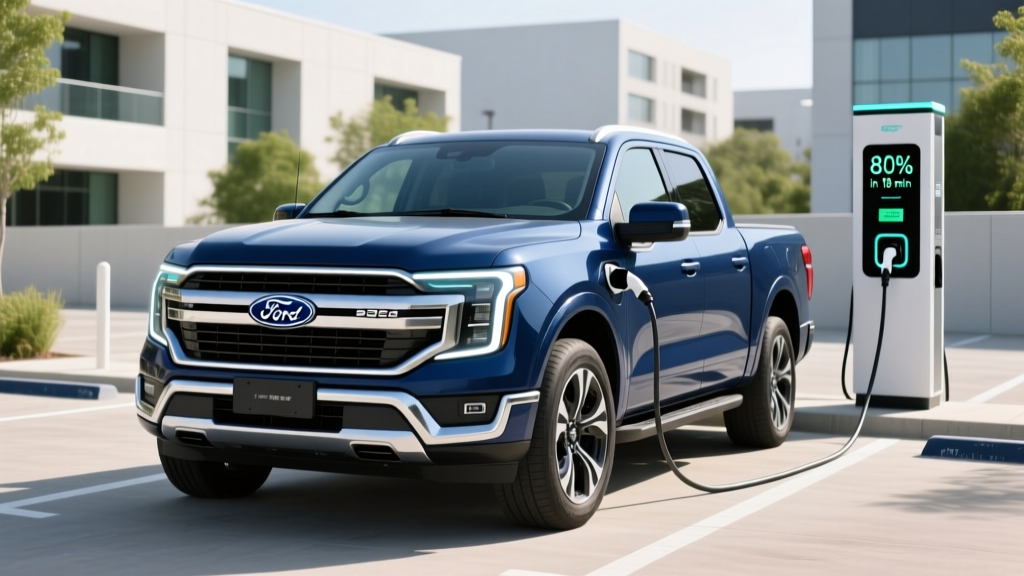
| DC Fast Charge (peak) | ~50–80 kW (estimated) | 10–80% in ~25–35 minutes |
The practical implication: if you charge at home overnight on a Level 2 circuit, you'll wake up with a full battery every morning, covering your daily commute on electricity alone. The generator exists for road trips, towing, and days when charging isn't available. DC fast charging is adequate but not spectacular—a 30-minute stop adds roughly 25–30 miles of electric range. Most EREV owners will rarely use DC fast charging because the generator eliminates range anxiety.
Connector: Ford has adopted the NACS (North American Charging Standard) connector across its electrified lineup, meaning access to Tesla Supercharger stations as well as growing NACS-equipped public networks from Electrify America and ChargePoint.
Performance, Towing, and Payload
The dual-motor AWD configuration Ford is targeting delivers the kind of low-end torque that truck buyers value for towing and hauling. Electric motors produce peak torque at 0 RPM, which translates to confident trailer launches and hill climbs without the transmission hunting for gears.
Estimated 0–60 mph times in the 5.5–6.5 second range put the EREV truck in line with mid-tier F-150 Lightning performance—not the 3.8-second Raptor territory, but more than adequate for a work truck that also serves as a daily driver. The combined system output of 400–500 HP provides ample passing power even when the generator is active and the battery SoC is low.
Towing caveat: When towing near maximum capacity (9,000–11,000 lbs target), expect electric-only range to drop significantly—possibly to 15–20 miles before the generator engages. The generator will then run continuously under high load, and fuel economy in generator mode while towing will likely fall to 12–16 MPG. This is the reality of moving heavy trailers; BEV trucks face the same physics, just expressed as range loss rather than fuel consumption.
Pricing, Trim Levels, and Tax Credit Eligibility
Ford has not released official MSRP figures for the EREV truck as of early 2026. Based on positioning relative to the F-150 Lightning (starting ~$55,000) and the F-150 PowerBoost hybrid (~$54,000), industry analysts project a base MSRP in the $50,000–$55,000 range for entry-level trims, with higher-spec models reaching $65,000–$75,000.
| Trim (Projected) | Est. MSRP | §30D Credit Eligibility | Effective Price (if eligible) |
|---|---|---|---|
| Base / XL | ~$50,000–$55,000 | Likely eligible (under $80K truck cap) | ~$42,500–$47,500 |
| Mid / XLT-Lariat | ~$58,000–$65,000 | Likely eligible (under $80K truck cap) | ~$50,500–$57,500 |
| High / Platinum-King Ranch | ~$68,000–$75,000 | Likely eligible (under $80K truck cap) | ~$60,500–$67,500 |
Federal tax credit (§30D) rules for 2026: The EREV truck, as a plug-in electric vehicle with a sufficient battery capacity, is expected to qualify for up to $7,500 in federal tax credits—but eligibility depends on several factors that vary by buyer:
- MSRP cap: Trucks/vans/SUVs must have an MSRP at or below $80,000. Most EREV trims should clear this.
- Buyer income cap: Modified adjusted gross income (MAGI) must not exceed $150,000 (single), $225,000 (head of household), or $300,000 (joint filing).
- Battery sourcing: Critical minerals and battery components must meet escalating domestic-sourcing percentages that tighten each year. Ford's supply chain decisions will determine whether specific model years qualify for the full $7,500 or a partial $3,750.
- Point-of-sale transfer: As of 2024, buyers can transfer the credit to the dealer at purchase, receiving it as an upfront price reduction rather than waiting until tax filing.
Always verify current eligibility at IRS.gov before purchasing, as battery-sourcing rules and manufacturer compliance change frequently.
Interior, Tech, and Driver Assistance
Expect the EREV truck to share the current F-150 cabin architecture, which means:
- Infotainment: SYNC 4 or SYNC 5 on a 12-inch portrait touchscreen (higher trims may get the 15.5-inch unit from the Lightning). Wireless Apple CarPlay and Android Auto are standard.
- Driver assistance: Ford BlueCruise (hands-on-lane-centering with hands-free capability on pre-mapped divided highways) is expected to be available. This is an SAE Level 2 system—the driver must remain attentive and is legally responsible for the vehicle at all times. It is not autonomous driving.
- Pro Power Onboard: Ford's integrated bed-outlet system (2.0 kW standard, up to 7.2 kW available) should carry over, making the EREV truck a mobile power source for job sites and camping. The generator adds an interesting wrinkle: unlike the Lightning, which draws from the traction battery, the EREV can run its generator to provide continuous power for extended periods without depleting drive range.
- Cargo space: Expect the standard 5.5-foot or 6.5-foot bed options. The absence of a large BEV pack under the floor may allow for a deeper bed or additional under-bed storage. A front trunk (frunk) is less likely on the EREV since the engine bay houses the generator.
- Passenger space: SuperCrew cab configuration provides approximately 43–44 inches of rear legroom, consistent with the current F-150 platform.
Ford BlueCruise is an SAE Level 2 driver-assistance system. Despite "hands-free" marketing on qualified highway sections, the driver must maintain visual attention on the road. A driver-monitoring camera enforces this. BlueCruise does not handle construction zones, unmapped roads, or adverse weather autonomously. You are the driver at all times.
Warranty and Battery Longevity
Ford is expected to offer warranty coverage consistent with its current electrified vehicles:
- Basic vehicle warranty: 3 years / 36,000 miles
- Powertrain warranty: 5 years / 60,000 miles
- High-voltage battery warranty: 8 years / 100,000 miles (minimum capacity retention threshold typically 70% of original capacity, per federal emissions warranty requirements)
The EREV's battery faces a different duty cycle than a pure BEV. Because the generator prevents deep discharge and the battery operates in a narrower SoC window (roughly 15–95%), degradation should be modest. NMC chemistry in this buffered operating range typically retains 85–90% capacity after 100,000 miles based on industry data from similar architectures. The smaller pack size also means replacement cost—if ever needed out of warranty—is significantly lower than a 100+ kWh BEV pack. Expect replacement estimates in the $6,000–$10,000 range versus $18,000–$25,000+ for a full BEV truck battery.
Who Should Buy the Ford EREV Truck?
- You need a full-size truck for work, towing, or hauling but want electric daily driving
- You lack reliable access to DC fast charging on common road-trip routes
- You want 700+ mile total range without trip planning around chargers
- You value Pro Power Onboard for job-site or camping use
- You want EV driving feel without range anxiety in cold climates
- You want zero gasoline dependency and tailpipe emissions in all modes
- Your daily commute exceeds 40 miles and you can't charge at work
- You prioritize maximum DC fast-charge speed for frequent long-distance travel
- You want the lowest possible per-mile fuel cost (BEVs still win on cents/mile)
- You need a frunk for secure, weatherproof front storage
Competitor Comparison: EREV vs BEV vs PHEV Trucks
The Ford EREV truck doesn't exist in a vacuum. Here's how it stacks up against key alternatives expected in the 2026–2027 timeframe:
| Attribute | Ford EREV Truck (Est.) | F-150 Lightning (BEV) | Ram 1500 Ramcharger (EREV) | F-150 PowerBoost (HEV) |
|---|---|---|---|---|
| Electric-Only Range | ~40 mi | 0 mi (no engine) | ~69 mi (est.) | 0 mi (no plug) |
| Total Range | 700+ mi | 230–320 mi (EPA) | 690+ mi (est.) | ~650 mi |
| Battery (usable kWh) | ~35–45 | 98–131 | ~92 | ~1.5 |
| DC Fast Charge (peak kW) | ~50–80 | ~150–195 | ~100–150 (est.) | N/A |
| Est. Base MSRP | ~$50,000–$55,000 | ~$55,000 | ~$55,000–$60,000 | ~$54,000 |
| Plug-In Tax Credit | Up to $7,500 | Up to $7,500 | Up to $7,500 | None |
The Ramcharger is the most direct competitor, also using an EREV architecture but with a larger battery targeting longer electric-only range. The Lightning offers pure electric operation with faster charging but requires charging-infrastructure confidence. The PowerBoost hybrid is the lowest-risk option but provides no electric-only driving and no plug-in credit.
Frequently Asked Questions
What is the real-world range of the Ford EREV truck?
Electric-only, expect roughly 30–40 miles depending on speed, temperature, and load. With the generator running, total range exceeds 700 miles. Cold weather reduces electric-only range by 20–30% but has minimal impact on generator-extended range since the engine provides cabin heat.
How fast does it charge at home and on DC fast chargers?
On a Level 2 home charger (240V, 32A), a full charge takes approximately 5–6 hours, adding 18–22 miles of EV range per hour. DC fast charging peaks around 50–80 kW, reaching 10–80% in roughly 25–35 minutes. The smaller battery means absolute charge times are reasonable despite the lower peak kW.
Does the Ford EREV truck qualify for the federal EV tax credit?
It is expected to qualify for up to $7,500 under IRS §30D, subject to buyer income limits ($150K single / $300K joint), the $80,000 MSRP cap for trucks, and battery-sourcing compliance. Point-of-sale transfer is available. Verify current rules at IRS.gov before purchase.
Is the Ford EREV truck worth buying over the F-150 Lightning?
If you need guaranteed long-distance range, tow frequently, or lack reliable charging access, the EREV offers a practical advantage. If you charge at home, drive under 200 miles daily, and want zero gasoline use, the Lightning's pure-electric operation and lower per-mile cost make more sense. The EREV is the pragmatic choice for truck buyers who can't yet commit to a BEV.
Can the generator charge the battery while parked?
Yes. The EREV architecture allows the generator to maintain battery charge even when stationary, which is useful for extended Pro Power Onboard use at job sites or campsites. The system manages SoC automatically.
What happens if I never plug it in?
The truck will function as a series hybrid, with the generator providing all electricity. Fuel economy will settle around 22–26 MPG combined—comparable to a conventional F-150 but with the smooth, torque-rich feel of electric propulsion. You'll pay more for fuel than if you plugged in regularly, but the truck remains fully operational.
Note: This review reflects preliminary and estimated specifications as of early 2026. Ford has not published final EPA-certified figures or official MSRP for the EREV truck platform. Specifications, pricing, and tax credit eligibility are subject to change. Consult Ford.com and fueleconomy.gov for official data when available.