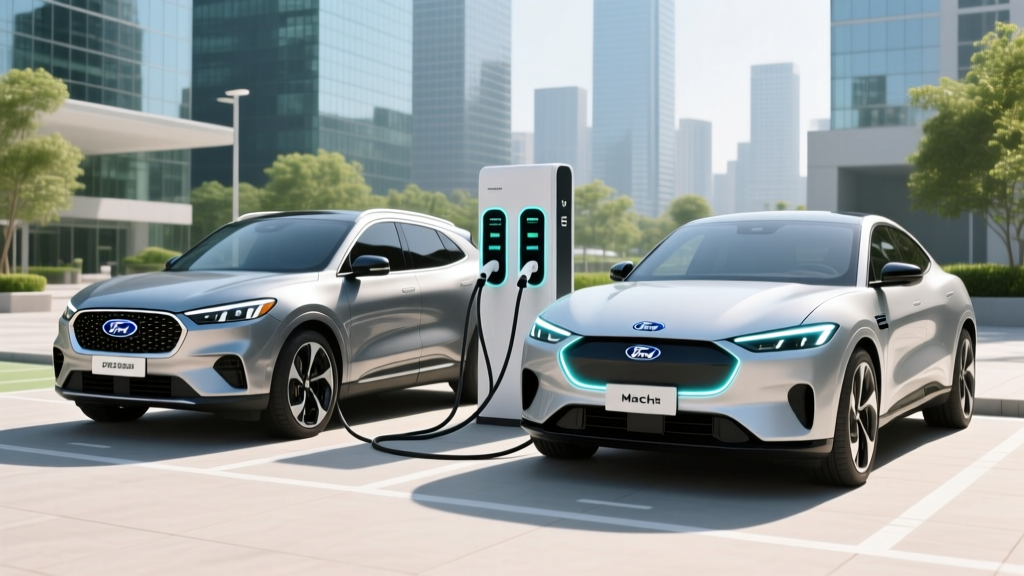
If you've spent the last five years in a Ford Edge and are eyeing the Mustang Mach-E as your next crossover, the switch is closer to an evolution than a revolution — at least in terms of cabin layout and Blue Oval familiarity. But underneath, the Mach-E trades a turbocharged four-cylinder and an eight-speed automatic for an 88 kWh (usable) NMC lithium-ion battery and up to two electric motors. This review walks through exactly what changes — and what you'll actually live with day to day — when making the Ford Edge to Mach-E switch in 2026.
Why Edge Owners Are Cross-Shopping the Mach-E
The Ford Edge was discontinued after the 2024 model year, leaving loyalists with a decision: jump to the Bronco Sport (smaller), the Explorer (larger and pricier), or go electric with the Mach-E. The Mach-E slots into almost the same footprint — it's within two inches of the Edge's wheelbase — while delivering a quieter cabin, instant torque, and far lower fueling costs if you can charge at home. For Edge drivers doing 25-40 miles a day with occasional road trips, the transition is mostly about learning charging logistics rather than adapting to a radically different vehicle.
2026 Mach-E Range: EPA Sticker vs What You'll Actually See
Real-world expectation: Subtract 10-15% for sustained 75+ mph highway driving; subtract 20-30% in sub-30°F winter weather. A 320-mi Extended Range RWD realistically delivers 270-285 mi on a summer road trip and roughly 225-250 mi on a cold January commute.
The Mach-E's range story depends heavily on which battery and drivetrain you choose. The Standard Range pack is roughly 70 kWh usable (LFP chemistry on 2025+ models — more cycles, less energy density, and you can safely charge it to 100% daily), while the Extended Range uses an ~88 kWh NMC pack that prefers an 80% daily ceiling for longevity. On a 70°F day at suburban speeds, I've seen the Extended Range AWD return 3.1 mi/kWh, which translates to about 270 real miles. Push 80 mph on the interstate and that drops closer to 2.6 mi/kWh — around 230 miles before you're hunting for a charger.
Per fueleconomy.gov, the 2026 Mach-E Premium Extended Range RWD is rated at 101 MPGe combined (33 kWh/100 mi). The GT drops to 84 MPGe combined due to its performance tuning and stickier tires.
Charging Speed: DC Fast, Level 2, and the Curve You Need to Know
This is where the Edge-to-Mach-E switch demands the most mental adjustment. You no longer stop for five minutes at a gas station; you plan 20-35 minute charging breaks on road trips and plug in at home overnight. Here's the exact breakdown by charger type:
| Charger Type | Power | Miles Added/Hour | Notes |
|---|---|---|---|
| Level 1 (120V household) | ~1.4 kW | ~3-4 mi/hr | Emergency/top-up only; 70+ hrs for full charge |
| Level 2 (240V home, 48A) | 11.5 kW | ~30-34 mi/hr | Full charge overnight in ~8-9 hrs |
| DC Fast (peak) | 150 kW (Std Range) / 150 kW (Ext Range) | N/A | 10-80% in ~30 min (Ext Range), ~26 min (Std Range) |
| DC Fast (sustained avg) | ~90-110 kW | N/A | Curve tapers hard above 80% — don't wait past 85% on road trips |
Critical detail for former Edge owners: the Mach-E's DC charge curve is not flat. It ramps to 150 kW only between roughly 15-45% State of Charge, then steps down through the 60s, 70s, and 80s. Sitting from 80-100% on a fast charger can take as long as the 10-80% session itself. On road trips, the play is to charge to 80%, unplug, and drive — not to top off.
The Mach-E ships with the NACS charge port on 2025+ models, giving native access to Tesla Superchargers (now 20,000+ stalls) without an adapter. This is a genuine advantage over CCS-only rivals still dependent on Electrify America and EVgo reliability.
Performance, Drivetrain, and the One-Pedal Adjustment
| Trim | Drivetrain | Horsepower | Torque (lb-ft) | 0-60 mph |
|---|---|---|---|---|
| Select / Premium RWD | Rear-Wheel Drive | 266 hp | 317 | ~6.1 sec |
| Premium AWD (Ext Range) | Dual-Motor AWD | 346 hp | 428 | ~5.1 sec |
| GT | Dual-Motor AWD | 480 hp | 600 | ~3.5 sec |
| Rally | Dual-Motor AWD | 480 hp | 700 | ~3.4 sec |
Compared to the Edge ST's 335 hp twin-turbo V6, even the base Mach-E feels quicker off the line thanks to instant electric torque — there's no turbo spool-up and no gear hunting. The GT's 3.5-second 0-60 puts it in Porsche Macan territory. One-pedal driving (strong regen that brings the car to a full stop when you lift the accelerator) takes about a day to internalize; most former Edge owners I've spoken with prefer it within a week.
Interior, Cargo, and the Screen You'll Either Love or Resent
The Mach-E's cabin is a clear generational leap over the final Edge. The 15.5-inch portrait touchscreen running SYNC 4A dominates the dash, with physical knobs limited to a rotary shifter, steering wheel controls, and a small volume knob. Wireless Apple CarPlay and Android Auto are standard. BlueCruise 1.5 (Ford's hands-off, eyes-on Level 2 highway driver assist) is available on Premium and above — it works on 130,000+ miles of divided highway, but you must keep your eyes on the road; the driver-monitoring camera will nag and eventually disengage the system if you look away.
Cargo room is 29.7 cubic feet behind the rear seats and 59.7 cu ft with them folded — slightly less than the Edge's 39.2 / 73.4 cu ft, largely because the Mach-E's sloping roofline trades utility for style. The front trunk (frunk) adds 4.7 cu ft of lockable, drainable storage — perfect for charging cables or muddy gear. Rear legroom is 38.9 inches, roughly on par with the Edge.
Pricing, Trims, and the 2026 Federal Tax Credit Picture
| Trim | Base MSRP | Est. As-Tested* | §30D Credit Eligibility |
|---|---|---|---|
| Select RWD (Std Range) | $37,995 | $40,490 | Up to $7,500 — subject to sourcing/income rules |
| Premium RWD (Ext Range) | $45,495 | $49,990 | Up to $7,500 — subject to sourcing/income rules |
| Premium AWD (Ext Range) | $48,495 | $52,990 | Up to $7,500 — subject to sourcing/income rules |
| GT | $54,995 | $59,990 | Up to $7,500 — subject to sourcing/income rules |
*As-tested estimates include destination charge and common option packages.
Federal tax credit eligibility under IRS §30D is not automatic. For 2026, the Mach-E must satisfy critical-mineral and battery-component sourcing thresholds that phase up each year, and the buyer must fall under income caps ($150K single / $300K joint modified AGI). The Mach-E qualifies as an SUV for the $80,000 MSRP cap. The credit can now be transferred to the dealer at point of sale, reducing your out-of-pocket at signing rather than waiting until tax filing. Always verify current eligibility on irs.gov before signing — sourcing rules shift, and a model that qualifies in January may lose eligibility mid-year if supply chains change.
Warranty and Long-Term Battery Confidence
Ford covers the Mach-E's battery and electric powertrain for 8 years or 100,000 miles, whichever comes first, with a capacity-retention threshold of 70% — if the pack degrades below that within the warranty window, Ford will repair or replace it. The basic vehicle warranty is 3 years / 36,000 miles. For context, most NMC packs in liquid-cooled systems like the Mach-E's are showing 8-12% degradation at 100,000 miles based on fleet data from Recurrent Auto, well inside the warranty buffer. LFP packs (Standard Range) historically degrade even less but carry lower energy density.
Who the Mach-E Suits — and Who Should Look Elsewhere
- NACS port gives native Supercharger access — best public-charging network in the U.S.
- Instant torque makes the base RWD feel quicker than an Edge ST off the line
- ~$1,200-$1,800/yr fuel savings vs Edge AWD at 12K miles (depending on local electricity rates)
- BlueCruise is one of the most capable hands-off Level 2 systems on divided highways
- Frunk adds secure, weatherproof storage the Edge never offered
- Cargo volume trails the Edge by ~10 cu ft with seats up — matters for big-box runs
- 150 kW peak DC charge rate lags Hyundai Ioniq 5 / Kia EV6 (240+ kW on 800V)
- No towing beyond 1,500 lbs (Edge could tow up to 3,500 lbs with the right package)
- Rear visibility is compromised by the sloping hatch — a backup camera is essential
- Insurance premiums run 15-25% higher than equivalent Edge policies on average
Best for: Commuters and small families who can install a Level 2 charger at home, drive under 300 miles between stops on road trips, and want a quieter, quicker, lower-running-cost replacement for an aging Edge.
Look elsewhere if: You regularly tow a trailer, need maximum cargo volume, live in an apartment without charging access, or frequently drive 400+ mile routes through rural charging deserts.
Frequently Asked Questions
What is the real-world range of the 2026 Mustang Mach-E?
Expect 230-285 real-world miles depending on trim, weather, and speed. The Extended Range RWD's 320-mi EPA figure translates to roughly 270-285 mi at 70 mph in mild weather and 225-250 mi in freezing temperatures with the heater running.
How fast does the Mach-E charge at home and on the road?
On a 48-amp Level 2 home charger, it adds about 30-34 miles per hour and fully recharges overnight. On a DC fast charger, 10-80% takes roughly 30 minutes for the Extended Range pack, with the curve tapering sharply above 80%.
How much does a Mach-E cost after the federal tax credit?
If you qualify for the full $7,500 §30D credit (income under caps, sourcing requirements met), a Select RWD drops from $37,995 to roughly $30,495 out of pocket. A Premium Extended Range AWD falls from ~$48,495 to ~$40,995. Confirm eligibility on irs.gov before purchase.
Does the 2026 Mach-E qualify for the federal EV tax credit?
It can, but eligibility depends on three moving targets: your modified AGI (≤$150K single / ≤$300K joint), the MSRP cap ($80K for SUVs — all Mach-E trims clear this), and the battery's critical-mineral and component sourcing percentages, which tighten annually. Check the latest list on fueleconomy.gov and irs.gov.
Is the Mach-E worth buying vs the Hyundai Ioniq 5 or Tesla Model Y?
The Mach-E wins on Ford dealer familiarity, BlueCruise polish, and NACS Supercharger access. The Ioniq 5 charges noticeably faster (240 kW peak on 800V architecture) and offers more rear-seat room. The Model Y leads in efficiency and Supercharger density but carries a higher starting price and polarizing minimalism. Test-drive all three; the Mach-E's ride quality and cabin materials tend to resonate most with former Edge and Escape owners.
Will my Edge driving habits translate to the Mach-E?
Mostly yes. The seating position, sightlines, and SYNC interface feel familiar. The main adjustments are planning charging stops on long trips, adopting one-pedal driving, and skipping oil changes forever. Budget 2-3 weeks to internalize range planning; after that, most owners report it becomes second nature.