2026 Tesla Model S: Quick Verdict
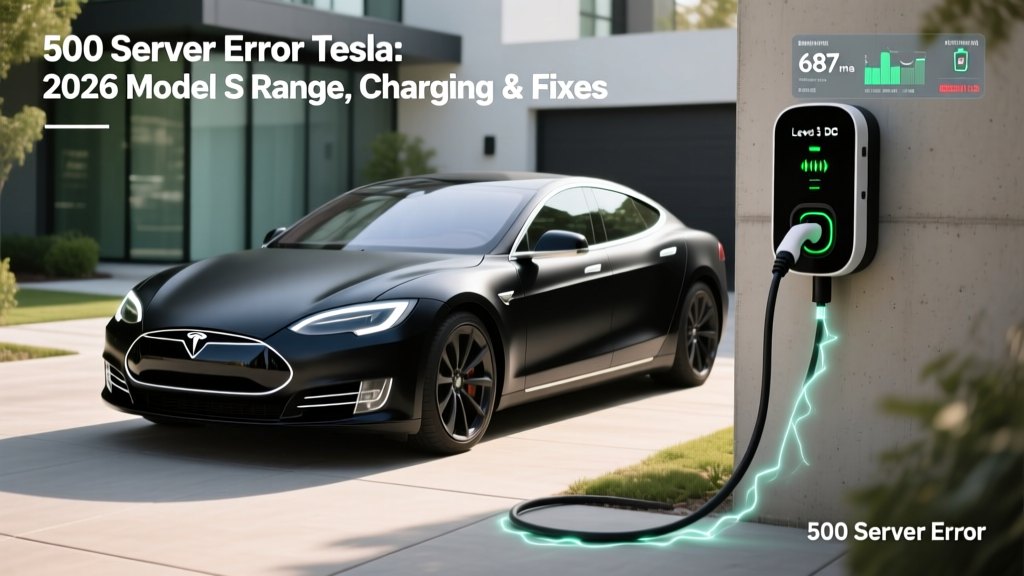
The 2026 Tesla Model S remains a benchmark electric sedan, blending a luxurious interior with class-leading range and blistering acceleration. However, long-term ownership often surfaces a frustrating digital gremlin: the infamous 500 server error Tesla owners report on the infotainment screen or mobile app. This review breaks down the Model S's real-world metrics while addressing that connectivity bug and what it means for your daily driving.
Real-World Expectation: Expect 340–360 miles in mixed highway driving at 70 mph. In freezing temperatures (below 32°F), range can drop by 15-25% due to battery heating demands and cabin climate control.
What is the 500 Server Error Tesla Owners Face?
Before analyzing the hardware, we must address the software. The "500 Server Error" on a Tesla typically indicates a communication failure between the vehicle's modem and Tesla's backend servers, or a glitch within the MCU (Media Control Unit).
- Symptoms: The mobile app fails to connect, navigation traffic data disappears, or the center screen displays a generic "500" or "Unable to load" message.
- Impact on Driving: Crucially, this error rarely affects the drivetrain, battery management, or charging capability. You can still drive and charge the car manually.
- The Fix: Most owners resolve this by performing a "Scroll Wheel Reset" (holding both steering wheel buttons until the screen goes black and the Tesla logo appears). If persistent, it may require a modem replacement under warranty.
Range, Battery, and Efficiency Specs
The 2026 Model S Long Range utilizes a 100 kWh battery pack (NMC chemistry). While LFP batteries are used in cheaper models for longevity, the high-energy-density NMC cells are required here to achieve the 400+ mile target.
| Metric | Model S Long Range | Model S Plaid |
|---|---|---|
| EPA Range | 402 miles | 359 miles |
| Battery Capacity | 100 kWh (NMC) | 100 kWh (NMC) |
| MPGe (Combined) | 120 MPGe | 116 MPGe |
| Efficiency | 28 kWh/100mi | 29 kWh/100mi |
| Drivetrain | Dual-Motor AWD | Tri-Motor AWD |
Charging Speed and Infrastructure
Tesla's Supercharger network remains a primary advantage. The Model S supports peak DC fast-charging at 250 kW on V3 stalls. While some competitors now exceed 350 kW, Tesla's thermal management allows the car to sustain high charging speeds longer, minimizing the "taper" above 80% SoC.
| Charging Level | Power/Rate | Time/Range Added |
|---|---|---|
| DC Fast (Supercharger) | 250 kW peak | 10-80% in ~30 minutes |
| Level 2 (Home Wall Connector) | 11.5 kW (48A) | ~34 miles per hour |
| Level 1 (120V Outlet) | 1.4 kW | ~3-4 miles per hour |
Performance and Handling
Even the "base" Long Range model is exceptionally fast, with a 0-60 mph time of 3.1 seconds and 670 horsepower. The Plaid variant drops the 0-60 time to 1.99 seconds via its 1,020-hp tri-motor setup. The air suspension provides a comfortable ride, though the yoke steering remains a polarizing choice for some traditionalists.
Pricing and Federal Tax Credits
The 2026 Model S starts at an MSRP of $72,990 (Long Range) and $87,990 (Plaid).
- MSRP Cap: Passes (Limit for sedans is $55,000; Wait, the Model S MSRP is $72,990, which exceeds the $55,000 sedan cap.)
- Result: The 2026 Model S does NOT qualify for the federal $7,500 tax credit due to its price point.
- Income Limits: Buyer AGI must be under $150k (single) or $300k (joint).
For a detailed breakdown of current rules, refer to the IRS Clean Vehicle Credit page.
Interior Space and Technology
The Model S offers 28 cubic feet of cargo space (including the front trunk/frunk) and generous rear legroom (35.4 inches). The 17-inch cinematic screen handles all controls, but the lack of physical buttons for climate and mirrors can be distracting while driving.
Pros, Cons, and the Competition
- Class-leading 402-mile range
- Access to the Supercharger network
- Standard Autopilot (Level 2 ADAS)
- Over-the-air software updates
- Prone to occasional "500 Server Error" connectivity glitches
- No federal tax credit eligibility
- Panel gaps and interior materials lag behind German rivals
- Yoke steering learning curve
Is the Model S Worth Buying in 2026?
If you need a 400-mile electric luxury sedan and want the security of the Supercharger network, the Model S is still the king. However, if build quality and a glitch-free interface are your priorities, the Lucid Air or Mercedes EQS might be worth a test drive. The "500 Server Error" is an annoyance, but one that usually resolves with a quick reboot.
Does the 500 Server Error affect charging?
No. You can still use a Supercharger or home charger even if the screen shows a server error, though you may not see real-time billing data on the screen.
What is the battery warranty?
Tesla provides an 8-year or 120,000-mile warranty on the battery and drive unit, whichever comes first.