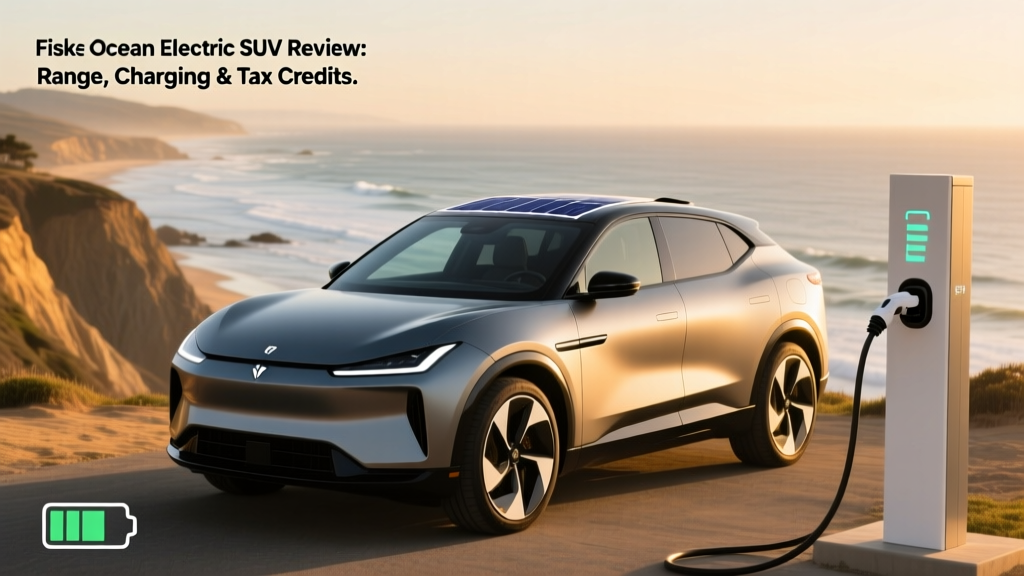
Quick Verdict: Can the Fisker Ocean Compete in a Crowded EV SUV Market?
The Fisker Ocean positions itself as a premium-yet-accessible all-electric SUV, aiming to undercut rivals like the Tesla Model Y, Hyundai Ioniq 5, and Ford Mustang Mach-E on price while matching or exceeding them on range. With an EPA-estimated range spanning 250 to over 350 miles depending on trim, a 250 kW DC fast-charging peak, and a starting MSRP of $38,999, the Ocean makes a compelling case on paper. But real-world efficiency, charging-curve behavior, and the nuances of federal tax credit eligibility separate marketing promises from driveway reality.
This review breaks down every spec that matters to an EV buyer — from battery chemistry and sustained charging rates to cargo dimensions and §30D credit qualification — so you can decide whether the Ocean earns a spot on your shortlist.
Fisker Ocean Specifications at a Glance
| Specification | Ocean Sport (Base) | Ocean Ultra / Extreme |
|---|---|---|
| EPA Est. Range | 250 miles | 350+ miles |
| Battery Capacity (Usable) | ~80 kWh (LFP) | ~113 kWh (NMC) |
| Battery Chemistry | LFP (Lithium Iron Phosphate) | NMC (Nickel Manganese Cobalt) |
| Max DC Fast Charge | ~175 kW | ~250 kW |
| 10–80% DC Charge Time | ~33 min | ~30 min |
| Level 2 Home Charge Rate | 10.5 kW (~30 mi/hr) | 10.5 kW (~30 mi/hr) |
| Drivetrain | FWD (Single Motor) | AWD (Dual Motor) |
| Horsepower | 275 hp | 540 hp |
| 0–60 mph | 6.9 sec | 3.7 sec |
| MPGe (Combined) | ~100 MPGe | ~93 MPGe |
| Cargo Volume (behind 2nd row) | ~32 cu ft (seats up) / ~65 cu ft (seats folded) | |
| Battery Warranty | 8 years / 100,000 miles (≥70% capacity) | |
| Base MSRP | $38,999 | $61,999–$68,999 |
Range, Efficiency, and Real-World Expectations
The Fisker Ocean's headline number is its 350+ mile EPA range on the Ultra/Extreme trims equipped with the large NMC battery pack. That places it among the longest-range electric SUVs available, rivaling the Tesla Model Y Long Range (330 mi) and edging past the Ford Mustang Mach-E Extended Range (312 mi).
EPA Sticker: 350 miles (Ultra/Extreme AWD)
Real-World Highway (70 mph, moderate temps): Expect ~290–310 miles. Highway driving at sustained speeds reduces efficiency due to aerodynamic drag — the Ocean's boxy SUV profile works against it compared to sleeker sedans.
Cold-Weather Impact (below 32°F): Plan for 20–30% range loss, bringing effective range down to ~245–280 miles. The Ocean's heat pump (standard on upper trims) mitigates some cabin-heating energy draw, but battery chemistry still loses efficiency in freezing temps.
City / Moderate-Climate Driving: You can approach or slightly exceed the EPA figure thanks to regenerative braking and lower average speeds.
The base Ocean Sport with its smaller LFP battery carries a 250-mile EPA rating. LFP chemistry offers advantages in cycle life and cost but carries lower energy density, which is why the pack is smaller and range is reduced. For urban commuters with home charging, 250 miles is ample; for road-trippers, the Ultra or Extreme is the pragmatic choice.
Efficiency-wise, the Ocean Ultra posts roughly 93 MPGe combined (about 36 kWh/100 mi), which is respectable for a 5,000+ lb dual-motor SUV but trails the Hyundai Ioniq 5's 110+ MPGe. The Sport's FWD configuration and lighter weight push it closer to 100 MPGe.
Charging Speed: DC Fast, Level 2, and the Curve Reality
Fisker quotes a peak DC fast-charging rate of 250 kW for the Ultra/Extreme and approximately 175 kW for the Sport. At a 350 kW-capable charger (Electrify America, EVgo, or Tesla Supercharger with NACS adapter), the Ocean Ultra can add roughly 150 miles of range in 15 minutes under ideal conditions.
But peak kW is not sustained kW. Here's what the charging curve actually looks like:
| Charge Level | Power / Rate | Miles Added per Hour | Notes |
|---|---|---|---|
| Level 1 (120V household) | ~1.4 kW | ~4 mi/hr | Emergency / overnight trickle only |
| Level 2 (240V home, 48A) | 10.5 kW | ~30 mi/hr | Full charge in ~10–11 hours (113 kWh pack) |
| DC Fast (Sport, peak) | 175 kW | ~500+ mi/hr (at peak) | 10–80% in ~33 min; tapers significantly above 80% |
| DC Fast (Ultra/Extreme, peak) | 250 kW | ~650+ mi/hr (at peak) | 10–80% in ~30 min; expect 35–40 min real-world including taper |
A critical ownership note: charging slows dramatically above 80% State of Charge (SoC) to protect battery health. A session from 10–80% might take 30 minutes, but pushing from 80–100% can add another 25–30 minutes. On road trips, plan your stops around the 10–80% window for maximum efficiency.
The Ocean ships with a CCS1 connector. Fisker has indicated NACS (Tesla Supercharger) adapter compatibility, which matters as the Tesla network remains the most reliable DC fast-charging infrastructure in the U.S. Verify adapter availability and Supercharger access before purchase, as network integration timelines have shifted across the industry.
Performance and Driving Dynamics
The dual-motor AWD Ocean Ultra and Extreme produce 540 horsepower and hit 0–60 mph in a claimed 3.7 seconds — firmly in performance-SUV territory, trailing only the Tesla Model Y Performance (3.5 sec) in this segment. The single-motor Sport's 275 hp and 6.9-second 0–60 time are adequate for daily driving but won't win drag races.
Ride quality benefits from a low center of gravity (battery pack under the floor) and a multi-link rear suspension. At roughly 5,100–5,400 lbs depending on trim, the Ocean is not a lightweight, and you'll feel that mass during aggressive cornering. However, straight-line acceleration and highway composure are strong.
The Ocean's standout driving feature is its adjustable regenerative braking, which supports one-pedal driving at its highest setting. A "California Mode" one-touch button lowers all windows and the rear hatch glass simultaneously — a gimmick, perhaps, but a memorable one for coastal drives.
Interior, Cargo, and Technology
The Ocean's cabin uses recycled and sustainably sourced materials, which Fisker markets heavily. Build quality on early production models drew mixed reviews, with some owners reporting panel-gap inconsistencies and software glitches — worth investigating on any specific vehicle you test-drive.
Cargo space: Approximately 32 cubic feet behind the second row, expanding to roughly 65 cubic feet with the rear seats folded. That's competitive with the Model Y (30/76 cu ft) and slightly behind the Mach-E (29/60 cu ft). The Ocean also includes a small front trunk (frunk) for additional storage.
Infotainment: A 17.1-inch rotating center touchscreen dominates the dash. It toggles between a portrait "Control Mode" and a landscape "Hollywood Mode" for media streaming while parked. Wireless Apple CarPlay and Android Auto are standard. The interface is visually striking but has drawn criticism for burying common functions (like climate controls) behind touchscreen menus.
Driver Assistance: The Ocean includes a suite of Level 2 (SAE) driver-assist features — adaptive cruise control, lane-keeping assist, automatic emergency braking, and blind-spot monitoring. This is a driver-support system, not autonomous driving. You must keep your hands on the wheel and eyes on the road at all times.
The Fisker Ocean's driver-assist features are SAE Level 2 — the vehicle can manage steering and acceleration/deceleration under specific conditions, but the driver remains fully responsible. This is the same classification as Tesla Autopilot, Ford BlueCruise, and GM Super Cruise. Do not treat it as self-driving.
Pricing, Trims, and Federal Tax Credit Eligibility
The Fisker Ocean's pricing strategy is designed to capture buyers across a wide budget range:
| Trim | Base MSRP | Est. Price After §30D Credit | Key Differentiator |
|---|---|---|---|
| Ocean Sport | $38,999 | ~$31,499 (if eligible) | 250 mi range, FWD, LFP battery |
| Ocean Ultra | $61,999 | ~$54,499 (if eligible) | 350 mi range, AWD, NMC, premium interior |
| Ocean Extreme | $68,999 | ~$61,499 (if eligible) | Top trim, all Ultra features + solar roof, full ADAS suite |
Federal Tax Credit (§30D) — Critical Caveats:
- MSRP Cap: SUVs must have an MSRP at or below $80,000 to qualify. All current Ocean trims clear this threshold.
- Buyer Income Cap: Modified adjusted gross income must not exceed $150,000 (single), $225,000 (head of household), or $300,000 (joint filing). Check IRS §30D guidelines for current-year limits.
- Battery Sourcing Requirements: The credit is split into two halves — $3,750 for critical-minerals sourcing and $3,750 for battery-component manufacturing. Sourcing rules tighten annually. Whether the Ocean qualifies for the full $7,500, a partial $3,750, or no credit depends on the specific model year's supply chain compliance. Always verify current eligibility on the IRS website or with a tax professional before relying on the credit in your purchase budget.
- Point-of-Sale Transfer: As of 2024, buyers can transfer the credit to the dealer at purchase, reducing the out-of-pocket price directly rather than waiting for a tax refund. This is available if the vehicle and buyer both qualify.
Pros, Cons, and Who the Fisker Ocean Suits Best
- Class-leading 350+ mi EPA range (Ultra/Extreme)
- Competitive starting price at $38,999
- Strong 540 hp / 3.7-sec 0–60 on dual-motor trims
- Sustainable interior materials
- 250 kW DC fast-charging peak
- Heat pump standard (upper trims) for cold-weather efficiency
- Early-production build quality and software complaints
- Infotainment buries climate controls in touchscreen
- CCS-only; NACS Supercharger access requires adapter (verify availability)
- Tax credit eligibility uncertain due to battery-sourcing rules
- Higher trims push past $60K, entering Model Y / Ioniq 5 territory
- Real-world highway range falls 15–20% below EPA sticker
Who should buy the Fisker Ocean?
- Commuters with home charging: The Sport at $38,999 with 250 miles of range is a strong value if your daily round-trip is under 100 miles and you charge overnight on Level 2.
- Families needing space and range: The Ultra's 350-mile range and 32 cu ft of cargo room handle school runs, grocery hauls, and weekend getaways without range stress.
- Eco-conscious buyers: Fisker's sustainability messaging and recycled-material interior resonate if that's a purchase motivator.
Who should look elsewhere?
- Frequent road-trippers in charging deserts: CCS reliability still lags behind the Tesla Supercharger network in rural areas. If NACS access is a dealbreaker, verify adapter availability or consider a native-NACS vehicle.
- Tech-first buyers: If you want the most polished infotainment and driver-assist experience, Tesla's ecosystem and Hyundai's proven software still lead.
Frequently Asked Questions
What is the real-world range of the Fisker Ocean?
The EPA rates the Ocean Ultra/Extreme at 350+ miles and the Sport at 250 miles. In real-world highway driving at 70 mph, expect ~290–310 miles from the Ultra and ~210–225 from the Sport. Cold weather (below 32°F) can reduce range by 20–30%.
How fast does the Fisker Ocean charge?
The Ultra/Extreme peaks at 250 kW DC, achieving 10–80% in roughly 30 minutes under ideal conditions. The Sport peaks at ~175 kW, taking ~33 minutes. Home Level 2 charging at 10.5 kW adds about 30 miles of range per hour.
How much does the Fisker Ocean cost after tax credits?
If you qualify for the full $7,500 federal credit (subject to income caps, MSRP limits, and battery-sourcing rules), the Sport drops to ~$31,499 and the Ultra to ~$54,499. Eligibility varies — confirm on irs.gov before committing.
Does the Fisker Ocean qualify for the federal EV tax credit?
It may, but eligibility depends on the model year's battery-sourcing compliance, your income, and the vehicle's MSRP (all trims are under the $80K SUV cap). The credit is split into $3,750 for critical minerals and $3,750 for battery components. Some model years may qualify for the full $7,500, a partial $3,750, or none at all. Always verify current status with the IRS or a tax professional.
Is the Fisker Ocean worth buying vs. the Tesla Model Y or Hyundai Ioniq 5?
The Ocean's 350-mile range and $38,999 starting price are compelling. However, the Model Y offers a more mature Supercharger network, faster software updates, and proven long-term reliability data. The Ioniq 5 delivers faster 800V charging (10–80% in ~18 min) and a more polished infotainment system. Test-drive all three and weigh charging-network access and software maturity against the Ocean's range and price advantages.
Sources: EPA range and efficiency data via fueleconomy.gov; federal tax credit rules via IRS §30D; manufacturer specifications via Fisker Inc. official press materials.