Why the First Tesla Ever Made Still Matters in 2026
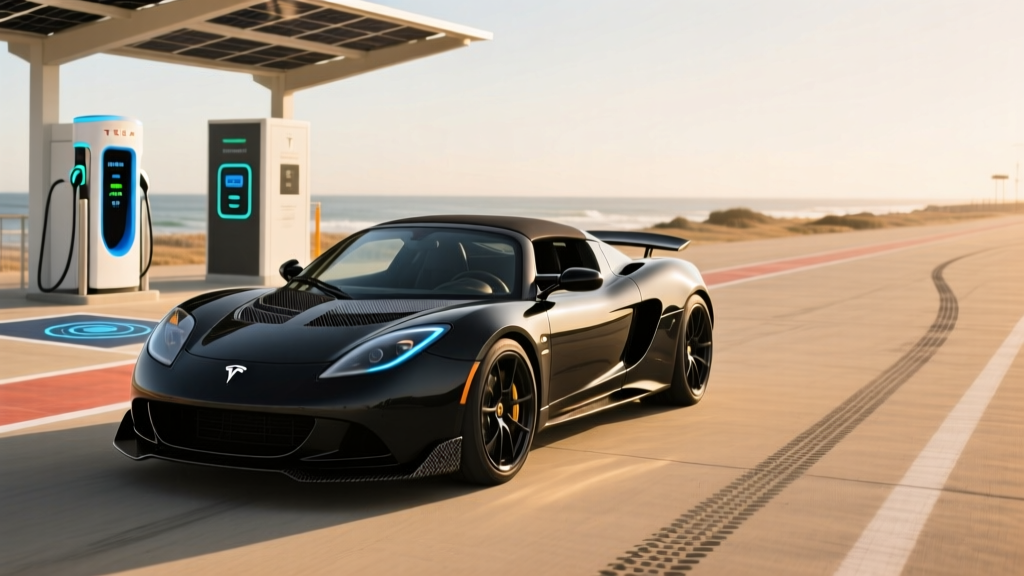
Before the Model S redefined luxury sedans, before the Model 3 brought EVs to the masses, and before the Cybertruck polarized the internet, there was a low-slung, Lotus-based sports car that proved lithium-ion batteries could deliver serious performance. The original Tesla Roadster, produced from 2008 to 2012, was the first Tesla ever made — and it remains one of the most consequential vehicles in automotive history.
With only about 2,450 units built, the Roadster is now a collector's item. But for EV enthusiasts and prospective buyers curious about Tesla's origins — or considering a used Roadster as a weekend car — understanding its real specs, limitations, and 2026 ownership reality is essential. This profile covers the original Roadster's range, charging, battery chemistry, performance, and what it costs to own one today.
Original Tesla Roadster: Core Specifications
| Spec | Roadster 1.5 (2008–2009) | Roadster 2.0/2.5 (2010–2012) |
|---|---|---|
| EPA Range | 244 miles (ideal); ~220 mi (combined) | 244 miles (ideal); ~220 mi (combined) |
| Battery Capacity | 53 kWh (usable) | 53 kWh (usable) |
| Battery Chemistry | NMC (Lithium Cobalt Oxide blend) | NMC (Lithium Cobalt Oxide blend) |
| Motor / Drivetrain | Single rear motor, RWD | Single rear motor, RWD |
| Horsepower | 248 hp (185 kW) | 288 hp (215 kW) |
| 0–60 mph | 3.9 seconds | 3.7 seconds |
| Top Speed | 125 mph (electronically limited) | 125 mph (electronically limited) |
| Efficiency | ~280 Wh/mi (120 MPGe) | ~280 Wh/mi (120 MPGe) |
| Curb Weight | 2,690 lbs | 2,690 lbs |
| Cargo Space | ~3.5 cu ft (rear trunk) | ~3.5 cu ft (rear trunk) |
| Original MSRP | $109,000 (base) | $128,500 (Sport) |
| Production | 2008–2012; ~2,450 units total | |
Sources: fueleconomy.gov, Tesla historical press materials.
Real-World Range: What the EPA Sticker Didn't Tell You
EPA (Ideal) Range: 244 miles
Real-World Combined: ~180–220 miles
Highway (70 mph sustained): ~160–180 miles
Cold Weather (below 40°F): ~130–160 miles
Tesla originally advertised the Roadster at 244 miles using what was then called the "ideal" range cycle — a generous testing protocol that predated the more stringent EPA five-cycle test used today. In practice, owners consistently report 180–220 miles in mixed driving at moderate temperatures.
The Roadster's air-cooled battery pack is particularly sensitive to cold weather. Without the sophisticated liquid thermal management systems found in modern Teslas, the original Roadster can lose 25–35% of its range in freezing conditions. Highway driving at sustained speeds above 65 mph also cuts range significantly due to the car's sports-car aerodynamics (drag coefficient of ~0.36) and lack of a heat pump — cabin heating draws directly from the traction battery.
For context, a 2026 Tesla Model 3 Long Range achieves an EPA 363 miles with a liquid-cooled pack and heat pump. The Roadster's range was remarkable in 2008 but reads as modest by today's standards.
Charging: The Roadster's Biggest 2026 Limitation
The original Roadster predates the modern DC fast-charging ecosystem entirely. There is no CCS connector, no NACS port, and no Supercharger compatibility. Here's what charging actually looks like:
| Charging Method | Power (kW) | Rate (mi/hr) | Full Charge Time |
|---|---|---|---|
| Level 1 (120V, standard outlet) | ~1.4 kW | ~5 mi/hr | ~44 hours |
| Level 2 — Tesla HPWC (240V, 70A) | ~16.8 kW | ~56 mi/hr | ~3.5 hours |
| Level 2 — Standard J1772 (240V, 30A) | ~7.2 kW | ~24 mi/hr | ~8 hours |
| DC Fast Charging | Not supported (no DC port) | ||
The Roadster uses a proprietary Tesla connector that was the predecessor to the modern NACS standard but is not physically or electrically compatible with today's NACS or Supercharger network. Tesla offered a High Power Wall Connector (HPWC) rated at 70 amps / 240 volts, delivering up to 16.8 kW — extremely fast for Level 2 even by 2026 standards.
However, finding public charging on the road is a serious challenge. The Roadster requires a Tesla-specific adapter (included with the car when new, now difficult to source) to use J1772 public Level 2 stations. There is no DC fast-charge capability whatsoever. On a road trip, you're limited to Level 2 speeds, meaning a 200-mile drive requires an overnight stop, not a 20-minute charge break.
This is the single biggest ownership reality for anyone considering a Roadster in 2026: it is a home-charge-only vehicle for practical purposes.
Battery Health, Degradation, and the Replacement Reality
The Roadster's 53 kWh battery pack uses approximately 6,831 individual 18650-format lithium-ion cells — the same form factor Tesla later used in the Model S and Model 3, though with a different cobalt-heavy NMC chemistry. This chemistry offered high energy density for 2008 but is more susceptible to degradation than modern LFP or nickel-rich NMC formulations.
After 14–18 years of service, original Roadster batteries have typically degraded to 60–80% of their original capacity, depending on usage patterns, storage conditions, and whether owners followed Tesla's charging recommendations (storing at 50% State of Charge, avoiding prolonged 100% charges).
Tesla offered a battery replacement program years ago, but it has since been discontinued. Third-party specialists such as Gruber Motors and independent EV shops now handle Roadster battery refurbishment and cell replacement. Expect to pay $25,000–$40,000 for a battery rebuild or replacement — a cost that can exceed the car's market value for non-Sport examples.
The original powertrain warranty was 3 years / 36,000 miles for the vehicle and 5 years / 100,000 miles for the battery. All factory warranties expired years ago.
Performance and Driving Experience
The Roadster's performance was genuinely startling in 2008 and still holds up as entertaining in 2026. The 2.5 Sport variant produces 288 hp and 295 lb-ft of torque available from zero RPM, launching the 2,690-lb car to 60 mph in 3.7 seconds. The two-speed automatic transmission (a unique unit developed after the original manual transmission proved problematic) delivers smooth, linear acceleration.
Based on the Lotus Elise chassis, the Roadster's handling is razor-sharp. The mid-rear battery placement gives it a low center of gravity, and the unassisted steering (the Elise-derived rack is manual) provides raw feedback that modern EVs — with their heavy, insulated steering systems — simply don't replicate. At 2,690 lbs, it's roughly 1,500 lbs lighter than a 2026 Tesla Model 3.
Regenerative braking is aggressive and enables one-pedal-style driving in most conditions, though the mechanical brakes (ventilated discs, no ABS on early 1.5 models) feel dated compared to modern blended regen systems.
Notable drawbacks: The cabin is spartan — no navigation, no backup camera, minimal sound insulation, and the touchscreen infotainment system (a 3.5-inch display on the 1.5, upgraded to 7 inches on the 2.5) is rudimentary by any modern standard. There are no driver-assistance features — no Autopilot, no lane-keeping, no adaptive cruise. This is a pure analog driving experience with an electric powertrain.
Pricing in 2026: What a First Tesla Actually Costs
| Model | Original MSRP | 2026 Used Market Value | Federal Tax Credit |
|---|---|---|---|
| Roadster 1.5 (2008–2009) | $109,000 | $120,000–$180,000 | Not eligible |
| Roadster 2.0 (2010–2011) | $111,000 | $140,000–$200,000 | Not eligible |
| Roadster 2.5 Sport (2011–2012) | $128,500 | $175,000–$300,000+ | Not eligible |
The Roadster has firmly entered collector-car territory. Values have appreciated significantly, with low-mileage Sport examples crossing $250,000 at auction. This is not a bargain entry into EV ownership — it's a premium collectible.
Regarding the IRS §30D federal tax credit: the Roadster does not qualify. The §30D credit applies to new clean vehicles purchased from a dealer, with strict MSRP caps ($55,000 for sedans, $80,000 for SUVs/trucks), buyer income limits, and battery critical-mineral sourcing requirements. A used Roadster purchased privately or at auction is ineligible. The used-EV credit (§25E, up to $4,000) also does not apply, as it requires purchase from a licensed dealer and has a $25,000 sale-price cap — far below current Roadster values.
Who Should Buy the First Tesla Ever Made?
Pros
- Historic significance — the car that launched the EV revolution
- Exceptional handling from Lotus Elise chassis, ultra-light at 2,690 lbs
- Strong collector appreciation potential
- Instant torque and 3.7-second 0–60 remain thrilling
- Active enthusiast community and specialist support network
Cons
- No DC fast charging — road trips require overnight Level 2 stops
- Battery replacement costs $25K–$40K; many original packs degraded
- No modern safety features (no airbags beyond front, no ABS on early models)
- No driver-assist tech, no navigation, minimal infotainment
- Collector pricing ($120K–$300K+) puts it far beyond practical EV territory
- Proprietary charging connector limits public charging access
The Roadster suits you if: You're an automotive collector seeking the genesis of the EV movement, you want a weekend canyon carver with electric torque, and you have home Level 2 charging with the Tesla HPWC. It is not a daily driver, commuter, or road-trip vehicle by any modern standard.
Look elsewhere if: You need practical range, fast charging, modern safety, or daily usability. A 2026 Tesla Model 3 Performance ($52,990, EPA 315 mi, 250 kW DC charging, Autopilot standard) delivers more performance, vastly more range, and full modern convenience for a fraction of the Roadster's collector price.
Frequently Asked Questions
What is the real-world range of the original Tesla Roadster?
Expect 180–220 miles in mixed driving at moderate temperatures. Highway driving at 70+ mph reduces this to roughly 160–180 miles, and cold weather (below 40°F) can drop range to 130–160 miles due to the air-cooled battery pack and resistive cabin heating.
How fast does the Roadster charge?
With the Tesla High Power Wall Connector (70A/240V), it charges at up to 16.8 kW — adding roughly 56 miles of range per hour and a full charge in about 3.5 hours. On a standard 30A Level 2 station, expect ~7.2 kW and ~8 hours for a full charge. There is no DC fast-charging capability.
Does the original Roadster qualify for any federal EV tax credit?
No. The IRS §30D credit applies only to new vehicles meeting MSRP, income, and battery-sourcing requirements. The used-EV credit (§25E) has a $25,000 price cap. The Roadster's collector values of $120,000–$300,000+ make it ineligible for both.
Is the original Roadster worth buying in 2026?
As a collectible and weekend car, yes — if you value historical significance and raw driving dynamics. As a practical EV, no. Modern Teslas and competitors offer more range, faster charging, full safety suites, and daily comfort at lower prices. The Roadster is an investment piece, not a transportation appliance.
How many original Tesla Roadsters were made?
Tesla produced approximately 2,450 Roadsters between 2008 and 2012 across the 1.5, 2.0, and 2.5 variants. Surviving examples with healthy batteries are increasingly rare, which contributes to rising collector values.
Can the Roadster use Tesla Superchargers?
No. The original Roadster uses a proprietary pre-NACS connector and is not compatible with any Tesla Supercharger station, nor with CCS or CHAdeMO DC fast-charging networks. It can use J1772 Level 2 public stations with an adapter.