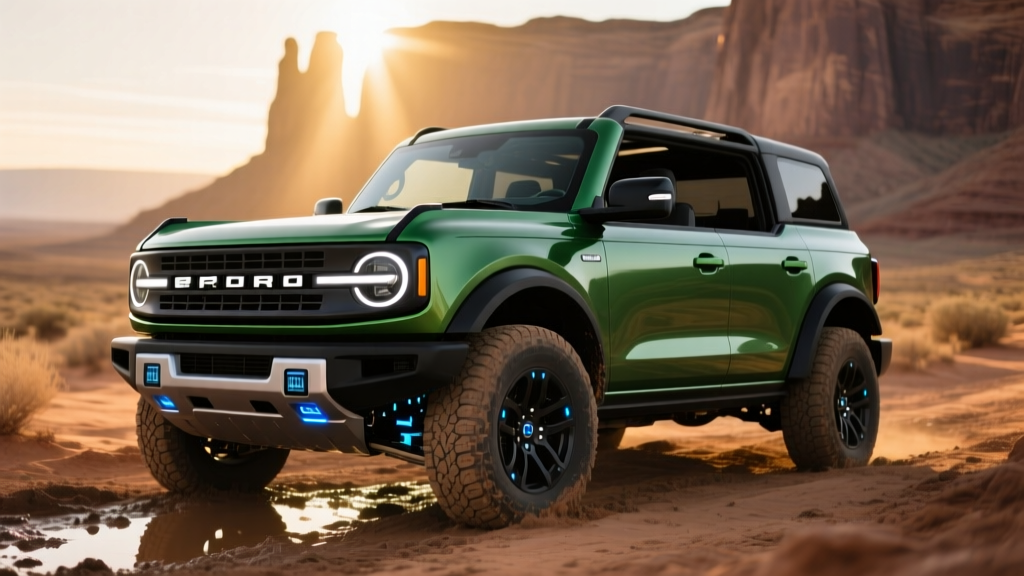
Ford has not yet released a production EV Bronco as of early 2026. What exists is widespread industry reporting and Ford executive commentary pointing to an electric Bronco variant under development, likely riding on a next-generation EV platform. If you are searching for an "EV Bronco" to buy today, the closest electrified alternatives in Ford's lineup are the Ford F-150 Lightning (electric truck) and the Ford Bronco Sport (gas-only compact SUV). No EV Bronco is available for order, and any specifications circulating online are preliminary estimates, not confirmed production figures.
Quick Answer: EV Bronco Status in 2026
Availability: Not yet announced for production. No confirmed MSRP, range, or release date.
Most likely platform: A derivative of Ford's flexible EV architecture, potentially sharing components with the F-150 Lightning or next-gen Explorer EV.
Estimated arrival: Industry analysts project a reveal no earlier than late 2026 or 2027, with deliveries in 2027–2028.
What you can buy now: Gas-powered Ford Bronco (2-door/4-door), F-150 Lightning, or Ford Mustang Mach-E.
What We Know About the EV Bronco So Far
Ford CEO Jim Farley has publicly stated that iconic nameplates like the Bronco are candidates for electrification, but the company has been cautious about committing to an EV Bronco timeline. The original Bronco's body-on-frame architecture, serious off-road hardware (locking differentials, high ground clearance, disconnecting sway bars), and removable roof/doors create engineering challenges that don't map cleanly onto existing EV skateboard platforms.
Based on Ford's current EV portfolio and supply chain, here are the most credible estimates for what an EV Bronco could look like if and when it reaches production:
| Spec | Estimated Range | Basis for Estimate |
|---|---|---|
| Battery capacity | 100–131 kWh usable (NMC) | F-150 Lightning Extended Range uses 131 kWh |
| EPA range | 230–300 miles | Boxy aerodynamics + heavy off-road hardware reduce efficiency vs. Mach-E |
| Peak DC fast charge rate | 150–210 kW | F-150 Lightning peaks at ~155 kW; newer platforms may improve |
| 10–80% DC charge time | 35–45 minutes (estimated) | Conservative charge curve typical of truck-based EVs |
| Level 2 charging (home) | ~11.5 kW / ~32 hours (0–100%) | Similar to Lightning with 80A Ford Charge Station Pro |
| Horsepower | 450–580 hp (dual motor AWD) | Lightning Extended: 580 hp |
| 0–60 mph | 4.0–5.5 seconds | Instant torque advantage; weight penalty from body-on-frame |
| Towing capacity | 5,000–7,500 lbs (estimated) | Gas Bronco tows up to 4,500 lbs; EV torque could improve this |
| Starting MSRP (est.) | $55,000–$65,000 | Positioned above gas Bronco ($39k+) and near Lightning pricing |
Critical caveat: These are analyst estimates, not Ford specifications. The boxy Bronco shape creates a drag coefficient significantly worse than the Mach-E or even the Lightning, which will compress highway range. Expect real-world highway range at 70 mph to fall 15–25% below the EPA sticker — meaning a 280-mile EPA rating might yield 210–240 miles on a flat, temperate interstate, and potentially under 200 miles in cold weather or at altitude with off-road tires.
EV Bronco vs. Gas Bronco: Cost and Capability Comparison
For buyers weighing whether to wait for an EV Bronco or purchase the current gas model, the comparison matters now. The 2026 gas Ford Bronco (4-door, Big Bend trim with 2.3L EcoBoost) starts around $41,295 and delivers an EPA-rated 20 MPG combined (fueleconomy.gov). Here's how the economics stack up over five years of ownership at 12,000 miles annually:
| Category | 2026 Gas Bronco (Big Bend 4dr) | EV Bronco (Estimated) |
|---|---|---|
| Purchase price (MSRP) | $41,295 | $60,000 (est.) |
| Federal tax credit (§30D) | $0 | Up to $7,500 (if eligible — see IRS rules) |
| Effective purchase price | $41,295 | ~$52,500 (est.) |
| Fuel/energy (5 yrs, 60k mi) | $10,800 (at $3.60/gal, 20 MPG) | $3,600 (at $0.12/kWh home charging) |
| Maintenance (5 yrs) | $3,500 (oil, filters, brakes) | $1,500 (no oil; regen saves brake pads) |
| Insurance (5 yrs, avg) | $8,500 | $9,500 (EV premiums typically 10–15% higher) |
| Estimated 5-yr total cost | $64,095 | $67,100 |
The gas Bronco wins on upfront price by a significant margin. The EV Bronco's fuel savings — roughly $7,200 over five years — don't fully close the gap unless you drive substantially more than 12,000 miles per year or have access to very cheap electricity (solar, time-of-use rates under $0.08/kWh). Where the EV pulls ahead is in driving dynamics: instant torque for rock crawling, no engine noise on trails, and the ability to run accessories (camp lights, a fridge, power tools) via a vehicle-to-load (V2L) system without a separate generator.
Real-World Ownership: What an EV Bronco Buyer Must Consider
The Bronco buyer profile skews toward outdoor recreation — trail driving, camping, towing, and road trips to remote areas. This creates specific challenges for an electric variant that don't apply to a Mach-E commuter:
Charging Access in Off-Road and Rural Areas
The DC fast-charging network remains concentrated along interstate corridors and in metropolitan areas. Popular off-road destinations — Moab, the Rubicon Trail, remote BLM land — have limited or no public charging infrastructure. An EV Bronco owner planning backcountry trips will need to budget for Level 1 trickle charging (120V, roughly 3–5 miles of range per hour) at campsites or invest in a portable solar generator setup. This is a genuine limitation, not a marketing talking point.
Cold-Weather Range Loss
Lithium-ion batteries lose 20–30% of their effective range in sub-freezing temperatures, and the Bronco's boxy shape compounds this by increasing energy consumption for cabin heating. A hypothetical 280-mile EPA range could realistically drop to 190–210 miles in January mountain driving. A heat pump (standard on some Ford EVs) mitigates but does not eliminate this loss.
Off-Road Tire Penalty
Bronco buyers frequently upgrade to 33-inch or 35-inch all-terrain or mud-terrain tires. Larger, heavier, knobbier tires increase rolling resistance and reduce range by an estimated 8–15%. On an EV, where every pound and every watt-hour matters more visibly than in a gas vehicle, this trade-off is significant. Ford would likely offer an EV Bronco with efficiency-focused all-season tires from the factory, with the understanding that aftermarket off-road rubber will cut into range.
Home Charging Requirements
A large-battery EV Bronco (100+ kWh) demands a robust Level 2 home charger to be practical. Charging on a standard 120V outlet (Level 1) would require 70–100+ hours for a full charge — essentially unusable for daily driving. A 48-amp Level 2 circuit (11.5 kW) would take roughly 9–11 hours, which is viable for overnight charging. Installation costs for a Level 2 home setup range from $500–$2,500 depending on panel capacity and conduit run distance, and older homes may need a $1,500–$3,000 electrical panel upgrade to support a 60-amp circuit.
Federal Tax Credit Eligibility: What We Know
Under current IRS §30D rules, a new EV Bronco would need to meet several criteria for the buyer to claim the full $7,500 federal tax credit:
- MSRP cap: SUVs and trucks must have an MSRP at or below $80,000. An EV Bronco should clear this threshold based on projected pricing.
- Buyer income limits: Adjusted gross income cannot exceed $150,000 (single), $225,000 (head of household), or $300,000 (joint filers).
- Battery sourcing requirements: Critical minerals and battery components must meet escalating domestic/free-trade-agreement sourcing percentages. Ford's supply chain decisions for an EV Bronco battery will determine eligibility — this is not guaranteed.
- Final assembly: Vehicle must be assembled in North America. Ford's US plants make this likely but unconfirmed.
- Point-of-sale transfer: Eligible buyers can transfer the credit to the dealer at purchase, reducing the upfront price rather than waiting for a tax refund.
Tax credit eligibility is model-specific and can change based on battery supplier contracts. Buyers should verify eligibility on the IRS clean vehicle credit page at the time of purchase, not rely on early estimates.
Common EV Bronco Misconceptions
| Myth | Fact |
|---|---|
| "The EV Bronco is available to order now." | No EV Bronco has been officially announced for production. Ford has not opened reservations. |
| "An EV can't handle serious off-roading." | Electric motors deliver instant, precise torque at zero RPM — ideal for rock crawling. The Rivian R1S and Hummer EV have demonstrated credible off-road capability. |
| "The battery will be destroyed by water crossings." | EV battery packs are sealed to IP67 or higher standards. The F-150 Lightning wades to 24 inches. Ford would engineer an EV Bronco for comparable or better water fording. |
| "I'll save $10,000+ in fuel over gas." | Realistic savings are $5,000–$8,000 over five years at average mileage and electricity rates. The premium purchase price partially offsets fuel savings. |
| "It'll get 350+ miles of range like a sedan." | A boxy, heavy, body-on-frame off-roader will likely achieve 230–300 miles EPA. Aerodynamics and weight work against range in this vehicle class. |
Alternatives to Consider Right Now
If you want an electrified adventure vehicle today and can't wait for a potential EV Bronco, these are the closest production options:
Rivian R1S (Dual-Motor, Standard Battery+): EPA range ~270 miles, 533 hp, quad-motor option available, genuine off-road capability with air suspension and 14.9 inches of ground clearance. Starts around $75,900. The closest functional analog to what an EV Bronco aims to be.
Ford F-150 Lightning (Extended Range): EPA range ~320 miles, 580 hp, 131 kWh battery, 7,700-lb towing, Pro Power Onboard V2L. Starts around $59,990. Less off-road focused than a Bronco but shares the Ford truck ecosystem and offers real utility.
Jeep Wrangler 4xe (PHEV): 21 miles electric-only range, 49 MPGe, solid front/rear axles, removable doors/roof — the closest spiritual competitor to a Bronco with a plug. Starts around $51,795. Limited electric range but preserves gas flexibility for remote trails.
Gas Ford Bronco (Badlands, 2.7L EcoBoost): 330 hp, locking front/rear differentials, sway-bar disconnect, available 35-inch tires from factory. Starts around $48,890. The proven, available option with zero charging concerns.
Decision Framework: Should You Wait for the EV Bronco?
Choose to Wait for the EV Bronco If:
- You have reliable home Level 2 charging access and rarely drive more than 200 miles without stopping overnight.
- Off-road trail driving is a primary use case and you value silent, precise electric torque for technical terrain.
- You want V2L capability to power camp accessories without a standalone generator.
- Your current vehicle is functional and you can comfortably wait 18–30 months for a potential product reveal.
Buy a Gas Bronco or Alternative EV Now If:
- You frequently travel to remote areas with no charging infrastructure and cannot plan routes around DC fast chargers.
- You need a vehicle within the next 3–6 months.
- Your budget tops out below $55,000 — the EV Bronco will likely start above this threshold.
- You tow heavy loads (>5,000 lbs) over long distances, where EV range drops dramatically under load.
- Cold-weather driving in sub-zero temperatures is routine and range loss would create real hardship.
Frequently Asked Questions
Has Ford officially confirmed the EV Bronco?
Ford executives have acknowledged that iconic nameplates are candidates for electrification, but no official production announcement, pricing, or timeline has been published as of early 2026. Treat all specs and dates as speculative.
Will the EV Bronco qualify for the $7,500 federal tax credit?
It likely would if its MSRP stays under $80,000 (the SUV/truck cap under §30D), but battery sourcing requirements and buyer income limits also apply. Eligibility cannot be confirmed until Ford publishes battery supply chain details. Always verify at irs.gov before purchasing.
Can an EV Bronco really handle off-road trails?
Electric drivetrains offer advantages for off-roading: instant torque at zero RPM, precise throttle modulation, and a low center of gravity from the floor-mounted battery pack. The Rivian R1S and GMC Hummer EV have proven that serious off-road capability is achievable in an EV. The question is whether Ford will preserve the Bronco's body-on-frame architecture or switch to a unibody EV platform that may compromise articulation and aftermarket modification potential.
How would I charge an EV Bronco on a remote camping trip?
Level 1 charging from a standard 120V outlet adds roughly 3–5 miles of range per hour — enough to recover 30–50 miles overnight at a campsite with shore power. For truly remote boondocking without grid access, you would need a portable solar array or a gas generator as a range-extender backup. This remains a practical limitation for backcountry use.
What's the best electrified adventure vehicle I can buy today?
The Rivian R1S offers the closest match to an EV Bronco concept — genuine off-road hardware, ~270 miles of range, and available quad-motor AWD. For buyers who want to stay in the Ford ecosystem, the F-150 Lightning provides V2L utility and strong range, though it's a pickup, not an SUV. The Jeep Wrangler 4xe PHEV offers the best of both worlds for remote trail use: 21 miles of electric range for quiet trail crawling plus a gas engine for long drives home.