Quick Answer: Should You Buy an EV Box Truck in 2026?
EV box trucks like the BrightDrop Zevo 600, Ford E-Transit, and Lightning Electric Class 4 are best suited for last-mile delivery routes under 150 miles per day with predictable depot-based charging. Expect a purchase premium of $30,000–$70,000 over diesel equivalents, offset by 50–70% lower fuel costs and 40% less maintenance over five years. Federal commercial EV credits (IRC §45W) and state incentive programs can reduce the upfront gap significantly. If your routes exceed 200 miles, involve heavy towing, or operate in extreme cold without garage parking, a diesel or hybrid remains the safer choice for now.
The EV Box Truck Landscape in 2026
Commercial fleets are the fastest-growing segment for electric vehicles, and box trucks — step vans and medium-duty delivery vehicles — sit at the center of that shift. Unlike consumer EVs, these trucks are purchased on total cost of ownership (TCO), route predictability, and uptime reliability rather than 0–60 times or infotainment features.
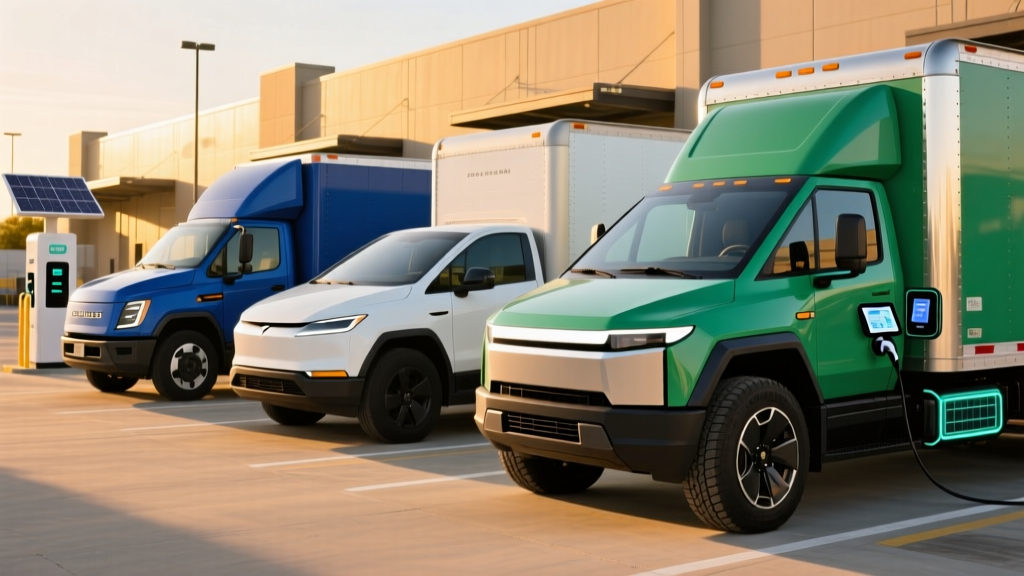
The 2026 market offers several production-ready EV box trucks across Class 2b through Class 5, with battery capacities ranging from 68 kWh to 220 kWh and EPA-estimated ranges from 108 to 272 miles. Major players include GM's BrightDrop, Ford Pro, Lightning eMotors, and Xos Trucks, each targeting slightly different duty cycles.
The business case hinges on a few realities: most urban delivery routes cover 60–120 miles daily, depot charging overnight on Level 2 is sufficient for those routes, and the cost per mile for electricity is roughly one-third that of diesel. But real-world variables — payload weight, stop frequency, HVAC use, and ambient temperature — compress range well below the EPA sticker.
Spec Comparison: Leading EV Box Trucks
| Spec | BrightDrop Zevo 600 | Ford E-Transit (Cutaway) | Lightning Electric Class 4 | Xos SV (Step Van) |
|---|---|---|---|---|
| GVWR Class | Class 3 (15,000 lbs) | Class 2b (9,500 lbs) | Class 4 (15,000–19,500 lbs) | Class 3 (15,000 lbs) |
| Battery Capacity | 165 kWh (NMC) | 68 kWh (NMC) | 198 kWh (NMC) | 169 kWh (LFP option avail.) |
| EPA Range | ~272 mi | ~108 mi | ~180 mi | ~200 mi |
| Real-World Range (loaded, mixed) | ~190–220 mi | ~75–90 mi | ~130–150 mi | ~145–170 mi |
| Peak DC Fast Charge | 120 kW | 115 kW | 85 kW | 100 kW |
| 10–80% DC Charge Time | ~55 min | ~45 min | ~90 min | ~75 min |
| Level 2 Charge Rate | 11.5 kW (~14 hr full) | 10.5 kW (~7 hr full) | 19.2 kW (~11 hr full) | 11.5 kW (~15 hr full) |
| Motor Output | 300 hp / 450 lb-ft | 266 hp / 317 lb-ft | 315 hp / 600 lb-ft | 280 hp / 500 lb-ft |
| Payload Capacity | ~5,200 lbs | ~3,800 lbs | ~7,500 lbs | ~5,000 lbs |
| Cargo Volume | 600 cu ft | 246 cu ft (cutaway upfit) | Varies by upfit | 550 cu ft |
| Base MSRP (est.) | ~$95,000 | ~$52,000 | ~$140,000 | ~$120,000 |
| Battery Warranty | 8 yr / 100,000 mi | 8 yr / 100,000 mi | 10 yr / 200,000 mi | 8 yr / 100,000 mi |
Note: Real-world range estimates reflect typical delivery duty cycles with 50–75% payload, frequent stops, and moderate climate-control use. Cold-weather operation (below 30°F) can reduce range an additional 20–35% depending on battery preconditioning and cabin-heating demands.
EV vs. Diesel Box Truck: Cost Comparison
The sticker price of an EV box truck is typically 1.5x to 2.5x that of a comparable diesel unit. But fleets don't buy on MSRP alone — they buy on cost per mile over a 5- to 10-year service life. Here's how the numbers stack up for a typical Class 3 delivery truck running 120 miles per day, 260 days per year.
| Cost Category | EV Box Truck | Diesel Box Truck | Notes |
|---|---|---|---|
| Vehicle Purchase | $95,000 | $55,000 | Before incentives |
| Federal Tax Credit (IRC §45W) | –$40,000 | $0 | Up to $40,000 for vehicles >14,000 lbs GVWR |
| State Incentive (avg.) | –$10,000 | $0 | Varies widely; CARB HVIP, NYTVIP, etc. |
| Net Vehicle Cost | $45,000 | $55,000 | EV can be cheaper after incentives |
| Fuel/Energy (5 years) | $14,500 | $47,000 | EV: $0.14/kWh avg. commercial; Diesel: $4.20/gal |
| Maintenance (5 years) | $8,200 | $14,500 | No oil, filters, DEF, fewer brake jobs (regen) |
| Depot Charging Infrastructure | $12,000 | $0 | Level 2 charger install + electrical upgrades |
| Insurance (5 years) | $18,000 | $15,500 | EV premiums ~10–15% higher on average |
| Total 5-Year Cost | $97,700 | $132,000 | EV saves ~$34,300 |
The crossover point — where cumulative EV savings surpass the upfront premium — typically arrives between years 2 and 4, depending on route mileage, local electricity rates, and available incentives. For high-mileage routes (150+ miles/day), the fuel savings accelerate payback. For low-mileage or seasonal routes, it may take 5+ years.
According to fueleconomy.gov, electric commercial vehicles convert over 77% of grid energy to wheel power, compared to roughly 12–30% for diesel engines. That efficiency gap is the primary driver of per-mile cost savings.
Charging Infrastructure: What Fleet Buyers Need
Home charging isn't relevant for most box truck buyers — depot charging is. And depot charging introduces infrastructure costs that don't exist for diesel fleets fueling at a truck stop.
Level 2 Depot Charging (Overnight)
Most delivery fleets charge overnight on Level 2 (19.2 kW or 11.5 kW AC) chargers. A single 19.2 kW Level 2 station adds roughly 40–55 miles of range per hour, sufficient to fully replenish a 165 kWh battery in 9–14 hours. For fleets running 100–150 miles daily, this is the workhorse solution.
Installation cost per charger: $4,000–$12,000 (hardware + electrician + panel upgrades + permitting). Costs escalate if the facility needs a new 480V service panel or transformer upgrade, which can add $15,000–$50,000+ for a multi-charger depot.
DC Fast Charging (Opportunity Charging)
For fleets needing mid-day top-ups or running extended routes, DC fast chargers (50–120 kW) can add 80–150 miles in 30–45 minutes. But commercial DCFC hardware runs $30,000–$80,000+ per unit, and installation with utility coordination can double that figure. Most small-to-mid-size fleets start with Level 2 only and add DCFC as route demands grow.
Utility Demand Charges
A hidden cost many first-time EV fleet buyers overlook: commercial electricity bills include demand charges based on peak kW draw. Simultaneously charging 10 trucks at 19.2 kW each creates a 192 kW peak that can trigger demand charges of $10–$25/kW/month in some utility territories — adding thousands per month. Smart charging software that staggers charge sessions is essential to manage this cost. Many utilities now offer EV-specific commercial rates with reduced demand charges; check with your local provider.
Real-World Ownership: What Catches Buyers Off Guard
Spec sheets tell one story. Route operations tell another. Here are the practical realities that experienced fleet managers factor in:
Payload Eats Range — Fast
A fully loaded box truck (75%+ payload) will see 15–25% less range than the EPA sticker. The BrightDrop Zevo 600's 272-mile EPA rating drops to roughly 200–220 miles with a 4,000-lb payload on a stop-heavy urban route. If your routes run close to the edge of rated range, spec conservatively.
Cold Weather Is Real Range Loss
Below 30°F, expect 20–35% range reduction, primarily from cabin heating and battery chemistry slowdown. Fleets in Minneapolis or Chicago need to plan routes around worst-case winter range, not summer best-case. Battery preconditioning (available on most 2026 models) helps but doesn't eliminate the loss. Some fleets spec auxiliary diesel heaters for cab warmth to preserve battery range in extreme cold — a pragmatic compromise.
Regenerative Braking Extends Brake Life
Stop-and-go delivery routes are where EVs shine mechanically. Regenerative braking handles the majority of deceleration, reducing friction-brake wear by 50–70%. Fleet operators report brake pad replacement intervals extending from 30,000 miles to 80,000+ miles. For a truck making 100+ stops daily, this is a meaningful maintenance savings.
Charging Deserts Exist for Commercial Vehicles
Public DC fast charging infrastructure for medium-duty trucks remains sparse. Unlike passenger EVs that can use Electrify America or Tesla Superchargers, box trucks need high-clearance pull-through stalls and often higher-power connectors. Most fleet operations cannot rely on public charging for daily duty — depot charging is non-negotiable for reliable operations.
Federal & State Incentives: The §45W Commercial Credit
The federal tax credit for commercial EVs operates under IRC §45W, which differs from the consumer §30D credit in important ways:
- Credit amount: Up to $7,500 for vehicles under 14,000 lbs GVWR; up to $40,000 for vehicles at or above 14,000 lbs GVWR.
- No MSRP cap: Unlike the consumer credit, there is no manufacturer's suggested retail price limit.
- No buyer income cap: Available to businesses and tax-exempt organizations regardless of income.
- Battery sourcing requirements: Similar to §30D — a percentage of battery components and critical minerals must be sourced from the US or free-trade-agreement partners. These percentages increase annually.
- Tax-exempt entities: Can receive the credit as a direct payment ("elective pay"), making it accessible to municipalities and nonprofits.
Many states layer additional incentives on top. California's HVIP program offers vouchers of $20,000–$120,000 for medium-duty EV trucks, and New York's NYTVIP provides similar support. Always verify current program funding status — these programs frequently exhaust allocated funds and reopen in new cycles.
Common Misconceptions About EV Box Trucks
| Myth | Fact |
|---|---|
| "EV trucks can't handle a full day's work." | Most urban delivery routes cover 60–120 miles/day. Even the Ford E-Transit's 75–90 real-world miles covers many routes; the Zevo 600 and Xos SV handle 150+ miles loaded. |
| "Battery replacement will bankrupt the fleet." | Battery warranties run 8–10 years / 100,000–200,000 miles. NMC degradation data shows ~10–15% capacity loss at 200,000 miles. Full replacement costs $25,000–$45,000 but is rarely needed within the vehicle's service life. |
| "Charging takes too long for commercial use." | Overnight Level 2 charging is sufficient for most routes. Opportunity DCFC adds 100+ miles in 30–45 minutes for extended routes. Fleet scheduling adapts; it's a planning challenge, not a dealbreaker. |
| "EVs are worse in cold climates." | Range loss is real (20–35%), but EVs start reliably in cold weather (no glow plugs, no diesel gelling). Preconditioning and route planning mitigate the range penalty. |
| "The grid can't handle fleet charging." | Utility demand charges are a real cost, but smart charging software and utility EV rate programs manage peak loads. Most depots can support 10–20 Level 2 chargers without grid upgrades. |
Decision Framework: Is an EV Box Truck Right for Your Fleet?
Choose an EV Box Truck If:
- Your daily routes are under 150 miles (loaded) with predictable start/end at a depot
- You have access to depot parking where Level 2 chargers can be installed
- Your operation is in a state with strong commercial EV incentives (CA, NY, NJ, CO, WA)
- Your routes involve frequent stops (delivery, service calls) — maximizing regenerative braking benefits
- You plan to hold vehicles 5+ years to capture full TCO savings
- Your fleet operates primarily in urban or suburban areas where diesel idling restrictions or clean-air-zone rules apply
Stick with Diesel or Consider a Hybrid If:
- Your daily routes regularly exceed 200 miles with no mid-day charging opportunity
- You operate in extreme cold (consistent sub-zero temps) without heated garages
- Your trucks tow heavy trailers or carry near-max payload on long highway runs
- You lack depot parking or the electrical service to support charging infrastructure
- You need the flexibility to reassign trucks to unpredictable long-haul routes on short notice
- Your operation is in a rural area with no utility EV rate programs and high commercial electricity costs
The Hybrid Middle Ground
For fleets that need more range than a BEV offers but want to reduce fuel costs and emissions, plug-in hybrid (PHEV) and range-extended EV (EREV) box trucks are emerging. These offer 30–50 miles of electric-only range for urban segments, then switch to a diesel or gasoline range extender for highway miles. The trade-off: higher complexity, dual-system maintenance, and smaller (but still meaningful) fuel savings of 25–40%.
First-Time EV Fleet Buyer Checklist
If this is your fleet's first electric truck, here's what to address before signing a purchase order:
- Audit your routes. Pull GPS or telematics data for 30 days. What's the max daily mileage? The 95th-percentile day, not the average, determines whether an EV works.
- Survey your depot's electrical capacity. Hire an electrician to assess your panel. Can it support 10–20 kW per charger across multiple bays? Budget $5,000–$50,000 for infrastructure upgrades.
- Contact your utility. Ask about commercial EV charging rates, demand-charge structures, and make-ready incentive programs. Many utilities will fund the wiring to your site.
- Model your TCO honestly. Include infrastructure, demand charges, insurance premiums, and realistic energy costs — not just the fuel-vs-electricity comparison.
- Verify incentive eligibility. Check IRC §45W battery-sourcing requirements for the specific model year you're buying. Confirm state incentive funding availability — apply early.
- Start with 1–2 trucks. Pilot before committing fleet-wide. Learn the charging logistics, driver adaptation, and route-fit realities before scaling.
- Plan for driver training. Regen braking behavior, range-aware driving habits, and charge-plug-in procedures require onboarding. Most drivers adapt within a week, but plan for it.
Frequently Asked Questions
What's the cheapest EV box truck available in 2026?
The Ford E-Transit cutaway starts around $52,000 before incentives, making it the most affordable entry point. However, its 108-mile EPA range (75–90 miles real-world loaded) limits it to shorter urban routes. After the $7,500 §45W credit (under 14,000 lbs GVWR), effective cost drops to ~$44,500.
How long do EV box truck batteries last?
NMC batteries in commercial service typically retain 85–90% capacity at 150,000 miles and 80–85% at 200,000 miles based on fleet degradation data. All major manufacturers warrant batteries for 8–10 years or 100,000–200,000 miles at a minimum 70% capacity retention threshold. LFP batteries (available on some Xos models) offer longer cycle life but lower energy density, meaning heavier battery packs for equivalent range.
Can I charge an EV box truck at a public station?
Technically yes, but practically it's difficult. Most public DCFC stations are designed for passenger vehicles — low clearance, tight pull-in spots, and 150–350 kW chargers that many commercial trucks can't fully utilize. Some networks (like EVgo and ChargePoint) are adding commercial-priority locations, but depot charging remains the backbone of fleet operations.
Do EV box trucks qualify for the $7,500 consumer tax credit?
No. Commercial vehicles are eligible under a different credit — IRC §45W — which offers up to $7,500 for vehicles under 14,000 lbs GVWR and up to $40,000 for heavier vehicles. The §45W credit has no MSRP cap and no buyer income cap, but does include battery-sourcing requirements that tighten annually.
What happens if a truck runs out of charge on a route?
Unlike a diesel truck that can be refueled in 10 minutes from a jerry can, a depleted EV requires a flatbed tow or a mobile charging unit. Most fleets prevent this through conservative route planning (keeping a 20–30% range buffer), telematics-based charge monitoring, and driver protocols that mandate plugging in immediately upon return to depot.
Are EV box trucks slower or less powerful than diesel equivalents?
No. Electric motors deliver peak torque at 0 RPM, giving EV box trucks strong launch performance and hill-climbing ability even when loaded. The BrightDrop Zevo 600's 450 lb-ft of torque outperforms most diesel Class 3 trucks in stop-and-go acceleration. Top speeds are electronically governed to 65–75 mph for efficiency, which is appropriate for commercial use.