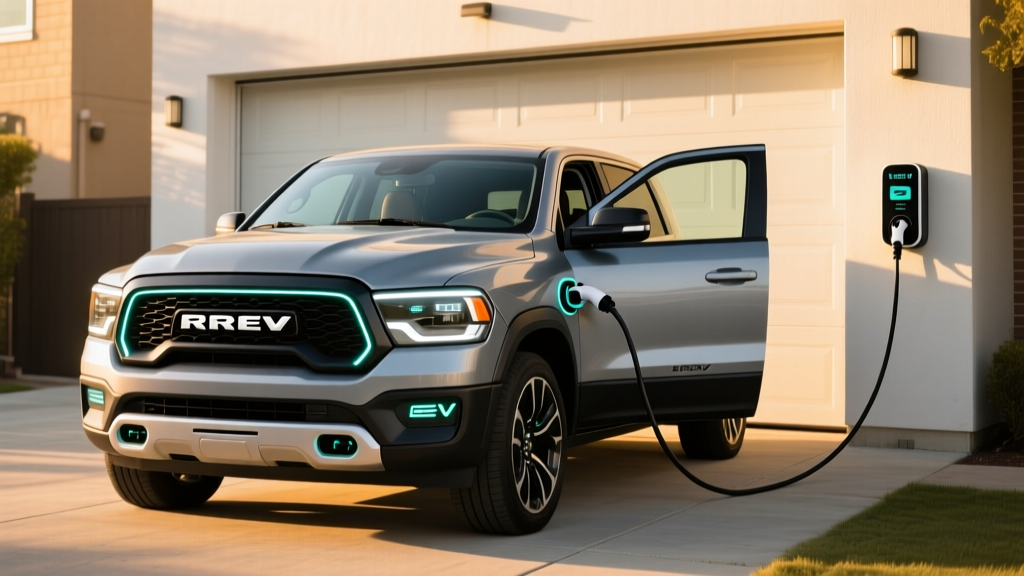
If you've been shopping for an electrified truck, you've likely encountered the acronym EREV and wondered how it differs from a standard battery-electric vehicle or a plug-in hybrid. Understanding the EREV meaning is critical before you spend $60,000+ on a vehicle that behaves differently than a pure BEV or a traditional PHEV. In this review, we'll define the term clearly, then put the concept to the test with one of the most anticipated EREVs on the market: the 2026 Ram 1500 REV.
What Does EREV Mean? The Powertrain Explained
EREV stands for Extended-Range Electric Vehicle. Unlike a plug-in hybrid (PHEV), where the gasoline engine can mechanically drive the wheels alongside the electric motor, an EREV's gas engine never connects to the drivetrain. The wheels are always and exclusively turned by electric motors. The onboard gasoline engine functions solely as a generator — it produces electricity to recharge the battery or feed the motors directly when the battery is depleted.
Think of it this way: a pure BEV (like a Tesla Model Y or Ford F-150 Lightning) runs entirely on battery energy. A PHEV (like a Toyota RAV4 Prime) blends engine and electric drive. An EREV sits between them — it drives like a pure EV at all times, but carries a gas-powered "range extender" generator as a backup to eliminate range anxiety on long trips or heavy-load scenarios.
- BEV: Battery only. No gas. Plug-in charging required. (e.g., Ford F-150 Lightning)
- PHEV: Battery + gas engine, both can drive wheels. Short EV range (20-50 mi). (e.g., Toyota RAV4 Prime)
- EREV: Battery + gas generator. Wheels always electric. Longer EV range (50-170+ mi). (e.g., Ram 1500 REV)
2026 Ram 1500 REV: Real-World Range and Efficiency
The 2026 Ram 1500 REV is offered with two battery configurations, and this is where the EREV meaning becomes tangible in everyday driving. The standard pack targets daily electric commuting, while the larger pack pushes the electric-only envelope for drivers who rarely want to visit a gas station.
| Spec | Standard Battery (150 kWh) | Max Battery (200 kWh) |
|---|---|---|
| EPA Est. Range (EV only) | ~230 miles | ~320 miles |
| Total Range (EV + Generator) | ~470+ miles | ~560+ miles |
| Battery Chemistry | NMC (Nickel Manganese Cobalt) | NMC |
| Efficiency (EV mode) | ~65 kWh/100 mi | ~63 kWh/100 mi |
| MPGe (EV mode) | ~52 MPGe | ~54 MPGe |
| Generator Fuel (when active) | 3.6L V6 — est. 18-22 mpg combined | 3.6L V6 — est. 18-22 mpg combined |
The EPA estimates above assume moderate temperatures and mixed driving. In real-world highway testing at 75 mph, expect approximately 15-20% less range from the EV battery — so the 230-mile pack delivers roughly 185-195 highway miles before the generator kicks in, and the 320-mile pack yields around 255-275 miles. In cold weather (below 30°F), lithium-ion chemistry loses efficiency; plan for an additional 20-30% reduction in EV-only range. The generator ensures you're never stranded, but your fuel costs will rise when it activates frequently.
Charging Speed: DC Fast Charge and Home Level 2
Charging an EREV is identical to charging a pure BEV — you plug into the same networks and hardware. The Ram 1500 REV uses a CCS1 connector (with a NACS adapter expected to be included or available for Tesla Supercharger access). Because the battery packs are large, charging speed matters enormously for road-trip practicality.
| Charging Level | Power / Rate | Time / Miles Added |
|---|---|---|
| Level 1 (120V household) | ~1.4 kW | ~2-3 miles per hour |
| Level 2 (240V home / public) | 11.5 kW (48A onboard charger) | ~17-20 miles per hour; full charge in 13-18 hours |
| DC Fast Charge (peak) | Up to 180 kW | 10-80% in ~35-40 minutes (est.) |
| DC Fast Charge (sustained avg.) | ~110-130 kW average | Adds ~100 miles in ~20 minutes |
A critical note on the charging curve: like all large NMC packs, the Ram 1500 REV will peak at 180 kW only at a low state of charge (roughly 10-25% SoC). As the battery fills past 60%, the charge rate tapers significantly — above 80%, expect speeds to drop below 50 kW. This is normal battery physics, not a defect. For daily driving, home Level 2 charging overnight is the most practical and cost-effective strategy. On road trips, the generator eliminates the need to wait for a full charge — you can charge to 60-70% and let the engine-generator extend your range as needed.
Source: Ram Trucks Official — 1500 REV
Performance: Horsepower, 0-60, and Drivetrain
Because an EREV's wheels are always driven by electric motors, the Ram 1500 REV delivers the instant torque characteristic of pure EVs — regardless of whether the battery or the generator is supplying the electricity.
- Powertrain: Dual-motor AWD (front and rear electric motors)
- Horsepower: 654 hp (combined system output)
- Torque: 620 lb-ft
- 0-60 mph: ~4.4 seconds (manufacturer estimated)
- Towing Capacity: Up to 14,000 lbs (properly equipped)
- Payload: Up to 2,700 lbs
The dual-motor setup provides confident traction in all conditions, and the low center of gravity from the under-floor battery pack reduces body roll compared to a conventional gas truck. The 4.4-second 0-60 time puts it in sports-sedan territory while hauling a full crew cab — a remarkable feat for a full-size pickup.
Pricing, Trim Levels, and Federal Tax Credit Eligibility
The Ram 1500 REV's pricing reflects its premium positioning and massive battery packs. Here's the expected trim breakdown for the 2026 model year:
| Trim | Battery | MSRP (est.) |
|---|---|---|
| Tradesman | 150 kWh | ~$58,000 |
| Big Horn / Lone Star | 150 kWh | ~$63,000 |
| Laramie | 150 kWh | ~$70,000 |
| Limited | 200 kWh | ~$85,000 |
| Tungsten | 200 kWh | ~$90,000+ |
- The §30D credit offers up to $7,500 for qualifying new EVs, but eligibility depends on multiple factors that change frequently.
- MSRP Cap: Trucks/vans/SUVs must have an MSRP at or below $80,000. This means the Tradesman, Big Horn, and Laramie trims likely qualify on price, while the Limited and Tungsten may exceed the cap.
- Income Cap: Buyer AGI must not exceed $150,000 (single), $225,000 (head of household), or $300,000 (joint).
- Battery Sourcing: Critical minerals and battery components must meet phased-in domestic-content and free-trade-agreement thresholds per IRS §30D rules. The Ram 1500 REV's large NMC pack may face partial-credit challenges depending on supply-chain sourcing.
- Point-of-Sale Transfer: As of 2024+, eligible buyers can transfer the credit to the dealer at purchase, reducing the upfront price rather than waiting for a tax refund.
Always verify current-year eligibility with a tax professional and the IRS Clean Vehicle Credit page before purchasing.
Interior, Cargo, and Technology
The Ram 1500 REV leverages Stellantis' latest STLA Frame platform, and the interior reflects the premium ambitions of the Tungsten and Limited trims.
- Infotainment: 14.5-inch central touchscreen (Uconnect 5), 12.3-inch digital cluster, available 10.25-inch passenger display
- Driver Assistance: SAE Level 2 — Active Driving Assist with hands-on-wheel supervision; available Active Driving Assist Plus with hands-off capability on mapped highways (driver must remain attentive)
- Frunk (Front Trunk): ~15 cu ft of lockable, weather-sealed storage — a major EREV/BEV advantage over gas trucks
- Bed Length: 5'7" (standard crew cab configuration)
- Rear Legroom: ~45.2 inches (crew cab)
- V2L (Vehicle-to-Load): Onboard power outlets (up to 7.2 kW) for job-site tools or tailgating
The frunk is a standout feature unique to electrified trucks — 15 cubic feet of secure, drainable storage where a gas engine would normally sit. For contractors, this means locking up tools without using the bed. For families, it's extra luggage space on road trips.
Warranty Coverage
| Coverage | Term |
|---|---|
| Basic (bumper-to-bumper) | 3 years / 36,000 miles |
| Powertrain (motors + generator) | 5 years / 60,000 miles |
| Battery Pack | 8 years / 100,000 miles (min. 70% capacity retention) |
| Corrosion | 5 years / unlimited miles |
The 8-year/100,000-mile battery warranty is federally mandated for EVs and PHEVs/EREVs and aligns with industry standards set by competitors like the Ford F-150 Lightning and Chevrolet Silverado EV. The 70% capacity retention threshold means Ram will repair or replace the battery if it degrades below that level within the warranty period.
Pros and Cons: The EREV Trade-Off
✅ Pros
- No range anxiety — generator provides 470-560+ total miles
- Pure EV driving feel with instant torque (654 hp, 4.4s 0-60)
- Massive 15 cu ft frunk for secure storage
- Class-leading 14,000-lb towing capacity
- V2L capability for job-site or camping power
- Daily EV commuting possible (185-275 real-world EV miles)
- Premium interior with up to 3 screens
❌ Cons
- Heavy — large battery + generator adds ~1,500+ lbs vs gas Ram
- High MSRP — $58K-$90K+; top trims exceed $80K tax-credit cap
- DC fast charging peaks at 180 kW — slower than some BEV trucks
- Generator requires gas-engine maintenance (oil, filters, spark plugs)
- Real-world EV range drops significantly in cold weather and at highway speeds
- Fuel economy when generator runs (~18-22 mpg) is modest for the weight
- Limited dealer/service familiarity with EREV systems at launch
Who Should Buy the Ram 1500 REV (and Who Shouldn't)?
- You need a full-size truck for towing or payload but want to commute on electricity most days
- You regularly drive 200+ miles in a day and can't rely on charging infrastructure alone
- You value the frunk and V2L for work or recreation
- You want EV torque without committing to a pure BEV in a region with sparse DC fast chargers
- You have reliable home charging and rarely exceed 250 miles in a day
- You want zero engine maintenance and the lowest possible per-mile energy cost
- You prioritize peak DC fast-charge speed for frequent road trips
- You want a lower starting price and don't need 300+ miles of EV-only range
- Your daily commute is under 50 miles and you tow occasionally
Frequently Asked Questions
Is an EREV better than a pure EV?
It depends on your use case. An EREV like the Ram 1500 REV is better if you regularly drive beyond the battery's range and can't depend on charging infrastructure. A pure BEV is simpler, cheaper to maintain (no gas engine), and often charges faster. For urban commuters with home charging, a BEV usually wins on total cost of ownership. For rural drivers, contractors, or frequent long-haul towers, the EREV's generator backup is a genuine advantage.
Does the Ram 1500 REV qualify for the $7,500 federal tax credit?
Possibly — but it depends on the trim, your income, and battery-sourcing compliance. Trims under the $80,000 MSRP cap (Tradesman, Big Horn, Laramie) are eligible on price. You must also meet IRS income limits and the vehicle's battery must satisfy critical-mineral and component-sourcing requirements per current IRS §30D guidance. Always confirm with your tax advisor before relying on the credit.
How much does it cost to charge the Ram 1500 REV at home?
At the US average electricity rate of ~$0.17/kWh (per EIA data), fully charging the 150 kWh pack costs roughly $25.50, and the 200 kWh pack costs about $34.00. That equates to approximately $0.11-$0.12 per mile in EV mode — significantly less than gasoline at $3.50/gallon and 18 mpg (~$0.19/mile). Over 15,000 miles/year of EV-mode driving, you'd spend roughly $1,700 on electricity vs. $2,900 on gasoline.
What happens when the battery runs out — does the truck stop?
No. This is the core advantage of the EREV meaning in practice. When the battery depletes to its minimum buffer (typically around 5-10% SoC), the 3.6L V6 generator automatically starts and begins producing electricity to power the motors. The transition is designed to be seamless — you'll hear the engine start, but the driving experience remains electric. You refuel the generator like any gas vehicle at a standard gas station.
How does the Ram 1500 REV compare to the Ford F-150 Lightning?
The F-150 Lightning is a pure BEV with up to ~320 miles of EPA range (extended-range battery), 580 hp, and a starting MSRP around $55,000. The Lightning charges faster (up to ~210 kW peak on higher trims) and has no gas engine to maintain. However, once the Lightning's battery is depleted, you must find a charger. The Ram 1500 REV's generator gives it effectively unlimited range with access to any gas station — a meaningful advantage for towing long distances or driving in charging-desert regions. Choose Lightning for simplicity and lower maintenance; choose the REV for range insurance and total miles between stops.