The Quick Answer: What Is the Ellen Electric Ferry?
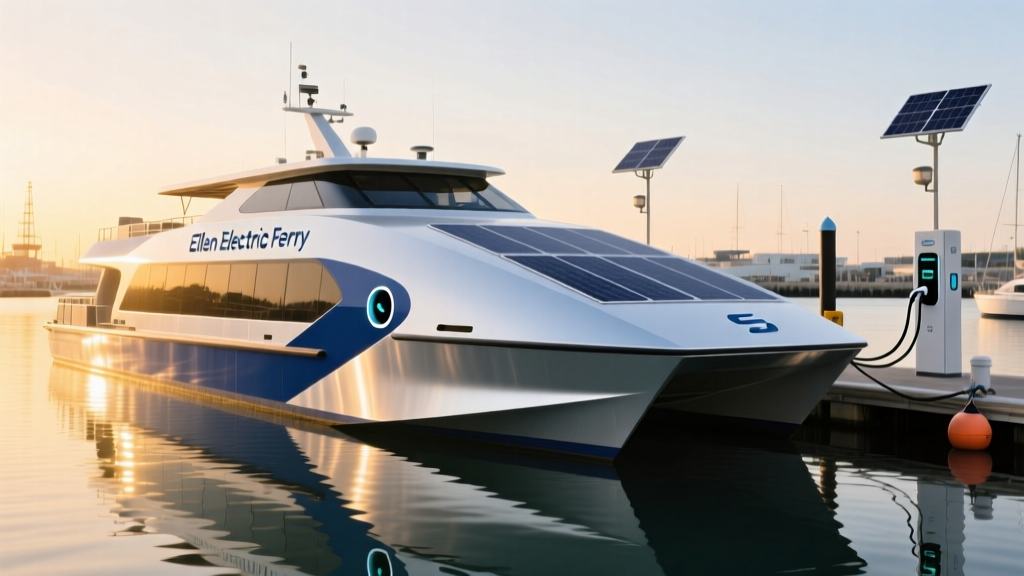
The Ellen electric ferry is a fully battery-electric passenger and vehicle ferry operating between the Danish islands of Ærø and Fynshav since 2019. It carries up to 30 cars and 200 passengers on a 22-nautical-mile (roughly 25 statute miles) route, powered by a 4.3 MWh (4,300 kWh) lithium-titanate-oxide (LTO) battery pack — roughly 50 to 70 times the capacity of a typical long-range electric car. For EV shoppers and fleet planners, Ellen is the benchmark proving that short-sea maritime routes can be fully electrified with current battery technology, and its operating economics offer a direct parallel to the EV-vs-gas ownership debate on land.
Ellen's Specs: Battery, Range, and Charging at a Glance
Understanding Ellen's engineering is essential before drawing parallels to passenger EVs. The ferry was built by the Danish shipyard Søby Værft under the EU-backed E-Ferry project, and its specifications read like a scaled-up electric vehicle platform:
| Specification | Ellen Electric Ferry | Comparable Passenger EV (e.g., 2026 Tesla Model Y LR) |
|---|---|---|
| Battery capacity | 4,300 kWh (4.3 MWh), LTO chemistry | ~78 kWh usable, NMC |
| Range per charge | 22 nautical miles (~25 mi / 40 km) | EPA 320 mi (~515 km) |
| Charging power | ~4.4 MW peak (shore-side DC) | 250 kW peak DC fast charge |
| Full charge time | ~1.5 hours (round-trip turnaround) | 10–80% in ~18 min |
| Passenger capacity | 200 passengers + 30 cars | 5 passengers |
| Operating speed | 15.5 knots (~18 mph) | N/A (top speed 125 mph) |
| Propulsion | 2 × 750 kW electric azimuth thrusters | Dual-motor AWD, ~384 HP |
The most instructive spec is the battery chemistry. Ellen uses lithium-titanate-oxide (LTO) rather than the NMC or LFP chemistries common in passenger EVs. LTO sacrifices energy density for extreme cycle life (15,000+ cycles), rapid charge acceptance, and superior thermal stability — the same trade-off calculus EV buyers face when choosing between LFP and NMC packs in cars like the Tesla Model 3 RWD (LFP) versus the Model 3 Long Range (NMC).
Operating Costs: Electric Ferry vs. Diesel Ferry
The economic case for Ellen mirrors the EV-vs-gas debate almost exactly. The E-Ferry project consortium published operating data showing substantial cost reductions compared to the diesel ferry Ellen replaced:
| Cost Category | Diesel Ferry (Annual) | Ellen Electric (Annual) | Savings |
|---|---|---|---|
| Energy/fuel | ~DKK 7.5M (~$1.1M USD) | ~DKK 3.0M (~$440K USD) | ~60% |
| Maintenance | ~DKK 3.0M (~$440K USD) | ~DKK 1.5M (~$220K USD) | ~50% |
| Crew (comparable) | ~DKK 8.0M | ~DKK 7.0M (reduced engine-room staff) | ~12% |
| Total annual operating | ~DKK 18.5M (~$2.7M) | ~DKK 11.5M (~$1.7M) | ~38% total |
This tracks with what EV owners experience on land. According to fueleconomy.gov, a typical electric vehicle costs roughly $0.04–$0.06 per mile in electricity versus $0.12–$0.18 per mile in gasoline (at 2025–2026 average U.S. energy prices). The ferry's 60% energy-cost reduction is even steeper because marine diesel is taxed and priced higher per energy unit than grid electricity in Denmark.
For EV buyers weighing a purchase, the parallel is clear: the higher upfront cost of electrification (Ellen cost approximately DKK 120M / ~$17.5M to build, roughly 30–40% more than a comparable diesel vessel) pays back through operating savings over a 10–15 year service life. Passenger EVs follow the same curve, with the payback window typically falling between years 3 and 7 depending on mileage, local electricity rates, and whether the buyer qualifies for the IRS §30D federal tax credit.
Real-World Ownership: What Ellen Teaches EV Buyers
Ellen's five-plus years of service have surfaced practical lessons that apply directly to passenger EV ownership:
1. Range Must Match the Route — Not the Spec Sheet
Ellen's 22-nautical-mile range is purpose-built for a fixed route. It doesn't need the 50+ nautical miles a larger ferry might require, just as a commuter who drives 30 miles daily doesn't need a 350-mile EPA-rated EV. The mistake — in maritime and automotive — is overpaying for surplus range. A 2026 Hyundai Ioniq 6 SE Long Range (EPA 361 mi, ~$38,000 base) is wasted on a 20-mile daily commute where a Standard Range variant or a PHEV would suffice.
2. Charging Infrastructure Is the Bottleneck
Ellen charges via a custom 4.4 MW shore-side connection at the Ærø port — a purpose-built installation that cost millions. The lesson for EV buyers: your charging experience depends entirely on your infrastructure. If you can install a Level 2 home charger (240V, 32–48A, adding 25–40 miles of range per hour), daily ownership is effortless. If you rely solely on public DC fast charging, expect inconsistent reliability, higher per-kWh costs ($0.35–$0.60/kWh at Electrify America or EVgo versus $0.12–$0.18/kWh at home), and charge-curve taper that makes 10–80% fast but 80–100% painfully slow.
3. Cold Weather and Sea State Reduce Range
Ellen's energy consumption rises 15–25% in winter due to headwinds, cold battery temperatures, and heavier sea states. Passenger EVs see a similar 15–30% range reduction in freezing weather, particularly in vehicles without a heat pump (standard on most 2026 Hyundai/Kia and Tesla models, still optional or absent on some GM and Stellantis EVs). Always budget real-world range at 70–80% of the EPA sticker in cold climates.
4. Battery Degradation Is Manageable With Chemistry Choice
Ellen's LTO chemistry was chosen specifically for its 15,000+ cycle life and minimal degradation — the ferry's operators report less than 5% capacity loss after years of daily full-cycle use. Passenger EVs using NMC chemistry typically see 8–12% degradation over 8 years/100,000 miles, while LFP packs (Tesla Model 3 RWD, Ford Mustang Mach-E Select) show 5–8% over the same period. All major manufacturers warranty their batteries for 8 years/100,000 miles with a minimum 70% capacity retention threshold, per federal mandate.
Common Misconceptions About Electric Ferries (and EVs)
| Myth | Fact |
|---|---|
| "Batteries can't power a vehicle that large." | Ellen carries 30 cars and 200 passengers on a 4.3 MWh pack. Electric school buses (200+ kWh) and semi-trucks (900 kWh, e.g., Tesla Semi) operate daily. |
| "Electric ferries are just concept projects." | Ellen has operated on a scheduled commercial route since August 2019. Norway's Ampere (since 2015) and dozens of Chinese electric ferries are in daily service. |
| "Charging takes too long for scheduled service." | Ellen charges in ~90 minutes during its scheduled port turnaround, matching the route's timetable. Passenger EVs at 250–350 kW chargers add 150–250 miles in 15–20 minutes. |
| "EVs don't save money long-term." | Ellen saves ~38% on total operating costs annually. Consumer Reports estimates average EV lifetime savings of $6,000–$10,000 over a gas equivalent in fuel and maintenance. |
| "Batteries will need constant replacement." | Ellen's LTO pack is rated for 15,000+ cycles (40+ years of daily use). Passenger EV batteries are warrantied for 8 years/100,000 miles and typically last 15–20 years before reaching 70% capacity. |
EV vs. Gas vs. Hybrid: A Buyer's Decision Framework
Whether you're evaluating a passenger EV, a PHEV, or waiting for broader maritime electrification to influence your next purchase, here's how to think about the decision with real numbers:
| Factor | Battery EV (e.g., 2026 Model Y LR) | PHEV (e.g., 2026 Toyota RAV4 Prime) | Gas (e.g., 2026 RAV4 LE) |
|---|---|---|---|
| Base MSRP | ~$44,990 | ~$43,690 | ~$30,495 |
| Fed. tax credit (§30D) | Up to $7,500 (if eligible) | Up to $7,500 (if eligible) | $0 |
| Effective price | ~$37,490 | ~$36,190 | $30,495 |
| Energy cost / mile | $0.045 (home L2, $0.15/kWh) | $0.05 (electric) / $0.13 (gas) | $0.13 ($3.50/gal, 28 MPG) |
| Annual fuel (15K mi) | ~$675 | ~$975 (blended) | ~$1,950 |
| 5-year fuel cost | ~$3,375 | ~$4,875 | ~$9,750 |
| Maintenance / year | ~$300 | ~$600 | ~$900 |
| 5-year total cost (purchase + fuel + maint.) | ~$42,365 | ~$44,065 | ~$39,495 |
The numbers tell the same story Ellen's operators learned: electrification carries a higher upfront cost but wins on operating economics within 4–7 years. The variable that changes the equation is your access to cheap home charging. At $0.15/kWh residential rates, an EV costs pennies per mile. At $0.55/kWh public DC fast-charging rates, the savings narrow significantly.
What First-Time EV Buyers Should Know
Ellen's success was not accidental — it was engineered around a specific route with known energy demands, a purpose-built charger, and a battery chemistry matched to the duty cycle. Apply the same discipline to your purchase:
If X, Then Y: Your EV Decision Guide
- If you have a garage or driveway with 240V access → a BEV is likely ideal. Install a Level 2 charger ($500–$2,000 including electrical work) and you'll wake up to a full "tank" daily at the lowest per-mile cost.
- If you rent or lack home charging → a PHEV is often the smarter move. You get 25–42 miles of electric-only range for daily errands plus a gas engine for longer trips, without depending on public charging reliability.
- If your daily commute is under 40 miles and you want maximum savings → consider a used EV to capture depreciation savings and the up to $4,000 used EV credit (§25E).
- If you regularly drive 300+ miles in a day or live in a charging desert → a PHEV or a long-range BEV (350+ EPA miles) with NACS access to the Tesla Supercharger network (now open to Ford, Rivian, and others via adapter) is essential.
- If you live in a cold climate (below 20°F winters) → prioritize a BEV with a heat pump and preconditioning capability, and budget 20–30% below EPA range for winter driving. Alternatively, a PHEV eliminates cold-range anxiety entirely.
Tax Credit Eligibility: The 2026 Rules That Actually Matter
The IRS §30D clean vehicle credit remains available in 2026, but eligibility is strict and model-specific:
- Maximum credit: $7,500 for new BEVs and PHEVs ($3,750 if only battery-component or only critical-minerals requirements are met)
- MSRP caps: $80,000 for SUVs, vans, and pickups; $55,000 for sedans
- Buyer income caps: $150K single / $225K head of household / $300K joint (modified AGI)
- Battery sourcing: Increasing percentages of critical minerals and battery components must be sourced from the U.S. or FTA partners — this disqualifies some models with China-sourced cells
- Point-of-sale transfer: Buyers can transfer the credit to the dealer at purchase, reducing the sale price directly rather than waiting for a tax refund
- FEOC restriction: Vehicles with battery components from a "foreign entity of concern" (primarily Chinese manufacturers) are ineligible
Always verify a specific model's eligibility on fueleconomy.gov before purchasing — the qualified-vehicle list changes frequently as automakers adjust supply chains. Consult a tax professional for your personal situation.
FAQ: Ellen Electric Ferry and EV Ownership
Can I visit or ride the Ellen electric ferry?
Yes. Ellen operates year-round on the Ærø–Fynshav route in southern Denmark, managed by Ærø Kommune. The crossing takes approximately 70 minutes. It carries foot passengers and vehicles, and tickets can be booked through the operator's website.
What battery chemistry does Ellen use, and why does it matter for EVs?
Ellen uses LTO (lithium-titanate-oxide) cells, chosen for extreme cycle life and rapid charging over energy density. Passenger EVs typically use NMC (nickel-manganese-cobalt) or LFP (lithium iron phosphate). LFP offers a middle ground — longer cycle life and lower cost than NMC, but lower energy density. The Tesla Model 3 RWD and Ford Mustang Mach-E Select both use LFP packs.
How does Ellen's cost-per-mile compare to a passenger EV?
Ellen's energy cost works out to roughly $15–20 per nautical mile in electricity, compared to $40–50 per nautical mile in marine diesel for the ferry it replaced. That's a 55–65% energy savings. A passenger EV saves a similar 50–65% on fuel cost per mile versus a gas car when charging at home ($0.045/mi vs. $0.13/mi at 2026 average U.S. prices).
Are there electric ferries operating in the United States?
Several U.S. operators have launched or announced electric ferries, including Washington State Ferries (planned hybrid-electric conversions) and New York's NYC Ferry (which has explored battery-electric vessels). Full-electric ferries in the U.S. remain less common than in Scandinavia and China due to longer routes and regulatory complexity, but the Ellen project is frequently cited as the proof-of-concept for short-sea electrification.
What should a first-time EV buyer prioritize over everything else?
Home charging access. A Level 2 home charger transforms EV ownership from a logistics challenge into a convenience advantage. If you cannot charge at home, prioritize a PHEV or ensure you have reliable, affordable public charging within 5 minutes of your home or workplace before committing to a BEV.