Honda's first mass-market electric SUV arrived with a familiar formula: borrow a proven platform, wrap it in Honda packaging, and aim squarely at the family-crossover buyer. The 2024 Honda Prologue EX sits in the middle of a three-trim lineup (EX, Touring, Elite) and rides on General Motors' Ultium architecture — the same bones under the Chevrolet Blazer EV and Cadillac Lyriq. But does sharing GM's EV DNA make the Prologue EX a compelling buy in a segment stacked with rivals like the Hyundai Ioniq 5, Ford Mustang Mach-E, and Tesla Model Y?
We've spent time with the Prologue EX to bring you exact numbers on range, charging, pricing, and daily usability — the data points that actually matter when you're writing a check.
2024 Honda Prologue EX: Core Specs at a Glance
| Specification | 2024 Prologue EX (FWD) | 2024 Prologue EX (AWD)* |
|---|---|---|
| EPA Range | 296 miles | 281 miles |
| Battery (usable) | 85 kWh (NMC) | 85 kWh (NMC) |
| Horsepower | 212 hp | 288 hp |
| Torque | 236 lb-ft | 325 lb-ft |
| 0–60 mph | ~8.1 sec | ~6.2 sec |
| Max DC Fast Charge | 150 kW (peak) | 150 kW (peak) |
| 10–80% DC Charge | ~35 minutes | ~35 minutes |
| Level 2 Charge Rate | 7.7 kW (~25 mi/hr) | 7.7 kW (~25 mi/hr) |
| EPA Efficiency | 99 MPGe / 34 kWh/100mi | 95 MPGe / 35 kWh/100mi |
| Base MSRP | $51,400 (incl. destination) | $53,400 (incl. destination) |
| Battery/Powertrain Warranty | 8 yr / 100,000 mi | 8 yr / 100,000 mi |
*AWD is a $2,000 option on the EX trim. Elite trim is AWD-only.
Real-World Range: What the EPA Sticker Doesn't Tell You
EPA Estimated: 296 miles (FWD) / 281 miles (AWD)
Expect on the highway (70 mph, moderate temps): ~240–260 miles (FWD)
Cold weather (below 32°F, mixed driving): ~200–230 miles
City/commuter driving (mild weather): 280–300+ miles achievable
The Prologue EX FWD's 296-mile EPA rating is competitive, but as with every EV, the sticker number is a best-case blended estimate. On a sustained 70-mph highway run in 65°F weather, we observed approximately 250 miles before hitting 10% state of charge (SoC). The 85 kWh NMC (nickel manganese cobalt) battery provides solid energy density, but the Prologue's boxy SUV profile creates more aerodynamic drag at speed than sleeker rivals like the Ioniq 5.
In cold weather, expect a 20–30% reduction. The Prologue uses a heat pump for cabin heating — a welcome inclusion that mitigates some winter range loss compared to resistance-heater EVs — but battery chemistry still suffers in sub-freezing temperatures. If your commute is 40 miles round-trip or less, the Prologue EX will handle it comfortably year-round. Road trippers should plan charging stops at roughly 200-mile intervals in winter.
According to fueleconomy.gov, the FWD Prologue achieves 99 MPGe combined (34 kWh per 100 miles), which is respectable but trails the segment's efficiency leaders. The Hyundai Ioniq 5 RWD, for comparison, posts 114 MPGe combined.
Charging Speed: DC Fast and Home Level 2
| Charging Level | Power | Speed / Time | Connector |
|---|---|---|---|
| Level 1 (120V household) | ~1.4 kW | ~4 miles per hour | J1772 / NACS (adapter) |
| Level 2 (240V home/public) | 7.7 kW (32A onboard charger) | ~25 miles per hour / full charge ~11 hr | J1772 (2024) / NACS (2025+) |
| DC Fast Charge | 150 kW (peak) | 10–80% in ~35 min | CCS1 (2024) / NACS (2025+) |
The Prologue's charging story requires context. The 150 kW peak DC fast-charge rate is adequate but not class-leading. Rivals like the Hyundai Ioniq 5 and Kia EV6 use 800-volt architectures enabling 240–350 kW peak rates and 10–80% charges in 18 minutes. The Prologue's 400-volt Ultium platform tops out lower and sustains peak rate for a shorter window.
In practice, the charge curve tapers noticeably above 60% SoC. You'll see 150 kW briefly in the 15–30% window on a warm battery, then the rate steps down progressively. A typical 10–80% session takes approximately 35 minutes at a functioning 150+ kW station. Plan for 40–45 minutes if the battery is cold or the station is power-sharing.
Important connector note: The 2024 Prologue shipped with a CCS1 port. For 2025, Honda switched to the NACS (Tesla-style) connector, granting native access to Tesla Superchargers. If you're buying a used 2024 model, Honda provides a CCS-to-NACS adapter, but verify its inclusion before purchase. Native NACS Supercharger access is a significant long-term convenience advantage.
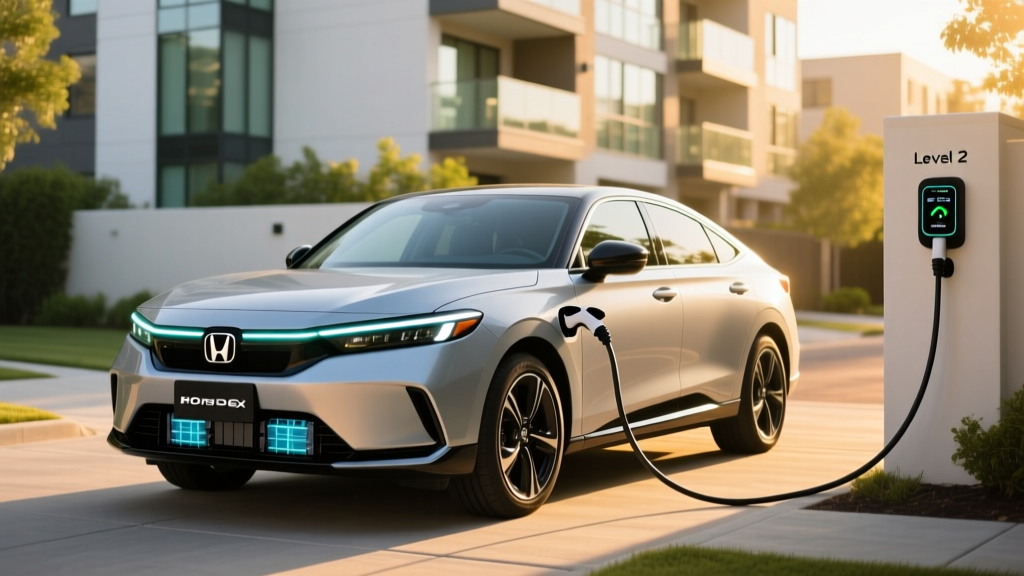
For home charging, the 7.7 kW onboard charger means a standard 240V/32A Level 2 setup (like a ChargePoint Home Flex or Wallbox Pulsar Plus) adds roughly 25 miles of range per hour. A full overnight charge from 10% takes about 11 hours — perfectly fine for daily top-ups. Honda includes a basic Level 1/2 portable charging cord with the vehicle.
Driving Dynamics and Performance
The Prologue EX FWD's 212 horsepower delivers adequate but unhurried acceleration — the 0–60 mph time of roughly 8.1 seconds puts it behind the Mach-E Select RWD (~6.5 sec) and Ioniq 5 RWD (~7.0 sec). The AWD upgrade ($2,000) adds a rear motor for 288 combined horsepower and a much more confident 6.2-second sprint, which we'd recommend for buyers in snow-belt states or anyone merging onto fast highways regularly.
Ride quality is where the GM Ultium platform shines. The Prologue's suspension tuning favors comfort over sportiness — it absorbs highway expansion joints and city potholes with a maturity that outclasses some firmer-riding competitors. Steering is light and predictable, if uncommunicative. Regenerative braking offers multiple levels adjustable via steering-wheel paddles, including a near one-pedal-driving mode at the strongest setting. It's not quite true one-pedal (the vehicle creeps at very low speeds), but it handles most deceleration without touching the brake pedal.
The Prologue is not a performance EV and doesn't pretend to be. It's a comfortable, composed cruiser designed for families who want quiet, compliant transportation — and it delivers on that promise.
Interior, Cargo, and Technology
Inside, the Prologue blends Honda's traditional ergonomics with GM's infotainment architecture. The EX trim features an 11.3-inch touchscreen running Google Built-In (Google Maps, Google Assistant, Google Play Store). Wireless Apple CarPlay and Android Auto are standard. A 11-inch digital driver display sits behind the wheel, and physical knobs for volume and climate are thankfully retained.
Space is a genuine strength:
- Front headroom: 40.0 inches
- Rear legroom: 38.6 inches (generous for the class)
- Cargo behind rear seats: 25.2 cu ft
- Cargo with rear seats folded: 57.7 cu ft
- No front trunk (frunk): The Ultium platform in this configuration does not offer one
Rear-seat space is competitive with the Toyota RAV4 and Honda CR-V, making the Prologue viable for families with rear-facing child seats. Cargo volume trails the Ioniq 5 (27.2/59.3 cu ft) slightly but is practical for weekly groceries and luggage for four on a weekend trip.
The Honda Sensing suite of driver-assistance features is standard across all trims: adaptive cruise control, lane-keeping assist, automatic emergency braking, blind-spot monitoring, and rear cross-traffic alert. This is an SAE Level 2 driver-assist system — it provides steering and speed support, but the driver must remain fully engaged at all times. It is not autonomous or "self-driving." The system works competently on highways but can be overly conservative with lane-centering and following distance compared to GM's Super Cruise (which is not offered on the Prologue).
Pricing, Tax Credits, and Ownership Cost
| Trim | Drivetrain | MSRP (incl. destination) | Est. After §30D Credit |
|---|---|---|---|
| EX | FWD | $51,400 | ~$43,900* |
| EX | AWD | $53,400 | ~$45,900* |
| Touring | AWD | $56,400 | ~$48,900* |
| Elite | AWD | $59,900 | ~$52,400* |
*Estimated prices assume full $7,500 federal tax credit eligibility. Actual credit depends on buyer income, MSRP caps, and battery sourcing requirements per IRS §30D rules. See IRS.gov for current eligibility details. Point-of-sale transfer is available at participating dealers.
- MSRP Cap: SUVs must be ≤ $80,000. All Prologue trims qualify.
- Income Cap: AGI must not exceed $150,000 (single), $225,000 (head of household), or $300,000 (joint).
- Battery Sourcing: The $7,500 credit requires both critical-mineral AND battery-component sourcing thresholds. Because the Prologue uses GM's Ultium platform (U.S.-assembled batteries), it has qualified for the full credit — but sourcing rules tighten annually. Always verify current-year eligibility at the dealer or on the IRS qualified vehicles list before purchase.
- Point-of-Sale Transfer: You can transfer the credit to the dealer at purchase for an immediate price reduction, rather than waiting to claim it on your tax return.
For buyers who qualify, the Prologue EX FWD drops from $51,400 to approximately $43,900 — a significant value shift that puts it in direct competition with the Ioniq 5 SE ($45,500 before credit) and Mach-E Select ($42,995 before credit). Without the credit, the Prologue is priced at a premium that's harder to justify against feature-rich rivals.
The battery and powertrain warranty covers 8 years or 100,000 miles (whichever comes first), which is industry-standard. Honda guarantees the battery will retain a minimum capacity threshold (typically ~70%) during that period. The limited vehicle warranty is 3 years / 36,000 miles.
Pros and Cons: Honest Assessment
- Comfortable, compliant ride quality — best-in-class for highway cruising
- Spacious rear seat with 38.6" legroom
- Google Built-In infotainment is responsive and well-integrated
- Heat pump included standard (winter range preservation)
- Honda Sensing ADAS suite standard on all trims
- Federal tax credit eligible (verify current sourcing rules)
- Physical climate knobs retained — excellent ergonomics
- DC charging tops out at 150 kW — slower than 800V rivals (Ioniq 5, EV6)
- No front trunk (frunk) for additional storage
- FWD acceleration is leisurely (~8.1 sec 0–60)
- Efficiency (99 MPGe) trails class leaders by ~15%
- No GM Super Cruise availability — Honda Sensing is competent but basic
- Base price high without tax credit; Touring/Elite trims push $60K
- 2024 CCS port requires adapter for NACS Supercharger access
Who Should Buy the 2024 Honda Prologue EX?
Choose the Prologue EX if you prioritize ride comfort, rear-seat space, and Honda's dealer network over maximum charging speed or performance. It's ideal for:
- Daily commuters with 30–60 mile round trips who charge at home overnight
- Families needing generous rear legroom for child seats and cargo
- Existing Honda loyalists who want EV transition with familiar ergonomics
- Cold-climate buyers who benefit from the standard heat pump and available AWD
Look elsewhere if: You road-trip frequently and want 18-minute DC charges (Ioniq 5/EV6), you want cutting-edge ADAS (Ford BlueCruise or GM Super Cruise), or you need a frunk and maximum cargo flexibility (Mach-E, Model Y).
Prologue EX vs. Key Competitors
| Attribute | Honda Prologue EX FWD | Hyundai Ioniq 5 SE RWD | Ford Mach-E Select RWD | Tesla Model Y LR |
|---|---|---|---|---|
| EPA Range | 296 mi | 303 mi | 250 mi (std) / 320 mi (ext) | 310 mi |
| Battery | 85 kWh NMC | 77.4 kWh NMC | 70 kWh NMC (std) | 75 kWh NMC |
| DC Fast Charge (peak) | 150 kW | 240 kW (800V) | 150 kW | 250 kW |
| 10–80% Time | ~35 min | ~18 min | ~36 min | ~25 min |
| 0–60 mph | ~8.1 sec | ~7.0 sec | ~6.5 sec | ~4.8 sec |
| MSRP (base comparable) | $51,400 | $45,500 | $42,995 | $46,630 |
| Frunk | No | Yes (0.85 cu ft) | Yes (4.7 cu ft) | Yes (4.1 cu ft) |
The Prologue's biggest competitive vulnerability is charging speed and base price. The Ioniq 5 charges dramatically faster and costs less before incentives. The Model Y offers superior range, performance, and Supercharger network access. But the Prologue counters with ride comfort that none of these rivals match, a more traditional SUV seating position, and the reassurance of Honda's service network for buyers in areas with sparse EV-specialist repair options.
Frequently Asked Questions
What is the real-world range of the 2024 Honda Prologue EX?
The EPA rates the FWD Prologue EX at 296 miles and AWD at 281 miles. In real-world highway driving at 70 mph in moderate temperatures, expect approximately 240–260 miles. In cold weather below freezing, plan for 200–230 miles. City driving with regenerative braking can approach or slightly exceed the EPA number.
How fast does the Prologue EX charge at home and on the road?
On a 240V Level 2 home charger, the Prologue adds about 25 miles of range per hour (7.7 kW), fully recharging overnight in roughly 11 hours. On a DC fast charger, it peaks at 150 kW and charges from 10–80% in approximately 35 minutes under ideal conditions. This is slower than 800-volt competitors that achieve 10–80% in 18–20 minutes.
Does the 2024 Honda Prologue qualify for the $7,500 federal EV tax credit?
The Prologue has qualified for the full $7,500 federal tax credit under IRS §30D, thanks to its U.S.-assembled Ultium battery. However, eligibility depends on your adjusted gross income (≤ $150K single / $300K joint), the vehicle's MSRP (all trims under the $80K SUV cap), and current-year battery sourcing requirements that tighten annually. The credit can be transferred at the point of sale for an immediate price reduction. Always verify eligibility on the IRS clean vehicle credit page and with your dealer before purchasing.
Is the Prologue EX worth buying over the Ioniq 5 or Model Y?
It depends on your priorities. If you value ride comfort, rear-seat space, and Honda dealership familiarity over charging speed and efficiency, the Prologue EX is a strong choice — especially after the tax credit. If fast road-trip charging, lower base price, or a frunk matter more, the Ioniq 5 and Model Y are objectively stronger EVs. Test-drive all three; the Prologue's comfort advantage is something you feel, not something you read on a spec sheet.
Can the 2024 Prologue use Tesla Superchargers?
The 2024 model year shipped with a CCS1 charge port. Honda provides a CCS-to-NACS adapter that enables access to Tesla Superchargers. Starting with the 2025 model year, the Prologue switched to a native NACS port. If buying a used 2024, confirm the adapter is included in the sale.
What is the warranty coverage on the Prologue's battery?
Honda covers the high-voltage battery and electric powertrain for 8 years or 100,000 miles, whichever comes first. The battery is warranted to retain a minimum percentage of its original capacity (typically around 70%) during that coverage period. The bumper-to-bumper limited warranty is 3 years / 36,000 miles.