Quick Answer: Is an Electric VW Beetle Conversion Worth It?
An electric VW Beetle conversion typically costs $15,000–$40,000+ on top of the donor car price, yielding 60–150 miles of real-world range depending on battery pack size (20–60 kWh). The project takes 3–12 months and requires a specialized shop or advanced DIY skills. While conversions offer unmatched character and a zero-emission classic, they are not eligible for the federal §30D tax credit (which applies only to new qualifying EVs), lack modern safety features, and carry higher insurance complexity. For most buyers seeking reliable daily EV transportation, a used production EV (like a Chevy Bolt or Nissan Leaf) delivers more range, DC fast charging, and warranty protection at a lower total cost. A Beetle conversion makes sense primarily as a passion project or weekend cruiser—not a primary commuter.
What an Electric VW Beetle Conversion Actually Involves
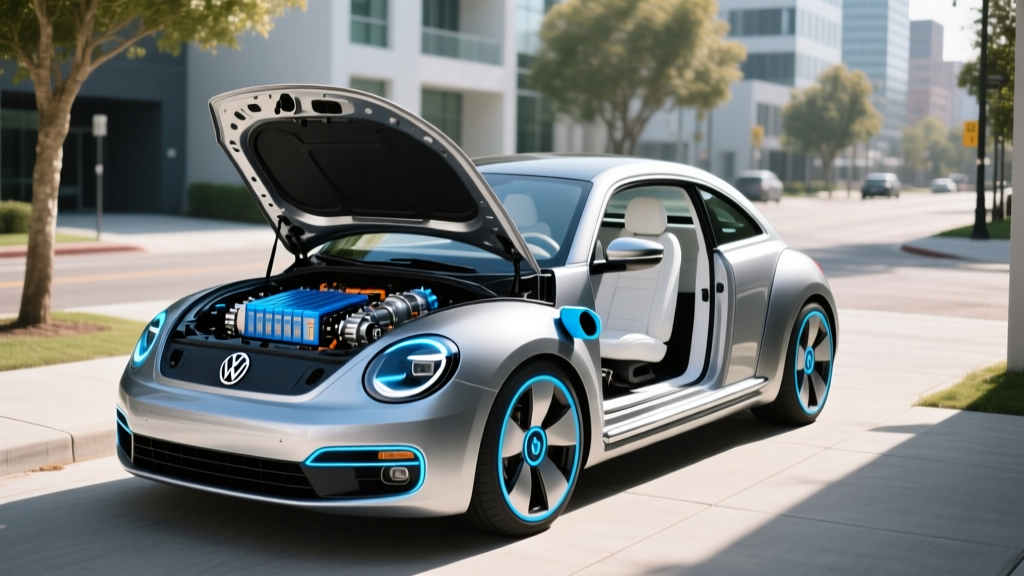
Converting a classic Volkswagen Beetle (typically a 1960s–1974 model) to electric power means removing the air-cooled flat-four engine, fuel tank, and exhaust system, then installing an electric motor, motor controller, battery pack, onboard charger, and DC-DC converter. The original transmission is sometimes retained (coupled to the electric motor via an adapter plate), though some builders opt for a direct-drive setup.
The most common motor choices include the NetGain Hyper9 (a brushed DC motor popular in lightweight classics) and repurposed drivetrains from salvaged production EVs like the Nissan Leaf or Tesla Model S rear subframe. Battery packs range from small 20 kWh setups (often using Nissan Leaf modules) to larger 40–60 kWh custom packs built from LG or Samsung NMC cells.
Because the Beetle's curb weight was roughly 1,800–2,000 lbs originally, adding 400–800 lbs of batteries and motor hardware significantly changes the car's dynamics. Reputable converters reinforce the chassis, upgrade brakes, and redistribute weight—often placing cells in the front "frunk" area and behind the rear seats where the fuel tank once lived.
Cost Breakdown: Conversion, Charging, and Long-Term Ownership
The financial picture of a Beetle EV conversion extends well beyond the initial build. Here's what to expect:
| Cost Category | Beetle EV Conversion | Used 2021 Chevy Bolt EV |
|---|---|---|
| Vehicle / Donor Car | $5,000–$15,000 | $12,000–$16,000 |
| Conversion Kit / Parts | $8,000–$20,000 | N/A |
| Labor (professional shop) | $7,000–$15,000 | N/A |
| Total Upfront Cost | $20,000–$50,000+ | $12,000–$16,000 |
| Federal Tax Credit (§30D) | $0 (not eligible) | Up to $4,000 (used-EV credit, income-limited) |
| Home Level 2 Charger Install | $500–$2,000 | $500–$2,000 |
| Annual Electricity (10K mi) | ~$300–$450 | ~$350–$500 |
| Annual Maintenance | $200–$600 (specialty) | $100–$300 |
| Insurance (annual) | $800–$2,000 (classic/specialty) | $900–$1,400 |
A critical cost factor: most conversions use Level 2 AC charging only (typically 3.3–6.6 kW onboard chargers), meaning no DC fast charging. A 40 kWh pack at 3.3 kW takes roughly 12 hours from empty to full—fine for overnight home charging, but impractical for road trips. By contrast, a used Bolt EV supports 55 kW DC fast charging (10–80% in about 45 minutes).
Range, Charging Speed, and Real-World Expectations
Range is where conversions face hard physics. The Beetle's aerodynamics (a drag coefficient around 0.48) and added weight from batteries mean efficiency typically falls between 2.5–3.5 miles per kWh—well below modern production EVs.
| Metric | Beetle EV (40 kWh) | Original Beetle (Gas) | 2025 Hyundai Ioniq 5 |
|---|---|---|---|
| Energy Capacity | 40 kWh usable | 10.6 gal fuel tank | 84 kWh usable (NMC) |
| Efficiency | ~3.0 mi/kWh (112 MPGe) | ~26 MPG combined | 125 MPGe combined |
| Real-World Range | 90–120 miles | ~275 miles | ~290 miles (EPA 310) |
| Cold-Weather Range (20°F) | ~65–85 miles | ~240 miles | ~220–250 miles |
| Max Charge Rate | 3.3–6.6 kW (AC only) | N/A (refuel in 3 min) | 240 kW DC peak |
| 10–80% Charge Time | 8–12 hours (Level 2) | 3 minutes | ~18 minutes (DC) |
The cold-weather penalty is significant. Without a modern thermal management system (heat pump and liquid battery cooling/heating), LFP or NMC packs in conversions lose 25–35% of range in freezing temperatures. If you live in the Upper Midwest or Northeast, plan for 65–85 usable winter miles from a 40 kWh pack.
Common Misconceptions About Classic EV Conversions
| Myth | Fact |
|---|---|
| "Conversions qualify for the $7,500 federal tax credit" | The IRS §30D credit applies only to new qualifying clean vehicles from certified manufacturers. Conversions do not qualify. The used-EV credit (§25E, up to $4,000) also requires a dealer-sold qualifying used EV—conversions generally don't apply. |
| "You'll save money vs buying a new EV" | At $20,000–$50,000 total cost for 90–120 miles of range, conversions cost more per mile of range than virtually any production EV. A 2025 Chevy Equinox EV starts around $33,000 with 319 miles EPA range. |
| "Any mechanic can service it" | EV conversions use high-voltage systems (typically 96–400V). Most standard mechanics won't touch them, and parts sourcing depends on the specific components used. You need a converter-specialist or high-voltage-trained technician. |
| "It's a reliable daily driver" | Conversions lack the millions of validation miles that production EVs undergo. Electrical gremlins, BMS (battery management system) faults, and thermal issues are more common in one-off builds. |
| "The Beetle becomes fast" | While electric torque is instant, most Beetle conversions produce 80–150 HP and are limited by the stock suspension, brakes, and chassis. Expect 0–60 mph in 8–14 seconds—quicker than the original 55 HP flat-four, but not sports-car territory. |
Who Should (and Shouldn't) Convert a Beetle to Electric
Decision Framework: Is a Beetle EV Conversion Right for You?
Choose the conversion if:
- You already own or have access to a clean Beetle donor car (pre-1975 models are most common)
- Your daily commute is under 50 miles round-trip and you have reliable Level 2 home charging
- You view this as a hobby/passion project and accept 6–12 months of build time
- You want a unique, emissions-free classic for weekend drives and car shows
- You have access to a reputable conversion shop or possess advanced fabrication and electrical skills
- You have a second vehicle for longer trips and highway driving
Choose a production EV instead if:
- You need a reliable daily driver with 200+ miles of range
- You want DC fast charging for road trips (10–80% in under 30 minutes)
- You need modern safety features (airbags, ABS, crumple zones, AEB—the Beetle has none)
- You want warranty coverage, dealer service, and tax credit eligibility
- Your budget is under $25,000 and you need maximum value per dollar
- You live in an apartment or lack home charging access (public charging a conversion is impractical without DC capability)
First-Time EV Buyer Considerations for Conversions
If a Beetle conversion is your introduction to electric vehicles, understand these ownership realities before committing:
Home charging is nearly mandatory. With only Level 2 AC charging (and no DC fast charge port), you cannot rely on public charging infrastructure. A 240V Level 2 home installation runs $500–$2,000 depending on your electrical panel capacity. Homes with older 100-amp panels may need a $1,500–$3,000 panel upgrade to support a 40-amp circuit—factor this into your budget.
Registration and inspection vary by state. Some states have straightforward processes for registering a converted vehicle; others require special inspections, emissions exemptions, or "kit car" titling. Check your state's DMV requirements before starting the build. States like California have relatively clear pathways through their Specially Constructed Vehicle program, while others are more restrictive.
Insurance requires specialty carriers. Standard insurers often won't cover a conversion at its build value. Companies like Hagerty or Grundy that specialize in classic and modified cars are usually the best option. Expect to provide detailed build documentation, receipts, and appraisals. Agreed-value policies typically run $800–$2,000 annually depending on the car's appraised value and your driving record.
Resale value is unpredictable. Unlike production EVs with established depreciation curves (data from sources like Kelley Blue Book), conversion values depend entirely on build quality, component selection, and buyer taste. A well-executed conversion by a known shop may hold value; a DIY build with undocumented components can be very difficult to sell.
Frequently Asked Questions
How long does a Beetle EV conversion take?
Professional shops typically quote 3–6 months for a turnkey conversion. DIY builds can stretch to 12–18 months depending on your skill level, parts availability, and the complexity of the battery enclosure fabrication. Plan for delays—custom adapter plates, BMS programming, and high-voltage cable routing often require iteration.
What battery chemistry is best for a conversion?
Most converters use NMC (nickel manganese cobalt) cells sourced from salvaged Nissan Leaf, Chevy Bolt, or Tesla modules because of their higher energy density—critical in a small car with limited space. LFP (lithium iron phosphate) offers longer cycle life and better thermal stability but is heavier and bulkier for the same kWh, which is a significant trade-off in a Beetle's tight packaging. For a 40 kWh target, NMC modules typically weigh 500–600 lbs; LFP would add 100–150 lbs more.
Can I DC fast charge a converted Beetle?
Technically possible but rare and expensive. Adding a CCS or NACS DC fast charge port requires a compatible high-voltage BMS, contactors, and a charge port controller—adding $3,000–$6,000+ to the build. Most converters skip this because the Beetle's small battery pack (20–40 kWh) would see diminishing returns from fast charging, and the added complexity introduces reliability risk. Expect to charge exclusively on Level 2 AC at home.
Is it cheaper to convert or buy a used EV?
Almost always cheaper to buy a used production EV. A 2021–2022 Chevy Bolt EV with 259 miles of EPA range sells for $12,000–$16,000 on the used market, includes DC fast charging, qualifies for up to $4,000 under the §25E used-EV credit (income-limited), and comes with remaining battery warranty. That's roughly one-third the cost of a Beetle conversion with more than double the range.
What's the top speed of a converted electric Beetle?
Most conversions are electronically limited to 75–90 mph for safety reasons—the Beetle's drum brakes (or basic front-disc conversions), narrow tires, and 1960s suspension geometry are not designed for sustained high-speed driving. The electric motor can technically push higher, but doing so would be unsafe and would drain the battery extremely quickly given the car's poor aerodynamics.
Do I need a special license to drive a converted EV?
No. A converted Beetle is titled and registered as a standard passenger vehicle (or specially constructed vehicle, depending on your state). A regular driver's license is all you need. However, you should invest time in learning EV-specific driving habits—regenerative braking behavior, one-pedal driving adjustment, and range management—especially since conversions typically lack the sophisticated range-prediction displays found in production EVs.