If you've been searching for details on the BYD truck interior, you've likely noticed a gap: most coverage focuses on the Shark 6's dual-motor powertrain or its aggressive front fascia, while the cabin itself gets a paragraph at best. That's a missed opportunity, because the Shark 6 PHEV pickup — BYD's first body-on-frame truck and its entry into the midsize ute segment dominated by the Ford Ranger and Toyota Hilux — packs a cabin that borrows heavily from the Seal and Atto 3 passenger cars, then reworks it for work-truck duty.
This review covers everything a prospective buyer needs: the interior layout and materials, the 15.6-inch rotating infotainment screen, real-world EV-only range from its 32.8 kWh LFP Blade battery, DC fast-charging speeds, pricing, and whether the Shark 6 qualifies for the U.S. federal EV tax credit under current IRS §30D rules.
BYD Shark 6 Interior: Materials, Layout, and the Rotating Screen
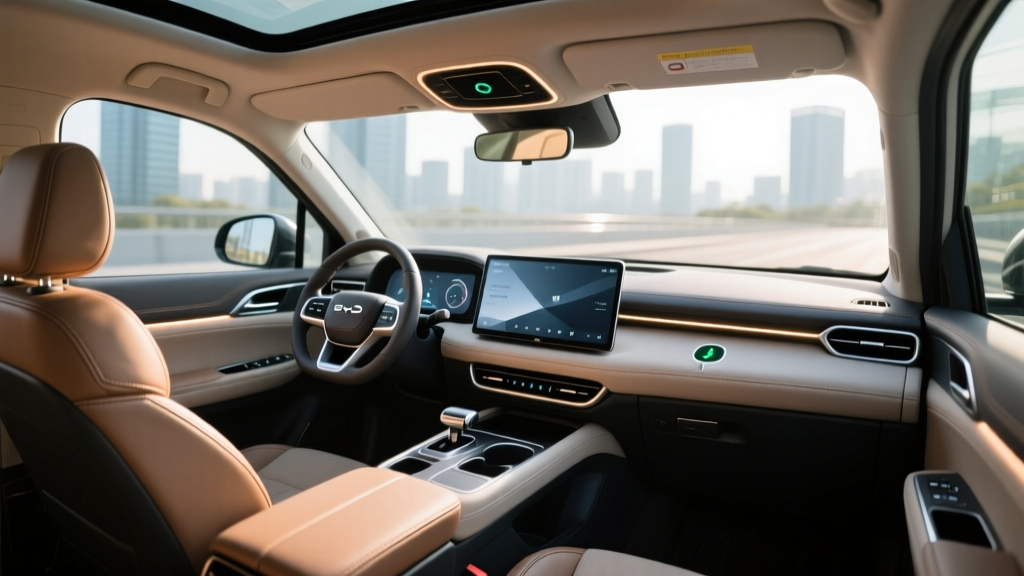
The first thing you notice climbing into the Shark 6 is that it doesn't feel like a traditional midsize pickup. BYD has transplanted the design language from its passenger EVs — soft-touch dashboard materials, a flat-bottom steering wheel, and a floating center console — into a truck with a 1,720 mm (67.7 in) wide cabin. The result is a cabin that sits well above the Ranger or Hilux in perceived quality, though not quite at the premium level of a Ford Maverick Lariat or a Rivian R1T.
The centerpiece is BYD's signature 15.6-inch rotating touchscreen, which can toggle between landscape and portrait orientation. In landscape mode it's ideal for navigation and media; in portrait, it mimics a tablet layout that some users prefer for climate controls and app menus. The screen runs BYD's DiLink 100 infotainment system with wireless Apple CarPlay and Android Auto, over-the-air (OTA) update capability, and a built-in 4G LTE hotspot.
Behind the wheel, a 10.25-inch digital instrument cluster displays powertrain status — including a real-time readout of whether you're drawing from the battery, the 1.5L turbo engine, or both. A head-up display (HUD) is available on the top Adventure trim, projecting speed and navigation onto the windshield.
Seating, Space, and Practicality
The Shark 6 is a four-door double-cab configuration with seating for five. Front seats are heated and ventilated on the Adventure trim, with eight-way power adjustment for the driver. Rear-seat legroom measures approximately 37.8 inches — competitive with the Ranger SuperCrew — though the floor hump for the drivetrain reduces the middle-seat foot space. The rear bench folds 60/40, revealing under-seat storage for the charging cable and tire-repair kit.
Cargo space behind the rear seats (with the bench folded) provides roughly 18 cubic feet of enclosed storage. The bed itself measures approximately 59.1 inches long × 58.3 inches wide × 20.1 inches deep — shorter than a Ranger's 6-foot bed but adequate for standard loads. Payload capacity is rated at 1,010 kg (2,227 lb), and the truck carries a 2,500 kg (5,512 lb) braked towing rating.
Range, Battery, and Electric-Only Driving
The Shark 6 uses a 32.8 kWh usable lithium iron phosphate (LFP) Blade battery — BYD's proprietary cell-to-pack design that eliminates module-level packaging for better energy density and superior thermal stability compared to NMC chemistries. LFP cells tolerate daily 100% charging without accelerated degradation, a meaningful advantage for owners who want maximum EV range every morning.
| Spec | Value |
|---|---|
| Battery Chemistry | LFP (Blade, cell-to-pack) |
| Usable Capacity | 32.8 kWh |
| EV-Only Range (WLTP) | 100 km (~62 mi) |
| EV-Only Range (est. EPA-equivalent) | ~61 miles |
| Combined System Range | ~840 km (~522 mi) WLTP |
| Engine | 1.5L turbo 4-cyl + dual electric motors |
The PHEV powertrain pairs the 1.5L turbocharged engine (producing approximately 150 hp on its own) with a front electric motor (150 kW / 201 hp) and a rear electric motor (150 kW / 201 hp). Combined system output reaches approximately 430 horsepower, making the Shark 6 one of the most powerful trucks in the midsize segment. BYD claims a 0–100 km/h (0–62 mph) time of 5.7 seconds — quicker than a Ford Ranger Raptor.
Charging Speed: DC Fast Charge and Home Level 2
For a PHEV, the Shark 6 offers unusually capable charging. The LFP Blade pack supports DC fast charging up to approximately 60 kW peak — modest compared to a full BEV, but exceptional for a plug-in hybrid. A 30%–80% DC fast charge takes roughly 20 minutes, which is practical for a quick top-up on a road trip or during a lunch break.
| Level | Power | Time / Rate |
|---|---|---|
| Level 1 (120V household) | ~1.4 kW | ~24 hours (0–100%) |
| Level 2 (240V, 32A) | ~7 kW | ~5 hours (0–100%) |
| DC Fast Charge | ~60 kW peak | ~20 min (30–80%) |
At home on a Level 2 charger (240V, 32-amp circuit), the 7 kW onboard charger replenishes the battery from empty to full in about 5 hours — easily overnight. Because the battery is LFP, BYD recommends periodic 100% charges to allow the battery management system (BMS) to recalibrate cell voltages, unlike NMC packs where daily 80% limits are preferred.
One practical note: the charge port is located on the driver's-side rear quarter panel, which affects how you orient the truck when backing into a charging stall. The port supports both Type 2 (AC) and CCS2 (DC) connectors in most markets; confirm your local connector standard with your dealer.
Pricing, Trims, and Federal Tax Credit Eligibility
The BYD Shark 6 launched in international markets (Australia, Mexico, Southeast Asia, South America) in late 2024 and continues through the 2026 model year with minor software and trim updates. Pricing varies significantly by market due to local tariffs, incentives, and homologation requirements.
| Market | Trim | Price (Local) | Est. USD Equivalent |
|---|---|---|---|
| Australia | Premium | AUD $59,990 | ~$38,500 |
| Australia | Adventure | AUD $64,990 | ~$41,700 |
| Mexico | Premium | MXN $899,900 | ~$46,000 |
Does the BYD Shark 6 Qualify for the U.S. Federal EV Tax Credit?
As of early 2026, BYD has not officially launched the Shark 6 in the United States, and the company has not announced a confirmed U.S. sale date. Even if the Shark 6 were sold stateside, qualifying for the IRS §30D clean vehicle credit would face significant hurdles:
- MSRP cap: Trucks must have an MSRP at or below $80,000 — the Shark 6 would likely clear this bar.
- Buyer income cap: AGI must not exceed $150,000 (single), $225,000 (head of household), or $300,000 (joint filers).
- Battery sourcing requirements: Critical minerals and battery components must meet escalating domestic-content thresholds. BYD's vertically integrated Chinese supply chain — including LFP cell manufacturing in China — would almost certainly fail the critical-minerals and battery-component tests under 2026 rules, disqualifying the truck from the credit.
- Foreign Entity of Concern (FEOC): BYD is classified as a Chinese-headquartered manufacturer, which triggers additional FEOC scrutiny under §30D.
Bottom line: U.S. buyers should not count on the $7,500 federal credit for a BYD truck. Consult a tax professional and the IRS guidelines for the latest rules before making any purchase decision.
Technology, Driver Assists, and Standout Features
The Shark 6 comes loaded with technology that would be optional or unavailable on similarly priced competitors:
- Vehicle-to-Load (V2L): A 6 kW V2L outlet in the bed and cabin lets you power tools, camping gear, or even a small appliance directly from the truck's battery — a genuine work-site and overlanding advantage.
- DiPilot ADAS suite: Includes adaptive cruise control with stop-and-go, lane-centering assist, blind-spot monitoring, rear cross-traffic alert, and a 360-degree surround-view camera. This is an SAE Level 2 driver-assist system — the driver must remain engaged with hands on the wheel and eyes on the road at all times.
- Tank turns (limited): Using independent front and rear motor torque vectoring, the Shark 6 can perform slow-speed pivot turns on loose surfaces — useful for tight trail maneuvers but not intended for pavement.
- Wireless phone charging: 50W Qi pad in the center console, with active cooling to prevent phone overheating.
- BYD app connectivity: Remote climate preconditioning, charge scheduling, geofencing, and vehicle-status monitoring via smartphone.
Warranty and Long-Term Ownership
BYD offers competitive warranty coverage on the Shark 6, though terms vary by market:
| Coverage | Term |
|---|---|
| Vehicle (bumper-to-bumper) | 6 years / 150,000 km (~93,000 mi) |
| Battery (Blade LFP pack) | 8 years / 160,000 km (~99,400 mi), ≥70% capacity retention |
| Powertrain (engine + motors) | 8 years / 160,000 km (~99,400 mi) |
| Roadside assistance | 6 years |
The LFP chemistry is a longevity advantage here. LFP cells typically sustain 3,000+ full charge cycles before reaching 80% State of Health (SoH), compared to roughly 1,500–2,000 cycles for NMC. For a PHEV with a 32.8 kWh pack that gets charged daily, that translates to well over a decade of daily cycling before meaningful degradation — a strong ownership proposition.
One caveat: BYD's service network outside of China is still maturing. In Australia and Mexico, dealer coverage is expanding but remains thinner than Toyota or Ford. Factor in potential wait times for warranty service and parts availability when evaluating long-term ownership.
How It Compares: Shark 6 vs. Key Rivals
The Shark 6 enters a midsize truck segment that's increasingly exploring electrification. Here's how it stacks up:
| Spec | BYD Shark 6 | Ford Ranger PHEV (2025) | Toyota Hilux (mild-hybrid diesel) |
|---|---|---|---|
| Powertrain | 1.5L turbo PHEV, dual-motor AWD | 2.3L turbo PHEV, AWD | 2.8L diesel, 48V mild-hybrid |
| System HP | ~430 hp | ~290 hp | ~204 hp |
| EV-Only Range | ~61 mi | ~37 mi (est.) | N/A |
| Battery | 32.8 kWh LFP | ~18.6 kWh NMC | N/A |
| V2L | Yes (6 kW) | Yes (2.4 kW) | No |
| 0–62 mph | 5.7 sec | ~7.5 sec (est.) | ~9.9 sec |
The Shark 6's power and EV range advantages are clear, but the Ranger and Hilux benefit from far more established dealer and parts networks in most markets. Your choice depends heavily on whether you prioritize performance and EV-only commuting or long-term service infrastructure.
Pros and Cons: The Honest Assessment
Pros
- Class-leading 430 hp and 5.7-second 0–62 mph
- 61-mile EV-only range covers most commutes without gasoline
- LFP Blade battery — superior cycle life and thermal safety
- 6 kW V2L for job-site and camping power
- Car-quality interior with 15.6-inch rotating screen
- Competitive pricing vs. Ranger PHEV and Raptor
Cons
- Not available in the U.S. market as of 2026
- Unlikely to qualify for §30D tax credit due to battery sourcing
- BYD service network still expanding outside China
- Bed is shorter than Ranger/Hilux (~59 in vs 72 in)
- DiPilot ADAS is Level 2 only — no hands-free highway driving
- Real-world cold-weather EV range drops 20–30%
Who Is the BYD Shark 6 Best For?
The Shark 6 fits a specific buyer profile: someone in a market where BYD sells the truck, who wants a daily-commutable PHEV with genuine truck capability on weekends. If your commute is under 55 miles round-trip and you can charge at home nightly, you'll drive most weekdays on electricity alone — saving significantly on fuel. On weekends, the 2,500 kg towing capacity, AWD system, and V2L outlet make it a credible work and adventure platform.
It is not the right truck for U.S.-only buyers (not available), for those who need a full-size bed (the ~59-inch bed is compact), or for anyone expecting autonomous driving capability (DiPilot is Level 2, requiring full driver attention).
Frequently Asked Questions
What is the real-world EV range of the BYD Shark 6?
In mixed driving at moderate temperatures, expect 55–60 miles on battery alone. Highway driving at 75 mph drops that to approximately 45–50 miles. In freezing conditions (below 32°F), plan for 40–48 miles of EV range. The gasoline engine extends total range to approximately 500+ miles.
How fast does the Shark 6 charge?
On a DC fast charger, the battery goes from 30% to 80% in about 20 minutes at up to 60 kW. At home on a Level 2 (240V) charger at 7 kW, a full charge takes roughly 5 hours. Level 1 (120V) trickle charging is possible but impractical at ~24 hours for a full charge.
Is the BYD Shark 6 interior better than the Ford Ranger?
In terms of materials, screen technology, and perceived quality, the Shark 6 interior edges ahead of the base and mid-trim Ranger. The 15.6-inch rotating screen and soft-touch surfaces feel more premium. However, the Ranger's SuperCrew cab offers slightly more rear-seat room and a longer bed.
Does the BYD Shark 6 qualify for the $7,500 federal EV tax credit?
No — as of 2026, the Shark 6 is not sold in the United States, and even if it were, its Chinese-manufactured LFP battery would almost certainly fail the §30D critical-minerals and battery-component sourcing requirements. Always verify current rules at IRS.gov.
Is the BYD Shark 6 worth buying over the Ford Ranger PHEV?
If you're in a market where both are available, the Shark 6 wins on power (430 hp vs ~290 hp), EV range (61 mi vs ~37 mi), and V2L output (6 kW vs 2.4 kW). The Ranger PHEV wins on dealer network depth, parts availability, and a longer bed. Choose the Shark 6 if performance and EV commuting matter most; choose the Ranger if service infrastructure and payload flexibility are priorities.
What is the BYD Shark 6 towing capacity?
The Shark 6 is rated for 2,500 kg (5,512 lb) braked towing — competitive with the Ranger and Hilux in most markets. Always confirm your local homologation rating, as towing limits can vary by jurisdiction.