Quick Answer: A mini electric vehicle like the 2026 Mini Cooper SE (EPA 146 miles, ~$30,900) or Fiat 500e (EPA 149 miles, ~$36,095) makes financial sense for city commuters driving under 80 miles daily with home Level 2 charging access. Expect $400–$600/year in electricity vs. $1,400+ in gasoline for a comparable gas car. The trade-off: limited highway range means road trips require DC fast-charging stops, and cold climates can cut range by 20–30%.
The Mini EV Segment: What You're Actually Buying
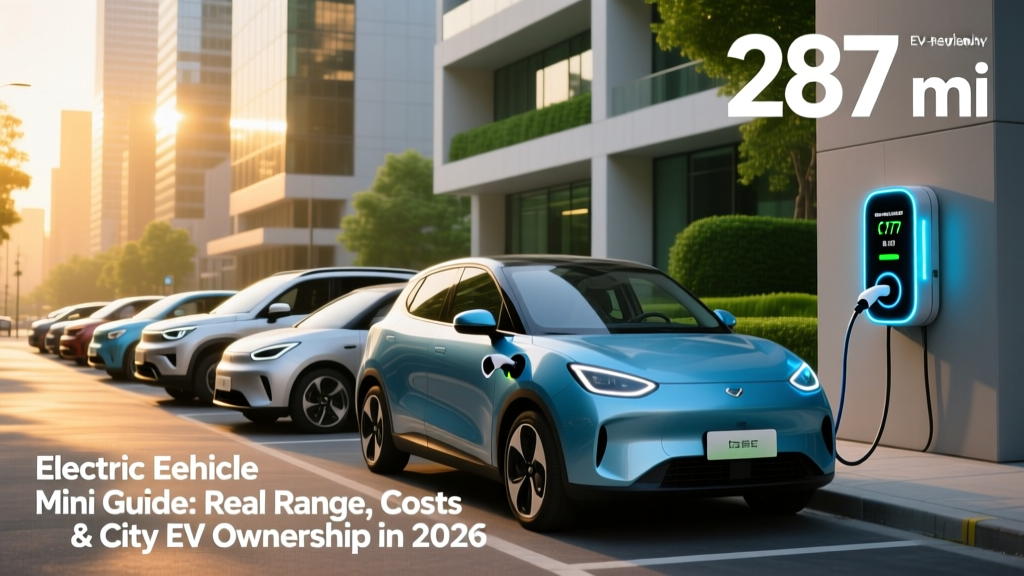
The "electric vehicle mini" category targets urban drivers who prioritize maneuverability, parking ease, and low operating costs over long-distance capability. In 2026, the primary contenders are the Mini Cooper SE (the electric version of the iconic hatchback), the Fiat 500e (reintroduced for the US market), and limited availability models like the Honda Prologue in its base trim or imported options like the Dacia Spring (not officially sold in the US).
These vehicles share common traits: batteries in the 40–55 kWh range, EPA ranges between 110–160 miles, peak DC fast-charge rates of 50–95 kW, and base MSRPs from $28,000 to $38,000 before incentives. They're not designed for cross-country travel—they're optimized for daily commuting, grocery runs, and city living where a compact footprint matters more than 300+ miles of range.
| Model | EPA Range | Battery (kWh) | Peak DC kW | 10–80% Time | Base MSRP |
|---|---|---|---|---|---|
| Mini Cooper SE | 146 mi | 54.2 (NMC) | 95 kW | ~30 min | $30,900 |
| Fiat 500e | 149 mi | 42.0 (NMC) | 85 kW | ~35 min | $36,095 |
| Nissan Leaf (S trim) | 149 mi | 40.0 (NMC) | 50 kW (CHAdeMO) | ~40 min | $28,140 |
Sources: EPA fueleconomy.gov, manufacturer specifications. Real-world highway range at 70 mph typically 10–15% lower than EPA; cold-weather (below 32°F) can reduce range 20–30%.
Real-World Range: EPA Sticker vs. What You'll Actually Get
The EPA range estimate assumes a mix of city and highway driving at moderate temperatures. In practice, mini EVs face the same physics as larger models, but their smaller batteries amplify the impact of adverse conditions.
Highway driving at 70–75 mph: Aerodynamic drag increases exponentially with speed. A Mini Cooper SE rated at 146 miles EPA will typically deliver 120–130 miles on a pure highway run at 70 mph. If you're driving 80 mph in mountainous terrain, expect closer to 100–110 miles.
Cold weather (20–32°F): Lithium-ion batteries lose efficiency in cold temperatures, and cabin heating draws significant power (3–5 kW continuous). Without a heat pump (standard on the 2026 Mini Cooper SE, optional on some trims of the Fiat 500e), range loss can reach 30%. With a heat pump, expect 15–20% loss. That 146-mile Cooper SE becomes a 100–115 mile car in January in Chicago.
City driving with regen braking: This is where mini EVs shine. Stop-and-go traffic allows aggressive regenerative braking to recapture energy. In moderate temperatures (50–75°F), city-only driving can actually exceed the EPA estimate by 5–10%. If your commute is 20 miles of surface streets, you'll rarely see range anxiety.
Real-World Range Expectations (Mini Cooper SE, 146 mi EPA):
- City, 65°F: 150–160 miles
- Mixed driving, 65°F: 135–145 miles
- Highway 70 mph, 65°F: 120–130 miles
- Highway 70 mph, 25°F (no heat pump): 90–105 miles
- Highway 70 mph, 25°F (with heat pump): 110–120 miles
Charging Speed and Infrastructure: The 95 kW Reality
The 2026 Mini Cooper SE supports up to 95 kW DC fast charging via CCS1 connector (or NACS with adapter, as Mini has committed to Tesla Supercharger access). But peak charge rate is not sustained charge rate—the battery management system tapers charging speed as the battery fills to protect cell longevity.
The charge curve: From 10% to 50% state of charge (SoC), the Cooper SE can sustain 80–95 kW. From 50–80%, it tapers to 50–60 kW. Above 80%, charging slows dramatically to 20–30 kW. This is why manufacturers quote "10–80% in X minutes"—the final 20% takes as long as the first 80%.
Level 2 home charging: The onboard charger accepts up to 11 kW AC. On a 48-amp Level 2 home charger (like a ChargePoint Home Flex or Tesla Wall Connector), you'll add roughly 30–35 miles of range per hour. A full 0–100% charge takes about 5 hours. Most owners plug in overnight and wake up to a full battery every morning.
Level 1 (120V outlet): Adds 3–4 miles per hour. If you drive 30 miles daily and can plug into a standard outlet for 10 hours, you'll recover your daily use—but you'll never fully recharge from empty overnight. Level 1 is a backup, not a primary strategy.
| Level | Power (kW) | Miles Added/Hour | 0–100% Time |
|---|---|---|---|
| Level 1 (120V) | 1.4 kW | 3–4 mi/hr | ~38 hours |
| Level 2 (240V, 48A) | 11 kW | 30–35 mi/hr | ~5 hours |
| DC Fast (95 kW peak) | 50–95 kW | 150–250 mi/hr* | 10–80% in ~30 min |
*Miles-per-hour at DC fast chargers varies with state of charge; peak rate only sustained at low SoC.
Cost Breakdown: Purchase Price, Charging, and Total Ownership
The upfront cost of a mini EV is higher than a comparable gas car, but operating costs are dramatically lower. Here's a 5-year ownership comparison assuming 12,000 miles/year, home charging at $0.14/kWh (national average), and gas at $3.50/gallon.
| Cost Category | 2026 Mini Cooper SE (EV) | 2026 Mini Cooper (Gas, 30 MPG) |
|---|---|---|
| Base MSRP | $30,900 | $24,900 |
| Federal Tax Credit (§30D) | -$3,750 (partial, sourcing rules) | $0 |
| Effective Purchase Price | $27,150 | $24,900 |
| Fuel/Energy (5 years, 60k miles) | $2,100 (4,300 kWh) | $7,000 (2,000 gallons) |
| Maintenance (5 years) | $800 (tires, cabin filter, brake fluid) | $2,500 (oil, filters, brakes, belts) |
| Insurance (5-year avg) | $7,500 | $6,200 |
| Total 5-Year Cost | $37,550 | $40,600 |
The verdict: The Mini Cooper SE breaks even around year 3–4 and saves roughly $3,000 over 5 years despite a higher sticker price. The savings widen if gas prices rise or if you qualify for the full $7,500 federal tax credit (which requires meeting battery sourcing, MSRP caps, and buyer income limits per IRS §30D rules).
Home charging installation: Budget $800–$2,500 for a licensed electrician to install a 240V, 50-amp circuit and hardwired Level 2 charger. If your electrical panel needs an upgrade (common in older homes), add $1,500–$3,000. This is a one-time cost that pays for itself in convenience and charging speed.
Tax Credit Eligibility: The §30D Reality Check
The federal clean vehicle credit is not a guaranteed $7,500 for every buyer. Under current IRS rules, eligibility depends on:
- MSRP caps: Vans, SUVs, and pickup trucks: $80,000. Sedans, hatchbacks, and other vehicles: $55,000. (The Mini Cooper SE qualifies.)
- Buyer income limits: Modified AGI cannot exceed $150,000 (single), $225,000 (head of household), or $300,000 (married filing jointly).
- Battery sourcing requirements: Partial credit ($3,750) requires critical minerals from the US or FTA partners. Full credit ($7,500) also requires battery components manufactured or assembled in North America. As of 2026, the Mini Cooper SE qualifies for $3,750 due to partial sourcing compliance.
- Point-of-sale transfer: You can transfer the credit to the dealer at purchase, reducing your out-of-pocket cost immediately (rather than waiting for tax refund).
State and local incentives vary widely—California's CVRP, Colorado's $5,000 credit, and utility rebates can stack with federal credits. Check your state's energy office and local utility for current programs.
EV vs. Gas vs. Hybrid: Which Powertrain Fits Your Life?
| Factor | Mini EV (Cooper SE) | Mini Gas (Cooper) | Toyota Prius (HEV) |
|---|---|---|---|
| EPA Range / MPG | 146 mi / 114 MPGe | 30 MPG combined | 57 MPG combined |
| Annual Fuel Cost | $420 | $1,400 | $740 |
| Home Charging Required? | Yes (Level 2 ideal) | No | No |
| Road Trip Capability | Limited (100-mi legs) | 400+ mi | 500+ mi |
| Cold-Weather Penalty | 20–30% range loss | Minimal | Minimal |
| Maintenance Complexity | Low (no oil, fewer brakes) | Medium | Medium (hybrid system) |
Choose a mini EV if: You drive under 80 miles daily, have home or workplace Level 2 charging, live in a moderate climate (or accept winter range loss), and rarely take road trips over 150 miles without overnight stops.
Choose a gas or hybrid if: You lack reliable charging access, regularly drive 200+ miles in a day, live in extreme cold (below 10°F for weeks), or need maximum flexibility without route planning.
Choose a plug-in hybrid (PHEV) like the Toyota Prius Prime if: You want 44 miles of electric-only range for daily commuting but gas-engine backup for road trips. PHEVs bridge the gap but add complexity (two powertrains to maintain).
Common Misconceptions About Mini Electric Vehicles
| Myth | Fact |
|---|---|
| "The battery will need replacement in 5 years." | Modern NMC batteries are warrantied for 8 years/100,000 miles (capacity retention ≥70%). Real-world degradation is typically 10–15% over 8 years. Replacement cost: $8,000–$12,000 if needed post-warranty. |
| "I can't take road trips." | You can, but you'll plan 30-minute DC fast-charging stops every 100–120 miles. Apps like A Better Routeplanner and PlugShare make this manageable. It's slower than gas, not impossible. |
| "Charging takes too long." | Home Level 2 charging happens while you sleep (5 hours for full charge). DC fast charging adds 80–100 miles in 20–30 minutes. You spend less time "fueling" annually than a gas car owner if you charge at home. |
| "EVs are worse for the environment due to battery mining." | Lifecycle analyses (including battery production) show EVs produce 50–70% fewer emissions over 150,000 miles vs. gas cars, even on coal-heavy grids. On renewable-heavy grids, the advantage widens to 80%+. Source: EPA lifecycle data. |
| "Mini EVs are unsafe due to small size." | The 2026 Mini Cooper SE earned IIHS Top Safety Pick with Good ratings in all crash tests. EVs have a low center of gravity (battery pack under floor) reducing rollover risk. |
Decision Framework: Is a Mini Electric Vehicle Right for You?
Answer these questions to decide:
- Do you drive under 80 miles on 90% of your days? If yes → mini EV viable. If no → consider a longer-range EV (250+ mi) or PHEV.
- Can you install Level 2 charging at home or access it at work? If yes → mini EV practical. If no (street parking only, no workplace charging) → mini EV will frustrate you; consider hybrid.
- Do you live in a climate where winter temps stay above 30°F, or can you accept 25% range loss? If yes → mini EV works. If no (frequent sub-10°F weather, 100+ mile winter commutes) → longer-range EV or PHEV safer.
- Do you take road trips over 200 miles more than 4 times per year? If no → mini EV fine. If yes → are you willing to plan charging stops? If not → gas/hybrid better fit.
- Does your household have a second gas or hybrid car for long trips? If yes → mini EV is an ideal daily driver. If no (this is your only car) → consider a 250+ mile EV for flexibility.
If you answered "yes" to questions 1, 2, and either 3 or 5, a mini electric vehicle is likely a smart financial and practical choice.
First-Time EV Buyer Checklist
- Verify your electrical panel: A 50-amp Level 2 circuit requires 200-amp service in most homes. Get a free quote from a licensed electrician before purchasing.
- Test your daily route: Drive your commute for a week tracking miles. If it's consistently under 60 miles, a mini EV works.
- Download charging apps: PlugShare, ChargePoint, EVgo, and Electrify America. Map DC fast chargers along routes you take monthly.
- Calculate your local electricity rate: Check your utility bill for $/kWh. At $0.14/kWh, a full Cooper SE charge costs $7.60. At $0.30/kWh (California peak), it's $16.30.
- Check insurance quotes: EV insurance is 15–25% higher than gas equivalents due to repair costs. Get quotes before committing.
- Understand the tax credit timing: The §30D credit can be transferred at point-of-sale (reducing purchase price) or claimed on your tax return. Consult a tax professional for your specific situation.
Frequently Asked Questions
Can I charge a mini EV on a regular household outlet?
Yes, but slowly. A 120V Level 1 outlet adds 3–4 miles of range per hour. If you drive 30 miles daily and plug in for 10 hours overnight, you'll recover daily use—but you'll never fully charge from empty overnight. Level 1 works as a supplement; Level 2 (240V) is the practical standard for daily ownership.
How long do mini EV batteries last?
Modern NMC lithium-ion batteries are warrantied for 8 years or 100,000 miles (whichever comes first) with a minimum 70% capacity retention guarantee. Real-world data from older EVs (Nissan Leaf, BMW i3) shows 10–15% degradation over 8 years. Battery replacement, if needed post-warranty, costs $8,000–$12,000 for mini EVs. Most batteries outlast the vehicle.
Are mini electric vehicles safe in crashes?
Yes. The 2026 Mini Cooper SE earned the IIHS Top Safety Pick award with "Good" ratings in all crashworthiness tests. EVs have structural advantages: the battery pack is mounted low (reducing rollover risk) and the absence of a front engine allows optimized crumple zones. Check IIHS.org for specific model ratings.
What happens if I run out of charge on the road?
Treat it like running out of gas—call roadside assistance. Many EV manufacturers (including Mini) include 3–4 years of roadside assistance that covers towing to the nearest charger. AAA also offers mobile charging trucks in major metro areas. The real solution: use your car's navigation (which factors in charge level and charger locations) and plan stops before you're below 15% SoC.
Do mini EVs qualify for the $7,500 federal tax credit?
Partially. As of 2026, the Mini Cooper SE qualifies for $3,750 (half credit) because it meets critical mineral sourcing requirements but not full battery component manufacturing rules. The Fiat 500e qualifies for $3,750 as well. Eligibility also depends on your income (must be under $150k single / $300k joint) and the vehicle's MSRP (must be under $55k for cars). Rules change—verify at IRS.gov before purchasing.
Is a mini EV practical for a family?
For a single person or couple with no children (or one child in a compact car seat), yes. Rear seats in the Mini Cooper SE and Fiat 500e fit children or occasional adult passengers for short trips, but cargo space is limited (8.7 cu ft behind rear seats in the Cooper SE). For families needing car seats, strollers, and grocery hauls, a compact SUV EV (Hyundai Ioniq 5, Tesla Model Y) is more practical.