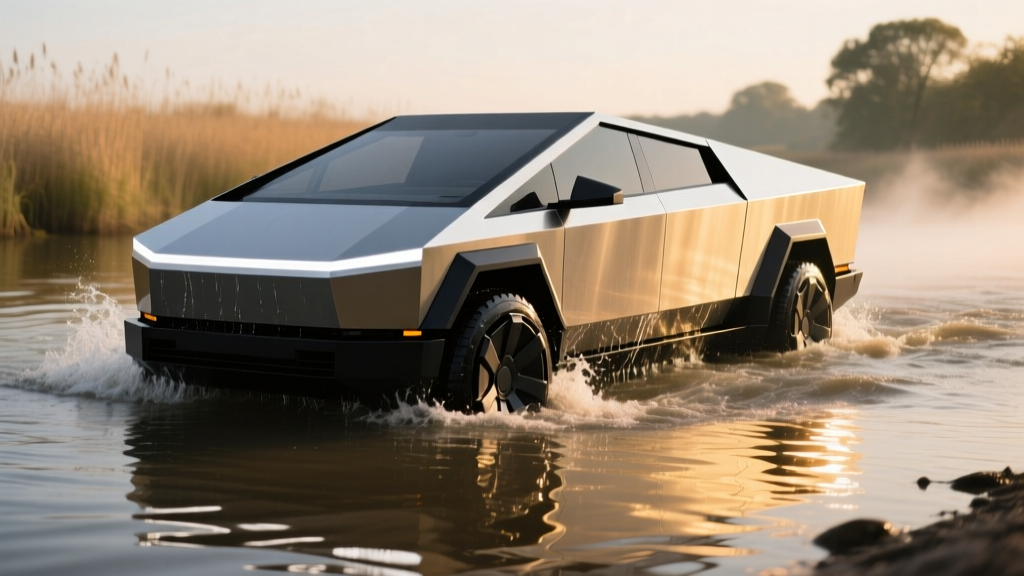
The question “does the Cybertruck float?” went viral the moment Tesla showed a prototype gliding across a short stretch of water. The honest answer for 2026 buyers: no, the production Tesla Cybertruck is not an amphibious vehicle and should not be driven into open water. What it can do is wade deeper than most pickups thanks to its sealed stainless-steel exoskeleton and elevated battery pack. Below, we separate the meme from the engineering, then deliver the full 2026 Cybertruck review you actually need — EPA range, 800V charging speeds, §30D tax-credit eligibility, and real-world ownership economics.
Water Fording vs. Floating: What the Cybertruck Actually Does
Tesla rates the production Cybertruck for up to 35 inches (889 mm) of water fording in its highest suspension setting. That figure applies to slow, controlled crossings over firm surfaces — not floating across lakes. The viral “floating Cybertruck” clips typically show a vehicle briefly buoyant in calm, shallow water, relying on the sealed skateboard and air suspension to trap enough displacement to stay above the surface for seconds, not minutes.
The sealed underbody, lack of a traditional air intake, and elevated battery placement give the Cybertruck a genuine advantage over internal-combustion trucks in flash-flood or trail-crossing scenarios. But 35 inches is a wade, not a swim.
2026 Cybertruck Spec Table: Range, Battery, Charging & Performance
| Spec | AWD | Cyberbeast |
|---|---|---|
| EPA Range | 340 miles | 320 miles |
| Battery (usable) | ~123 kWh (est.), 4680 NMC-type cells | ~123 kWh (est.), 4680 NMC-type cells |
| Max DC Fast Charge | ~350 kW (800V architecture) | ~350 kW (800V architecture) |
| 10–80% DC Time | ~15–18 min (V4 Supercharger) | ~15–18 min (V4 Supercharger) |
| Level 2 Home Charge | 11.5 kW / ~37 mi/hr | 11.5 kW / ~37 mi/hr |
| 0–60 mph | 3.9 sec | 2.6 sec |
| Horsepower | 600 hp | 845 hp |
| Drivetrain | Dual-motor AWD | Tri-motor AWD |
| Towing Capacity | 11,000 lbs | 11,000 lbs |
| Water Fording | 35 in (889 mm) | 35 in (889 mm) |
| MPGe (combined) | ~60 MPGe | ~56 MPGe |
| Base MSRP (2026) | $79,990 | $99,990 |
Sources: fueleconomy.gov, Tesla Cybertruck specs. Figures reflect 2026 model-year data; always verify at purchase.
Real-World Range: What the EPA Sticker Doesn’t Tell You
AWD: 340 mi EPA → expect ~270–295 mi on the highway at 70–75 mph.
Cyberbeast: 320 mi EPA → expect ~250–275 mi highway.
Cold weather (below 30°F): subtract 15–25% due to cabin heating and battery resistance.
Towing 8,000+ lbs: range can drop below 180 mi.
The Cybertruck’ angular stainless-steel body is iconic but aerodynamically punishing compared to a Tesla Model Y. At highway speeds, drag dominates energy consumption. In mixed city/highway driving at moderate temperatures, owners report mid-280s to low-300s for the AWD trim — close to EPA. Sustained 80 mph cruising, headwinds, or roof-rack accessories compress that number fast.
Efficiency lands around ~56–60 MPGe combined, or roughly 56–60 kWh per 100 miles depending on trim. That’s significantly less efficient than a sedan or crossover, but competitive with the Rivian R1T and Ford F-150 Lightning in the electric-truck segment.
Charging Speed: 800V Architecture & the Real Charge Curve
The Cybertruck uses an 800-volt electrical architecture, the same platform concept used by the Hyundai Ioniq 5 and Porsche Taycan, enabling very high DC charge rates when paired with capable stations. Peak rate is roughly 350 kW on Tesla V4 Superchargers. But peak is not sustained.
| Charging Level | Power | Miles Added per Hour | Notes |
|---|---|---|---|
| Level 1 (120V) | ~1.4 kW | ~4–5 mi/hr | Emergency only; impractical for a 123 kWh pack |
| Level 2 (240V, 48A) | 11.5 kW | ~37 mi/hr | Full charge overnight (~10–11 hrs 10–100%) |
| DC Fast (V4 Supercharger) | Up to ~350 kW peak | ~15–18 min 10–80% | Curve tapers sharply above 80% SoC |
| DC Fast (third-party CCS via adapter) | Up to ~250 kW | ~20–25 min 10–80% | Depends on network (EA, EVgo, etc.) |
Charge-curve reality check: The ~350 kW peak holds only between roughly 10–40% SoC. From 40–60% you’ll see ~200–250 kW, and above 80% the rate drops below 100 kW to protect the pack. Plan road-trip stops around the 10–80% window for the fastest throughput; charging to 100% at a DC station is painfully slow and unnecessary for most trips.
Preconditioning matters. Navigate to a Supercharger via the Cybertruck’s built-in nav and the thermal management system will warm or cool the pack ahead of arrival. Skip preconditioning on a cold morning and your peak rate may be cut in half for the first several minutes.
Pricing, Trims & Federal Tax Credit Eligibility (§30D)
For the 2026 model year, Tesla lists three Cybertruck configurations (the long-promised single-motor RWD, targeted as a fleet/commercial variant, has remained limited in availability and is excluded here):
| Trim | MSRP | §30D Credit Eligibility | Effective Price (if eligible) |
|---|---|---|---|
| AWD | $79,990 | Eligible (truck MSRP cap: $80,000) | ~$72,490 |
| Cyberbeast | $99,990 | Ineligible (exceeds $80k truck cap) | $99,990 |
Critical §30D caveats (verify each before purchase):
- MSRP cap for trucks: $80,000. The AWD Cybertruck squeaks in at $79,990; the Cyberbeast does not qualify.
- Buyer income caps: $150,000 single / $225,000 head-of-household / $300,000 joint MAGI.
- Battery sourcing & critical-mineral requirements: Phased-in percentages that tighten annually. Confirm current-year compliance on irs.gov or via the dealer’s IRS-reported seller report.
- Point-of-sale transfer: As of 2024+, you can transfer the credit to the dealer and take it as an immediate price reduction rather than waiting for tax filing.
- VIN and assembly: Final assembly must be in North America. Cybertruck is built in Austin, TX — qualifies.
Always consult a tax professional. Credit rules change, and options/packages that push AWD MSRP above $80,000 will disqualify the purchase.
Interior, Cargo & Tech: Practicality Meets Minimalism
The Cybertruck seats five (six with the optional front bench configuration) and uses a stripped-down, brutalist interior dominated by an 18.5-inch front touchscreen and a 9.4-inch rear screen. There are no physical stalks — turn signals are on the steering wheel, wipers and drive modes are touch-based. Love it or hate it, the learning curve is real.
Cargo dimensions (approximate, 2026 production):
- Bed length: 6 ft (72 in) with the tonneau closed; extended to ~8 ft with tailgate down
- Bed volume: ~67 cu ft (tonneau closed)
- Front trunk (frunk): ~7 cu ft — useful for charging cables and groceries
- Max payload: ~2,500 lbs
- Rear-seat legroom: ~38 inches — adequate for adults on long trips
Tech highlights:
- Power-operated stainless-steel tonneau (lockable, walk-on rated)
- 120V and 240V bed outlets (up to 11.5 kW output — jobsite and tailgate power)
- Bioweapon Defense Mode (HEPA cabin filtration)
- Adaptive air suspension with ~16 inches of ground clearance in Off-Road mode
- Tesla Autopilot standard; FSD (Supervised) available as a paid option — SAE Level 2 only, driver must remain engaged
- Sentry Mode, Dashcam, and integrated camera views for trailer monitoring
Notable drawbacks: Panel-gap variability remains a talking point; the sharp exoskeleton edges can be unforgiving in tight garages; the yoke-style or round-wheel touch-heavy UI is polarizing; rear visibility is compromised by the sloping bed cover, making the backup camera essential.
Warranty, Battery Longevity & Ownership Costs
Tesla covers the Cybertruck with:
- Basic Vehicle Limited Warranty: 4 years / 50,000 miles
- Battery & Drive Unit Warranty: 8 years / 120,000 miles, with a minimum 70% capacity retention threshold
- Stainless-steel body: Corrosion-resistant by nature, but cosmetic surface rust (“tea staining”) from rail dust and environmental contaminants has been reported — Tesla has published care guidance recommending prompt cleaning
The 4680-format cells use an NMC-type chemistry optimized for energy density and power output, not the longer cycle life of LFP packs found in the base Model 3 RWD. Expect typical NMC degradation: roughly 8–12% capacity loss over the first 100,000 miles based on historical Tesla fleet data, then a slower decline. Keeping daily SoC between 20–80% and avoiding repeated 100% DC charges will extend pack life.
5-year ownership snapshot (AWD, 15,000 mi/yr, national avg electricity at $0.16/kWh):
- Charging cost: ~$5,000–$6,500 (mix of home and Supercharger)
- Comparable gas truck fuel cost: ~$11,000–$13,000
- Insurance: typically 20–35% higher than an F-150 Lightning — get quotes before purchase
- Tires: large, heavy truck with instant torque — expect 25,000–35,000 mi per set
Pros, Cons & Who the Cybertruck Is For
- 35-in water fording — best in EV truck class
- 11,000-lb towing & 240V bed power
- 800V architecture with ~350 kW peak DC charge
- Stainless exoskeleton & armored glass (durable, not pretty after rock chips)
- Access to the Tesla Supercharger network
- AWD trim qualifies for §30D credit (with caveats)
- Does NOT float — viral clips are misleading
- Highway efficiency suffers due to boxy aero
- Cyberbeast exceeds $80k MSRP cap — no federal credit
- Polarizing UI (no stalks, touch-heavy)
- Insurance premiums above segment average
- Panel-gap and surface-rust complaints
Who it suits: Tech-forward truck buyers who need serious towing, jobsite power (240V output), and off-road clearance — and who accept the aero and insurance trade-offs. Not ideal for efficiency-obsessed commuters (a Model Y or Ioniq 5 wins on MPGe) or buyers who want a conventional truck experience (F-150 Lightning is more familiar).
Cybertruck vs. R1T vs. F-150 Lightning: Which Electric Truck Wins?
If the floating question brought you here, you’re likely cross-shopping. Quick verdict:
- Choose Cybertruck AWD if you want maximum fording depth, Supercharger access, and the most distinctive design, and you qualify for §30D.
- Choose Rivian R1T (Dual/Quad) if you prioritize refined off-road capability, a more conventional interior, and a broader accessory ecosystem. Range and charging competitive; no Supercharger access.
- Choose Ford F-150 Lightning if you want a traditional truck layout, Mega Power Pro (V2H capability), and a lower entry price — though efficiency and DC charge rate trail the Cybertruck.
Frequently Asked Questions
Can the Tesla Cybertruck actually float across a lake?
No. The production Cybertruck is rated for 35 inches of water fording, not sustained flotation. Brief buoyancy in calm, shallow water has been demonstrated, but driving into open water risks catastrophic electrical damage and is not covered under warranty.
What is the real-world highway range of the 2026 Cybertruck?
Expect ~270–295 miles for the AWD and ~250–275 miles for the Cyberbeast at 70–75 mph in moderate temperatures. Cold weather, towing, and roof accessories reduce range further.
How fast does the Cybertruck charge on a Supercharger?
Peak rate is ~350 kW on V4 Superchargers, with a 10–80% time of roughly 15–18 minutes. The charge curve tapers sharply above 80% SoC — plan stops accordingly.
Does the Cybertruck qualify for the $7,500 federal EV tax credit?
The AWD trim at $79,990 MSRP qualifies if the buyer meets IRS §30D income caps and the vehicle meets current-year battery-sourcing and critical-mineral requirements. The $99,990 Cyberbeast exceeds the $80,000 truck MSRP cap and does not qualify. Verify on irs.gov.
Is the Cybertruck self-driving?
No. Autopilot and FSD (Supervised) are SAE Level 2 driver-assist systems. The driver must remain attentive with hands ready to take over at any moment. Fully driverless (Level 4) capability is not available on consumer vehicles.
How does towing affect Cybertruck range?
Towing 8,000+ lbs can cut range by 40–55%, dropping real-world range below 180 miles. Plan frequent Supercharger stops and use the truck’s integrated trip planner for tow-mode routing.