Quick Answer: What Are Electric USPS Vehicles?
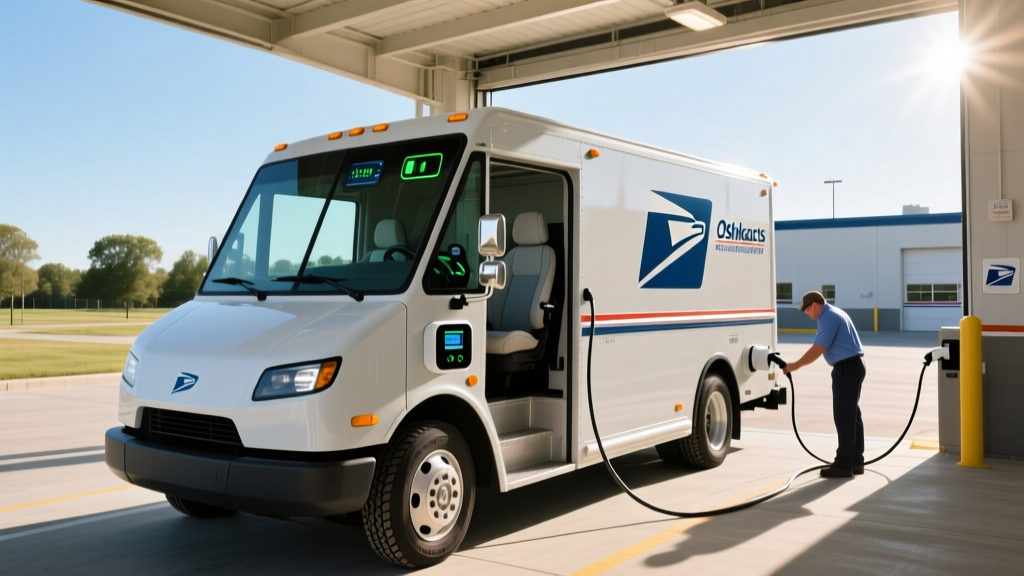
The United States Postal Service is replacing its 30-year-old Grumman LLV mail trucks with the Oshkosh NGDV (Next Generation Delivery Vehicle), available in both battery-electric and low-emission ICE variants. The BEV version features a ~70-mile EPA-estimated range, a ~63 kWh LFP battery pack, and Level 2 AC charging capability. Under the USPS's 2022–2028 modernization plan, at least 66,000 of the planned 92,000+ new delivery vehicles are slated to be battery-electric. As of early 2026, initial production units are entering service in select metro routes, with volume deliveries ramping through the year.
Why USPS Is Going Electric: The Numbers Behind the Fleet
The USPS operates roughly 230,000 delivery vehicles, the majority being the iconic Grumman LLV — a 1987–1994-era truck with no air conditioning, no airbags, and an EPA fuel economy hovering around 8.2 mpg combined. Maintenance costs on these trucks exceeded $5,000 per vehicle annually by the early 2020s, and the fleet burns approximately 125 million gallons of gasoline per year.
The NGDV contract, initially awarded to Oshkosh Defense (now Oshkosh Corporation) in February 2022, was valued at up to $6.2 billion. Following environmental review pressure and an updated commitment in late 2022, USPS shifted the procurement mix to prioritize electric powertrains. The Inflation Reduction Act and subsequent federal fleet electrification mandates provided supplemental funding that made the BEV-heavy mix financially viable.
For context on fleet EV economics: a mail truck averaging 18 miles per day, 5 days per week (roughly 4,680 miles/year) is an ideal EV use case. Short, predictable routes with overnight depot charging eliminate range anxiety and maximize the fuel-cost advantage.
NGDV BEV Specs: Battery, Range, and Charging
Here's what we know from Oshkosh technical disclosures and USPS environmental impact documentation about the battery-electric NGDV variant:
| Specification | NGDV BEV |
|---|---|
| Battery Chemistry | LFP (Lithium Iron Phosphate) |
| Battery Capacity (usable) | ~63 kWh |
| EPA-Estimated Range | ~70 miles |
| Real-World Range (loaded, stop-and-go) | ~55–65 miles |
| Motor Output | ~200 kW (~268 hp) |
| Max DC Fast Charge Rate | Not equipped (Level 2 only) |
| Level 2 AC Charge Rate | ~19.2 kW (80A depot charger) |
| Level 2 Charge Time (0–100%) | ~4 hours |
| GVWR | ~9,990 lbs (Class 2b) |
| Cargo Volume | ~120 cu ft |
| Estimated Unit Cost (BEV) | ~$65,000–$75,000 |
Real-World Range Reality
The NGDV's ~70-mile EPA estimate assumes moderate conditions. In real postal operations — frequent stops (often 150+ per route), heavy curb weight when loaded with parcels, HVAC use, and cold-weather battery losses — expect 55 to 65 usable miles before needing a charge. For most urban and suburban routes averaging 18–25 miles, this leaves a comfortable buffer. Rural routes exceeding 50 miles may require the ICE variant or mid-day opportunity charging infrastructure.
Why LFP Chemistry?
Oshkosh's choice of LFP (lithium iron phosphate) over NMC is deliberate for fleet duty. LFP offers:
- Cycle life: 3,000–5,000+ full cycles vs. ~1,500–2,500 for NMC — critical for a vehicle expected to serve 15–20 years
- Thermal stability: Higher resistance to thermal runaway, important in dense depot parking
- Lower cost: No cobalt or nickel — reducing supply chain risk and per-kWh cost
- Trade-off: Lower energy density (~160 Wh/kg cell-level vs. ~250 for NMC), meaning a heavier pack for the same range. Acceptable in a low-speed delivery truck.
EV vs. Gas: Cost Comparison for a Mail Delivery Fleet
The economic case for electric USPS vehicles hinges on total cost of ownership (TCO) over the vehicle's service life. Here's a comparison based on USPS operational data and fueleconomy.gov benchmarks:
| Cost Factor | NGDV BEV | Grumman LLV (Gas) | NGDV ICE (Low-Emission) |
|---|---|---|---|
| Estimated Unit Price | $65,000–$75,000 | N/A (fully depreciated) | $45,000–$55,000 |
| Fuel/Energy Cost Per Mile | $0.08–$0.12 | $0.38–$0.45 | $0.28–$0.34 |
| Annual Fuel/Energy (4,680 mi) | $375–$560 | $1,775–$2,100 | $1,310–$1,590 |
| Annual Maintenance | $800–$1,200 | $4,500–$5,500 | $2,500–$3,500 |
| Estimated Annual Savings vs. LLV | $5,500–$6,800 | — | $2,000–$3,000 |
| Projected 15-Year Fuel Savings | $19,500–$23,000 | — | $7,000–$11,000 |
Energy costs assume commercial electricity at $0.10–$0.14/kWh and gasoline at $3.20–$3.60/gallon (2026 national averages for commercial fleet fueling). The BEV's dramatically lower maintenance costs come from eliminating oil changes, transmission service, exhaust system repairs, and the frequent engine-related failures that plague the LLV's aging 2.5L Iron Duke-derivative powertrain.
Depot Charging Infrastructure: The Hidden Cost
Electric USPS vehicles require depot charging — not public charging networks. Each postal facility converting to BEVs needs:
Per-Vehicle Depot Charging Cost Estimate
| Component | Cost Range |
|---|---|
| Level 2 AC charger (19.2 kW, 80A commercial unit) | $3,000–$6,000 |
| Electrical infrastructure (conduit, wiring, panel upgrades) | $5,000–$20,000 |
| Utility service upgrade (if needed for multi-charger depot) | $20,000–$150,000+ |
| Installation labor (licensed electrician, permitting) | $3,000–$10,000 |
| Charging management software | $500–$2,000/yr per site |
| Estimated per-stall total (small depot) | $15,000–$35,000 |
| Estimated per-stall total (large depot w/ utility upgrade) | $30,000–$80,000+ |
For a depot housing 40 NGDV BEVs, total charging infrastructure investment could range from $600,000 to $2.5 million, depending on existing electrical capacity. The USPS has been leveraging IRA provisions and Department of Energy grants to offset these costs. Critically, most postal routes end by early afternoon, giving vehicles 12+ hours to charge overnight — meaning slower, cheaper Level 2 charging is sufficient, and DC fast charging hardware is unnecessary.
Common Misconceptions About Electric USPS Vehicles
| Myth | Fact |
|---|---|
| "70 miles of range isn't enough for mail delivery" | The average USPS route is 18–25 miles/day. The NGDV BEV has 2–3x the range needed for most routes, with buffer for detours and HVAC use. |
| "EVs can't handle cold weather routes" | LFP batteries do lose 20–30% range in sub-freezing temps. At 70 miles EPA, that means ~50 miles in cold weather — still sufficient for the vast majority of routes. Depot preconditioning while plugged in mitigates cabin heating draw. |
| "All 92,000 new USPS trucks will be electric" | The commitment is for at least 66,000 BEVs out of 92,000+ vehicles. Remaining units will be low-emission ICE for long rural routes where charging infrastructure is impractical. |
| "Electric mail trucks are too slow" | The NGDV BEV produces ~268 hp — far more than the LLV's 100 hp. It's electronically governed to safe fleet speeds but has strong low-end torque for stop-and-go efficiency. |
| "The batteries will need replacement mid-service" | LFP chemistry is rated for 3,000–5,000+ cycles. At one cycle per day, that's 8–14 years before significant degradation. With a partial-discharge daily pattern, the pack should last the vehicle's full 15–20 year service life. |
What This Means for Consumers: The Broader EV Signal
While you can't buy an NGDV for personal use, the electric USPS vehicle rollout signals important trends for consumer EV buyers:
- LFP is fleet-proven: If LFP is durable enough for daily postal abuse, it's more than adequate for consumer use. Vehicles like the Tesla Model 3 RWD and Ford F-150 Lightning standard-range already use LFP.
- Depot charging works: The USPS strategy validates that overnight Level 2 charging is the backbone of practical EV operation — the same approach consumer EV owners use at home.
- Short-route EVs save the most: If your daily commute is under 40 miles round-trip (like most mail routes), an EV's per-mile cost advantage over gas is maximized. The fuel savings math that justifies a $70,000 electric mail truck works even better for a $35,000 consumer EV.
- Infrastructure investment precedes adoption: The USPS is spending heavily on depot charging before vehicles arrive — a reminder that home Level 2 charger installation should happen before your EV delivery, not after.
Decision Framework: How USPS Route Data Informs Your EV Choice
If the USPS Route Logic Fits Your Driving, an EV Likely Fits You
Choose a BEV if: Your daily round-trip driving is under 60 miles, you have access to overnight Level 2 charging (home or workplace), and your climate doesn't regularly drop below 10°F. Like a mail truck, you'll charge overnight and never visit a gas station for daily driving.
Choose a PHEV if: Your daily commute is short (under 30 miles, matching most mail routes) but you regularly take 200+ mile road trips. A PHEV gives you electric-only daily driving with gas backup — similar to USPS keeping ICE variants for long rural routes.
Choose a gas/hybrid if: You lack reliable overnight charging access, regularly drive 200+ miles daily, or operate in extreme cold climates where BEV range loss would create hardship. The USPS's decision to retain ICE variants for 25–30% of its fleet acknowledges these same limitations.
Frequently Asked Questions
Who makes the electric USPS vehicles?
Oshkosh Corporation (formerly Oshkosh Defense) is the prime contractor for the NGDV program. The vehicles are assembled at a dedicated facility in Spartanburg, South Carolina. Oshkosh subcontracts components including the electric powertrain and battery systems from established Tier 1 automotive suppliers.
How much does an electric USPS mail truck cost?
The NGDV BEV variant is estimated at $65,000–$75,000 per unit, compared to roughly $45,000–$55,000 for the ICE variant. When charging infrastructure and lifetime fuel/maintenance savings are factored in, USPS projects BEV TCO parity within 6–8 years of service, with significant net savings over the vehicle's 15–20 year lifespan.
Will USPS electric vehicles use Tesla Superchargers?
No. The NGDV BEV charges exclusively at postal depot facilities via Level 2 AC chargers. These are fleet vehicles that return to a fixed location nightly — they don't use public charging networks. This is analogous to how most consumer EV owners charge at home rather than relying on public fast chargers.
What happens if an NGDV BEV runs out of charge mid-route?
USPS route planning software matches vehicles to routes within their range envelope, with buffer. If an unexpected situation arises (extended detour, extreme cold), USPS protocols include returning the vehicle to the depot for a partial charge or swapping to a spare ICE vehicle. The fleet model means there's always backup capacity — something individual EV drivers replicate by planning charging stops on longer trips.
Are electric USPS vehicles good in snow and cold weather?
The NGDV BEV includes a thermal management system and electric cabin heating. LFP batteries experience 20–30% range reduction in sub-freezing temperatures, but since most routes are well under the vehicle's range, this is manageable. Depot preconditioning — warming the battery and cabin while still plugged in — minimizes range impact during cold starts.
When will electric USPS vehicles be in my area?
The USPS began limited NGDV deployments in 2025, with volume production ramping through 2026–2028. Priority is given to facilities in areas with poor air quality and dense urban routes that maximize the BEV's health and cost benefits. Full fleet replacement is expected to take 10+ years. Check USPS.com for local facility modernization announcements.