The Short Answer on Electric Snowboards
An electric snowboard is a motorized board that uses a small battery-powered motor (typically 500W to 3,000W) to propel a rider on snow without needing ski lifts or slopes. Most consumer models offer 5 to 15 miles of range on a single charge, top speeds of 15–30 mph, and recharge via standard 120V outlets or portable lithium-ion packs in 2–4 hours. Prices range from $800 for entry-level boards to over $5,000 for performance models. For EV owners, an electric snowboard can be a fun off-piste companion — but it's a niche powersports product, not a vehicle, and it shares almost nothing with EV drivetrains beyond lithium-ion batteries and electric motors.
If you've landed here searching for "electric snowboard," you may be an EV owner exploring how electric powersports gear fits into your lifestyle — or you may have been looking for electric-vehicle guidance and taken a detour. Either way, let's address what an electric snowboard actually is, what it costs, and how it relates (or doesn't) to the EV ownership world we cover at AutoEdgeView.
What Is an Electric Snowboard, Exactly?
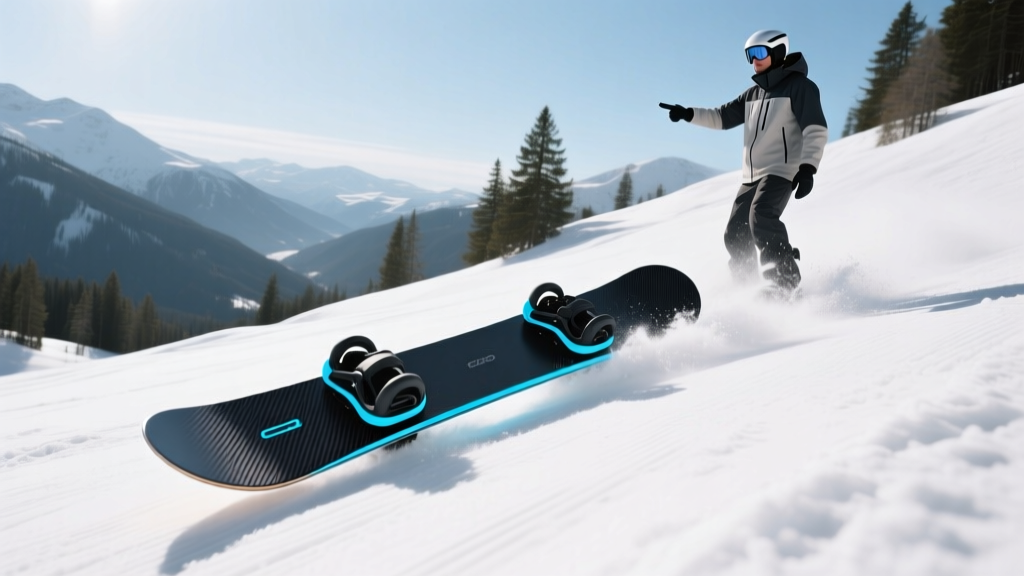
An electric snowboard — sometimes called a motorized snowboard or electric snowskate — is a snowboard fitted with a continuous track system (similar to a snowmobile's) or small hub-driven motors that grip the snow surface. Unlike traditional snowboarding, which relies entirely on gravity and ski-lift access, these boards are self-propelled, letting you ride flat terrain, uphill sections, or backcountry areas without infrastructure.
Key brands in this emerging niche include Moonshine, Noboard, and a handful of Kickstarter-stage startups. The category remains small: there's no standardized testing body like the EPA for range claims, no IIHS for safety, and no federal incentive eligibility. Think of it as closer to an electric skateboard on snow than to any vehicle you'd register with the DMV.
Typical Electric Snowboard Specifications
| Spec | Entry-Level | Mid-Range | Performance |
|---|---|---|---|
| Motor Power | 500–800W | 1,000–1,500W | 2,000–3,000W |
| Battery Capacity | ~300 Wh | ~500–800 Wh | 1,000–1,500 Wh |
| Claimed Range | 5–8 miles | 8–12 miles | 12–18 miles |
| Top Speed | 12–18 mph | 18–25 mph | 25–30+ mph |
| Charge Time (120V) | 2–3 hours | 3–4 hours | 4–6 hours |
| Weight | 25–35 lbs | 35–50 lbs | 50–70 lbs |
| Price Range | $800–$1,500 | $1,500–$3,000 | $3,000–$5,500+ |
Electric Snowboard vs. EV: What's Actually in Common?
The overlap between an electric snowboard and a battery-electric vehicle like a Tesla Model Y or Hyundai Ioniq 5 is thinner than the shared "electric" label suggests. Here's a concrete comparison:
| Attribute | Electric Snowboard | Typical EV (e.g., 2026 Ioniq 5) |
|---|---|---|
| Battery Chemistry | Li-ion (NMC pouch cells) | NMC or LFP (large-format prismatic) |
| Battery Capacity | 0.3–1.5 kWh | 58–84 kWh |
| Voltage | 24V–48V | 400V–800V architecture |
| Charging | Standard 120V wall outlet; no DC fast charge | Level 1/2/DC fast charge up to 240+ kW |
| Thermal Management | None (passive) | Active liquid cooling/heating |
| Federal Tax Credit | Not eligible | Up to $7,500 via IRS §30D (with income, MSRP, and sourcing requirements) |
| Regulatory Body | None specific | EPA, NHTSA, IIHS |
| Warranty | 6–12 months typical | 8 years/100,000 miles (battery & powertrain) |
The bottom line: your electric snowboard's battery holds roughly 1/80th the energy of an EV battery pack. It has no thermal management, no regenerative braking system, and no standardized charging connector. You cannot charge it at a Tesla Supercharger or Electrify America station. If you're researching electric snowboards expecting EV-grade engineering or infrastructure compatibility, recalibrate expectations — this is a consumer powersports product.
Real Costs: Buying, Charging, and Owning an Electric Snowboard
Let's break down what ownership actually costs, since manufacturer marketing tends to gloss over the full picture.
| Cost Category | Electric Snowboard (Mid-Range) | Traditional Snowboard (Season) |
|---|---|---|
| Upfront Purchase | $1,500–$3,000 | $300–$700 (board + bindings + boots) |
| Season Lift Pass | $0 (no lift needed) | $600–$1,500 (major resort) |
| Charging/Energy per Season | $15–$40 (electricity) | $0 |
| Maintenance | $100–$300/yr (track wear, battery care) | $50–$150/yr (wax, edge tune) |
| Battery Replacement | $300–$800 (every 3–5 years) | N/A |
| Insurance | Not typically insurable; rider assumes risk | N/A |
| 5-Year Total (Est.) | $3,500–$7,000 | $3,550–$8,250 |
The economics are interesting in a narrow case: if you ride frequently enough that a season lift pass would exceed $1,000 and you have suitable terrain nearby, the electric snowboard can pay for itself in 2–3 seasons on lift-pass savings alone. But this assumes you have flat or rolling terrain to ride — these boards don't replace lift-served downhill runs at a resort, and most ski areas prohibit motorized boards on their slopes.
Charging Logistics for EV Owners
If you already own an EV, charging an electric snowboard is trivially easy: it uses a standard 120V household outlet and draws roughly 2–4 amps. A full charge of a 500 Wh battery at 120V takes about 3 hours and costs approximately $0.08 at the U.S. average electricity rate of ~$0.16/kWh (per EIA data).
However, there are practical considerations:
- Cold-weather battery performance: Lithium-ion batteries lose 20–40% of their effective capacity in sub-freezing temperatures. If you're riding in 10°F conditions, expect your 10-mile claimed range to drop to 6–7 miles. Unlike an EV, there's no battery preconditioning system — you're at the mercy of ambient temperature.
- Charging at the mountain: Most ski lodges won't let you plug in a motorized board at an outdoor outlet. Plan to charge at home or in your vehicle.
- Charging from your EV: Some EVs with V2L (vehicle-to-load) capability — like the Hyundai Ioniq 5, Kia EV6, or Ford F-150 Lightning — can power a 120V outlet from the traction battery. You could theoretically charge your snowboard from your EV in a parking lot. A 500 Wh charge would use less than 1 kWh from an 84 kWh battery — negligible impact on your driving range.
Common Misconceptions About Electric Snowboards
| Myth | Fact |
|---|---|
| "They qualify for the federal EV tax credit." | No. The IRS §30D credit applies to qualified plug-in electric drive motor vehicles with 4 wheels and a gross vehicle weight rating — snowboards don't qualify. See IRS guidelines. |
| "I can ride them at any ski resort." | Most resorts explicitly ban motorized devices on their terrain. Check local regulations; BLM and national forest land may allow them. |
| "Range claims are accurate." | Like early EVs, manufacturer range claims assume ideal conditions. Cold snow, rider weight, uphill grades, and soft powder all reduce real range by 25–40%. |
| "They're maintenance-free." | Track systems wear out, batteries degrade, and motor controllers can fail in wet/cold conditions. Budget $100–$300 annually in upkeep. |
| "They're just like electric skateboards." | Snow introduces moisture ingress, extreme cold, and variable traction that no electric skateboard faces. Failure modes and safety risks are different. |
Decision Framework: Should You Buy an Electric Snowboard?
Choose an Electric Snowboard If:
- You live near or frequently visit flat/rolling snow terrain (frozen lakes, golf courses, backcountry meadows) where traditional snowboarding requires a lift or hike.
- You want a self-propelled way to explore backcountry areas without a snowmobile ($10,000+).
- You're comfortable with a niche product that lacks standardized testing, strong warranty coverage, or resale-value data.
- You have reliable access to a 120V outlet for charging and can accept cold-weather range reduction.
- You understand this is a recreational toy, not a vehicle — no registration, no insurance framework, no consumer protections equivalent to the auto industry.
Skip It and Buy/Keep Your EV If:
- You were hoping for an EV-adjacent product with similar infrastructure, warranty, or tax-credit benefits — none of that applies here.
- Your primary snow-sport activity is downhill resort riding, where motorized boards are prohibited.
- You need reliable range in sub-zero temperatures without range loss — current battery tech in this category isn't there yet.
- You're on a tight budget and a $400 traditional snowboard plus a $800 lift pass would serve you better for the season.
First-Time EV Buyer? Start Here Instead
If you arrived at this article researching your first electric vehicle — not a snowboard — here's what actually matters:
- Real-world range: EPA estimates are a starting point. Expect 10–20% less on the highway, and 20–40% less in freezing weather. A 300-mile EPA rating might deliver 220 miles on a cold January road trip.
- Home charging is essential: Level 2 home charging (240V, 7–11 kW) adds 25–40 miles of range per hour and costs $500–$2,000 to install. Without it, EV ownership is significantly harder.
- Federal tax credit (§30D): Up to $7,500 for qualifying new EVs, but subject to MSRP caps ($55,000 for sedans, $80,000 for SUVs/trucks), buyer income limits ($150K single / $300K joint), and battery critical-mineral sourcing rules. Check current eligibility at IRS.gov before committing.
- Total cost of ownership: EVs typically cost more upfront but save $600–$1,200/year on fuel and maintenance. Break-even is usually 3–5 years depending on your mileage and local electricity rates.
We cover all of this in depth across our EV reviews, charging guides, and ownership cost analyses. An electric snowboard is a fun accessory for the EV-owning snow enthusiast — but the EV itself is the purchase that demands serious research.
Frequently Asked Questions
Are electric snowboards street-legal or registrable?
No. Electric snowboards are not classified as motor vehicles by any U.S. state DMV. They cannot be registered, plated, or insured as vehicles. They're treated as recreational equipment, similar to snowmobiles on designated trails — but without the established regulatory framework snowmobiles have.
Can I charge an electric snowboard from my EV?
If your EV has a V2L (vehicle-to-load) feature with a 120V outlet — available on the Hyundai Ioniq 5, Kia EV6, Ford F-150 Lightning, and some others — yes. The snowboard charger draws roughly 200–500 watts, which is well within V2L capacity. A full charge would use less than 1 kWh from your EV's battery.
How long do electric snowboard batteries last?
Most use lithium-ion cells rated for 300–500 full charge cycles before degrading to 80% capacity. With moderate use (30–50 rides per season), expect 3–5 years before noticeable range loss. Replacement battery packs cost $300–$800 depending on capacity. This is far less robust than an EV battery warranty, which typically guarantees 70% capacity retention over 8 years or 100,000 miles.
Is an electric snowboard the same as an electric ski or snowmobile?
No. Electric skis (like those from Elan) are a separate product category with different propulsion mechanisms. Electric snowmobiles (from brands like Taiga Motors, starting around $18,000) are full-sized vehicles with 80+ kWh-range equivalents, liquid cooling, and far greater capability — but at 5–10× the price. An electric snowboard sits below both in capability and cost.
Do electric snowboards work in deep powder?
Performance drops significantly in powder deeper than 6–8 inches. The track system needs a relatively firm surface to generate traction. Soft, deep snow causes the track to spin and sink, reducing range and speed dramatically. Hard-packed snow, frozen lakes, and groomed flat trails are ideal conditions.