The Short Answer on Electric RVs
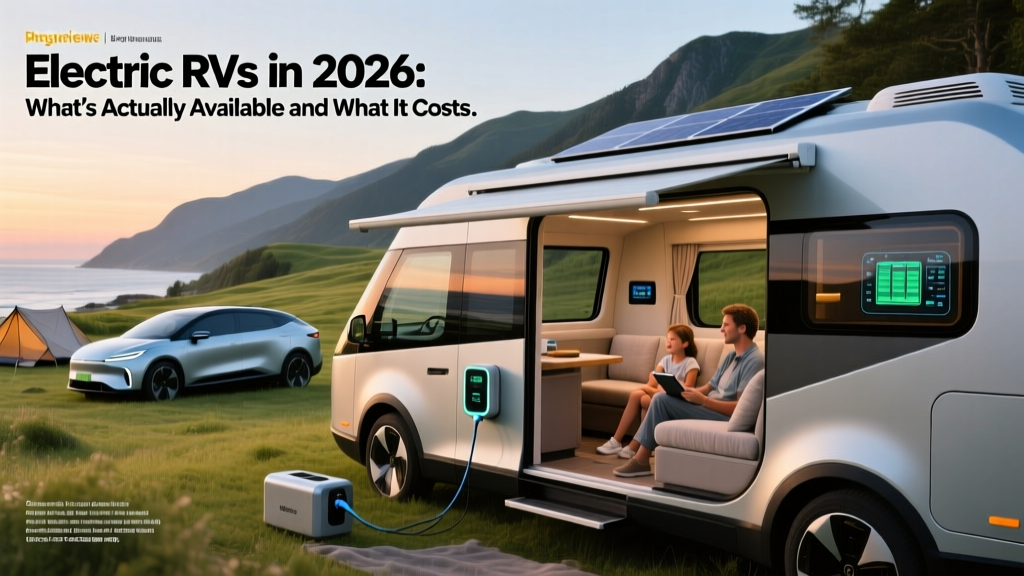
True electric RVs — fully electric Class A, B, or C motorhomes with living quarters — remain extremely limited in 2026. The only production electric camper van widely available in the US is the Winnebago e-RV, built on a Ford E-Transit chassis with approximately 108 miles of EPA-estimated range and a starting price around $125,000. For towable electric RVs (travel trailers with integrated battery systems), options like the Lightship L1 (announced, with deliveries expected mid-to-late 2026) aim for solar-assisted, aerodynamic travel trailers that don't destroy your tow vehicle's range. If you need long-distance RV capability today, a diesel or gas motorhome remains the practical choice. Electric RVs are best suited for weekend trips within ~100 miles of home, campground-to-campground travel, or as a second RV for local adventures.
What Electric RVs Actually Exist in 2026
The electric RV market is still in its infancy. Unlike electric cars, where dozens of models compete across price segments, electric motorhomes are limited to a handful of offerings — and most carry premium pricing that reflects low production volumes and complex engineering challenges.
The core problem is physics: RVs are heavy, boxy, and energy-intensive. A typical Class A motorhome weighs 15,000–30,000 lbs and pushes air like a rolling billboard. That combination demands enormous battery packs to achieve even modest range, driving cost and weight higher.
| Model | Type | Battery / Usable kWh | EPA Range (mi) | Max DC Charge kW | Base MSRP | Status |
|---|---|---|---|---|---|---|
| Winnebago e-RV | Class B (Camper Van) | 68 kWh (NMC) / ~54 usable | ~108 | 115 kW | ~$125,000 | Available (limited production) |
| Lightship L1 | Travel Trailer (towable) | 80 kWh (LFP) + solar roof | N/A (trailer — extends tow range) | N/A | ~$125,000 (announced) | Pre-orders; deliveries expected 2026 |
| Airstream e-stream Concept | Travel Trailer (concept) | ~80 kWh (estimated) | N/A | N/A | TBD | Concept / not on sale |
Important distinction: The Winnebago e-RV is a self-propelled motorhome. The Lightship L1 is a travel trailer — it has no motor of its own but carries a large battery pack that can power its own systems (and potentially push-propel to offset tow-vehicle range loss) while being towed. These serve very different use cases.
Electric RV vs. Gas/Diesel RV: Range, Cost, and Practicality
Let's compare the Winnebago e-RV against a comparable gas-powered Class B camper van, the Winnebago Revel (built on a Mercedes-Benz Sprinter diesel chassis), to see where electric RVs stand today.
| Spec | e-RV (Electric) | Revel 4×4 (Diesel) |
|---|---|---|
| Powertrain | Single electric motor, 266 hp | 3.0L turbo diesel, 188 hp |
| Battery / Fuel Tank | 68 kWh NMC (~54 usable) | 24.5-gallon diesel tank |
| Range | ~108 mi (EPA est.) | ~400–450 mi (real-world) |
| Energy/Fuel Cost per Mile | ~$0.10–$0.18/mi (electricity) | ~$0.22–$0.30/mi (diesel at $4.00/gal, 14 mpg) |
| Refuel/Recharge Time | 10–80% in ~45 min at 115 kW DC | ~10 min at any diesel pump |
| Base MSRP | ~$125,000 | ~$110,000–$120,000 |
| Maintenance (annual est.) | $200–$400 | $800–$1,500 (diesel service) |
| Boondocking Power | Full house battery + traction battery (massive capacity) | Generator or solar + house battery |
Where the Electric RV Wins
- Boondocking: The e-RV's traction battery (54 kWh usable) can power onboard appliances — air conditioning, microwave, induction cooktop — for days without a generator. This is a massive advantage for off-grid camping.
- Quiet operation: No diesel idle noise at campgrounds. No generator hum disturbing neighbors.
- Lower per-mile energy cost: At $0.14/kWh (national average for DC fast charging), the e-RV costs roughly $0.14–$0.18 per mile vs. $0.25+ per mile for diesel.
- Minimal drivetrain maintenance: No oil changes, no diesel particulate filter regeneration, no transmission fluid.
Where the Electric RV Falls Short
- Range: 108 miles is limiting. A 300-mile trip requires 2–3 DC fast-charge stops, each taking 30–45 minutes. With a diesel RV, you'd stop once for fuel and lunch.
- Charging infrastructure: Most DC fast-charging stations are designed for passenger cars. Pulling a 20-foot camper van into a tight ChargePoint or Electrify America stall — or worse, needing to unhitch a travel trailer — is impractical at many locations. RV parks with 50-amp shore power are far more common than destination chargers that accommodate large vehicles.
- Upfront cost: At $125,000, the e-RV carries a premium over diesel alternatives, with no federal §30D tax credit applicable (the credit is capped at vehicles under 14,000 lbs GVWR for new purchases, and the e-RV's eligibility depends on specific IRS sourcing and MSRP rules — consult IRS §30D guidelines).
- Cold-weather range loss: Expect 25–40% range reduction in freezing temperatures. That 108-mile range could shrink to 65–80 miles in winter conditions, compounded by cabin and battery heating demands.
Real Costs of Electric RV Ownership
Understanding total cost of ownership requires looking beyond the sticker price. Here's a 5-year projection comparing the Winnebago e-RV to a comparable diesel Class B, assuming 6,000 miles/year (typical RV usage).
| Category | e-RV (Electric) | Diesel Class B |
|---|---|---|
| Purchase Price | $125,000 | $115,000 |
| Fuel/Energy (5 years, 30k mi) | $4,500 (at $0.15/mi avg) | $8,250 (at $0.275/mi avg) |
| Maintenance (5 years) | $1,500 | $6,000 |
| Insurance (5 years) | $12,500 (est. $2,500/yr) | $10,000 (est. $2,000/yr) |
| Depreciation (est. 5-yr) | ~$50,000 (40% — uncertain for EV RVs) | ~$40,000 (35%) |
| Total 5-Year Cost | ~$193,500 | ~$179,250 |
Key takeaway: The electric RV saves roughly $5,000–$8,000 on fuel and maintenance over five years, but those savings are offset by higher insurance premiums (EV RVs carry higher replacement-cost valuations) and potentially steeper depreciation due to market uncertainty around used electric motorhomes. The total cost of ownership is comparable — not dramatically cheaper — and heavily dependent on how much you drive and your local electricity rates.
If you're a high-mileage RVer (10,000+ miles/year), the fuel savings tilt more favorably toward electric. If you drive 3,000 miles a year, the math strongly favors diesel.
Charging an Electric RV: What You Actually Need to Know
Charging logistics are the single biggest practical hurdle for electric RV ownership. Here's what the reality looks like across three charging scenarios:
Home Charging (Level 2)
The Winnebago e-RV accepts up to 10.5 kW on Level 2 AC charging. From a depleted battery to full, expect roughly 6–7 hours. This requires a dedicated 240V/50-amp circuit — similar to what a large electric dryer uses. Most homes can accommodate this, but expect $800–$2,000 for a licensed electrician to install a hardwired Level 2 station (such as a ChargePoint Home Flex or Emporia Level 2) near your RV parking spot.
If you store your RV at a storage facility or campground, home charging becomes irrelevant. Confirm with your storage provider whether 240V/50-amp service is available.
Public DC Fast Charging
The e-RV peaks at 115 kW DC fast charging, achieving a 10–80% charge in roughly 45 minutes. However, the charge curve tapers significantly above 80% — a full 10–100% session could take 70+ minutes. At a typical Electrify America or EVgo station, you'll pay $0.35–$0.55/kWh for DC fast charging, raising the per-mile cost to $0.20–$0.28 — approaching diesel territory.
The bigger issue is physical access. Most public DC fast chargers are designed for passenger vehicles. You'll need pull-through sites (rare) or a location where you can maneuver a 20+ foot van without blocking adjacent stalls. PlugShare and the AFDC charging locator can help identify RV-friendly stations, but the network of large-vehicle-capable chargers remains sparse.
Campground Shore Power
Most RV campgrounds offer 30-amp or 50-amp shore power at 120/240V. A 50-amp pedestal can deliver up to 12 kW — enough to charge the e-RV's traction battery at roughly the same rate as a home Level 2 charger. This is the most practical road-trip charging strategy: arrive at a campground, plug in overnight, and wake up with a full battery. The challenge is that not all campgrounds provide 50-amp service, and those that do may not have it at every site.
Common Misconceptions About Electric RVs
| Myth | Fact |
|---|---|
| "Electric RVs can go 300+ miles like an electric car." | No current production electric motorhome exceeds ~120 miles of real-world range. Heavy weight and poor aerodynamics destroy efficiency. Expect 65–100 miles highway in real conditions. |
| "You can charge an electric RV at any public charger." | Most public DC fast chargers cannot accommodate a vehicle this size. Pull-through sites for large vehicles are rare. Campground shore power is the more realistic road-charging solution. |
| "Electric RVs qualify for the $7,500 federal tax credit." | Eligibility under IRS §30D depends on MSRP caps (vans capped at $80,000 — most electric RVs exceed this), buyer income limits, and battery-sourcing requirements. Most electric RVs priced at $125,000+ do NOT qualify. Verify on IRS.gov. |
| "The battery will need expensive replacement in a few years." | The Ford E-Transit battery pack carries an 8-year/100,000-mile warranty. LFP and NMC batteries in commercial platforms are designed for 150,000+ mile lifespans with <20% degradation. Replacement cost, if needed out of warranty, is estimated at $15,000–$25,000 — significant but unlikely within normal ownership. |
| "Electric RVs are useless for boondocking." | Actually the opposite. The massive traction battery provides days of off-grid power for appliances without a noisy generator — a major advantage over diesel RVs for dispersed camping. |
Electric Travel Trailers: A Different Approach
If you already own an electric truck — say a Ford F-150 Lightning or Rivian R1T — you've likely noticed that towing a conventional travel trailer cuts your range by 40–60%. A truck with 320 miles of solo range might manage just 130–170 miles while towing.
Electric travel trailers like the Lightship L1 aim to solve this by integrating a large battery pack (targeting ~80 kWh with LFP chemistry) and solar panels into the trailer itself. The concept: the trailer's battery offsets the energy draw of towing, preserving more of your truck's range. The L1 also promises to power its own living systems off-grid for extended periods.
As of early 2026, the Lightship L1 remains in pre-order status with deliveries expected later in the year. Final EPA-equivalent efficiency data, real-world range-offset performance, and pricing are preliminary. This is a promising concept but not yet a proven, shippable product.
For reference, towing efficiency data from fueleconomy.gov shows that the Ford F-150 Lightning achieves roughly 2.0–2.5 kWh/mile when towing a 5,000-lb conventional trailer — compared to 0.45–0.55 kWh/mile unloaded. An electric trailer that offsets even 30–40% of that towing energy draw would meaningfully extend range, but independent verification is needed.
Decision Framework: Should You Buy an Electric RV?
Choose an Electric RV (e-RV / Camper Van) If:
- You take weekend trips within 80–100 miles of home and can charge overnight at your destination (campground with 50-amp shore power or your own driveway).
- Boondocking and off-grid camping are priorities — you want silent, generator-free power for days.
- You value zero tailpipe emissions at campgrounds and in national forests.
- You can absorb a $125,000+ purchase price and understand depreciation uncertainty.
- You have reliable Level 2 charging at your home or storage location.
Stick with a Gas/Diesel RV If:
- You regularly drive 200+ miles between campsites and need the flexibility to refuel in 10 minutes anywhere.
- You travel in winter conditions where cold-weather range loss would make an electric RV impractical.
- Budget is a primary concern and you want proven depreciation curves and a robust used market.
- You tow a car behind your motorhome (adding even more weight to an already range-limited electric platform).
- You camp in remote areas far from DC fast-charging infrastructure.
Wait and Watch If:
- You're interested in an electric travel trailer (Lightship L1, Airstream concepts) — these are promising but unproven as of 2026.
- You want a full Class A electric motorhome — no production models exist yet, and battery technology needs another generation of energy-density improvement to make 250+ mile electric Class A motorhomes viable.
- Solid-state batteries (expected in commercial applications in the late 2020s) could dramatically change the electric RV equation by offering lighter, denser battery packs.
Frequently Asked Questions
Can I tow a travel trailer with an electric truck like the F-150 Lightning?
Yes, but expect severe range reduction. The F-150 Lightning Extended Range (131 kWh battery, EPA 320 mi solo) typically manages 130–180 miles when towing a 5,000–7,000 lb trailer, depending on speed, terrain, and temperature. Plan charging stops carefully and use apps like A Better Routeplanner (ABRP) with towing profiles.
Do electric RVs qualify for any federal tax credits?
Most do not. The IRS §30D new clean vehicle credit has an MSRP cap of $80,000 for vans and SUVs — nearly all electric motorhomes exceed this. Additionally, buyer income caps ($150K single / $300K joint) and battery critical-mineral sourcing requirements apply. The commercial clean vehicle credit (§45W) may apply if you use the RV for business purposes (e.g., a mobile office or rental fleet), but consult a tax professional. Check current rules at IRS.gov.
What is the real-world range of the Winnebago e-RV?
The EPA-estimated range is approximately 108 miles. In real-world highway driving at 65 mph, expect 80–95 miles. In cold weather (below 32°F), that drops further to roughly 65–80 miles. The e-RV's heavy build (curb weight ~9,500 lbs) and boxy shape work against efficiency.
How long does it take to charge an electric RV?
On a Level 2 home charger at 10.5 kW: roughly 6–7 hours for a full charge. On a 115 kW DC fast charger: 10–80% in about 45 minutes, but the full 10–100% session takes 70+ minutes due to charge-curve taper above 80%. On campground 50-amp shore power (~12 kW): approximately 5–6 hours.
Are there any electric Class A motorhomes available?
No. As of 2026, there are no production electric Class A motorhomes available for purchase. Several concepts have been shown at RV trade shows, but the battery weight and cost required for a 30,000-lb vehicle with 200+ mile range remain prohibitive with current NMC and LFP cell technology. Watch for announcements later this decade as energy density improves.
What's the biggest risk of buying an electric RV today?
Depreciation uncertainty and charging logistics. The used electric RV market is virtually nonexistent, making resale value hard to predict. And on longer trips, finding DC fast chargers that physically accommodate a large motorhome remains a genuine challenge — not a theoretical one. If you can accept a ~100-mile operating radius and charge at home or at campgrounds with shore power, these risks become manageable.