Quick Answer: Can You Take an Electric Razor on a Plane?
Yes. The TSA allows electric razors in both carry-on and checked baggage as of 2026. However, if your razor contains a lithium-ion or lithium-metal battery, TSA and FAA rules require that spare (uninstalled) lithium batteries must go in your carry-on. Devices with installed batteries may be checked, but airlines strongly prefer you carry them on to reduce fire risk in the cargo hold. Always check your airline's specific battery-size limits before flying.
Why This Question Matters for EV Owners
If you own an electric vehicle, you're already thinking about lithium batteries — the 60–100+ kWh packs powering your car share the same fundamental chemistry as the small cells inside your electric razor, laptop, and phone. Understanding TSA battery rules isn't just about grooming; it's about building the literacy to travel confidently with all the battery-powered accessories that come with the EV lifestyle.
EV owners tend to accumulate lithium-powered gear: portable tire inflators, jump starters (yes, even for 12V auxiliary batteries), OBD-II dongles, dashcams with supercapacitors or Li-ion cells, and Level 1 charging adapters with smart electronics. Knowing what can fly — and what must stay grounded — saves you from gate-checking surprises.
TSA Lithium Battery Rules: What's Allowed and What's Not
The FAA governs lithium batteries on aircraft, and the TSA enforces those rules at security checkpoints. Here's the breakdown as of 2026:
| Item | Carry-On | Checked Bag | Notes |
|---|---|---|---|
| Electric razor (battery installed) | ✅ Yes | ✅ Yes | Device must be powered off, not in sleep/standby |
| Spare lithium batteries (<100 Wh) | ✅ Yes (required) | ❌ No | Must be in original packaging or terminals protected |
| Spare lithium batteries (100–160 Wh) | ✅ With airline approval | ❌ No | Max 2 spare batteries per passenger |
| Portable power banks | ✅ Yes (required) | ❌ No | Treated as spare batteries |
| EV charging cables/adapters | ✅ Yes | ✅ Yes | No battery — purely conductors |
| OBD-II diagnostic dongles | ✅ Yes | ✅ Yes | Small battery or none |
The 100 Wh threshold is the key number. For context, a typical electric razor battery is 2–5 Wh — nowhere near the limit. A fully charged Tesla Model Y battery, by comparison, holds roughly 75 kWh (75,000 Wh) — which is why EVs don't fly as cargo and are subject to entirely different hazmat shipping rules.
EV Road Trips vs. Flying: The Real Cost Comparison
Many EV owners asking about packing an electric razor are actually weighing a broader question: should I drive my EV to my destination, or fly and deal with battery packing rules? Let's run the numbers for a common corridor — Los Angeles to San Francisco (roughly 380 miles one way).
| Factor | Driving (2026 Tesla Model Y LR) | Flying (Economy Round-Trip) |
|---|---|---|
| Energy/Fuel Cost | ~$28–$42 (home + Supercharger mix at $0.30–$0.48/kWh) | $0 (included in ticket) |
| Ticket/Vehicle Cost | $0 (you own the car) | $180–$400 round-trip |
| Travel Time | ~6 hours (including one 20-min charge stop) | ~3.5 hours (security + gate + flight + baggage) |
| CO₂ Emissions | ~40–80 lbs (grid-dependent, CA is ~60% renewable) | ~300–500 lbs per passenger |
| Luggage Hassle | None — pack whatever you want | TSA battery rules, bag fees ($35+ each way) |
| Destination Mobility | Full — your car is there | Rental car or rideshare needed ($50–$120/day) |
For solo travelers on short trips, flying can be cheaper if you book early and don't need a car at the destination. For families, multi-stop itineraries, or trips where you'll need wheels on arrival, driving the EV wins on cost and convenience — and you never have to think about whether your razor is in the right bag.
EV Ownership Costs: The Numbers Behind the Plug
Whether you drive or fly, owning an EV in 2026 involves a distinct cost structure compared to gas vehicles. Here's what a first-time buyer should budget for, based on a mainstream model like the 2026 Hyundai Ioniq 5 (84 kWh usable battery, NMC chemistry, EPA-estimated 303 miles range):
| Cost Category | EV (2026 Ioniq 5 SE) | Gas Equivalent (2026 Tucson AWD) |
|---|---|---|
| MSRP | $42,600 | $32,250 |
| Federal Tax Credit (§30D) | Up to $7,500 (income/MSRP/sourcing rules apply — see IRS §30D guidelines) | $0 |
| Effective Purchase Price | ~$35,100 (if full credit qualifies) | $32,250 |
| Annual Fuel/Energy (12,000 mi) | ~$540 (home charging at $0.14/kWh, 3.5 mi/kWh) | ~$1,560 (28 MPG combined at $3.65/gal) |
| Annual Maintenance | ~$150 (cabin filter, tire rotation, wiper fluid) | ~$650 (oil, filters, brakes wear faster) |
| Insurance (avg annual) | ~$1,900 | ~$1,500 |
| 5-Year Total Operating Cost | ~$12,950 | ~$11,050 |
| 5-Year Total Cost (incl. purchase) | ~$48,050 (before credit) / ~$40,550 (after) | ~$43,300 |
The EV pulls ahead on operating costs — saving roughly $1,000/year on fuel and $500/year on maintenance. But the upfront premium, higher insurance, and battery depreciation mean the break-even point typically lands around year 4–6 depending on your local electricity rates and annual mileage.
Common Misconceptions About Batteries and Travel
| Myth | Fact |
|---|---|
| "All battery-powered devices must go in carry-on" | Devices with installed batteries (razors, phones, laptops) can be checked. Only spare/uninstalled lithium batteries are carry-on-only. |
| "EV batteries are dangerous because planes restrict lithium batteries" | Aircraft restrictions target loose, unprotected cells that can short-circuit in a cargo hold. EV packs are heavily armored, liquid-cooled, and managed by sophisticated BMS systems — fundamentally different risk profiles. |
| "My portable EV charger has a battery, so I can't check it" | Most portable Level 1/2 EVSE units (like the Tesla Mobile Connector) contain no battery — they're just cables and control boxes. They can be checked or carried on freely. |
| "Cold weather at altitude will damage my razor battery" | Lithium-ion cells tolerate cold storage fine. It's charging a cold battery that causes lithium plating. Your razor in a checked bag on a cold tarmac won't be harmed. |
| "I can't fly with my EV-related accessories" | Tire inflators, OBD dongles, dashcams, and charging cables are all fine. Only items with spare lithium batteries above 100 Wh require airline pre-approval. |
Decision Framework: Should You Drive Your EV or Fly?
If X, Then Y
- If your trip is under 400 miles one-way AND you need a car at the destination: Drive the EV. One DC fast-charge stop (10–80% in ~18 minutes at 240 kW on a Tesla Supercharger or Electrify America station) adds minimal time, and you'll save $200+ vs. flying + renting.
- If your trip is over 600 miles AND you're traveling solo AND don't need a car: Fly. Pack your electric razor in your carry-on to avoid any checked-bag battery questions, and skip the 10+ hour drive.
- If you're traveling with 2+ passengers: Drive. The per-person cost of flying multiplies, while your EV's energy cost stays flat. A family of four driving LA to SF saves $500–$900 round-trip vs. four airline tickets.
- If you live in a cold climate (below 20°F in winter) AND the trip is long: Factor in 20–30% cold-weather range loss. A 300-mile EPA range becomes ~210–240 real-world miles. You may need an extra charge stop, making flying more competitive on time.
- If you don't have reliable home charging: Driving long-distance still works via DC fast charging, but your daily ownership costs are higher (public charging at $0.40–$0.60/kWh vs. $0.14 home rate). This doesn't affect the fly-vs-drive decision for one trip, but it's worth noting for overall EV economics.
Practical Packing Tips for the EV Owner's Travel Kit
As an EV owner, your travel tech kit likely extends beyond a razor. Here's how to pack it all without TSA issues:
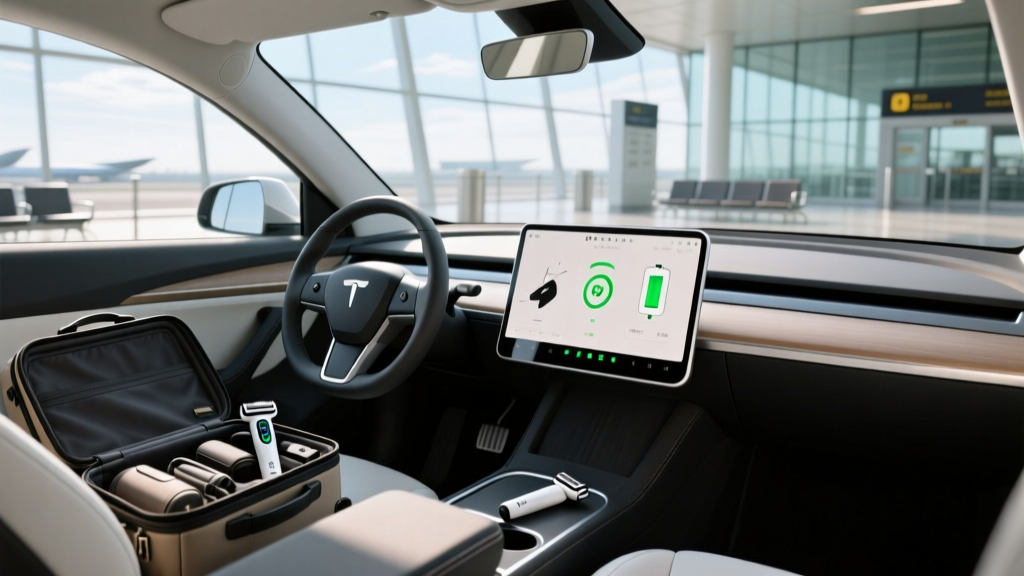
- Electric razor: Carry-on preferred (avoids any checked-bag battery ambiguity). If checked, power it fully off — not standby.
- Portable power bank: Must be carry-on. If it's over 100 Wh (about 27,000 mAh at 3.7V), you need airline approval. Most consumer power banks are 10,000–20,000 mAh — well under the limit.
- EV charging adapter (J1772-to-NACS, etc.): No battery — pack anywhere. These are just metal and plastic conductors.
- TPMS sensors or OBD-II dongle: Tiny batteries (<1 Wh) — carry-on or checked, no issue.
- 12V lithium jump starter: Check the Wh rating. Most are 15–40 Wh — carry-on only, treated as spare lithium battery.
Frequently Asked Questions
Do I need to declare my electric razor at TSA security?
No. Electric razors are treated like any other personal electronic device. You don't need to remove it from your bag unless a TSA agent specifically asks. Unlike laptops, razors don't need to be placed in a separate bin.
Can I bring a cordless electric razor with a removable battery?
Yes, but the removable battery counts as a spare lithium battery. If it's under 100 Wh (virtually all razor batteries are under 5 Wh), it must go in your carry-on with terminals protected from short-circuiting — either in original packaging or with tape over the contacts.
Are international flight rules different for electric razors?
ICAO (International Civil Aviation Organization) rules align closely with FAA/TSA standards. The 100 Wh carry-on requirement for spare lithium batteries is nearly universal. However, some countries impose additional restrictions on checked electronics — check your airline's international baggage policy before departure.
Does flying with my electric razor affect its battery health?
No. Cabin pressure changes and temperature variations in both the cabin and cargo hold are well within the operating tolerance of consumer lithium-ion cells. Your razor's battery won't degrade from a flight any more than your phone's does.
What's the maximum battery size I can bring on a plane?
Spare lithium batteries up to 100 Wh require no approval. Batteries between 100–160 Wh require airline pre-approval (max 2 per passenger). Anything over 160 Wh is prohibited on passenger aircraft. For reference, a MacBook Pro battery is ~100 Wh, and an EV battery is 60,000–100,000+ Wh — which is why EVs ship by truck and train, not air cargo.