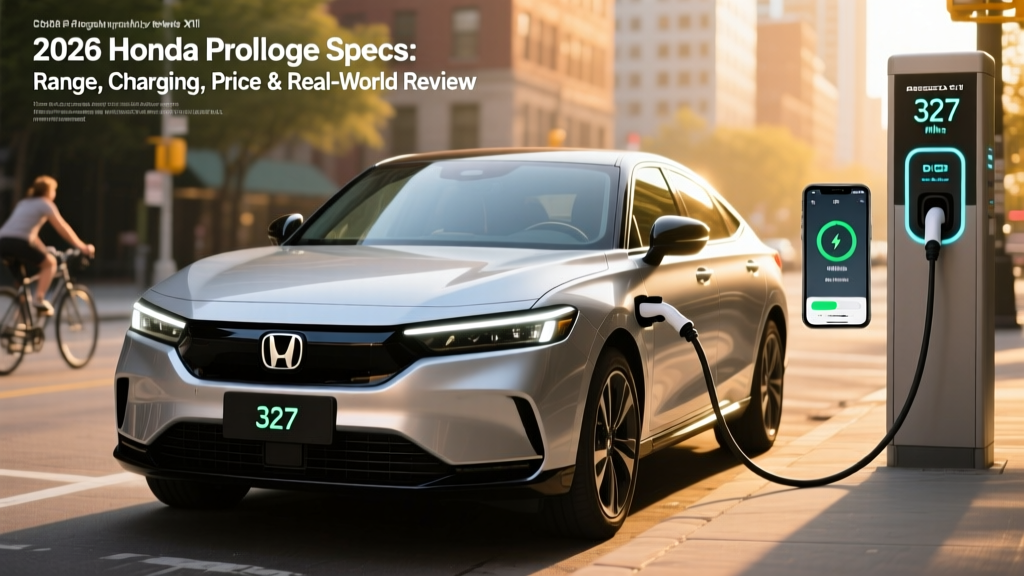
Honda's first purpose-built electric SUV continues to evolve in its second full model year. The 2026 Honda Prologue rides on General Motors' Ultium platform — a partnership that gave Honda an immediate foothold in the EV SUV segment without waiting to develop its own architecture. But sharing bones with the Chevrolet Blazer EV and Cadillac Lyriq doesn't make the Prologue a rebadge. Honda tuned the suspension, designed its own interior, and layered on the Google-based infotainment system its buyers expect. The question for shoppers is whether the Prologue's specs stack up against rivals that have been iterating for years.
This review breaks down every Honda Prologue spec that matters — from the 85 kWh battery pack and real-world range expectations to DC fast-charging curves and federal tax credit eligibility under current IRS §30D rules. We'll also flag where the Prologue excels and where competitors pull ahead.
2026 Honda Prologue Full Spec Sheet
| Specification | EX (FWD) | EX-L (FWD) | Touring (AWD) |
|---|---|---|---|
| EPA Range | 296 mi | 296 mi | 273 mi |
| Battery (usable) | 85 kWh, NMC lithium-ion | ||
| Drivetrain | FWD | FWD | Dual-motor AWD |
| Horsepower | 220 hp | 300 hp | |
| Torque | 236 lb-ft | 355 lb-ft | |
| 0–60 mph | ~7.2 sec | ~5.9 sec | |
| DC Fast Charge (peak) | 190 kW (CCS1) | ||
| 10–80% DC Charge | ~34 min | ||
| Level 2 Home Charge | 11.5 kW (~24 mi/hr) | ||
| MPGe (combined) | 94 MPGe | 87 MPGe | |
| Efficiency (kWh/100 mi) | ~36 kWh | ~39 kWh | |
| Base MSRP | $47,400 | $50,400 | $57,900 |
| Cargo (behind 2nd row) | 25.2 cu ft | ||
| Cargo (seats folded) | 57.7 cu ft | ||
| Battery Warranty | 8 yr / 100,000 mi | ||
| Vehicle Warranty | 3 yr / 36,000 mi (bumper-to-bumper) 5 yr / 60,000 mi (powertrain) | ||
Source: fueleconomy.gov, Honda Newsroom
Range & Efficiency: EPA Sticker vs. Real-World Driving
EPA Estimate: 296 miles (EX/EX-L FWD) | 273 miles (Touring AWD)
Real-World Expectation: Expect 250–270 miles on a mixed highway trip in the FWD trims, and 230–250 miles in the AWD Touring. In cold weather (below 32°F), plan for a 20–30% reduction, which can drop the FWD to roughly 200–230 miles. City driving with frequent regenerative braking opportunities tends to match or slightly exceed the EPA figure.
The Prologue's 85 kWh usable NMC (nickel-manganese-cobalt) battery sits in GM's Ultium skateboard platform. NMC chemistry delivers strong energy density, which is why Honda can package nearly 300 miles of range into a midsize SUV footprint. The trade-off compared to LFP (lithium iron phosphate) chemistry found in some Tesla and Ford models is slightly faster long-term degradation and a recommendation to keep daily charging around 80–90% rather than routinely filling to 100%.
Efficiency varies noticeably by trim. The FWD EX and EX-L achieve 94 MPGe combined (about 36 kWh per 100 miles), while the dual-motor AWD Touring drops to 87 MPGe (~39 kWh/100 mi). The extra 80 horsepower and all-wheel-drive hardware carry a range penalty of 23 EPA miles. If you don't need AWD traction for snow or mountain roads, the FWD trims offer meaningfully better efficiency.
For context, highway driving at sustained 70–75 mph speeds consumes more energy than the EPA combined cycle suggests. On a 300-mile road trip, FWD owners should plan a charging stop around the 250-mile mark to maintain a comfortable buffer. The AWD Touring will need that stop closer to 220 miles.
Charging Speed: DC Fast, Level 2, and What to Expect
| Charging Level | Power / Rate | Speed (miles added) | Notes |
|---|---|---|---|
| Level 1 (120V) | ~1.4 kW | ~3 mi/hr | Emergency/trickle only; not practical for daily use |
| Level 2 (240V, 48A) | 11.5 kW | ~24 mi/hr | Full charge in ~8 hours; ideal for overnight home charging |
| DC Fast Charge | Peak 190 kW | ~140 mi in 15 min | 10–80% in ~34 min; tapers significantly above 80% |
The Prologue's 190 kW peak DC fast-charging rate is respectable but not class-leading. Competitors like the Hyundai Ioniq 5 and Kia EV6 accept up to 240–350 kW on 800-volt architectures and can complete a 10–80% session in 18 minutes or less. The Prologue's ~34-minute 10–80% time is closer to the Chevrolet Blazer EV and Volkswagen ID.4 — adequate for road trips, but you'll spend a few extra minutes at each stop.
One nuance worth understanding: the 190 kW figure is a peak, not a sustained rate. Like most EVs, the Prologue's charge curve tapers as the battery fills. You'll see the highest rates between roughly 10–40% state of charge. Above 80%, charging slows dramatically to protect the battery — a 80–100% session can add another 25–30 minutes. For road-trip efficiency, plan stops from 10–80% and skip topping off unless you need the full range for the next leg.
At home, the Prologue's 11.5 kW onboard charger is a strong point. A Level 2 wallbox on a 48-amp circuit adds roughly 24 miles of range per hour, meaning an overnight session (8 hours) replenishes about 190 miles — enough to cover nearly any daily commute. Home Level 2 installation typically costs $800–$2,000 depending on your panel capacity and wiring distance; if your home has a 200-amp panel with spare capacity, expect the lower end of that range.
Honda provides a CCS1 (Combo) charge port, which is compatible with Electrify America, EVgo, and most public DC networks. The industry is shifting toward Tesla's NACS connector, and Honda has confirmed future models will adopt NACS — but for the 2026 Prologue, CCS1 is the standard. Adapters for Tesla Supercharger access are expected to become available, expanding your public charging options.
Performance, Drivetrain, and Driving Impressions
The FWD Prologue (EX and EX-L) sends 220 horsepower and 236 lb-ft of torque to the front wheels through a single motor. The result is a 0–60 mph time around 7.2 seconds — perfectly adequate for merging and passing but not particularly thrilling. This is a comfort-oriented SUV, and the tuning reflects that: the suspension soaks up bumps well, and the steering is light and predictable around town.
The dual-motor AWD Touring is a different character. With 300 hp and 355 lb-ft, it hits 60 mph in approximately 5.9 seconds. The instant electric torque makes highway on-ramps effortless, and the AWD system provides confident grip in rain and light snow. The added weight of the second motor and drivetrain components is noticeable in tight corners, but the low center of gravity from the underfloor battery keeps body roll controlled.
Regenerative braking offers multiple levels, selectable through paddle shifters behind the steering wheel. The strongest setting enables near one-pedal driving in city traffic, though it doesn't bring the vehicle to a complete hold — you'll still need the brake pedal at stops. This is a deliberate choice that some drivers prefer for smoothness, while others find it less convenient than the full one-pedal systems in the Chevrolet Bolt or Nissan Ariya.
Towing capacity is rated at 1,500 pounds across all trims — enough for a small utility trailer or a couple of dirt bikes, but not suitable for boat or camper towing. If you need serious tow capability, the Rivian R1S or Ford F-150 Lightning are in a different class entirely.
Interior Space, Cargo, and Technology
The Prologue is classified as a midsize SUV, and its interior dimensions reflect that positioning. Front-seat passengers get 41.4 inches of legroom, while the rear seat offers 38.6 inches — competitive with the Hyundai Ioniq 5 and slightly more generous than the Toyota bZ4X. Three adults can sit across the rear bench for shorter trips, though shoulder room gets tight on longer drives.
Cargo volume measures 25.2 cubic feet behind the second row and 57.7 cubic feet with the rear seats folded. There's no front trunk (frunk), which is a missed opportunity for additional sealed storage — something the Ioniq 5 and Ford Mustang Mach-E both offer. The cargo area itself is well-shaped and includes a reversible load floor, but the total volume trails the Ioniq 5 (27.2/59.3 cu ft) and the Volkswagen ID.4 (30.3/64.2 cu ft).
On the technology front, the Prologue uses Google built-in for infotainment on an 11.3-inch touchscreen (EX-L and Touring; the EX gets an 11.3-inch display as well for 2026). Google Maps navigation, Google Assistant voice control, and access to the Play Store for apps are all integrated. Wireless Apple CarPlay and Android Auto are standard. The system is responsive, but some users report that relying on Google services means reduced functionality if you lose cellular connectivity in rural areas.
The Honda Sensing suite of driver-assistance features is standard across all trims. This includes adaptive cruise control with low-speed follow, lane-keeping assist, automatic emergency braking, and traffic sign recognition. This is an SAE Level 2 driver-assist system — meaning you must keep your hands on the wheel and eyes on the road at all times. It is not self-driving. The system is competent for highway cruising but doesn't offer the hands-free capability of GM's Super Cruise or Ford's BlueCruise on mapped highways.
Pricing, Trims, and Federal Tax Credit Eligibility
| Trim | MSRP | Destination | Total Before Credit |
|---|---|---|---|
| EX (FWD) | $47,400 | $1,395 | $48,795 |
| EX-L (FWD) | $50,400 | $1,395 | $51,795 |
| Touring (AWD) | $57,900 | $1,395 | $59,295 |
The Prologue's pricing positions it squarely in the mainstream midsize EV SUV segment. The EX trim at $48,795 (with destination) undercuts the Touring model by more than $10,000 while still delivering the full 296-mile range and Honda's full safety suite. The EX-L adds leather seating, a power liftgate, and a premium audio system. The Touring bundles AWD, a panoramic roof, heads-up display, and a Bose premium audio system.
Does the Honda Prologue Qualify for the Federal EV Tax Credit?
The 2026 Honda Prologue's eligibility for the IRS §30D federal tax credit depends on several factors that buyers need to verify before purchase:
- MSRP Cap: SUVs must have an MSRP at or below $80,000. All Prologue trims clear this threshold.
- Buyer Income Cap: Modified adjusted gross income must not exceed $150,000 (single), $225,000 (head of household), or $300,000 (joint filers).
- Battery Sourcing: The vehicle must meet critical-minerals and battery-component sourcing requirements that tighten annually. Because the Prologue uses GM's Ultium platform with battery cells manufactured in the U.S. (at Ultium Cells plants in Ohio and Tennessee), it has historically qualified for the full $7,500 credit — but sourcing rules evolve, and you should confirm eligibility for your specific purchase date using the IRS's official list at fueleconomy.gov.
- Point-of-Sale Transfer: As of 2024, eligible buyers can transfer the credit to the dealer at purchase, reducing the vehicle price at the point of sale rather than waiting to claim it on a tax return. This effectively drops the EX to approximately $41,295 if you qualify for the full $7,500.
Consult a tax professional to confirm your personal eligibility. State and local incentives may stack on top of the federal credit — check your state energy office or the AFDC incentive database for details.
How the Prologue Compares to Key Rivals
The midsize EV SUV segment is crowded. Here's how the Prologue stacks up on the specs that matter most:
| Spec | Honda Prologue (FWD) | Hyundai Ioniq 5 (RWD) | VW ID.4 (RWD) | Ford Mustang Mach-E (RWD) |
|---|---|---|---|---|
| EPA Range | 296 mi | 303 mi | 291 mi | 320 mi |
| Battery | 85 kWh (NMC) | 84 kWh (NMC) | 82 kWh (NMC) | 91 kWh (NMC) |
| DC Fast Charge | 190 kW | 240 kW (800V) | 175 kW | 150 kW |
| 10–80% Time | ~34 min | ~18 min | ~34 min | ~40 min |
| 0–60 mph | ~7.2 sec | ~7.0 sec | ~7.7 sec | ~6.1 sec |
| Cargo Volume | 25.2 cu ft | 27.2 cu ft | 30.3 cu ft | 29.7 cu ft |
| Base MSRP | $47,400 | $43,600 | $40,700 | $42,995 |
The Prologue's 296-mile range is competitive, but the Ioniq 5's 800-volt architecture delivers significantly faster DC charging — a meaningful advantage on road trips. The ID.4 offers more cargo space at a lower starting price. The Mach-E leads on range and offers a sportier driving experience. The Prologue's advantage is Honda's reputation for reliability, strong dealer network, and the Google-based infotainment system that many buyers find intuitive.
Pros and Cons: The Honest Take
What We Like
- Comfortable, well-tuned ride quality that absorbs rough roads
- Google built-in infotainment is fast and feature-rich
- Full Honda Sensing safety suite standard on every trim
- Competitive 296-mile EPA range (FWD)
- Strong 11.5 kW Level 2 home charging rate
- Qualifies for up to $7,500 federal tax credit (verify sourcing rules)
- Honda dealer network for service and warranty work
Where It Falls Short
- No frunk — misses easy sealed front storage
- Cargo volume (25.2 cu ft) trails ID.4, Mach-E, and Ioniq 5
- 190 kW peak DC charging is slower than 800V rivals
- No hands-free driving option (no Super Cruise/BlueCruise equivalent)
- CCS1 port may require adapter for future NACS Supercharger access
- Higher base price than ID.4 and Ioniq 5
- Regen braking doesn't bring vehicle to a full stop
Who Should Buy the Honda Prologue?
Choose the Honda Prologue if:
- You want a comfortable, no-drama daily-driver EV SUV with Honda's dealer support and reliability reputation
- Your commute is under 100 miles round-trip and you can charge at home overnight
- You value Google-integrated infotainment and wireless CarPlay/Android Auto
- You prefer a traditional SUV driving feel over sporty or futuristic alternatives
- You qualify for the federal tax credit, bringing the EX close to $41,000
Look elsewhere if:
- Road-trip charging speed is a top priority (the Ioniq 5's 800V system is significantly faster)
- You need maximum cargo space (the ID.4 and Mach-E offer more)
- You want hands-free highway driving (GM's Super Cruise on the Blazer EV or Ford's BlueCruise on the Mach-E)
- You want a frunk for charging cables and groceries
The Prologue is best understood as a well-executed, comfort-first EV SUV that prioritizes daily livability over performance benchmarks. It won't win a spec-sheet shootout against the Ioniq 5 or Mach-E, but it offers the kind of predictable, dealer-supported ownership experience that Honda buyers have come to expect. For a family commuter that charges at home and takes occasional road trips, the Prologue's 296-mile range and strong safety suite make it a credible choice — especially with the federal tax credit reducing the effective price.
Frequently Asked Questions
What is the real-world range of the Honda Prologue?
In mixed driving conditions, expect 250–270 miles from the FWD trims and 230–250 miles from the AWD Touring. Sustained highway speeds above 70 mph and cold weather below freezing will reduce these figures by 15–30%. City driving with regenerative braking can match or slightly exceed the EPA sticker.
How fast does the Honda Prologue charge at home and on the road?
On a Level 2 home charger (240V, 48A), the Prologue charges at 11.5 kW, adding about 24 miles per hour — a full overnight charge covers most commutes. On DC fast chargers, it peaks at 190 kW and completes a 10–80% session in approximately 34 minutes. Charging above 80% slows significantly, so plan road-trip stops around the 10–80% window.
How much does the Honda Prologue cost after the federal tax credit?
If you qualify for the full $7,500 §30D credit and transfer it at the point of sale, the EX trim drops from $48,795 to approximately $41,295 (with destination). The Touring AWD drops to about $51,795. Eligibility depends on your income, the vehicle's battery sourcing compliance, and MSRP caps — all Prologue trims are under the $80,000 SUV cap. Verify current eligibility at fueleconomy.gov before purchasing.
Is the Honda Prologue worth buying over the Ioniq 5 or ID.4?
It depends on your priorities. The Ioniq 5 charges faster (18 min vs. 34 min for 10–80%) and starts lower. The ID.4 offers more cargo space and a lower entry price. The Prologue's advantages are Honda's dealer network, a comfortable ride, Google-based infotainment, and strong standard safety features. If Honda brand loyalty and daily comfort matter more than spec-sheet wins, the Prologue is a solid pick.
Does the Honda Prologue have a frunk?
No. The Prologue does not include a front trunk. All cargo space is in the rear area (25.2 cu ft behind the second row, 57.7 cu ft with seats folded). This is a notable omission compared to the Ioniq 5, Mach-E, and Ford F-150 Lightning.
Can the Honda Prologue use Tesla Superchargers?
The 2026 Prologue uses a CCS1 charge port. Honda has announced that future models will adopt the NACS (Tesla) connector natively. For the 2026 Prologue, access to the Supercharger network requires a CCS-to-NACS adapter — Honda and GM have indicated adapters will be available, but confirm compatibility and availability with your dealer before relying on Supercharger access.
What is the Honda Prologue battery warranty?
Honda covers the Prologue's high-voltage battery for 8 years or 100,000 miles (whichever comes first), which is the industry standard for EVs. The warranty covers defects and capacity loss below a specified threshold (typically 60–70% of original capacity). The bumper-to-bumper warranty is 3 years/36,000 miles, and the powertrain warranty is 5 years/60,000 miles.