Quick Answer: What Is an Electric Motor?
An electric motor is a device that converts electrical energy (stored in a battery as kilowatt-hours, or kWh) into mechanical energy (rotational force measured in horsepower and pound-feet of torque) to drive a vehicle's wheels. Unlike a gas engine that burns fuel in cylinders to move pistons, an EV motor uses electromagnetic fields — typically a rotor spinning inside a stator — to generate instant torque with zero emissions at the tailpipe. Modern EV motors operate at 85–97% efficiency, compared to just 20–35% thermal efficiency for internal combustion engines, meaning far more of your stored energy actually moves the car.
Electric Motor Definition: The Engineering Basics
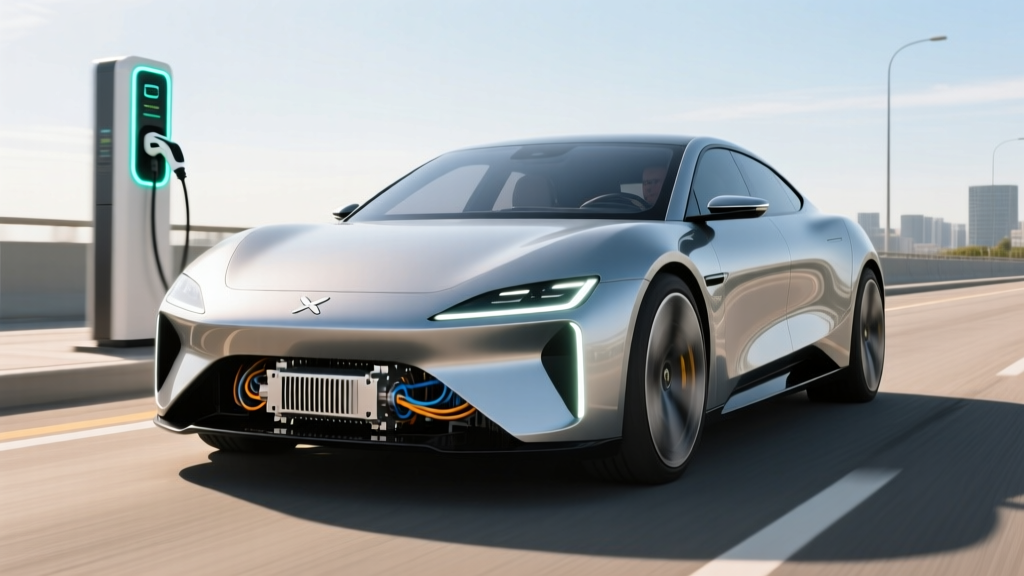
The textbook electric motor definition describes an electromechanical converter: supply current, generate a magnetic field, produce rotation. In an electric vehicle, the traction motor receives high-voltage DC power from the battery pack, which an inverter converts to AC (in most modern designs). The interaction between the stator's electromagnetic coils and the rotor's magnetic field creates torque that spins the axle.
Two specifications define any EV motor for buyers:
- Power (kW or horsepower): How much work the motor can do — determines top speed and sustained acceleration. A 150 kW motor produces roughly 201 hp.
- Torque (lb-ft): The twisting force available instantly from 0 RPM. This is why a 4,500-lb EV like the Hyundai Ioniq 5 (325 lb-ft in RWD) can hit 0-60 mph in 5.1 seconds despite modest horsepower.
Because electric motors deliver peak torque from standstill — no revving, no turbo spool, no transmission downshift — real-world acceleration feels stronger than gas-car horsepower numbers suggest.
Types of EV Motors: Permanent Magnet vs. Induction vs. Others
Not all electric motors are the same. The chemistry debate (LFP vs. NMC batteries) gets attention, but motor type shapes efficiency, cost, cold-weather behavior, and even supply-chain ethics.
| Motor Type | How It Works | Example Vehicles | Pros | Cons |
|---|---|---|---|---|
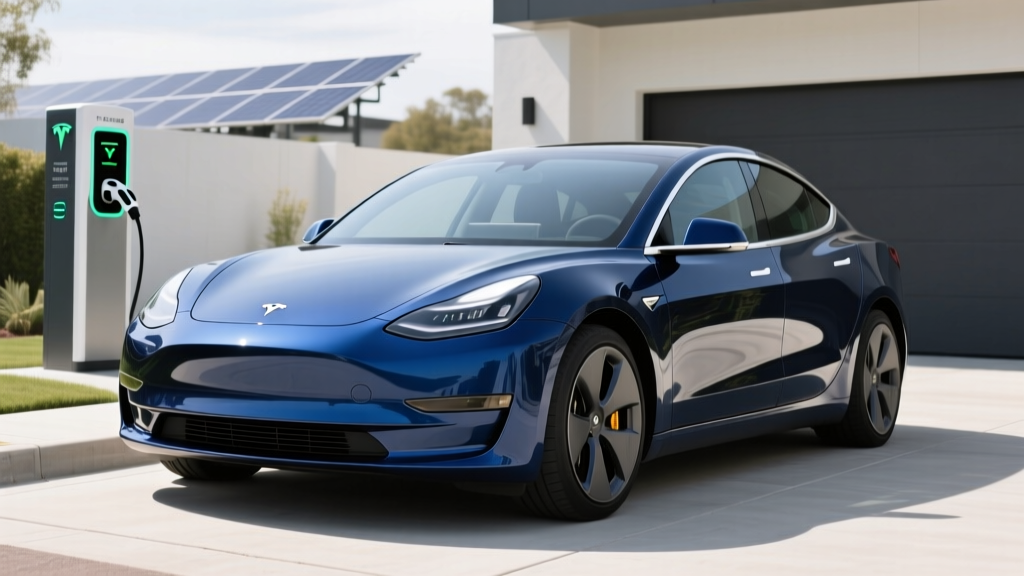
| Permanent Magnet Synchronous (PMSM) | Rotor uses rare-earth magnets (neodymium); stator field pulls it around | Tesla Model 3 RWD, Hyundai Ioniq 5, Chevrolet Equinox EV, Ford Mustang Mach-E | Highest efficiency (93–97%); best range per kWh; compact | Rare-earth supply risk; magnet cost; slight power loss at very high temps |
| AC Induction (Asynchronous) | No magnets; rotor current is induced by the stator's rotating field | Tesla Model S/X (front motor), older Tesla Model 3 AWD (front), Rivian R1T (front) | No rare earths; robust at high RPM; naturally freewheels (good for dual-motor coasting) | 2–5% lower efficiency; slightly heavier; more heat generation |
| Externally Excited Synchronous (EESM) | Rotor has copper windings fed by current (no magnets) | BMW i4, iX, i7; Renault Megane E-Tech | No rare earths; tunable field for efficiency across speed range | More complex (slip rings or wireless rotor power); heavier than PMSM |
| Switched Reluctance (SRM) | Rotor is plain steel; aligns to stator's energized poles | Emerging/prototype applications | Cheap, rugged, no magnets or copper in rotor | Noisy (torque ripple); complex control; not mainstream in EVs yet |
The industry trend through 2026 is clear: PMSM dominates single-motor efficiency-focused models, while dual-motor AWD vehicles often pair a PMSM rear (for range) with an induction or EESM front (which can decouple and freewheel when unpowered, reducing drag). Tesla pioneered this hybrid-motor strategy, and it has become standard practice.
Electric Motor vs. Gas Engine: Numbers That Matter
The electric motor definition only becomes useful to buyers when you compare it against what it replaces. Here's how a typical EV motor stacks up against a comparable gas powertrain in measurable, ownership-relevant ways.
| Metric | EV (e.g., Hyundai Ioniq 5 SEL AWD) | Gas Equivalent (e.g., Hyundai Tucson AWD) |
|---|---|---|
| Powertrain type | Dual PMSM, 320 hp / 446 lb-ft | 2.5L I-4, 187 hp / 178 lb-ft |
| 0-60 mph | 4.5 seconds | 8.8 seconds |
| Moving parts in powertrain | ~20 (rotor, bearings, reduction gear) | ~2,000+ (pistons, valves, cams, injectors, transmission) |
| Energy efficiency (tank-to-wheel / battery-to-wheel) | 89–93% | 20–30% |
| EPA combined economy | 101 MPGe (33 kWh/100 mi) | 28 MPG combined |
| Fuel/energy cost per mile (US avg, 2026) | ~$0.045 (home L2 at $0.16/kWh) | ~$0.12 (at $3.35/gal) |
| Annual "fuel" cost (12,000 mi) | ~$540 | ~$1,440 |
| Scheduled maintenance (annual avg) | ~$150 (cabin filter, tire rotation, wipers) | ~$550 (oil, filters, plugs, transmission fluid) |
Source: fueleconomy.gov EPA ratings and DOE energy-cost modeling.
The motor itself is essentially maintenance-free for the life of the vehicle. There is no oil to change, no spark plugs, no timing belt, no catalytic converter, no exhaust system. The single-speed reduction gear uses a small amount of fluid that rarely needs service. This is where the "electric motor definition" translates directly into ownership cost: fewer wear items, fewer failure points.
Real Costs of EV Ownership: Purchase, Charging, Insurance, Maintenance
The motor saves you money after purchase, but the upfront math requires honesty. Here is a realistic 5-year cost breakdown comparing a mainstream EV against a gas rival, using 2026 pricing, current electricity rates, and IRS §30D rules.
| Line Item | EV (Ioniq 5 SEL AWD, ~$50,250 MSRP) | Gas (Tucson SEL AWD, ~$33,500 MSRP) |
|---|---|---|
| Purchase price (after §30D credit, if eligible) | $42,750 (assuming $7,500 point-of-sale) | $33,500 |
| Fuel / electricity (60k mi) | $2,700 (mostly home L2) | $7,200 |
| Maintenance (5 years) | $750 | $2,750 |
| Insurance (5-year avg) | $9,500 (EV premium ~15–20% higher) | $7,800 |
| Home Level 2 charger install | $1,200 (240V/48A, typical panel OK) | $0 |
| Estimated depreciation (5 yr) | $22,000 | $14,500 |
| Total 5-year cost | ~$78,900 | ~$65,750 |
| Cost per mile (all-in) | ~$1.32 | ~$1.10 |
Key caveats behind these numbers:
- The $7,500 federal §30D credit is not automatic. Per IRS rules, you must meet income caps ($150k single / $300k joint MAGI), the vehicle must be under the MSRP cap ($55k sedans / $80k SUVs/trucks), and the battery must satisfy critical-mineral and battery-component sourcing requirements that tighten every year through 2030. Many 2026 EVs qualify only partially or not at all — verify each VIN at fueleconomy.gov before signing.
- Depreciation on EVs has been volatile; recent price wars and battery-chemistry improvements are still settling in used-car values.
- Insurance is structurally higher for EVs (repair costs, battery replacement exposure) — always quote before buying.
- Home Level 2 installation can jump to $2,500–$4,500 if your panel needs a 200A upgrade. Renters and condo owners face additional access barriers.
Common Misconceptions About EV Motors — Myth vs. Fact
| Myth | Fact (with data) |
|---|---|
| "EV motors wear out like gas engines." | EV traction motors have essentially no wear items beyond bearings. Tesla and Hyundai warranty the motor as part of the high-voltage powertrain for 8 years / 100,000 miles (10/150,000 in CARB states). Real-world motor failures before 200k miles are rare; the battery, not the motor, is the longevity variable. |
| "All EV motors are the same." | PMSM, induction, and EESM designs differ in efficiency by 3–6%, which translates to 10–25 miles of real-world range on a 300-mile pack. Motor choice also affects cold-weather regen behavior and rare-earth exposure. |
| "Horsepower numbers mean the same thing in EVs and gas cars." | A 200-hp EV motor feels quicker than a 200-hp gas engine because torque is instant and there are no gear shifts. The relevant spec is sustained power — some EVs peak at 450 hp for 10 seconds but sustain only 280 hp. Always check both. |
| "EV motors don't work in cold weather." | The motor itself is largely unaffected by cold. Range loss (typically 20–35% at 20°F) comes from the battery's internal resistance and cabin heating load — not the motor. Preconditioning the battery while plugged in recovers much of this loss. |
| "More motors = better." | Tri-motor setups (e.g., Tesla Model S Plaid, Lucid Air Sapphire) deliver extraordinary performance but cost 15–25% more and add weight that slightly reduces range. For 90% of drivers, a single rear motor or dual-motor AWD is the optimal balance. |
What First-Time EV Buyers Need to Know About the Motor — and Everything Around It
The electric motor is the least of your worries as a first-time EV buyer. It will almost certainly outlast the car. Your real decision points orbit the motor rather than involving it directly:
- Home charging access is the make-or-break factor. If you can install a Level 2 charger (240V, 40–48A, adding 25–35 miles of range per hour), EV ownership is cheap and convenient. If you rely solely on public DC fast charging, your per-mile cost roughly triples and your time cost grows substantially.
- Real-world range ≠ EPA range. Expect 85–90% of EPA at 70 mph in mild weather, 65–75% in freezing temps, and 70–80% when driving through mountains. A 310-mile EPA sticker is really a 220–280 mile real-world envelope depending on conditions.
- Charging speed matters more than battery size for road trips. A vehicle that peaks at 250 kW and sustains 180 kW through 80% SoC (like the Ioniq 5 or Kia EV6 on 800V architecture) adds 180 miles in 18 minutes. A 400V vehicle peaking at 150 kW might need 32 minutes for the same gain, even with a bigger battery.
- NACS vs. CCS is mostly resolved. As of 2026, nearly all non-Tesla automakers have adopted the NACS (Tesla-style) connector or include adapters. Tesla Supercharger access is broadly available to Ford, GM, Rivian, Hyundai/Kia, and others.
- Tax credits are VIN-specific and sourcing-specific. A model that qualified in 2025 may not in 2026 due to tightening battery-component rules. Verify the exact vehicle, not just the model line.
Decision Framework: Which EV Motor (and Vehicle) Fits Your Life?
IF you have Level 2 home charging AND commute under 80 miles round trip → Single-motor RWD with a 60–75 kWh LFP battery (e.g., Tesla Model 3 RWD, Chevrolet Equinox EV) is the value sweet spot. Lower cost, longest motor/battery life, minimal degradation concern.
IF you need AWD for snow or tow occasionally AND road-trip 4+ times per year → Dual-motor AWD with NMC battery and 800V architecture (e.g., Hyundai Ioniq 5, Kia EV6, Hyundai Ioniq 6). Fast charging offsets the range penalty of dual motors.
IF you lack reliable home charging AND drive over 40 miles daily → Consider a PHEV first (Toyota RAV4 Prime, Hyundai Tucson PHEV). 30–40 miles of electric-only range covers most errands; the gas engine handles the rest without charging-infrastructure dependency.
IF you regularly tow over 5,000 lbs or drive in sustained sub-zero weather → A heavy-duty EV truck (Rivian R1T, Ford F-150 Lightning) works, but expect 40–50% range loss under load. A diesel or hybrid may still be the pragmatic choice for heavy commercial use.
IF performance is the priority AND budget exceeds $90k → Tri-motor setups (Model S Plaid, Lucid Air Sapphire, Taycan Turbo GT) deliver sub-2.5-second 0-60 times. The motor count is about thrill, not efficiency.
Frequently Asked Questions
Do EV motors need oil changes or regular service?
No. The traction motor itself has no oil, filters, spark plugs, or belts. The reduction gearbox uses a small amount of lubricant typically inspected (not replaced) during routine service. The only regular maintenance items on an EV are tires (EVs wear tires 20–30% faster due to weight and torque), cabin air filter, brake fluid check, wiper blades, and washer fluid. Expect $100–$200 in annual scheduled maintenance versus $500–$800 on a gas car.
How long does an EV motor last?
Real-world data from Tesla, Nissan, and Hyundai fleets shows traction motors routinely exceeding 200,000 miles with no service. Motor bearings and the inverter (which converts DC battery power to AC for the motor) are the components most likely to require attention — and even those failures are uncommon. The battery pack, not the motor, is the component that defines an EV's useful life, with typical degradation of 10–15% over 150,000 miles for NMC and 5–10% for LFP chemistry.
Why do some EVs have two or three motors?
Dual motors provide all-wheel drive and enable torque vectoring for better traction and handling. Tri-motor setups (one front, two rear, or vice versa) deliver extreme performance and redundancy. Each additional motor adds 40–80 kg, increases cost by $4,000–$15,000, and slightly reduces range. For daily commuting, a single motor is perfectly adequate; dual motors make sense for snow-belt buyers or those who tow.
Does motor type affect charging speed?
Indirectly. Motor efficiency determines how many kWh the car consumes per mile, which in turn determines how many miles you gain per minute of charging. A PMSM-equipped vehicle consuming 28 kWh/100 mi gains more range from a 150 kW charger than an induction-motor vehicle consuming 33 kWh/100 mi, even at the same charge rate. Motor type also influences thermal management load, which can slightly affect the battery's ability to accept a fast charge.
Is regenerative braking part of the motor?
Yes — this is one of the electric motor's biggest advantages. When you lift off the accelerator, the motor reverses its role and becomes a generator, converting kinetic energy back into electricity that recharges the battery. This is why EVs experience far less brake wear than gas cars; many owners report original brake pads at 80,000+ miles. Regen effectiveness drops when the battery is very cold or nearly full (above ~95% SoC), which is why some EVs feel "different" in those conditions.
What about the 12V battery — does the motor use that?
No. The traction motor runs off the high-voltage pack (typically 400V or 800V). The 12V auxiliary battery runs lights, computers, door locks, and infotainment — just like in a gas car. It's charged by a DC-DC converter from the main pack. 12V battery failures are actually a common EV ownership gotcha; a dead 12V battery can prevent the car from "starting" even when the main pack is full.
The electric motor definition is simple in engineering terms — electromagnetic force producing rotation — but its implications reshape every ownership metric: fuel cost, maintenance schedule, acceleration feel, reliability profile, and even vehicle packaging (no transmission tunnel, available frunk space). In 2026, the smarter question isn't "what is an electric motor" but "which motor architecture matches my driving, charging access, and budget." Answer that, and the rest of the EV purchase falls into place.