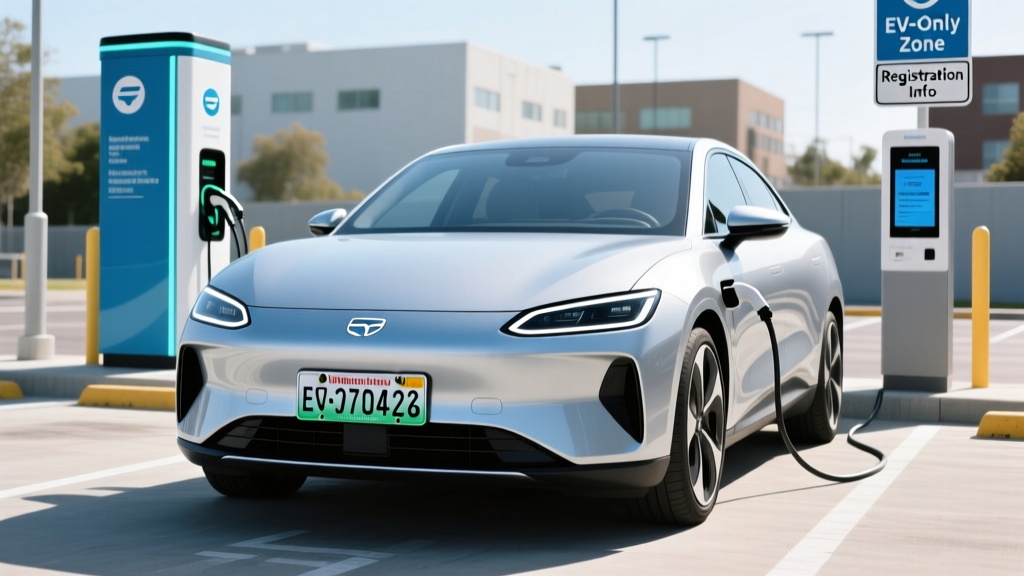
Every electric vehicle on U.S. roads must display a valid license plate, and in many states, EVs receive specialized plates, decals, or registration classes that affect what you pay and the perks you get. An electric license plate typically refers to either a state-issued EV designation on your registration (sometimes a special decal, plate style, or plate code) or the emerging digital e-plate technology. In 2026, 34 states charge EVs an additional annual registration fee — ranging from $50 in Colorado to $225 in Washington — to offset lost gas-tax revenue. Meanwhile, states like California, Florida, and Virginia offer HOV-lane access via clean-air decals tied to your EV registration. Before you buy, know your state's exact fee structure, because a $200+ annual EV registration surcharge meaningfully changes your five-year cost of ownership.
What an Electric License Plate Actually Means
The term "electric license plate" covers three distinct things that EV buyers regularly confuse:
- EV-designated registration class: Most states classify your vehicle as electric at registration, which triggers specific fees, inspection exemptions (no emissions test), and sometimes special plate codes. Your physical plate looks standard, but your DMV record flags the vehicle as a BEV or PHEV.
- Clean-air decals and HOV stickers: States including California (Clean Air Vehicle decal), Virginia (HOV lane stickers), and Florida issue windshield decals or plate-frame identifiers that grant carpool-lane access with a single occupant. These are tied to your registration and typically expire after 3–4 years.
- Digital e-plates (Reviver-style): California, Arizona, and Texas now permit digital license plates — battery-powered e-ink screens that replace metal plates. These cost $20/month or ~$500 outright and allow GPS tracking, fleet management, and instant registration renewal. They work on any vehicle, not just EVs, but early adopters skew heavily electric.
For most new EV buyers in 2026, "electric license plate" means the first two items: your state's EV registration classification and any associated decals or perks.
State-by-State EV Registration Fees: What You'll Actually Pay
Because EVs don't purchase gasoline, they don't contribute to state road-fund gas taxes (averaging $0.31/gallon federally plus $0.20–$0.67/gallon at the state level, per the Federal Highway Administration). To compensate, most states now levy annual EV registration surcharges. Here's what the landscape looks like in 2026:
| State | Annual EV Surcharge | HOV / Clean-Air Decal | Emissions Inspection |
|---|---|---|---|
| California | $100 | CAV decal (HOV access, ~$25 application, expires after 4 years) | Exempt |
| Texas | $200 | None statewide | Exempt (safety only in some counties) |
| Florida | $150 (effective 2024+) | HOV decal available | Exempt |
| Washington | $225 | None | Exempt |
| Colorado | $50 | HOV plate available | Exempt |
| New York | $0 (as of 2026) | None statewide | Exempt |
| Georgia | $214 (annual alt-fuel fee) | HOV decal available | Exempt |
| Virginia | $64.75 (highway use fee) | HOV stickers available | Exempt |
| Ohio | $200 | None | Exempt |
Source: Compiled from state DMV and Alternative Fuels Data Center records, current as of early 2026. Verify with your local DMV — fees change with each legislative session.
The pattern is clear: states with higher gas taxes and larger road budgets tend to impose steeper EV surcharges. Washington's $225 fee is the nation's highest, while states like New York have resisted surcharges so far. Over a 5-year ownership period, a $200 annual surcharge adds $1,000 to your costs — a number worth factoring into your EV-vs-gas comparison.
EV vs Gas: Total Registration and Ownership Cost
Registration fees are just one line item. Let's compare what a typical EV buyer actually spends versus a gas-car buyer over five years, using a 2026 Tesla Model Y Long Range (EPA 320 miles, ~$44,990 before incentives) against a comparably priced 2026 Toyota RAV4 gas AWD (~$33,000 MSRP).
| Cost Category | 2026 Tesla Model Y LR (BEV) | 2026 Toyota RAV4 AWD (Gas) |
|---|---|---|
| Base MSRP | $44,990 | $33,000 |
| Federal Tax Credit (§30D) | Up to $3,750 (subject to MSRP, income, and battery-sourcing rules per IRS) | $0 |
| Effective Purchase Price | ~$41,240 | $33,000 |
| 5-Year Registration (avg state, $150 EV surcharge) | $1,250 (incl. surcharges) | $500 |
| 5-Year Fuel / Electricity (15,000 mi/yr) | ~$3,900 (at $0.14/kWh avg, 28 kWh/100mi) | ~$10,500 (at $3.50/gal, 28 MPG combined) |
| 5-Year Maintenance | ~$1,200 (cabin filter, wipers, tire rotation) | ~$3,500 (oil, filters, brakes, transmission fluid) |
| 5-Year Insurance (national avg) | ~$9,500 | ~$7,200 |
| Emissions Inspections | $0 (exempt) | ~$150 (where required) |
| 5-Year Total Cost of Ownership | ~$57,090 | ~$54,850 |
The EV costs roughly $2,200 more over five years in this scenario, driven almost entirely by the higher purchase price and insurance premiums. But fuel savings of ~$6,600 and near-zero maintenance costs narrow the gap significantly. If you qualify for the full $7,500 federal credit (available on certain models with compliant battery sourcing), the EV comes out ahead by over $3,000. Your state's EV registration surcharge is a real cost, but it's dwarfed by fuel savings.
Federal Tax Credits and How They Interact with Registration
Your electric license plate and registration class don't directly affect federal tax credit eligibility — that's determined at purchase under IRS §30D rules. But they're linked in a practical sense: states often require proof of purchase and credit eligibility to issue clean-air decals.
For 2026, the §30D New Clean Vehicle Credit provides up to $7,500, split into two halves:
- $3,750 — Critical Minerals Requirement: A percentage of battery minerals must be sourced from the U.S. or free-trade-agreement partners. This threshold increases annually.
- $3,750 — Battery Component Requirement: A percentage of battery components must be manufactured or assembled in North America.
Additional eligibility gates include:
- MSRP caps: Vans, SUVs, and pickups: $80,000 max. Sedans and other body styles: $55,000 max.
- Buyer income caps: $150,000 single / $225,000 head of household / $300,000 joint (modified AGI).
- Point-of-sale transfer: You can apply the credit as an instant dealer discount rather than waiting for a tax refund.
- Foreign entity of concern (FEOC) exclusion: Vehicles with battery components or minerals from certain restricted foreign entities are ineligible.
Not all 2026 EVs qualify for the full $7,500. Many qualify for $3,750 (one half only), and some qualify for nothing. Always check the EPA's qualified vehicle list before purchasing.
HOV Lane Access and Clean-Air Decals: The Real Registration Perk
For commuters in congested metro areas, HOV-lane access may be the single most valuable benefit tied to your electric license plate registration. In California, the Clean Air Vehicle (CAV) decal lets solo EV drivers use carpool lanes — saving 20–40 minutes on typical freeway commutes in Los Angeles, San Francisco, or San Jose.
Here's how the programs compare in states that offer them:
- California: CAV decal, $25 application fee, valid through January 1 of the fourth year after issuance. Available for all new BEVs and qualifying PHEVs (must have 40+ miles of EPA electric range).
- Virginia: HOV stickers for EVs, no additional fee, valid as long as the vehicle is registered. Requires an E-ZPass Flex transponder set to HOV mode on I-66.
- Florida: HOV decal available for EVs, $15 fee, renewable annually. Active on I-95 Express and I-75 Express lanes.
- Georgia: HOV decal for EVs, no fee, valid on I-85 Express lanes. Requires a Peach Pass transponder.
- Maryland: HOV access for EVs on I-270 and US 50, no decal required — EV plates are sufficient.
If your commute involves a congested freeway with HOV lanes, this perk alone can justify the EV registration surcharge many times over in time saved and reduced stress.
Digital E-Plates: The Emerging Option for EV Owners
A newer meaning of "electric license plate" refers to digital e-plates — electronic displays that replace traditional stamped metal plates. Reviver's Rplate Pro is the dominant product in 2026, approved in California, Arizona, Texas, and Michigan.
Key details:
- Hardware cost: ~$499 one-time purchase or included in a $19.95/month subscription.
- Features: GPS-based registration renewal, customizable banner messages, vehicle tracking (fleet use), theft-alert notifications.
- Battery life: Internal battery lasts 3–5 years; powered by an internal lithium cell, not hardwired to your EV's 12V system.
- Privacy concern: GPS tracking is built in. Reviver states location data is encrypted and not sold, but privacy-conscious buyers should review terms carefully.
Digital plates work on any vehicle, but EV owners adopt them at higher rates — likely due to tech affinity and the desire to avoid dealership visits for registration renewal. They're optional, not required, and traditional metal plates remain the default everywhere.
Myths vs. Facts About EV Registration
| Myth | Fact |
|---|---|
| "EVs are exempt from registration fees." | False. EVs pay standard registration fees plus surcharges in 34 states. You'll pay more, not less, than a gas car in most jurisdictions. |
| "I automatically get HOV lane access with any EV." | False. HOV access requires a separate decal or sticker application in most states, and programs have expiration dates or income/price caps. |
| "EV registration fees are higher than what gas-car drivers pay in gas taxes." | Depends on the state and mileage. A driver covering 15,000 miles/year at 28 MPG pays ~$166/year in state gas tax (at $0.31/gal avg). Many state EV surcharges ($150–$225) exceed this, particularly for low-mileage drivers. |
| "I need a special charger at home to register my EV." | False. Home charging setup has zero bearing on registration. You can register and legally operate an EV using only public chargers or a standard 120V outlet. |
| "The federal tax credit reduces my registration cost." | No. The §30D credit reduces federal tax liability (or purchase price via point-of-sale transfer). Registration fees are state-level and unaffected. |
Decision Framework: What Your EV Registration Means for Your Purchase
Use this framework to decide how registration costs and perks affect your EV purchase:
- If you live in a state with a high EV surcharge ($150+) AND drive under 10,000 miles/year: The surcharge may exceed what you'd pay in gas tax. Consider a PHEV (some states exempt PHEVs from full EV surcharges) or a highly efficient gas hybrid like the Toyota Prius (57 MPG combined) to minimize total costs.
- If your commute uses HOV lanes AND your state offers clean-air decals: The time savings (20–40 min/day in heavy traffic) far outweigh any surcharge. A BEV with a CAV or HOV decal is a strong choice. Apply for the decal immediately after registration — some states have waitlists.
- If you qualify for the full $7,500 federal credit: The credit dwarfs any state registration surcharge. Proceed confidently with a qualifying BEV. Factor the surcharge into your 5-year budget but don't let it deter you.
- If you can't charge at home AND live in a state with no HOV perks: Registration costs and perks matter less than charging access. Prioritize finding reliable public DC fast chargers (50+ kW) near your home or workplace before committing to an EV.
- If you're interested in digital e-plates: Budget $500 upfront or $240/year. The convenience is real, but weigh the GPS-tracking privacy tradeoff. Available only in select states — check your DMV before ordering.
Frequently Asked Questions
Do I need a special license plate to drive an electric vehicle?
No. You receive a standard state-issued license plate when you register an EV. Some states assign an EV-specific plate code or allow you to opt into an EV-themed plate design, but a special plate is never required to legally drive. Your DMV record classifies the vehicle as electric, which triggers the relevant fees and exemptions.
Are EV registration fees tax-deductible?
In most cases, personal vehicle registration fees are not deductible on your federal return. Some states allow you to deduct the portion of registration fees based on vehicle value (the ad valorem portion) as a state and local tax (SALT) deduction, but the flat EV surcharge is generally not deductible. Consult a tax professional for your specific situation.
Do plug-in hybrids (PHEVs) pay the same EV registration fees?
It depends on the state. Some states classify PHEVs separately and charge a lower surcharge (or none at all), while others lump PHEVs into the same EV fee category. For example, California charges the same $100 EV fee for both BEVs and PHEVs, but Texas's $200 surcharge applies only to pure EVs — PHEVs are exempt. Always check your specific state's rules.
Can I transfer my existing license plate to a new EV?
In most states, yes — you can transfer a personalized or standard plate to your new vehicle at registration. However, if your current plate is tied to a specific vehicle class (e.g., a commercial or motorcycle plate), it may not transfer to a passenger EV. Check with your DMV during the registration process.
Do electric vehicles need emissions inspections?
No. BEVs have no tailpipe and are exempt from emissions testing in every state that requires it. You may still need a safety inspection in some states (Virginia, Texas in certain counties), but the emissions portion is always waived. This saves $15–$30 per inspection cycle depending on your state.
Will my HOV decal expire, and can I renew it?
Yes, most HOV/clean-air decals have expiration dates. California's CAV decals expire on January 1 of the fourth year after issuance, and renewal policies change with each legislative cycle — as of 2026, expired decals cannot be renewed for the same vehicle. Virginia's HOV stickers remain valid as long as the vehicle is registered. Check your state's current program rules before relying on long-term HOV access.