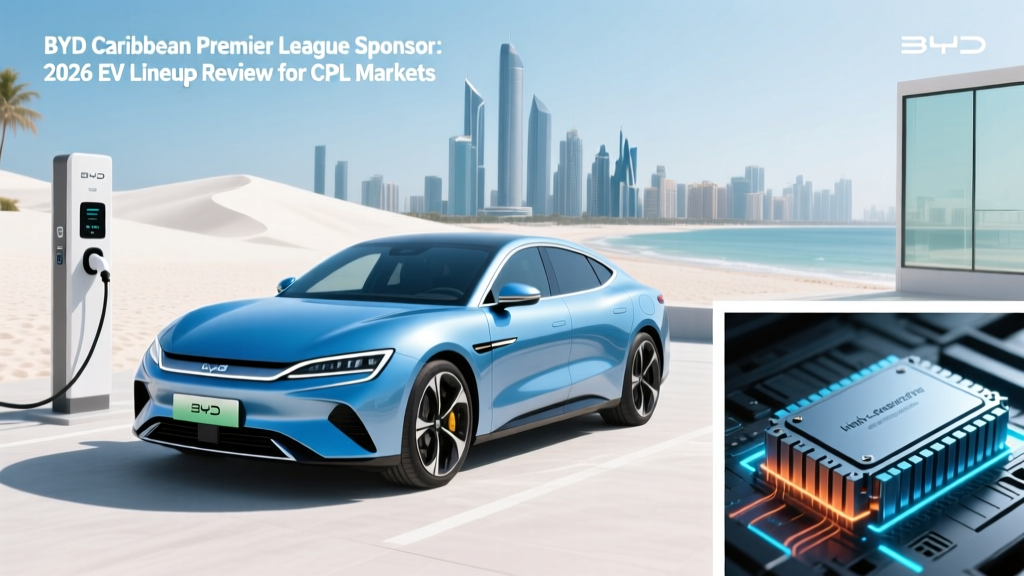
BYD's multi-year sponsorship of the Caribbean Premier League (CPL) has turned the Chinese automaker into a household name across the Caribbean — but for EV-curious buyers in the region and beyond, the real question isn't about cricket. It's whether BYD's growing global lineup delivers competitive range, charging, and value. This review breaks down the three core models BYD is pushing into export markets in 2026: the Atto 3 (compact SUV), the Dolphin (hatchback), and the Seal (sedan). We cover EPA-equivalent range, battery chemistry, charging speeds, pricing, and whether these vehicles make sense for buyers outside China.
BYD Atto 3 (2026): The CPL Market Workhorse
The Atto 3 — known as the Yuan Plus in China — is BYD's best-selling export model globally and the vehicle most frequently featured in CPL sponsorship activations. It's a compact crossover targeting the same segment as the Hyundai Kona Electric and Kia Niro EV, but at a noticeably lower price point in most markets.
| Spec | Standard Range | Extended Range |
|---|---|---|
| Battery (usable) | 49.9 kWh (LFP Blade) | 60.5 kWh (LFP Blade) |
| WLTP Range | 345 km (214 mi) | 420 km (261 mi) |
| EPA-Equivalent Range | ~185 mi | ~225 mi |
| Motor Output | 150 kW (201 hp), FWD | |
| 0-100 km/h (0-62 mph) | 7.3 seconds | |
| Max DC Fast Charge | 70 kW | 88 kW |
| 10-80% DC Time | ~38 min | ~29 min |
| Level 2 AC Charge | 7 kW (~25 mi/hr) | |
| MPGe (est.) | ~110 MPGe combined | |
| Cargo Volume | 15.4 cu ft (rear seats up) / 46.0 cu ft (folded) | |
| Base MSRP (Export) | ~$30,000 - $35,000 USD equivalent (varies by market) | |
| Battery Warranty | 8 years / 160,000 km (~100,000 mi) | |
Battery Chemistry: LFP Blade Architecture
All Atto 3 variants use BYD's proprietary LFP (lithium iron phosphate) Blade Battery. LFP trades energy density for exceptional thermal stability — the Blade form factor passes nail-penetration tests without thermal runaway, a meaningful safety advantage over NMC cells. The trade-off: LFP batteries are heavier per kWh, which is why the Atto 3's range doesn't match rivals with similar-size NMC packs. LFP also tolerates repeated 100% charging better than NMC, meaning daily full charges are less detrimental to long-term health.
Charging Reality: Adequate, Not Class-Leading
The Atto 3's DC fast-charging speed is its most notable limitation. At 88 kW peak (Extended Range), it falls well short of the Hyundai Kona Electric's 100+ kW or the Kia Niro EV's similar capabilities. More critically, the charge curve tapers early — you'll see 88 kW only between roughly 10-30% State of Charge (SoC), after which it steps down to ~55 kW and then ~35 kW above 70%. The 29-minute 10-80% time is acceptable for a sub-$35K vehicle but means longer road-trip stops compared to 800V-architecture competitors.
For Caribbean buyers where daily driving distances average 30-50 km (18-31 miles), the 7 kW Level 2 home charge rate is perfectly sufficient — a full overnight charge adds roughly 200+ miles, far exceeding daily needs.
BYD Dolphin (2026): The Affordable Entry Point
The Dolphin is BYD's global-market subcompact hatchback, positioned below the Atto 3 and aimed at first-time EV buyers, urban commuters, and fleet/ride-hail operators. In CPL markets, it's the model most likely to appear as a promotional or demo vehicle.
| Spec | Active (Base) | Design (Extended) |
|---|---|---|
| Battery (usable) | 44.9 kWh (LFP Blade) | 60.4 kWh (LFP Blade) |
| WLTP Range | 310 km (193 mi) | 427 km (265 mi) |
| EPA-Equivalent Range | ~165 mi | ~230 mi |
| Motor Output | 70 kW (94 hp), FWD | 150 kW (201 hp), FWD |
| 0-100 km/h | 12.3 sec | 7.0 sec |
| Max DC Fast Charge | 60 kW | 88 kW |
| 10-80% DC Time | ~41 min | ~29 min |
| Level 2 AC Charge | 7 kW (~25 mi/hr) | |
| Cargo Volume | 12.0 cu ft (rear up) / 36.5 cu ft (folded) | |
| Base MSRP (Export) | ~$22,000 - $30,000 USD equivalent | |
| Battery Warranty | 8 years / 160,000 km | |
The Design trim's 230-mile EPA-equivalent range and 7-second 0-62 mph time make it surprisingly capable for the price. The base Active trim, with 165 miles and a 12.3-second acceleration time, is strictly a city commuter — highway merging and overtaking require planning.
BYD Seal (2026): The Tesla Model 3 Challenger
The Seal is BYD's premium electric sedan, explicitly benchmarked against the Tesla Model 3. It rides BYD's e-Platform 3.0 with cell-to-body (CTB) battery integration, where the LFP Blade pack serves as a structural floor member — improving torsional rigidity and lowering the center of gravity.
| Spec | Design (RWD) | Excellence (AWD) |
|---|---|---|
| Battery (usable) | 82.5 kWh (LFP Blade, CTB) | |
| WLTP Range | 570 km (354 mi) | 520 km (323 mi) |
| EPA-Equivalent Range | ~300 mi | ~275 mi |
| Motor Output | 230 kW (308 hp), RWD | 390 kW (523 hp), AWD |
| 0-100 km/h | 5.9 sec | 3.8 sec |
| Max DC Fast Charge | 150 kW | |
| 10-80% DC Time | ~26 min | |
| Level 2 AC Charge | 11 kW (~40 mi/hr) | |
| Cargo Volume | 14.1 cu ft trunk + 1.8 cu ft frunk | |
| Base MSRP (Export) | ~$42,000 - $52,000 USD equivalent | |
| Battery Warranty | 8 years / 160,000 km | |
Tax Credits, Pricing, and the U.S. Market Wall
For U.S.-based readers who discovered BYD through CPL sponsorship coverage: BYD vehicles are not available for purchase in the United States. As of 2026, Chinese-manufactured EVs face a 100%+ tariff under Section 301 trade provisions, making importation economically unviable. This means IRS §30D federal tax credit eligibility is moot — there is no U.S. MSRP to apply the credit against.
For Caribbean and other export-market buyers, local incentives vary significantly by country and territory. Jamaica, Barbados, and the Dominican Republic have introduced EV import-duty reductions or VAT exemptions, but these change frequently. Always check your local ministry of finance or transport authority for current incentive structures.
| Model | Base Trim | Top Trim | U.S. Availability | §30D Credit |
|---|---|---|---|---|
| Dolphin | ~$22,000 | ~$30,000 | Not available | N/A |
| Atto 3 | ~$30,000 | ~$35,000 | Not available | N/A |
| Seal | ~$42,000 | ~$52,000 | Not available | N/A |
BYD vs. Key Competitors in CPL Markets
In the Caribbean and Latin American export markets where BYD competes, its main rivals include:
- Hyundai Kona Electric (2026): EPA-rated 261 miles, 100+ kW DC charging, ~$34,000 USD. Better charging speed, slightly more range, but typically 10-15% higher pricing in export markets.
- MG4 EV: Another Chinese export competitor. Similar pricing to the Dolphin, comparable LFP battery, slightly sportier handling. Less brand recognition in the Caribbean.
- Toyota bZ4X: Available in some Caribbean markets via parallel import. Heavier, less efficient, and significantly more expensive — but carries Toyota's service-network advantage.
- Tesla Model 3 (Highland): Available in limited Caribbean markets. EPA 341 miles (Long Range), 250 kW Supercharging, but $40K+ and limited service infrastructure on most islands.
BYD's advantage is consistently the price-to-range ratio. The Atto 3 Extended at ~$33,000 with 225 miles undercuts most competitors by $3,000-$8,000 depending on the market. The trade-off is slower DC charging and less established dealer/service networks outside Asia.
Pros
- Best-in-class price-to-range ratio in most export markets
- LFP Blade Battery — superior thermal safety, 100% SoC daily charging tolerance
- 8-year/160,000 km battery warranty
- Seal AWD: 523 hp / 3.8s 0-62 at ~$48K is exceptional performance value
- CTB structural battery (Seal) improves rigidity and interior space
- Growing CPL-market dealer partnerships via sponsorship visibility
Cons
- DC fast-charging speeds lag competitors (88 kW Atto 3 vs 100+ kW Kona)
- No U.S. market access — irrelevant for American buyers
- Service/parts network still developing in Caribbean and Latin America
- Atto 3 and Dolphin lack frunk (front trunk) storage
- Driver-assist features (BYD Pilot) are basic Level 2 — no hands-free highway capability
- Infotainment UI translation inconsistent in some export markets
- Resale value data limited — BYD is a newer brand in most CPL regions
Who Should Buy a BYD in 2026?
Choose BYD Atto 3 if:
You need a practical family crossover for daily commutes under 80 miles, want the lowest entry price in the compact EV SUV segment, and have reliable home Level 2 charging. The 225-mile range covers most Caribbean island circumferences with margin, and the LFP battery's longevity reduces replacement-anxiety over a 10-year ownership horizon.
Choose BYD Dolphin if:
You're a city commuter, ride-hail driver, or second-car buyer who rarely exceeds 60 miles per day. The base Active trim at ~$22,000 is one of the cheapest new EVs available in export markets. Skip it if you regularly drive highways — the 94 hp base motor is underpowered.
Choose BYD Seal if:
You want Model 3-rivaling range and performance at a lower price, and you're in a market where Tesla's Supercharger network isn't a deciding factor. The AWD Excellence trim's 3.8-second 0-62 mph time and ~275-mile range make it the most compelling performance EV under $50K in most CPL markets.
Look elsewhere if:
You regularly road-trip beyond 200 miles (the Atto 3 and Dolphin's slower DC charging adds up), you need established dealer service within 30 minutes, or you're a U.S. buyer (BYD simply isn't an option).
Standout Tech and Notable Drawbacks
Infotainment: All three models feature a 12.8-inch rotating center display (portrait/landscape toggle) running BYD's DiLink system. It supports wireless Apple CarPlay and Android Auto in most 2026 export trims. The rotating screen is a genuine differentiator — portrait mode excels for navigation, landscape for media. However, the UI's English translations in Caribbean-market units remain inconsistent, with occasional Chinglish in settings menus.
Driver Assistance (BYD Pilot): This is a conventional SAE Level 2 system — adaptive cruise control with lane-centering. It requires hands on the wheel at all times and does not offer hands-free highway driving like GM's Super Cruise or Ford's BlueCruise. It's competent for highway cruising but unremarkable compared to Tesla Autopilot or Hyundai's Highway Driving Assist.
V2L (Vehicle-to-Load): The Atto 3 and Seal support V2L, allowing you to power external devices (laptops, power tools, small appliances) from the traction battery via an adapter. In Caribbean markets prone to hurricane-season power outages, this is a genuinely useful feature — the Atto 3's 60.5 kWh pack can run a refrigerator for roughly 2-3 days.
Frequently Asked Questions
What is the real-world range of BYD's most popular CPL-market EV?
The Atto 3 Extended Range delivers approximately 195-210 miles in real-world mixed driving in tropical climates, against its WLTP-rated 261 miles (EPA-equivalent ~225 miles). Highway-only driving at sustained speeds reduces this to roughly 170-180 miles.
How fast do BYD EVs charge at home and on DC fast chargers?
Home Level 2 charging runs at 7 kW for the Atto 3 and Dolphin (~25 miles of range per hour) and 11 kW for the Seal (~40 miles per hour). DC fast charging peaks at 88 kW (Atto 3 Extended), 60-88 kW (Dolphin), and 150 kW (Seal). The Seal's 150 kW capability is competitive; the Atto 3 and Dolphin lag behind rivals.
Does BYD qualify for the U.S. federal EV tax credit?
No. BYD vehicles are not sold in the United States due to 100%+ tariffs on Chinese-manufactured EVs. The IRS §30D credit applies only to vehicles purchased and placed in service in the U.S., subject to MSRP caps ($55,000 for sedans, $80,000 for SUVs/trucks), buyer income limits, and battery-component/critical-mineral sourcing requirements.
Is the BYD Atto 3 worth buying over a Hyundai Kona Electric?
On price alone, the Atto 3 wins — it undercuts the Kona Electric by $3,000-$5,000 in most export markets while offering comparable range. However, the Kona charges faster on DC, has a more mature dealer network in the Caribbean, and offers Hyundai's 10-year/100,000-mile powertrain warranty. If charging speed and service access matter, the Kona edges ahead. If budget is the priority, the Atto 3 is the rational choice.
How long will a BYD LFP Blade Battery last?
LFP chemistry is rated for 3,000+ full charge cycles before reaching 80% State of Health (SoH) — significantly more than NMC's typical 1,000-2,000 cycles. At 200 miles per cycle, that's 600,000+ miles before meaningful degradation. BYD's warranty guarantees the battery will retain at least 70% capacity over 8 years / 160,000 km. Real-world data from Chinese-market BYD fleets shows approximately 8-12% degradation at 100,000 miles.
What's the biggest drawback of buying a BYD in the Caribbean?
Service infrastructure. While BYD's CPL sponsorship is building brand awareness, the physical dealer and parts network across Caribbean islands is still expanding. Before purchasing, confirm the nearest authorized service center and ask about parts availability timelines — body panels and proprietary components may require shipping from regional hubs, adding days or weeks to collision repairs.