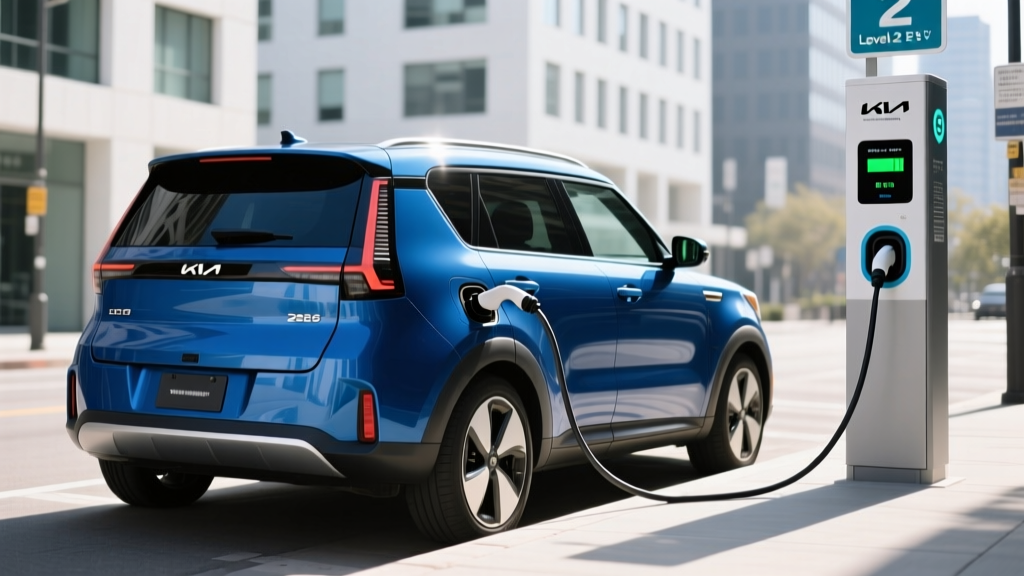
Quick Answer: The 2026 Kia Soul EV (Long Range) offers an EPA-estimated 243 miles of range from its 64 kWh battery, charges from 10–80% in approximately 54 minutes on a 77 kW DC fast charger, and starts around $35,000 MSRP before incentives. It's one of the most affordable, practical small electric crossovers on the market — but its modest DC charging speed and limited public fast-charging compatibility (CCS only, no NACS adapter included standard) mean it's best suited for drivers with reliable home Level 2 charging and mostly city/suburban commutes under 150 miles round-trip.
Is the Kia Soul EV Still Worth Buying in 2026?
The Kia Soul EV occupies a unique niche: a boxy, upright small crossover with genuinely useful cargo space, a comfortable ride, and a price point that undercuts most EV competitors. For 2026, Kia continues to offer the Soul EV primarily in the Long Range trim with a 64 kWh (usable) lithium-ion polymer battery pack and a single front-mounted electric motor producing 201 horsepower and 291 lb-ft of torque.
If you're searching for an EV Kia Soul and wondering whether it holds up against newer competitors like the Hyundai Kona Electric, Chevrolet Equinox EV, or Volvo EX30, the answer depends heavily on your driving patterns and charging situation. The Soul EV trades cutting-edge charging speed for affordability and practicality — a tradeoff that works well for many buyers but frustrates road-trippers.
Before we get into the numbers, let's address the core decision: Does the 2026 Kia Soul EV make financial and practical sense compared to the gas-powered Kia Soul or a hybrid alternative?
Kia Soul EV vs. Gas Soul vs. Hybrid: The Numbers
The gas-powered 2026 Kia Soul starts around $21,500 and gets an EPA-estimated 29 MPG combined (27 city / 33 highway). A hybrid version is not currently offered in the U.S. market, so the real comparison is EV vs. gas.
| Metric | 2026 Kia Soul EV (Long Range) | 2026 Kia Soul (Gas, 2.0L) |
|---|---|---|
| Base MSRP | ~$35,000 | ~$21,500 |
| EPA Range / Fuel Economy | 243 mi / 120 MPGe combined | 29 MPG combined |
| Energy Cost per Mile (nat'l avg) | ~$0.04–0.05 (home charging) | ~$0.12 (at $3.40/gal) |
| Annual Fuel/Energy (12,000 mi) | ~$480–$600 | ~$1,407 |
| Annual Maintenance Estimate | ~$300–$400 | ~$600–$800 |
| 0–60 mph | 7.0 seconds | 9.2 seconds |
| Horsepower / Torque | 201 HP / 291 lb-ft | 147 HP / 132 lb-ft |
| Cargo Volume (rear seats up) | 24.2 cu ft | 24.2 cu ft |
| Federal Tax Credit (§30D) | Up to $7,500 (eligibility varies) | None |
Sources: EPA fueleconomy.gov, Kia America specifications.
The price gap narrows significantly when you factor in the federal tax credit. Under current IRS §30D rules, the Soul EV may qualify for up to $7,500 depending on battery component sourcing, critical mineral requirements, your adjusted gross income, and the vehicle's MSRP falling under the $55,000 cap for SUVs/crossovers. The point-of-sale transfer option lets you apply the credit directly at the dealership, reducing your out-of-pocket cost. However, sourcing requirements have tightened — always verify current-year eligibility on IRS.gov or with your tax professional before committing.
With the full $7,500 credit applied, the effective price drops to roughly $27,500 — closing the gap with the gas Soul to about $6,000, a difference you can recover in fuel and maintenance savings within 5–7 years depending on mileage.
Real-World Range: What 243 EPA Miles Actually Means
EPA Range: 243 miles
Real-World Expectation: 190–220 miles highway (70–75 mph); 210–240 miles mixed city/suburban; 150–180 miles in cold weather (below 32°F) with cabin heating.
The 243-mile EPA figure is measured under controlled lab conditions. In practice, the Soul EV's boxy aerodynamics (drag coefficient around 0.35) hurt highway efficiency more than sleeker competitors. On a 75-mph interstate run in moderate temperatures (65–75°F), expect to use roughly 33–36 kWh per 100 miles, translating to about 190–210 real miles before you hit a 10% state of charge buffer.
Cold weather is the bigger concern. The Soul EV uses a resistive PTC heater rather than a heat pump, which draws significantly more energy from the battery in winter. In sustained sub-freezing temperatures, range loss of 25–35% is typical. If you live in Minnesota or Maine and need 150+ miles of winter range, precondition the battery while plugged in and use heated seats/steering wheel instead of cranking cabin heat.
The 64 kWh usable battery capacity (lithium-ion polymer, NMC chemistry) provides a reasonable buffer, but it's smaller than the 77–84 kWh packs in larger crossovers. For a daily commute of 40–60 miles with home charging, this is more than adequate. For road trips exceeding 200 miles one-way, you'll need to plan a DC fast-charging stop.
Charging Speed and Infrastructure: The Soul EV's Weak Point
Here's where the Kia Soul EV shows its age relative to newer platforms. The maximum DC fast-charge rate is 77 kW (peak), and in real-world conditions, sustained rates average closer to 50–60 kW across the 10–80% window.
| Charging Level | Power | Estimated Time | Miles Added per Hour |
|---|---|---|---|
| Level 1 (120V household) | 1.2 kW | ~55+ hours (0–100%) | ~4 mi/hr |
| Level 2 (240V, 32A home) | 7.2 kW | ~9.5 hours (0–100%) | ~26 mi/hr |
| DC Fast Charge (CCS) | 77 kW peak | ~54 min (10–80%) | ~150 mi/hr (peak) |
The 10–80% time of approximately 54 minutes is competitive with the Hyundai Kona Electric but far behind vehicles on 800V architectures (Hyundai Ioniq 5, Kia EV6) that can do 10–80% in 18 minutes. If you take frequent road trips of 300+ miles, this charging speed will feel slow.
Connector note: The 2026 Soul EV uses the CCS1 connector. Tesla's NACS connector is becoming the North American standard, and while CCS-to-NACS adapters are available, Kia does not include one standard. Tesla Supercharger access via adapter is possible but verify compatibility with Kia's latest software updates before relying on it.
For home charging, a Level 2 wallbox (240V, 32A circuit) will fully replenish the battery overnight in about 9.5 hours. Installation costs typically range from $500–$2,000 depending on your electrical panel's capacity and the distance from panel to charger location. If your home has a 200-amp panel with spare capacity, expect the lower end. Older 100-amp panels may require a $1,500–$3,000 upgrade — a cost many first-time EV buyers overlook.
Total Cost of Ownership: 5-Year Breakdown
Let's model a realistic 5-year, 60,000-mile ownership scenario comparing the Soul EV (with a $7,500 federal credit applied at purchase) against the gas Soul.
| Cost Category (5 Years) | Kia Soul EV | Kia Soul (Gas) |
|---|---|---|
| Purchase Price (after credit) | $27,500 | $21,500 |
| Energy/Fuel (60,000 mi) | $2,700 | $7,035 |
| Maintenance | $1,750 | $3,500 |
| Insurance (est. avg) | $8,500 | $7,000 |
| Depreciation (est.) | $12,000 | $9,500 |
| Total 5-Year Cost | $52,450 | $48,535 |
| Cost Per Mile | $0.87 | $0.81 |
EV insurance premiums tend to run 15–25% higher than equivalent gas vehicles due to higher repair costs and battery replacement risk. Shop quotes from multiple insurers before purchasing — the difference between carriers can be $500–$1,000/year.
The EV's energy and maintenance savings ($4,335 + $1,750 = $6,085 over five years) partially offset the higher purchase price, insurance, and steeper depreciation. If electricity rates are low in your area (under $0.12/kWh) and you drive more than 12,000 miles/year, the math shifts further in the EV's favor. At 15,000 miles/year, the Soul EV likely breaks even or comes out ahead by year five.
The Kia battery warranty covers 10 years / 100,000 miles (capacity retention above 70%), which is among the best in the industry and provides genuine peace of mind for long-term ownership.
Common Misconceptions About the Kia Soul EV
| Myth | Fact |
|---|---|
| "The battery will need replacing in 5 years." | Kia warranties the battery for 10 years/100,000 miles. NMC degradation averages 10–15% over 100,000 miles based on industry data. Most owners will never need a replacement. |
| "243 miles of range isn't enough." | The average American drives 37 miles/day (FHWA data). 243 miles covers nearly a week of typical driving. The issue is road trips, not daily use. |
| "EVs are worse in cold weather." | EVs lose range in cold (25–35% for the Soul EV), but they start reliably, don't need warmup idling, and regenerative braking works well on cold roads. Preconditioning while plugged in mitigates most range loss. |
| "You need a $7,500 tax credit to make it affordable." | Even without the federal credit, many states offer $1,500–$4,000 in rebates. Combined with fuel savings, the break-even timeline extends but remains realistic for high-mileage drivers. |
| "Charging takes too long." | Home Level 2 charging happens while you sleep — zero active time. The 54-minute DC fast charge is a road-trip inconvenience, not a daily one. |
Who Should Buy the Kia Soul EV — And Who Shouldn't
Buy the Kia Soul EV if:
- You have (or can install) Level 2 home charging — this is the single biggest factor in EV satisfaction.
- Your daily round-trip commute is under 150 miles, including errands.
- You prioritize cargo space and visibility over sleek styling or sporty handling.
- You qualify for the federal §30D credit and/or state incentives, bringing the effective price below $30,000.
- You take road trips of 300+ miles fewer than 3–4 times per year.
- You live in a moderate climate or can precondition in winter.
Look elsewhere if:
- You rely exclusively on public DC fast charging (the 77 kW peak speed will frustrate you).
- You regularly drive 200+ miles one-way and need quick charge stops (consider a Hyundai Ioniq 5 or Kia EV6 with 800V architecture).
- You live in an apartment or condo without charging access and your area has limited public Level 2 infrastructure.
- You need AWD — the Soul EV is front-wheel drive only.
- You tow — the Soul EV is not rated for towing.
If the Soul EV doesn't fit your needs but you want a Kia, the Kia EV6 (310-mile range, 233 kW peak DC charging, ~$42,000) solves the charging-speed problem at a higher price. If budget is paramount and you can't charge at home, a conventional hybrid like the Toyota Corolla Cross Hybrid (42 MPG, ~$29,000) eliminates range anxiety entirely.
First-Time EV Buyer Checklist
If the Kia Soul EV is your first electric vehicle, here's what to confirm before signing:
- Home charging feasibility: Get a quote from a licensed electrician for a 240V / 40A circuit installation. Budget $500–$2,000 (or more if a panel upgrade is needed).
- Tax credit eligibility: Check current §30D rules on IRS.gov — income caps ($150K single / $300K joint), MSRP caps, and battery sourcing requirements all apply.
- Insurance quotes: Get at least three quotes specifically for the Soul EV. Expect 15–25% higher premiums vs. the gas Soul.
- Utility EV rate plans: Many utilities offer time-of-use plans with off-peak rates under $0.08/kWh — this can cut your charging cost in half.
- Public charging apps: Download PlugShare, ChargePoint, and EVgo before buying. Map your common routes and verify CCS charger availability.
- Winter plan: If you live in a cold climate, plan to precondition the battery while plugged in and budget for 25–35% range loss in winter months.
Frequently Asked Questions
What is the real-world range of the 2026 Kia Soul EV?
The EPA rates it at 243 miles. In real-world mixed driving at moderate temperatures, expect 210–230 miles. Highway driving at 75 mph drops this to roughly 190–210 miles, and cold weather (below freezing) can reduce range to 150–180 miles. Preconditioning while plugged in helps recover some of that winter loss.
How long does it take to charge the Kia Soul EV at home?
On a Level 2 home charger (240V, 7.2 kW), a full 0–100% charge takes approximately 9.5 hours. Most owners plug in each evening and wake up to a full battery. On a standard 120V outlet (Level 1), a full charge takes over 55 hours — only practical for topping up if you drive fewer than 30 miles/day.
Does the Kia Soul EV qualify for the $7,500 federal tax credit?
It may, but eligibility depends on current-year IRS §30D requirements including your income (under $150K single / $300K joint AGI), the vehicle's MSRP (under $55,000 for SUVs), and battery component/critical mineral sourcing. These sourcing rules have tightened annually. Verify on IRS.gov and with your tax professional before purchase. The credit can be transferred at point of sale to reduce your purchase price directly.
Is the Kia Soul EV good for road trips?
It's adequate but not ideal. The 243-mile range covers most legs between major cities, but the 77 kW peak DC charging speed means 10–80% takes about 54 minutes — noticeably slower than 800V competitors that charge in 18–20 minutes. If road trips are a weekly occurrence, consider a faster-charging EV. For 3–4 road trips per year with planning, it's manageable.
How does the Kia Soul EV compare to the Hyundai Kona Electric?
They share a similar powertrain and battery size. The Kona Electric has a slightly larger 65.4 kWh battery, 256 miles of EPA range, and a marginally faster 100 kW peak DC charge rate. The Soul EV counters with more headroom, better outward visibility, and a boxier cargo area that's easier to load. Both are front-wheel drive only and similarly priced.