Quick Answer: The GMC Hummer EV interior offers class-leading space with up to 116.8 cubic feet of cargo volume (SUV) or a 5-foot bed (pickup), a 13.4-inch infotainment screen, and standard Super Cruise hands-free driving. However, buyers should expect real-world range of 240–280 miles (vs. the EPA's 314–381 miles depending on trim), a base MSRP starting around $98,845 for 2026, and no federal §30D tax credit eligibility due to the MSRP cap. Home Level 2 charging is essential given the massive 246 kWh Ultium battery, which can take 12+ hours on a standard 11.5 kW home charger from empty.
Inside the Electric Hummer: Cabin Space and Technology
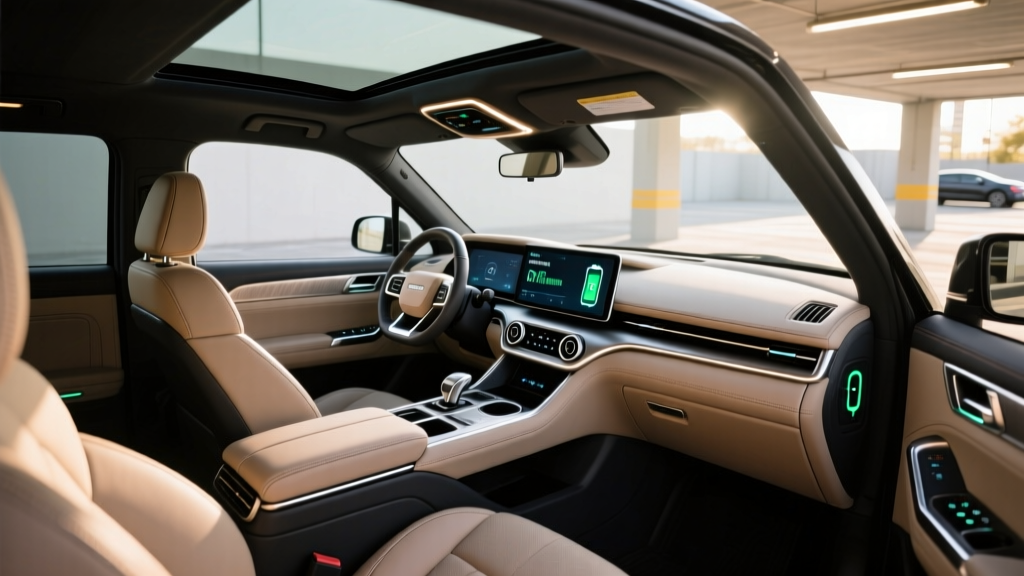
The GMC Hummer EV was engineered to dominate on presence alone, and the interior reflects that mandate. Whether you choose the Pickup or SUV variant, the cabin is built around GM's Ultium platform, which enables a flat floor and expansive cabin width. Front headroom exceeds 42 inches, rear legroom sits near 40 inches, and the removable Infinity Roof panels (standard on most trims) create an open-air experience no other electric truck can match.
The dashboard centers on a 13.4-inch diagonal infotainment touchscreen running GM's latest Ultifi software platform, paired with a 12.3-inch digital instrument cluster. Wireless Apple CarPlay and Android Auto are standard. Higher trims (Edition 1, 3X) add a 14-speaker Bose audio system and an available head-up display with augmented-reality navigation overlays.
Material quality varies by trim. The base 2X trim uses durable cloth and synthetic leather, while the 3X and Edition 1 trims feature genuine leather seating surfaces, heated and ventilated front seats, and a heated steering wheel. All trims include a standard trailer-assist system and up to 12 camera views — critical for a vehicle this wide (over 95 inches with mirrors).
Hummer EV Range, Charging, and Battery Specs
| Specification | 2X Trim | 3X Trim | Edition 1 |
|---|---|---|---|
| Battery Capacity (usable) | ~246 kWh (NMC) | ~246 kWh (NMC) | ~246 kWh (NMC) |
| EPA Range | ~314 mi | ~329 mi (SUV) / ~355 mi (Pickup) | ~381 mi (Pickup) |
| Real-World Range (highway, 70 mph) | ~250 mi | ~265 mi | ~300 mi |
| Peak DC Fast Charge Rate | 350 kW | 350 kW | 350 kW |
| 10–80% DC Fast Charge Time | ~35 min | ~35 min | ~35 min |
| Level 2 Home Charge Rate | 11.5 kW | 11.5 kW | 11.5 kW |
| Level 2 Full Charge Time (0–100%) | ~22 hours | ~22 hours | ~22 hours |
| 0–60 mph | ~5.0 sec | ~3.0 sec (Watts to Freedom) | ~3.0 sec |
| Horsepower | 625 hp | 830 hp | 1,000 hp |
| Base MSRP (2026) | $98,845 | $119,395 | Discontinued after 2024 |
| Battery/Powertrain Warranty | 8 yr / 100,000 mi | 8 yr / 100,000 mi | 8 yr / 100,000 mi |
Real-World Range Reality Check: The Hummer EV's EPA-estimated range (up to 381 miles on Edition 1) assumes a mix of city and highway driving at moderate temperatures. In real-world highway testing at 70 mph, expect a 15–20% reduction. In cold weather (below 32°F), range can drop 25–35% due to battery thermal management demands and cabin heating. The Hummer EV's massive 246 kWh battery helps buffer this loss, but its 9,000+ lb curb weight works against efficiency. Plan for roughly 2.0–2.5 kWh/mile in mixed driving.
Charging the Hummer EV at home requires planning. The 246 kWh battery is the largest in any production EV, and even at the maximum 11.5 kW Level 2 rate, a full charge takes roughly 22 hours. Most owners will charge incrementally — plugging in overnight to recover 50–80 miles of range per 8-hour session. For road trips, the 350 kW DC fast-charge capability (on 800-volt-capable chargers like Electrify America's 350 kW stations) can add roughly 100 miles in 12 minutes, though the charge curve tapers significantly above 80% state of charge to protect battery health.
Hummer EV vs. Gas Hummer H2: Cost and Efficiency Comparison
For buyers cross-shopping the electric Hummer against a used gas-powered Hummer H2 (2003–2009) or a comparable large gas truck like the Ford F-150 or Ram 1500, the economics are stark:
| Category | Hummer EV (3X) | Gas V8 Truck (14 MPG) |
|---|---|---|
| Fuel/Energy Cost | $1,350 (at $0.14/kWh) | $3,750 (at $3.50/gal) |
| Maintenance (oil, filters, brakes) | $300 | $900 |
| Insurance (estimated avg) | $3,200 | $2,100 |
| Annual Total | $4,850 | $6,750 |
| 5-Year Operating Total | $24,250 | $33,750 |
The Hummer EV saves roughly $1,900 per year in fuel and maintenance compared to a gas V8 truck getting 14 MPG combined. However, the EV's higher insurance premiums (driven by repair costs for the massive battery and aluminum body panels) and significantly higher purchase price offset much of that advantage over a five-year horizon. The Hummer EV is not eligible for the federal §30D tax credit because its MSRP exceeds the $80,000 cap for trucks — a critical factor for buyers expecting a $7,500 offset.
Home Charging Requirements for the Hummer EV
Owning a Hummer EV without reliable home charging is impractical. Public DC fast chargers can supplement road trips, but daily use demands a Level 2 home setup. Here's what that entails:
| Component | Typical Cost Range |
|---|---|
| Level 2 Charger (48-amp, hardwired) | $500–$800 |
| Electrical Panel Upgrade (200A service, if needed) | $1,500–$3,500 |
| Wiring & Conduit (50-ft run) | $400–$900 |
| Electrician Labor | $600–$1,500 |
| Permit & Inspection | $100–$300 |
| Total Estimated Cost | $3,100–$7,000 |
The Hummer EV's onboard charger accepts up to 11.5 kW (48 amps at 240V). To deliver this, you'll need a dedicated 60-amp circuit with a hardwired charger or a NEMA 14-50 outlet rated for 50 amps (delivering ~9.6 kW). Homes with older 100-amp electrical panels will almost certainly require a panel upgrade to 200 amps — a $2,000–$3,500 expense that catches many first-time EV buyers off guard. Always consult a licensed electrician for a site assessment before purchase.
Super Cruise and Driver-Assist Technology
Every Hummer EV comes standard with GM's Super Cruise, a hands-free driving system operational on over 750,000 miles of mapped highways in the US and Canada. Super Cruise uses a combination of LiDAR-mapped road data, GPS, cameras, and radar to maintain lane position and following distance without driver steering input — though it requires continuous driver attention monitored via an infrared camera on the steering column.
SAE Automation Level: Super Cruise is classified as SAE Level 2 driver-assist technology. This means the driver must remain engaged, attentive, and prepared to take over at any time. It is not "self-driving" (Level 4/5). Hands-free does not mean mind-free. Only services like Waymo's robotaxi operate at Level 4 with no driver required.
Super Cruise excels on long highway stretches — reducing fatigue on 400-mile road trips — but disengages in construction zones, unmapped roads, and poor-weather conditions where lane markings are obscured. The Hummer EV also includes GM's Enhanced Automatic Emergency Braking, HD Surround Vision cameras, and Trailer Side Blind Zone Alert as standard safety features.
Total Cost of Ownership: 5-Year Breakdown
| Cost Category | 5-Year Estimate |
|---|---|
| Purchase Price (MSRP, before options) | $119,395 |
| Federal Tax Credit (§30D) | $0 (MSRP exceeds $80K cap) |
| Home Charger Installation | $4,500 (avg) |
| Charging Cost (15,000 mi/yr × 5 yr) | $6,750 |
| Insurance (5 yr) | $16,000 |
| Maintenance & Repairs | $1,500 |
| Estimated Depreciation (50% over 5 yr) | $59,700 |
| 5-Year Net Cost | ~$148,145 |
The Hummer EV's total 5-year cost is dominated by depreciation and insurance. Luxury electric trucks tend to lose 45–55% of their value in the first five years, and the Hummer EV's niche appeal and massive battery replacement cost (estimated $30,000+ out of warranty) weigh on resale values. Buyers should view this vehicle as a premium lifestyle purchase rather than a cost-saving EV — the efficiency gains over a gas truck are real but modest relative to the purchase premium.
Common Hummer EV Misconceptions — Fact vs. Fiction
| Myth | Fact |
|---|---|
| "The Hummer EV qualifies for the $7,500 federal tax credit." | It does not. The IRS §30D credit caps eligibility at $80,000 MSRP for trucks. The Hummer EV starts at $98,845. |
| "It charges as fast as a Tesla." | The Hummer EV peaks at 350 kW, but its massive 246 kWh battery means a 10–80% charge still takes ~35 minutes. A Tesla Model Y (75 kWh) charges 10–80% in ~15 minutes at 250 kW because the battery is far smaller. |
| "I can charge it on a standard 120V outlet." | Level 1 (120V) charging delivers roughly 1.4 kW — adding about 3 miles of range per hour. Fully charging the 246 kWh battery would take over 7 days. Level 2 (240V) is mandatory for practical ownership. |
| "The CrabWalk feature makes it hard to drive normally." | CrabWalk (rear-wheel steering up to 10 degrees) is an on-demand feature activated via a dashboard button. In normal driving, the Hummer EV steers like any other large truck, though the 95-inch width requires constant spatial awareness. |
| "Electric means no maintenance." | EVs eliminate oil changes, spark plugs, and transmission fluid, but the Hummer EV still requires tire rotations (its 35-inch tires are expensive), brake fluid checks, cabin air filter replacement, and coolant system service for the battery thermal management system. |
Decision Framework: Is the Hummer EV Right for You?
Choose the Hummer EV if:
- You have access to Level 2 home charging (240V, 60-amp circuit minimum) and understand the panel-upgrade cost.
- You need a full-size electric truck with best-in-class cargo space, 7,500-lb towing capacity, and genuine off-road capability (16 inches of ground clearance in Extract Mode).
- You want hands-free highway driving via Super Cruise for frequent long-distance trips.
- Your budget accommodates a $100K+ vehicle with high insurance and depreciation costs, and you're not relying on the federal tax credit.
- You value the open-air Infinity Roof experience and the sheer road presence no other EV offers.
Consider alternatives (Rivian R1T, Ford F-150 Lightning, Chevrolet Silverado EV) if:
- You need federal tax credit eligibility — the F-150 Lightning (base ~$55,000) qualifies under the §30D MSRP cap, subject to income and battery-sourcing rules.
- You lack home charging access — the Hummer EV's battery is too large for public-charging-only ownership.
- You prioritize efficiency over presence — the Rivian R1T delivers 350+ miles of range with a smaller, lighter platform and faster home charging.
- Your primary use is daily commuting under 50 miles — the Hummer EV's size and weight make it impractical for tight urban environments.
Frequently Asked Questions
How many people does the Hummer EV seat?
The Hummer EV Pickup seats five passengers across two rows. The SUV variant also seats five. There is no third-row option. Interior width is generous (over 65 inches at the shoulder), but the vehicle's exterior width makes parking in standard garages challenging — measure your garage door opening (minimum 8 feet wide recommended).
Does the Hummer EV have a frunk?
Yes. The Hummer EV Pickup features a front trunk (frunk) with approximately 11.3 cubic feet of storage — large enough for charging cables, a soft cooler, or a weekend bag. The SUV variant has a smaller front storage compartment. The frunk includes a drain plug for use as a cooler.
What is the Hummer EV's MPGe rating?
The EPA rates the Hummer EV 2X at approximately 47 MPGe combined — among the lowest of any production EV due to its 9,000+ lb curb weight and boxy aerodynamics. For context, the Ford F-150 Lightning achieves 70 MPGe combined, and the Rivian R1T achieves 73 MPGe. The Hummer EV consumes roughly 2.0–2.5 kWh per mile in mixed driving.
Can I tow with the Hummer EV, and how does it affect range?
The Hummer EV is rated to tow up to 7,500 lbs (Pickup) or 5,000 lbs (SUV). Towing at maximum capacity typically reduces range by 40–50% due to increased aerodynamic drag and rolling resistance. Plan for 130–160 miles of range when towing a 7,000-lb trailer at highway speeds, and map DC fast-charger stops accordingly.
What battery chemistry does the Hummer EV use, and how long will it last?
The Hummer EV uses NMC (nickel manganese cobalt) lithium-ion cells manufactured by Ultium Cells (a GM-LG Energy Solution joint venture). NMC offers higher energy density than LFP but is more sensitive to sustained high-state-of-charge storage. GM warranties the battery for 8 years or 100,000 miles against capacity loss below 70% of original capacity. Real-world degradation data for the Ultium platform is still emerging, but similar NMC packs in the Chevrolet Bolt have shown 8–12% degradation over 100,000 miles.