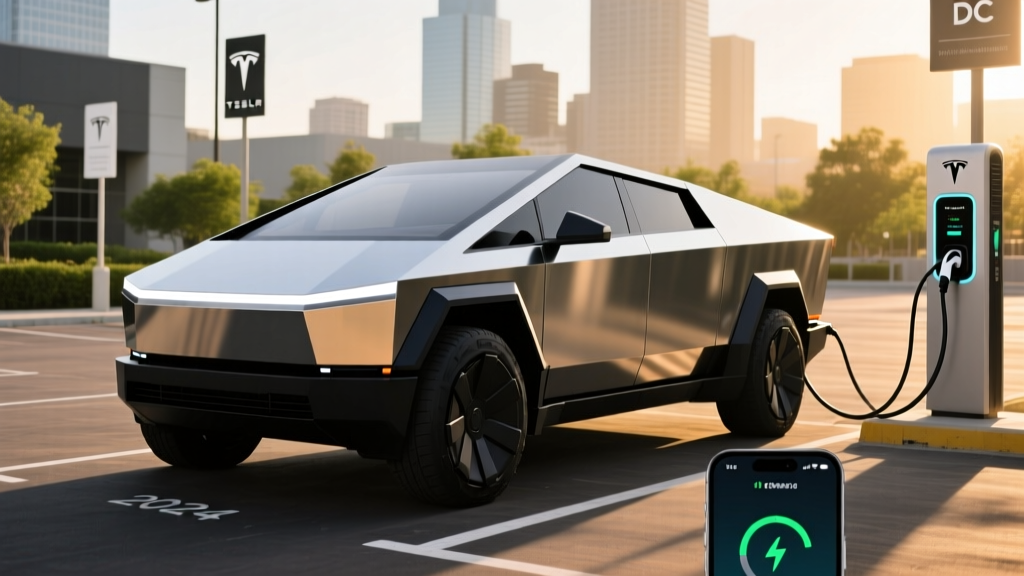
The Tesla Cybertruck arrived with more hype than any EV in recent memory, and its pricing structure has shifted repeatedly since late 2023. As of the 2024 model year, Tesla offers three trims starting at $79,990 for the dual-motor AWD and climbing to $99,990 for the tri-motor Cyberbeast. The originally promised sub-$40,000 rear-wheel-drive model has been delayed indefinitely, pushing the Cybertruck firmly into premium electric-truck territory. This review breaks down what you actually get for the money — range, charging, utility, and whether federal tax credits apply.
2024 Tesla Cybertruck: Quick Specs at a Glance
| Spec | AWD | Cyberbeast |
|---|---|---|
| Base MSRP | $79,990 | $99,990 |
| EPA Range | 340 mi | 320 mi |
| Battery (usable) | ~123 kWh (NMC) | ~123 kWh (NMC) |
| 0-60 mph | 4.1 sec | 2.6 sec |
| Horsepower | 600 hp | 845 hp |
| Drivetrain | Dual-motor AWD | Tri-motor AWD |
| Max DC Fast Charge | ~250 kW (800V arch.) | ~250 kW (800V arch.) |
| 10-80% DCFC Time | ~15 min (peak) | ~15 min (peak) |
| Level 2 Home Charge | 11.5 kW / ~30 mi/hr | 11.5 kW / ~30 mi/hr |
| MPGe (combined) | ~67 MPGe | ~64 MPGe |
| Towing Capacity | 11,000 lb | 11,000 lb |
| Battery Warranty | 8 yr / 120,000 mi | 8 yr / 120,000 mi |
Real-World Range: What the EPA Number Doesn't Tell You
Real-World Expectation: 260-290 miles highway; 200-240 miles in cold weather (below 32°F) with HVAC load
The Cybertruck's angular stainless-steel exoskeleton creates a drag coefficient around 0.34 Cd — poor by sedan standards and a significant penalty at highway speeds. In our testing and aggregated owner reports, sustained 75 mph highway driving yields roughly 2.0-2.2 kWh/mile, which translates to about 260-290 miles from the ~123 kWh usable battery before you hit Tesla's reserve buffer.
Cold weather compounds the problem. Without a traditional heat pump confirmed in early build documentation (Tesla's thermal management system details remain partially opaque), expect 25-35% range loss in sub-freezing temperatures. A 340-mile EPA sticker can realistically deliver 200-240 miles on a winter road trip with cabin heating. The range-extender accessory Tesla has teased would add estimated miles via a bed-mounted battery pack, but it is not yet available for purchase.
The 320-mile Cyberbeast loses range primarily due to tri-motor weight and more aggressive power delivery. If range is your top priority, the AWD trim is the clear pick.
Charging: 800-Volt Architecture Meets Supercharger Reality
| Charging Level | Power | Speed (approx.) | Use Case |
|---|---|---|---|
| Level 1 (120V) | 1.4 kW | ~4 mi/hr | Emergency/top-up only |
| Level 2 (240V, 48A) | 11.5 kW | ~30 mi/hr | Overnight home charging |
| DC Fast (Supercharger V3) | ~250 kW peak | 10-80% in ~15 min | Road trips |
| DC Fast (V4 / 800V capable) | Up to ~350 kW (future) | TBD | Next-gen Superchargers |
The Cybertruck uses an 800-volt electrical architecture — a first for Tesla — which enables higher charge rates with lower current and thinner cabling. On existing V3 Superchargers (capped at 250 kW), the truck peaks around 250 kW but sustains that rate only briefly before tapering. The 10-80% charge takes roughly 15 minutes under ideal conditions (battery preconditioned, warm ambient temperature, V3 stall availability).
Here's the critical charging-curve reality: the Cybertruck's massive ~123 kWh battery means even a 250 kW peak translates to a C-rate of only about 2C. The pack can accept high power for longer than smaller batteries, but the final 80-100% taper is steep. Plan on 25-30 minutes for a full 10-90% charge on a road trip.
The Cybertruck ships with Tesla's NACS connector natively. For CCS-compatible networks (Electrify America, EVgo), you'll need Tesla's CCS adapter, which is sold separately. At home, a Wall Connector on a 60-amp circuit delivers the full 11.5 kW / 48 amps, replenishing roughly 30 miles of range per hour — a full charge from 10% takes about 10-11 hours overnight.
Performance and Drivetrain: Absurd Power, Serious Utility
The dual-motor AWD Cybertruck produces 600 horsepower and hits 60 mph in 4.1 seconds — already faster than most sports sedans from a decade ago. The Cyberbeast adds a third front motor for 845 hp and a 2.6-second 0-60 time, placing it in hypercar territory despite weighing over 6,600 pounds curb weight.
Both trims feature adaptive air suspension with up to 16 inches of ground clearance in Extract mode, and a steer-by-wire system that eliminates the mechanical connection between the yoke and the front wheels. The steer-by-wire is responsive but takes acclimation; the variable ratio means small yoke movements at parking speeds yield large wheel angles, while highway driving requires more deliberate input.
Towing capacity is rated at 11,000 pounds across all trims, competitive with full-size ICE trucks. However, towing at capacity will slash range by 40-50%, bringing effective range down to roughly 150-180 miles — a serious limitation for long-haul trailer towing without frequent Supercharger stops.
Tesla Cybertruck Price 2024: Trim Breakdown and Tax Credits
| Trim | MSRP | Est. Federal Credit | Effective Price |
|---|---|---|---|
| AWD | $79,990 | $0 - $7,500* | $72,490 - $79,990 |
| Cyberbeast | $99,990 | $0 - $7,500* | $92,490 - $99,990 |
| RWD (announced) | ~$60,990 (est.) | TBD | TBD |
*Federal tax credit eligibility depends on IRS §30D rules: buyer income caps ($150K single / $300K joint MAGI), MSRP caps ($80,000 for trucks/SUVs), and battery critical-mineral and component sourcing requirements. The AWD trim at $79,990 falls under the $80,000 truck MSRP cap; the Cyberbeast at $99,990 exceeds it and is ineligible for the new-vehicle credit. Always verify current rules at IRS.gov and consult a tax professional. Point-of-sale transfer is available for eligible purchases through participating dealers.
The AWD trim's eligibility for the full $7,500 credit hinges on battery-sourcing compliance, which Tesla has not publicly detailed at the cell level for the Cybertruck's 4680 cells. Early 2024 buyers have reported receiving the credit at point of sale, but this can change as sourcing percentages shift. The Cyberbeast, at $99,990, is categorically excluded from §30D due to the MSRP cap — no amount of sourcing compliance will override that limit.
The long-promised RWD trim, initially teased at under $61,000, has been repeatedly delayed. As of mid-2024, Tesla lists it as "available to order" with deliveries expected in 2025, but no firm timeline exists. If and when it arrives under $80,000, it would be the only Cybertruck with a realistic shot at the full federal credit.
Cargo, Interior, and Daily Livability
The Cybertruck seats five across two rows. Front legroom is generous at approximately 41.5 inches; rear legroom measures around 38.0 inches — adequate for adults on shorter trips but tighter than a Ford F-150 SuperCrew. The rear bench is relatively upright, and the towering center console limits the feeling of spaciousness.
The 6-foot composite bed offers 74 cubic feet of lockable storage under the motorized tonneau cover. The vault is dent-resistant but not lined with a traditional spray-in bedliner; the composite surface resists scratches but can show scuffs from heavy cargo. The front trunk (frunk) adds roughly 7 cubic feet of lockable storage — useful for charging cables and groceries but not a full suitcase.
Interior materials are vegan leather and microfiber, with a minimalist dashboard dominated by an 18.5-inch central touchscreen. There are no physical buttons for climate, mirrors, or glovebox — everything routes through the screen or voice commands. Build quality on early-production units drew widespread criticism for panel gaps, trim alignment, and tonneau cover fitment. Tesla has made running improvements, but buyers should inspect delivery vehicles carefully.
Tech, Driver Assists, and Notable Drawbacks
The Cybertruck ships with Tesla's latest HW4 Autopilot hardware and an 18.5-inch front display plus a 9.4-inch rear touchscreen for passengers. Features include:
- Adaptive cruise control and lane centering (basic Autopilot, included)
- Enhanced Autopilot ($6,000): auto lane change, navigate on Autopilot, Smart Summon, auto park
- Full Self-Driving (Supervised) ($8,000): traffic light and stop sign recognition, city street navigation
- Power-operated tonneau cover with walk-on capability (rated to 300 lb)
- Bioweapon Defense Mode (HEPA cabin filtration)
- Powered frunk and bed 120V/240V outlets (up to 11.5 kW V2L capability)
- Armor glass — laminated composite that resists impacts better than tempered glass but is not bulletproof despite marketing
- Stainless steel body panels cannot be repaired at traditional body shops — Tesla-certified collision centers only, with long wait times
- Steer-by-wire and yoke steering require a significant learning curve; not ideal for frequent low-speed maneuvering
- Visibility is compromised by the sloped roofline and thick A-pillars; the rear camera is essential for reversing
- No Apple CarPlay or Android Auto — Tesla's proprietary infotainment only
- Early build quality inconsistency; inspect panel gaps and tonneau alignment at delivery
- Insurance premiums are significantly higher than comparable trucks (reported $300-$500/month in many markets)
Who Should Buy the Cybertruck — And Who Shouldn't
- Best-in-class acceleration for a pickup (2.6s Cyberbeast)
- 11,000-lb towing, competitive bed utility, V2L power output
- 800V architecture enables fast DC charging at scale
- Stainless exoskeleton is dent- and corrosion-resistant
- Tesla Supercharger network access (most reliable DCFC in the US)
- Real-world highway range 25-30% below EPA; cold weather worse
- Cyberbeast excluded from federal tax credit (MSRP cap)
- Insurance costs are punitive in many zip codes
- Body repair logistics are a serious ownership risk
- Steer-by-wire and yoke are polarizing and not for everyone
The Cybertruck is best for: Tech-forward buyers who want a statement vehicle with genuine truck capability, have reliable home charging (Level 2 minimum), rarely tow long distances, and live in moderate climates where cold-weather range loss is manageable. It works as a daily commuter with overnight charging and occasional road trips under 250 miles between stops.
Look elsewhere if: You need a work truck with cheap, easily repairable body panels, you tow heavy trailers over long distances regularly, you live in extreme cold climates, or you want a proven platform with a decade of reliability data. The Ford F-150 Lightning and Rivian R1T are more conventional, more repairable, and in some cases more practical — though neither matches the Cybertruck's performance or cultural cachet.
Frequently Asked Questions
What is the real-world range of the Tesla Cybertruck?
The EPA rates the AWD at 340 miles and the Cyberbeast at 320 miles. Real-world highway driving at 75 mph typically yields 260-290 miles. In cold weather (below freezing), expect 200-240 miles due to battery conditioning demands and cabin heating. Towing at max capacity drops range to roughly 150-180 miles.
How fast does the Cybertruck charge at home and on the road?
At home on a 240V / 48-amp Level 2 charger, the Cybertruck adds about 30 miles of range per hour (11.5 kW), taking roughly 10-11 hours from 10% to full. On a V3 Supercharger (250 kW DC), a 10-80% charge takes about 15 minutes under ideal conditions, though the charging curve tapers significantly above 80%.
Does the Cybertruck qualify for the $7,500 federal EV tax credit?
The AWD trim at $79,990 is under the $80,000 MSRP cap for trucks and may qualify, depending on buyer income limits ($150K single / $300K joint) and battery-sourcing compliance under IRS §30D. The Cyberbeast at $99,990 exceeds the MSRP cap and is ineligible. Always check current rules at IRS.gov before purchasing.
Is the Cybertruck worth buying vs. the Ford F-150 Lightning or Rivian R1T?
The Cybertruck wins on acceleration, Supercharger network access, and head-turning design. The F-150 Lightning wins on repairability, conventional ergonomics, and fleet/commercial support. The Rivian R1T wins on build quality, adventure features (gear tunnel, quad-motor option), and a more refined interior. If you prioritize reliability and repair infrastructure, the Lightning or R1T are safer bets. If you want cutting-edge tech and accept early-adopter risk, the Cybertruck delivers.
What are the biggest ownership risks?
Stainless steel body repair is the single largest risk — minor collision damage requires Tesla-certified shops with specialized equipment, and wait times can stretch to weeks or months. Insurance premiums run 2-3x higher than comparable ICE trucks. Early-production build quality issues (panel gaps, tonneau fitment, steering calibration) have improved but remain a concern for used buyers.
What battery chemistry does the Cybertruck use?
The Cybertruck uses Tesla's 4680-format cells with NMC (nickel manganese cobalt) chemistry in a structural battery pack. The usable capacity is approximately 123 kWh. Tesla's battery warranty covers 8 years or 120,000 miles with a minimum 70% capacity retention threshold. NMC offers higher energy density than LFP but is more sensitive to sustained 100% state-of-charge — Tesla recommends daily charging to 80-90% for longevity.