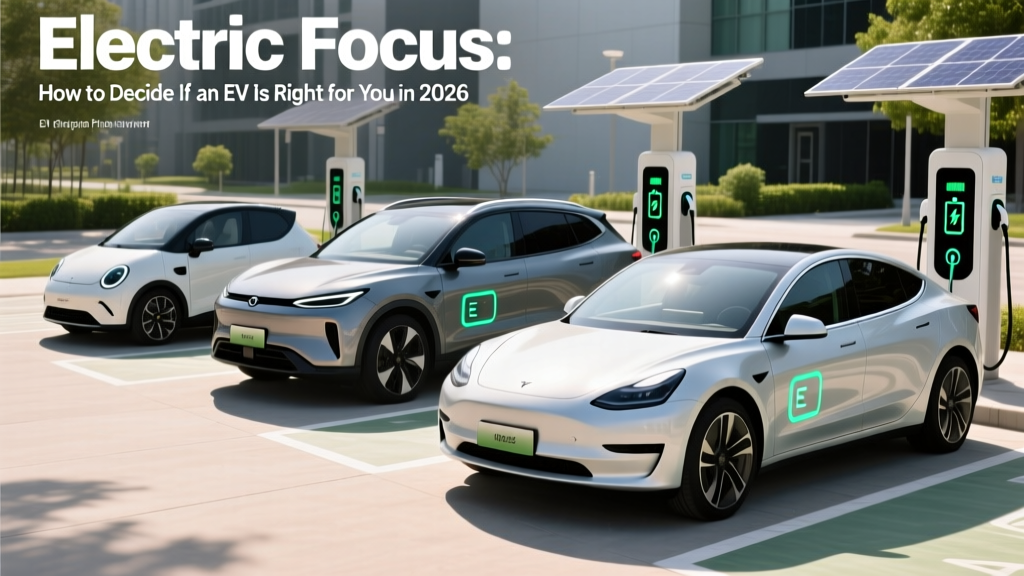
Quick Answer: Should You Make the Electric Focus Shift?
An EV makes financial and practical sense in 2026 if you can install a Level 2 home charger (typically $800–$2,200), drive under 250 miles on most days, and qualify for up to $7,500 in federal §30D tax credits (subject to MSRP caps, income limits, and battery-sourcing rules). Expect EPA-rated ranges of 250–370 miles on mainstream models, real-world highway ranges 15–25% lower, and fuel-cost savings of $600–$1,400 per year versus a comparable gas car. If you lack reliable home or workplace charging, regularly drive in sub-20°F winters, or frequently tow heavy loads over long distances, a hybrid or PHEV may serve you better.
What "Electric Focus" Actually Means for Car Buyers
Making an electric focus shift in your car-buying process means evaluating vehicles through an electrification lens: battery capacity (kWh), charging speed (kW), real-world efficiency (kWh/100 mi), and total cost of ownership rather than just sticker price. It also means understanding where EVs excel — daily commuting, stop-and-go traffic, home-base charging — and where they still carry compromises: long rural road trips, extreme cold, and apartment living without charging access.
The average American drives roughly 37 miles per day, according to FHWA data. That means a modern EV with 250+ miles of EPA range covers most daily needs with substantial buffer. The question isn't whether an EV can handle your commute — it almost certainly can — but whether your lifestyle supports convenient charging and whether the math works for your budget.
EV vs Gas vs Hybrid: The Numbers Side by Side
Let's compare three realistic 2026 options in the compact crossover segment: a battery-electric vehicle (BEV), a conventional hybrid (HEV), and a gasoline-only baseline. The figures below use EPA data and national average fuel/electricity prices.
| Metric | BEV (e.g., Hyundai Ioniq 5) | HEV (e.g., Toyota RAV4 Hybrid) | Gas (e.g., Toyota RAV4 AWD) |
|---|---|---|---|
| Base MSRP | $42,600 | $33,425 | $30,250 |
| Federal Tax Credit (§30D) | Up to $7,500* | $0 | $0 |
| Effective Price After Credit | ~$35,100 | $33,425 | $30,250 |
| EPA Efficiency | 114 MPGe / 30 kWh/100mi | 39 MPG combined | 28 MPG combined |
| Annual Fuel/Energy Cost (12k mi) | ~$540 | ~$1,080 | ~$1,500 |
| Annual Maintenance (est.) | ~$300 | ~$550 | ~$700 |
| EPA Range | 310 mi | 580 mi (14.5 gal tank) | 464 mi (14.5 gal tank) |
| Real-World Highway Range | ~240–260 mi | ~500 mi | ~400 mi |
| 0–60 mph | 5.1 sec (AWD Long Range) | 7.4 sec | 8.0 sec |
* §30D eligibility requires MSRP under $80,000 for SUVs, buyer AGI under $150K single / $300K joint, and compliance with critical-mineral and battery-component sourcing rules. Verify current-year rules at IRS.gov. Credit can be transferred to the dealer at point of sale as an upfront discount.
Real Costs of EV Ownership: A 5-Year Breakdown
Sticker price tells only part of the story. Here's a realistic 5-year / 60,000-mile total cost of ownership (TCO) comparison for the BEV vs gas scenario above, assuming national averages.
| Cost Category (5 yr / 60k mi) | BEV ($35,100 effective) | Gas ($30,250) |
|---|---|---|
| Purchase Price (after credit) | $35,100 | $30,250 |
| Energy / Fuel | $2,700 | $7,500 |
| Maintenance | $1,500 | $3,500 |
| Insurance (avg premium) | $9,500 | $7,800 |
| Home Charger Install (Level 2) | $1,500 | $0 |
| Estimated Depreciation | $14,000 | $11,500 |
| Total 5-Year TCO | $64,300 | $60,550 |
| Cost Per Mile | $1.07 | $1.01 |
The BEV's higher insurance premiums (typically 15–25% more than gas equivalents) and upfront charger cost narrow the savings gap. However, the gap continues to widen in the EV's favor beyond year five as fuel and maintenance savings accumulate and battery degradation remains minimal on modern chemistries. Drivers in states with cheaper electricity (under $0.12/kWh) or additional state rebates will see the BEV pull ahead sooner.
Charging Reality: What First-Time Buyers Must Know
Charging is the single biggest adjustment for new EV owners. Understanding the three levels — and the difference between kW (power, or how fast energy flows) and kWh (energy, or how much your battery holds) — is essential.
| Level | Power (kW) | Miles Added per Hour | Typical Use Case | Cost to Install / Use |
|---|---|---|---|---|
| Level 1 (120V household) | 1.0–1.4 kW | 3–5 mi/hr | Overnight top-up, low-mileage drivers | $0 (included cord) |
| Level 2 (240V home/public) | 7.2–11.5 kW | 25–44 mi/hr | Daily home charging, workplace | $800–$2,200 home install |
| DC Fast Charge | 50–350 kW | 150–800+ mi/hr | Road trips, quick stops | $0.30–$0.55/kWh public |
A critical nuance: DC fast charging speeds are peak rates, not sustained. A vehicle rated for 240 kW peak might sustain that rate only between 10–40% State of Charge (SoC), then taper significantly. Expect a 10–80% session on a 240 kW-capable BEV to take roughly 18–25 minutes at a compatible station, not the theoretical minimum. Above 80% SoC, charging slows dramatically to protect the battery — plan your road-trip stops around 10–80% charges rather than filling to full.
Home charging access is the make-or-break factor. If you own a home with a garage or driveway, a Level 2 charger installation (240V, 40–48 amp circuit) typically costs $800–$2,200 depending on panel proximity and local permitting. If your electrical panel needs an upgrade from 100A to 200A service, add $1,500–$3,000. Renters and apartment dwellers without access to workplace or reliable public charging should strongly consider a PHEV instead — it offers 30–45 miles of electric-only range for daily commutes plus a gas engine for longer trips.
Common EV Misconceptions: Myth vs Fact
| Myth | Fact (with data) |
|---|---|
| "EV batteries need replacing every few years." | Modern LFP and NMC batteries degrade roughly 1–2% per year. At 10 years, expect 85–90% capacity retention. Federal warranty mandate requires 8 years / 100,000 miles with at least 70% capacity. Full replacements (rare) cost $8,000–$18,000 depending on pack size. |
| "EVs don't work in cold weather." | Range drops 20–35% in sub-20°F conditions due to cabin heating and battery chemistry. A 310-mile EPA vehicle may deliver ~200–240 miles in deep cold. Models with heat pumps (standard on many 2026 BEVs) recover roughly 10% of that loss. Preconditioning while plugged in mitigates further. |
| "Charging takes too long for road trips." | On a 300-mile trip in a 240 kW-capable BEV, expect one 20-minute DC fast charge stop — comparable to a gas station bathroom-and-snack break. Cross-country travel adds roughly 30–60 minutes to a 10-hour drive. |
| "EVs are worse for the environment because of battery mining." | Lifecycle analyses from the EPA and Argonne National Lab show EVs produce fewer lifetime emissions than gas cars in every U.S. grid region, even accounting for battery manufacturing. The grid continues to decarbonize, widening this advantage over time. |
| "The tax credit is $7,500 for everyone." | The §30D credit has buyer income caps ($150K single / $300K joint AGI), vehicle MSRP caps ($55K sedans / $80K SUVs and trucks), and strict battery-sourcing requirements that eliminate some models. Always check the latest qualified-vehicle list on fueleconomy.gov before purchasing. |
Decision Framework: Is an Electric Focus Right for You?
Choose a Full BEV If:
- You have reliable Level 2 charging at home or work
- Your daily driving is under 200 miles round-trip
- You qualify for the §30D credit (check income, MSRP, and sourcing)
- You want the lowest per-mile energy cost ($0.04–$0.06/mi on home electricity)
- You value instant torque, quiet operation, and minimal maintenance
Choose a PHEV If:
- You rent or lack guaranteed home charging access
- You want 30–45 miles of daily electric commuting but need gas flexibility for road trips
- You frequently tow or drive long distances in rural areas with sparse DC charging
- You want EV-like daily driving without range anxiety in extreme cold
Choose a Hybrid (HEV) If:
- You have zero access to any plug (home, work, or public)
- You want maximum range flexibility with no behavior change
- Your budget prioritizes the lowest upfront cost
- You drive very high annual miles (25,000+) where HEV reliability and simplicity pay off
Stick with Gas (for now) If:
- You live in an area with extremely limited public charging infrastructure
- Your daily drive exceeds 300+ miles in remote territory
- You cannot afford the higher upfront cost or insurance premium of an EV even with tax credits
What First-Time EV Buyers Should Do Before Signing
Follow this checklist to avoid the most common new-owner regrets:
- Verify your electrical panel capacity. A licensed electrician can confirm whether your panel supports a 40–48 amp Level 2 circuit. Budget for a panel upgrade if needed.
- Test-charge before you buy. Download the PlugShare or ChargePoint app and visit your nearest DC fast charger. Understand the connector your vehicle uses — NACS (Tesla-standard, now adopted by Ford, GM, Rivian, Hyundai, and others for 2025+) or CCS1 (still common on older models).
- Confirm §30D eligibility for your exact trim. Battery sourcing requirements change periodically. Cross-reference the specific model and trim on fueleconomy.gov and consult a tax professional if your situation is complex.
- Get an insurance quote before purchasing. EV premiums run 15–25% higher on average. Some insurers offer EV-specific discounts — shop multiple quotes.
- Calculate your real-world range. Take the EPA number and subtract 15–25% for highway-heavy driving, another 20–35% for sub-20°F winters, and remember that battery degradation will gradually reduce range by ~1–2% per year.
Frequently Asked Questions
How much does it cost to charge an EV at home versus filling a gas tank?
At the U.S. average residential electricity rate of roughly $0.16/kWh (EIA 2025 data), fully charging a 77 kWh battery (like the Ioniq 5 Long Range) costs about $12.30 and delivers ~270 real-world miles. That's roughly $0.046 per mile. A 28 MPG gas car at $3.50/gallon costs $0.125 per mile — nearly three times more. Over 12,000 annual miles, the EV saves approximately $950 per year on energy alone.
Will an EV's battery last the life of the car?
Based on current degradation data from LFP and NMC packs, most EV batteries retain 85–90% of original capacity after 10 years or 100,000 miles. The federal warranty mandate requires manufacturers to cover at least 8 years / 100,000 miles for capacity dropping below 70%. Full battery replacements remain rare and are typically only needed after high-mileage use well beyond the warranty period.
Can I take a road trip in an EV without major hassle?
Yes, with planning. A 500-mile road trip in a 310-mile EPA-rated BEV requires one DC fast-charge stop of approximately 20–25 minutes (10–80% SoC). Use your vehicle's built-in route planner or apps like A Better Routeplanner to identify reliable stations. The Tesla Supercharger network (now open to NACS-equipped non-Tesla vehicles) remains the most reliable DC network in the U.S., with Electrify America and EVgo expanding coverage.
Do EVs require less maintenance than gas cars?
Significantly less. EVs have no engine oil, spark plugs, timing belts, exhaust systems, or multi-speed transmissions. Routine maintenance consists of tire rotations (EVs are heavier and wear tires faster), cabin air filter replacement, brake fluid checks, and windshield washer fluid. Regenerative braking extends brake pad life substantially — many EV owners report original brake pads lasting 80,000+ miles. Annual maintenance costs average $300–$400 versus $600–$900 for gas vehicles.
What happens if I can't install a home charger?
Relying solely on public charging is feasible but less convenient and more expensive. Public DC fast charging at $0.35–$0.55/kWh can cost as much as or more than gasoline per mile. Public Level 2 chargers (often at workplaces, malls, or parking garages) are cheaper ($0.15–$0.25/kWh) but slower. If you cannot charge at home, a PHEV with 35–45 miles of electric range is often a smarter choice — you get electric commuting when you can plug in and gas flexibility when you can't.