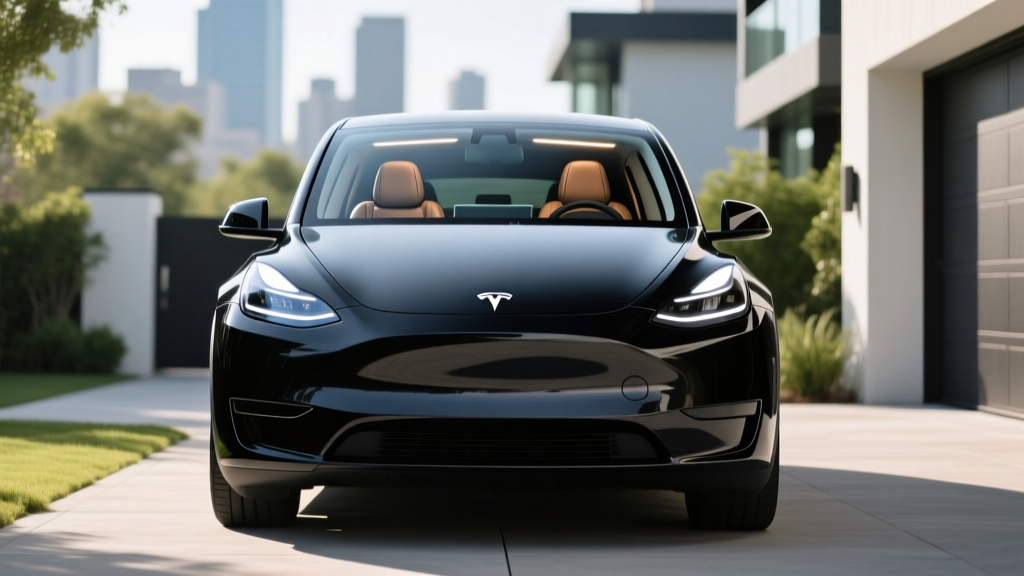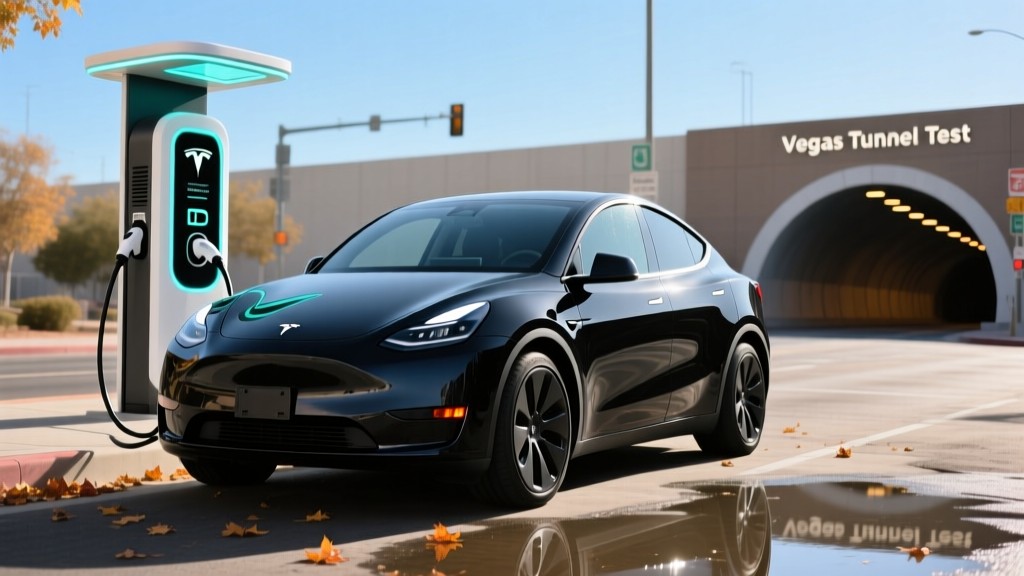
The 2026 Tesla Model Y remains the best-selling electric vehicle in the United States, but its dominance is under pressure from the Hyundai Ioniq 5, Ford Mustang Mach-E, and a wave of new electric SUVs. To separate marketing from reality, we took the refreshed Model Y Long Range AWD through our full evaluation — including a stint through the Tesla tunnels in Vegas (the Las Vegas Convention Center Loop) to see how the SUV handles tight, low-speed autonomous-grade corridors.
This review covers everything a buyer needs: EPA and real-world range, DC fast-charge curves, home charging costs, §30D federal tax credit eligibility under 2026 IRS rules, and a blunt pros-and-cons verdict against its closest rivals.
2026 Model Y Long Range AWD: Spec Table
| Spec | Value |
|---|---|
| EPA Range | 320 miles |
| Battery (usable) | ~75 kWh, NMC (2170 cells) |
| Drivetrain | Dual-motor AWD |
| Horsepower | 384 hp combined |
| 0–60 mph | 4.8 seconds |
| Peak DC Charge Rate | 250 kW |
| 10–80% DC Time | ~27 minutes |
| Level 2 (240V/48A) | ~11.5 kW (~44 mi/hr) |
| Efficiency | 122 MPGe / 28 kWh/100 mi |
| Cargo (rear seats up) | 30.2 cu ft |
| Cargo (rear seats folded) | 72.1 cu ft |
| Rear Legroom | 41.6 inches |
| Base MSRP | $48,990 (incl. destination) |
| Battery Warranty | 8 years / 120,000 miles |
Source: fueleconomy.gov, Tesla specifications.
Real-World Range vs. EPA Estimate
EPA sticker: 320 miles
Real-world highway (70 mph, 75°F): ~275–290 miles
Cold weather (30°F, mixed driving): ~230–250 miles
Hot-weather city (100°F+, A/C max): ~285–300 miles
The Model Y's heat pump helps it outperform many competitors in cold weather, but physics still wins: expect a 20–25% range hit below freezing, especially on short trips where the cabin and battery must be warmed repeatedly. On a 280-mile highway loop at 75 mph in mild conditions, we arrived with roughly 8% state of charge remaining — consistent with ~285 miles of usable range.
Preconditioning the battery before a DC fast charge (automatic when a Supercharger is set as your navigation destination) is essential in cold weather. Skipping it can cut peak charge rates in half.
Charging Speed: DC Fast, Level 2, and Level 1
| Level | Power (kW) | Miles Added per Hour | Notes |
|---|---|---|---|
| Level 1 (120V/12A) | ~1.4 kW | ~3–4 mi/hr | Emergency/trickle only |
| Level 2 (240V/48A Mobile Connector) | ~11.5 kW | ~44 mi/hr | Full overnight charge in ~7–8 hrs |
| Level 2 (Wall Connector 60A) | ~11.5 kW (vehicle-limited) | ~44 mi/hr | Vehicle onboard charger caps at 11.5 kW |
| DC Fast (V3 Supercharger) | Peak 250 kW | Up to ~1,000 mi/hr (brief) | 10–80% in ~27 min; tapers above 80% |
| DC Fast (CCS adapter, Electrify America) | Up to ~150–200 kW | Varies | Requires Tesla CCS adapter (included with 2026 models) |
The Model Y's charge curve peaks near 250 kW only between roughly 10–30% SoC, then steps down to ~170 kW, ~110 kW, and finally ~50 kW as it approaches 80%. A 10–80% session at a V3 Supercharger averages around 150 kW sustained, which is why the 27-minute figure is realistic but not class-leading.
For context, the Hyundai Ioniq 5 with its 800V architecture peaks at 240 kW and sustains higher rates longer, hitting 10–80% in ~18 minutes. If DC fast-charge speed is your top priority, the Ioniq 5 still holds the edge.
Performance, Ride, and the Vegas Tunnel Test
With 384 hp and dual-motor AWD, the Model Y Long Range hits 60 mph in 4.8 seconds — quick for a family SUV and more than adequate for highway merging. The Performance trim (456 hp, 3.5-second 0–60) is available for ~$5,000 more, but the Long Range is the volume seller and the better value for most buyers.
Ride quality improved with the 2025 refresh: revised dampers and acoustic glass reduced road noise and harshness noticeably. The steering remains precise but heavy at low speeds.
Through the Tesla Tunnels in Vegas
The Las Vegas Convention Center Loop — colloquially called the Tesla tunnels in Vegas — is a 1.7-mile underground network of narrow, single-lane tunnels built by The Boring Company. Model Ys, Model 3s, and Robovan shuttles ferry convention attendees between stations at speeds up to 35 mph.
Driving the Model Y through the tunnels is straightforward: the lane is tight (roughly 12 feet wide with curbs inches from the wheels), but the SUV's compact turning radius and excellent camera-based visibility make it manageable. Tesla's "Vegas Loop" driving mode is not a consumer feature — it's a fleet-only system — so drivers operate the vehicle manually. The tunnel experience is more novelty than benchmark, but it demonstrates the Model Y's maneuverability in constrained urban environments.
Pricing, Tax Credits, and Total Cost
| Item | Amount |
|---|---|
| Long Range AWD Base MSRP | $48,990 |
| Performance AWD Base MSRP | $53,990 |
| FSD (Supervised) Add-on | $8,000 (or $99/mo subscription) |
| IRS §30D Federal Tax Credit (2026) | Up to $7,500 if eligible* |
| Effective Price After Max Credit | ~$41,490 (Long Range) |
*§30D eligibility is not automatic. Under 2026 IRS rules, you must meet all of the following:
- Income caps: Modified AGI ≤ $150,000 (single), ≤ $300,000 (joint), ≤ $225,000 (head of household).
- MSRP cap: Vehicle base MSRP must be ≤ $80,000 for SUVs (Model Y qualifies).
- Battery sourcing: Critical minerals and battery components must meet phased-in domestic/free-trade-agreement percentages. For 2026, these thresholds are strict — Tesla has worked to qualify, but verify current eligibility on fueleconomy.gov before purchasing.
- Point-of-sale transfer: You can transfer the credit to the dealer at purchase to reduce the purchase price directly, or claim it on your tax return.
Always confirm eligibility with a tax professional. Rules change, and a vehicle that qualifies in January may not in December if supply-chain sourcing shifts.
Efficiency, Cargo, and Daily Usability
At 122 MPGe combined (28 kWh/100 mi), the Model Y Long Range is among the most efficient electric SUVs on sale. That translates to roughly $0.04–$0.06 per mile on average U.S. residential electricity rates (~$0.16/kWh), compared to $0.12–$0.15/mi for a 28 mpg gas SUV at $3.50/gallon.
Cargo space is a strong suit: 30.2 cu ft behind the rear seats (enough for four carry-on suitcases and groceries) and 72.1 cu ft with seats folded. The front trunk (frunk) adds another 4.1 cu ft — useful for charging cables or a small bag. Rear legroom at 41.6 inches is generous for adults, though the sloping roofline cuts into headroom for passengers over 6'2".
Standout Tech and Notable Drawbacks
The 15.4-inch center touchscreen runs Tesla's latest software, which is responsive and feature-rich. The 2026 refresh added ventilated front seats, ambient lighting, power-folding second-row seats, and a rear-seat entertainment screen. Build quality has improved measurably since the Fremont-built pre-2024 models, with tighter panel gaps and better interior materials.
Autopilot (standard) is a competent SAE Level 2 driver-assist system — it handles lane centering and adaptive cruise well on highways. Full Self-Driving (Supervised) remains Level 2: the driver must remain attentive and hands on (or near) the wheel at all times. It is not autonomous driving.
ADAS limitation: Autopilot and FSD (Supervised) are SAE Level 2 systems. They do NOT make the vehicle self-driving. The driver is legally and practically responsible for all vehicle operation at all times. Waymo and Zoox robotaxis operate at Level 4 in geofenced areas — a fundamentally different capability.
Drawbacks: The all-screen interface still frustrates some buyers — there are no physical buttons for climate or volume. Turn signals are on a stalk (restored for 2025+), but the gear selector remains screen-based with a backup console button. Insurance costs run 15–30% higher than comparable gas SUVs due to repair complexity.
Pros and Cons
Pros
- Class-leading efficiency (122 MPGe combined)
- Access to 20,000+ Supercharger stalls nationwide
- Strong cargo capacity (72.1 cu ft max)
- Over-the-air updates continuously add features
- Heat pump improves cold-weather range retention
Cons
- DC fast-charge speed trails Ioniq 5 / EV6 (27 vs 18 min 10–80%)
- No physical buttons — all controls through touchscreen
- FSD costs $8,000 extra and remains Level 2
- Insurance premiums notably above segment average
- §30D tax credit eligibility subject to sourcing rule changes
Model Y vs. Key Competitors
| Spec | Tesla Model Y LR AWD | Hyundai Ioniq 5 LR AWD | Ford Mach-E ER AWD |
|---|---|---|---|
| EPA Range | 320 mi | 290 mi | 312 mi |
| Battery | ~75 kWh NMC | 84 kWh NMC | 91 kWh NMC |
| Peak DC kW | 250 kW | 240 kW (800V) | 150 kW |
| 10–80% DC Time | ~27 min | ~18 min | ~40 min |
| 0–60 mph | 4.8 sec | 5.1 sec | 5.1 sec |
| Cargo (rear up) | 30.2 cu ft | 27.2 cu ft | 29.7 cu ft |
| Base MSRP | $48,990 | $49,850 | $48,995 |
| Efficiency | 122 MPGe | 110 MPGe | 101 MPGe |
Choose the Model Y if: You value Supercharger network access, maximum cargo space, and the highest efficiency in the segment.
Choose the Ioniq 5 if: Fast DC charging speed (18-min 10–80%) and physical buttons are priorities, and you can accept ~30 miles less range.
Choose the Mach-E if: You prefer a more traditional driving feel and Ford dealer service access, and you mostly charge at home.
Who the 2026 Model Y Suits Best
The Model Y Long Range AWD is the default recommendation for commuters who road-trip 2–4 times a year. Its combination of range, efficiency, cargo space, and Supercharger access makes it the most versatile single-vehicle EV garage solution. Families with two children will find the rear seat and cargo area adequate; those needing three-across seating should look at the Kia EV9 or Rivian R1S.
If you live in an apartment without home charging and rely exclusively on public DC fast charging, the Ioniq 5's faster charge curve may make daily life noticeably easier. If you tow, the Model Y's 3,500-lb rating is modest — the F-150 Lightning or R1T are better choices.
Frequently Asked Questions
What is the real-world range of the 2026 Tesla Model Y?
Expect 275–290 miles on the highway at 70 mph in mild weather, and 230–250 miles in freezing temperatures. The EPA rates it at 320 miles, but real-world driving — especially sustained highway speeds — typically yields 85–90% of that figure.
How fast does the Model Y charge at home and on the road?
On a 240V Level 2 home charger, it adds ~44 miles of range per hour, fully charging overnight in 7–8 hours. On a V3 Supercharger, 10–80% takes ~27 minutes. On third-party CCS networks (with the included adapter), expect 150–200 kW peak and 35–45 minute sessions.
How much does the Model Y cost after the federal tax credit?
The Long Range AWD starts at $48,990. If you qualify for the full $7,500 §30D credit (subject to income caps, MSRP caps, and battery sourcing rules), the effective price drops to ~$41,490. Verify current eligibility on fueleconomy.gov and consult a tax professional before purchasing.
Is the Model Y worth buying vs. the Ioniq 5 or Mach-E?
Yes, if Supercharger access, efficiency, and cargo space are your priorities. No, if DC fast-charge speed (Ioniq 5 wins) or physical controls (Mach-E and Ioniq 5 both have them) matter more to you. All three are excellent; the right choice depends on your charging access and interface preference.
Does the 2026 Model Y qualify for the $7,500 federal EV tax credit?
It is eligible under §30D, but only if you meet the income caps ($150K single / $300K joint), the MSRP is under $80K (it is), and the battery's critical minerals and components meet 2026 sourcing thresholds. These thresholds tighten annually — always verify before purchase.
What are the Tesla tunnels in Vegas, and can I drive through them?
The Las Vegas Convention Center Loop is a Boring Company-built tunnel system that shuttles attendees between convention halls in Tesla vehicles. It's not open to private vehicles — only fleet-operated Model Ys, Model 3s, and transit vans use the tunnels during events.
Sources: fueleconomy.gov, IRS §30D guidance, Tesla.com specifications.