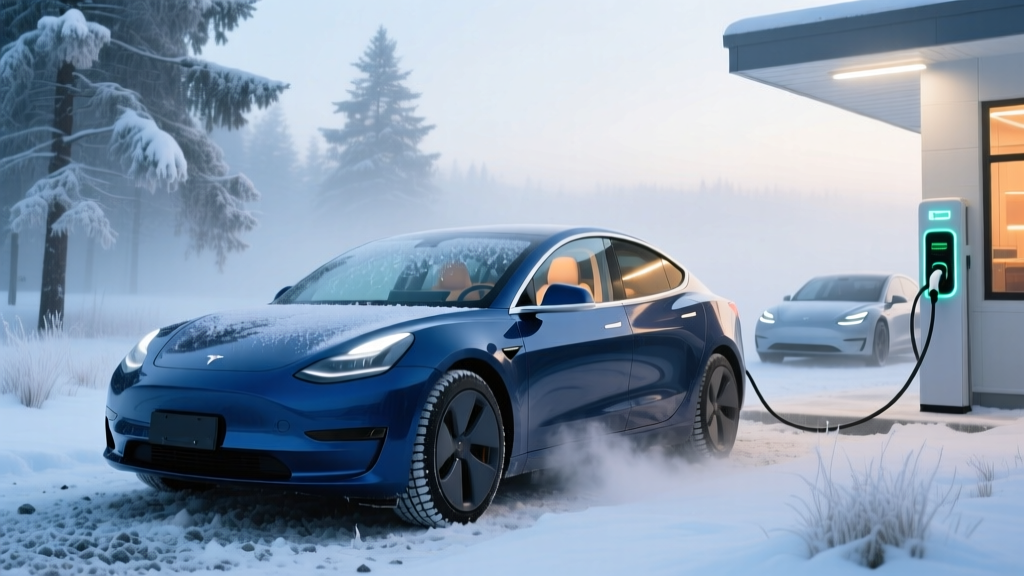
The short answer: Electric cars in cold weather lose between 10% and 40% of their EPA-estimated range, depending on temperature, driving speed, and whether the vehicle uses a heat pump for cabin heating. At 20°F (-7°C), the average EV sheds roughly 20–30% of its rated range. At 0°F (-18°C) or below, losses can reach 35–40% on vehicles without a heat pump. Charging speeds also taper in freezing temperatures unless the battery is preconditioned. The good news: modern EVs with heat pumps, active thermal management, and proper planning remain practical daily drivers even in harsh winters.
Why Cold Weather Hits EVs Harder Than Gas Cars
Internal combustion engines waste a tremendous amount of energy as heat — roughly 60–70% of the energy in gasoline becomes waste heat. In winter, that "waste" becomes a feature: it heats the cabin for free. An electric motor, by contrast, is 85–95% efficient, meaning there's very little surplus heat. Every BTU of cabin warmth must come from the traction battery, directly reducing the energy available for propulsion.
But cabin heating is only part of the story. Lithium-ion batteries operate through chemical reactions that slow down in cold temperatures. Internal resistance increases, which means:
- Reduced usable capacity: Some energy becomes inaccessible until the battery warms up.
- Slower charge acceptance: The battery management system (BMS) limits charging speed to protect cells from lithium plating — a degradation mechanism where metallic lithium deposits on the anode.
- Increased rolling resistance: Cold, dense air increases aerodynamic drag, and winter tires (while essential for safety) add rolling resistance.
According to testing by AAA's Automotive Research Center, when ambient temperature drops to 20°F and cabin heating is used, EV range decreases by an average of 41% across a multi-vehicle test fleet. More recent vehicles with heat pumps show significantly smaller losses — typically 15–25% under similar conditions.
Heat Pump vs. Resistive Heater: The Biggest Cold-Weather Differentiator
A resistive heater (PTC heater) converts electrical energy directly into heat at a 1:1 ratio — drawing 1 kWh of battery energy produces 1 kWh of heat. It works, but it's enormously energy-intensive, often pulling 3–6 kW continuously in cold weather.
A heat pump works differently. It moves heat rather than generating it, extracting thermal energy from the ambient air (yes, even cold air contains extractable heat) and compressing it for cabin use. The coefficient of performance (COP) for a modern EV heat pump typically ranges from 2.0 to 4.0, meaning 1 kWh of battery energy produces 2–4 kWh of heating effect.
| System | Typical Power Draw | Effective Heat Output | Range Impact (30-min drive) |
|---|---|---|---|
| Resistive (PTC) Heater | 4–6 kW | 4–6 kW (COP 1.0) | ~15–25 miles lost |
| Heat Pump | 1.5–3 kW | 3–6 kW (COP 2.5–4.0) | ~5–12 miles lost |
As of the 2025–2026 model years, heat pumps are standard on most Hyundai/Kia E-GMP vehicles (Ioniq 5, Ioniq 6, EV6, EV9), Tesla models, Rivian vehicles, the BMW iX, and many others. However, some base-trim EVs still use resistive heating. Always check the spec sheet — it's one of the most consequential features for cold-climate buyers.
Real-World Range Loss by Temperature: What the Data Shows
The following data synthesizes findings from AAA, fueleconomy.gov, Recurrent Auto's fleet data, and independent testing to give a realistic picture of range retention across temperatures. Figures assume highway driving (65–70 mph) with cabin heat set to 70°F.
| Ambient Temp | With Heat Pump | Without Heat Pump | Est. Real-World Range (Heat Pump) | Est. Real-World Range (Resistive) |
|---|---|---|---|---|
| 70°F (21°C) | ~95–100% | ~90–95% | 285–300 mi | 270–285 mi |
| 40°F (4°C) | ~85–90% | ~75–85% | 255–270 mi | 225–255 mi |
| 20°F (-7°C) | ~75–82% | ~60–72% | 225–246 mi | 180–216 mi |
| 0°F (-18°C) | ~65–75% | ~55–65% | 195–225 mi | 165–195 mi |
| -20°F (-29°C) | ~55–65% | ~45–55% | 165–195 mi | 135–165 mi |
Critical note: These figures compound with highway speed. At 80 mph, aerodynamic drag increases roughly 25% over 65 mph, further reducing range. A 300-mile EPA vehicle driven at 80 mph in 20°F weather with a resistive heater might deliver as little as 150–170 miles before needing a charge.
DC Fast Charging in the Cold: The Preconditioning Imperative
Cold batteries accept charge more slowly. This isn't a defect — it's electrochemistry. Charging a lithium-ion cell below roughly 32°F (0°C) at high power risks lithium plating, which causes permanent capacity loss. The BMS protects against this by throttling charge rates until the battery reaches a safe temperature, typically 50–60°F internally.
Here's what this looks like in practice at a 250 kW DC fast charger:
| Condition | Peak Charge Rate | 10–80% Time | Notes |
|---|---|---|---|
| Battery preconditioned (warm) | 220–250 kW | 18–22 minutes | Optimal charge curve sustained |
| Cold-soaked, no preconditioning | 40–80 kW initially | 40–60+ minutes | BMS ramps power as battery warms |
| Cold-soaked, preconditioned en route | 180–230 kW | 22–30 minutes | Navigation-based warming active |
Preconditioning means the vehicle's thermal management system actively warms the battery before you arrive at a charger. Most modern EVs do this automatically when you navigate to a charging station using the built-in navigation (Tesla, Rivian, Hyundai/Kia, Ford, BMW). The system typically begins warming 15–30 minutes before arrival, using grid power if plugged in or battery power if driving.
The practical takeaway: always navigate to your DC fast charger using the car's native system. If you just drive to a charger without triggering preconditioning, you may face dramatically slower charge times.
EV vs. Gas Car in Winter: A Fair Comparison
Gas cars aren't immune to cold weather. Fuel economy drops 10–22% in winter according to fueleconomy.gov, due to increased engine friction, longer warm-up times, winter fuel blends, and accessories like defrosters. However, gas cars don't lose range proportionally because the tank holds far more energy than an EV battery, and waste heat keeps the cabin warm without additional fuel draw.
| Factor | EV (300 mi EPA, Heat Pump) | Gas Car (30 MPG, 15-gal tank) |
|---|---|---|
| Rated range / distance | 300 mi EPA | 450 mi (theoretical) |
| Cold-weather range loss | 20–30% (~60–90 mi) | 10–15% (~45–68 mi) |
| Real-world winter range | ~210–240 mi | ~380–405 mi |
| Cabin heat energy source | Traction battery (or heat pump) | Waste engine heat (free) |
| Cold-start reliability | Excellent (no engine cranking) | Good (12V battery dependent) |
| "Refueling" at home | Yes — wake up "full" every morning | No — must visit gas station |
The EV's winter advantage is home charging. If you have Level 2 home charging, you start every morning with a full battery and a pre-warmed cabin (using grid power, not battery). A gas car owner still needs to visit a station, and idling to warm up wastes fuel.
Cost Breakdown: Winter EV Ownership in Context
Cold weather doesn't just affect range — it affects the economics of ownership. Here's a realistic winter-month cost comparison for a driver covering 1,000 miles/month in a region averaging 30°F in winter.
| Cost Factor | EV (Home L2, $0.14/kWh) | Gas Car (30 MPG, $3.20/gal) |
|---|---|---|
| Energy/fuel cost | $42–52 (3.0–3.7 kWh/mi in cold) | $107–118 (25–27 MPG winter) |
| Cabin heating cost (included above) | Included in kWh draw | Free (waste heat) |
| Maintenance (oil, filters, etc.) | $0 (no oil changes) | $25–40/month avg. |
| Winter tire swap (amortized monthly) | $25–35 | $25–35 |
| Total monthly operating cost | ~$67–87 | ~$157–193 |
Even accounting for increased winter energy consumption, the EV saves roughly $70–110/month in operating costs during winter months. Over a 5-month winter season, that's $350–550 in savings. Home charging is the critical variable here — public DC fast charging at $0.35–0.50/kWh narrows or eliminates this gap.
Practical Cold-Weather EV Ownership: A Decision Framework
Should you buy an EV for cold-climate driving? Use this framework:
Choose an EV if:
- You have access to Level 2 home charging (garage or driveway with a 240V circuit) — this is the single biggest cold-weather advantage
- Your typical daily round-trip is under 100 miles, even with 30% range loss
- You select a vehicle with a heat pump and battery preconditioning
- You're willing to plan DC fast charging stops on road trips longer than 150 miles in extreme cold
- You can budget for a vehicle with 300+ miles of EPA range to provide a cold-weather buffer
Consider a PHEV or HEV instead if:
- You rely exclusively on street parking with no charging access
- Your daily commute exceeds 150 miles round-trip in sub-freezing temperatures
- You frequently drive long distances in remote areas with sparse charging infrastructure
- You cannot install a Level 2 charger and public charging is unreliable in your area
Prioritize these features for cold climates:
- Heat pump: Non-negotiable for below-freezing climates
- Battery preconditioning: Essential for DC fast charging in cold
- Heated seats and steering wheel: These use far less energy (~100–200W) than cabin air heating (~3,000–6,000W), allowing you to lower the cabin temp and save range
- All-wheel drive: Adds weight and reduces range slightly, but critical for snow traction
- 300+ EPA miles: Provides a sufficient buffer for 30–40% cold-weather loss
Common Cold-Weather EV Myths — Addressed with Data
| Myth | Fact |
|---|---|
| "EVs can't handle winter — they'll leave you stranded." | Norway, where EVs exceed 80% of new car sales, has harsh winters averaging 20–30°F. Proper planning and a heat pump-equipped EV make winter driving routine. Range loss is predictable and manageable. |
| "The battery will degrade quickly in cold climates." | Cold actually slows chemical degradation. The real risk is charging at high power when the battery is cold (lithium plating), which is why the BMS limits charge rates. Modern thermal management systems protect against this. Recurrent Auto's fleet data shows minimal long-term degradation difference between cold and moderate climates. |
| "You can't use the heater or you'll run out of charge." | A heat pump draws 1.5–3 kW — significant but manageable. On a 200-mile winter trip, using heated seats (0.1–0.2 kW) and a moderate cabin temp (68°F) with a heat pump might cost 15–20 miles of range versus 40+ miles with a resistive heater at 74°F. |
| "EVs are unreliable in snow and ice." | EVs are typically heavier than comparable gas cars (due to the battery pack), which improves traction. The low center of gravity (battery mounted in the floor) reduces rollover risk. Instant torque delivery with traction control is effective on slippery surfaces. Winter tires remain essential for all vehicles. |
| "Charging takes forever in the cold." | Without preconditioning, yes — a cold-soaked battery may charge at 40–80 kW instead of 200+ kW. With proper preconditioning (navigating to the charger via the car's system), charge times increase only 20–30% in typical winter conditions. |
Top Cold-Weather EV Picks for 2025–2026
Based on heat pump availability, battery preconditioning, AWD options, and EPA range buffer, these models perform well in cold climates:
- Hyundai Ioniq 5 (AWD, 290 mi EPA): Standard heat pump, excellent preconditioning, 84 kWh NMC battery, peaks at ~240 kW DC charging. Base MSRP ~$46,000 (AWD). Eligible for up to $7,500 §30D credit depending on sourcing and buyer income — verify at irs.gov.
- Tesla Model Y (Long Range AWD, 311 mi EPA): Industry-leading heat pump efficiency, automatic Supercharger preconditioning, ~75 kWh usable NMC battery, peaks at ~250 kW. Base MSRP ~$48,000. Federal credit eligibility varies by sourcing requirements.
- Rivian R1S (Dual-Motor AWD, 352 mi EPA, Max Pack): Heat pump standard, 149 kWh Max Pack (NMC) provides enormous cold-weather buffer, peaks at ~200 kW DC. MSRP ~$82,000+ (above §30D SUV cap of $80,000 for most trims).
- BMW iX xDrive50 (324 mi EPA): Heat pump standard, 105.2 kWh usable NMC, peaks at ~200 kW DC, excellent cold-weather thermal management. MSRP ~$72,000.
Frequently Asked Questions
Do EVs lose range permanently after a cold winter?
No. Cold-weather range loss is temporary and reversible. Once temperatures rise, your EV's range returns to normal. Permanent battery degradation is caused by factors like sustained high SoC storage, frequent DC fast charging at high temperatures, and calendar aging — not cold weather driving.
Should I charge my EV to 100% in winter?
If your EV has an NMC battery, daily charging to 80% is recommended for longevity, but charging to 90–100% before a cold-weather trip is practical and acceptable. The extra buffer compensates for range loss. If your EV has an LFP battery (some Tesla Model 3/Y Standard Range, base Rivian), manufacturers recommend periodic 100% charges regardless of season. Always consult your owner's manual for chemistry-specific guidance.
Does regenerative braking work in cold weather?
Regen is often limited or unavailable when the battery is cold, because accepting high charge currents into a cold cell risks lithium plating. Most EVs gradually restore regen as the battery warms through driving. Some vehicles (Tesla, Rivian) offer a "low regen" mode for cold starts to match driver expectations. This means you'll use friction brakes more in the first 10–20 minutes of a cold drive — plan accordingly.
Can I precondition my EV while it's plugged in?
Yes, and you should. Preconditioning while plugged in draws power from the grid rather than the battery, so you leave with a full charge and a warm cabin. Most EVs allow you to schedule departure times via the app, automatically warming the battery and cabin before your commute. This is the single most impactful cold-weather habit for EV owners.
How do cold-weather EV insurance costs compare?
EV insurance premiums are generally 15–25% higher than comparable gas vehicles, regardless of climate, due to higher repair costs and vehicle values. Cold-climate states don't typically add a specific EV surcharge, but comprehensive coverage (which covers weather-related damage) may be slightly higher in regions with severe winters. Shop quotes from multiple providers — EV-specific insurance programs from manufacturers like Tesla and Rivian can sometimes offer competitive rates.