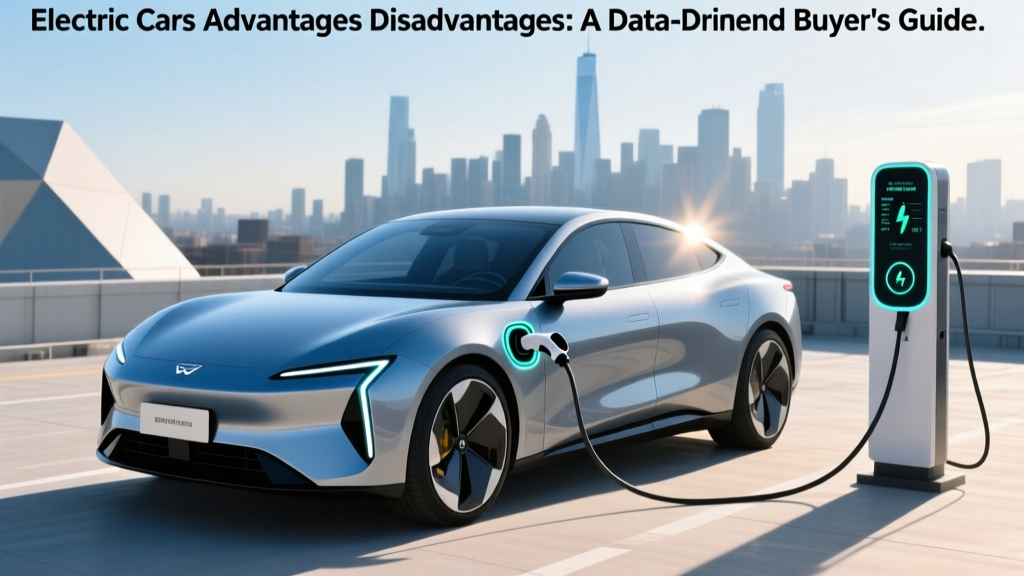
The Short Answer: Electric Cars Advantages Disadvantages
Advantages: Lower per-mile fueling cost (roughly $0.04–$0.06/mile on home electricity vs. $0.12–$0.16/mile for gas), fewer moving parts (no oil changes, no transmission fluid, regenerative braking extends pad life), instant torque, and up to $7,500 in federal tax credits for qualifying models under IRS §30D rules.
Disadvantages: Higher upfront purchase price (average EV transaction price ~$48,000 vs. ~$42,000 for gas equivalents), real-world range loss of 15–30% in cold weather, DC fast charging sessions of 20–40 minutes on road trips, and limited public charging infrastructure in rural areas. Home charging access remains the single biggest ownership variable.
Bottom line: If you can charge at home and drive under 250 miles daily, an EV will likely save you $4,000–$8,000 over five years. If you rely solely on public charging or regularly tow in cold climates, a hybrid may serve you better.
EV vs Gas: The Numbers Side by Side
Before weighing pros and cons, let's ground the comparison in hard data. The table below uses a representative 2025/2026 midsize crossover — the Hyundai Ioniq 5 (EV) versus the Toyota RAV4 AWD (gas) — to illustrate typical ownership differences.
| Metric | 2025 Hyundai Ioniq 5 SE AWD (EV) | 2025 Toyota RAV4 LE AWD (Gas) |
|---|---|---|
| Base MSRP | $46,700 | $32,350 |
| Effective Price (after §30D credit) | ~$39,200* | $32,350 |
| EPA Range / Fuel Economy | 290 miles / 110 MPGe | 30 MPG combined |
| Energy/Fuel Cost per Mile | ~$0.05 (home L2, $0.15/kWh) | ~$0.12 ($3.60/gal) |
| 5-Year Fuel/Energy Cost (75,000 mi) | ~$3,750 | ~$9,000 |
| 5-Year Maintenance Estimate | ~$1,800 | ~$3,500 |
| 0–60 mph | 5.1 seconds | 8.2 seconds |
| Powertrain Warranty | 10 yr / 100,000 mi | 5 yr / 60,000 mi |
*Federal §30D credit eligibility depends on MSRP caps ($80,000 for SUVs), buyer income limits ($150K single / $300K joint), and battery sourcing requirements. Verify at IRS.gov and confirm with a tax professional. Point-of-sale transfer is available at participating dealers.
The Ioniq 5 costs more upfront but recoups roughly $6,950 in fuel and maintenance savings over five years, according to fueleconomy.gov data. The break-even point typically arrives between years 3 and 4 for drivers covering 15,000 miles annually.
The Real Advantages of Electric Cars
Fueling Cost Savings That Compound
Home electricity at the US average of $0.15/kWh delivers an effective cost of roughly $0.04–$0.06 per mile for a typical EV consuming 3.0–3.5 miles per kWh. That compares to $0.10–$0.16 per mile for a 28–32 MPG gas car at $3.20–$4.00 per gallon. Over 15,000 annual miles, that's $900–$1,500 in annual savings — and electricity prices are historically more stable than gasoline.
Maintenance Reduction
EVs eliminate oil changes, spark plugs, timing belts, transmission fluid, and exhaust system repairs. Regenerative braking typically extends brake pad life to 80,000–100,000+ miles. The remaining maintenance items are cabin air filters, wiper fluid, tire rotations, and brake fluid checks. AAA research estimates EV maintenance at roughly $0.061 per mile versus $0.101 per mile for gas vehicles — a 40% reduction.
Performance and Driving Experience
Electric motors deliver peak torque from 0 RPM, which translates to responsive acceleration without the lag of turbo spool-up or transmission downshifts. Even mainstream EVs like the Chevrolet Equinox EV (0–60 in ~7.5 seconds, 213 HP) feel quicker in daily driving than their powertrain specs suggest, because that torque is instantly available at stoplights and during highway merges.
Tax Credits and Incentives
The federal §30D credit offers up to $7,500 for qualifying new EVs and $4,000 for qualifying used EVs (capped at 30% of sale price). Many states add their own incentives — though these vary by jurisdiction and change frequently, so check your state energy office or the Alternative Fuels Data Center for current programs. Some utilities also offer rebates of $500–$1,500 for home Level 2 charger installation.
The Real Disadvantages of Electric Cars
Higher Upfront Cost
The average new EV transaction price in early 2026 hovers around $48,000, compared to roughly $42,000 for gas vehicles. Even after the $7,500 federal credit, you're often paying a premium of $1,000–$5,000 at purchase. Budget EVs like the Nissan Leaf S ($29,290 MSRP, 149 miles EPA range) exist but come with range and charging-speed trade-offs.
Cold-Weather Range Loss
This is physics, not a flaw — but it's real. Lithium-ion batteries lose efficiency in cold temperatures, and cabin heating draws significant energy. In testing at 20°F, most EVs lose 15–30% of their EPA-rated range. A 300-mile EPA vehicle may deliver 210–255 miles in deep winter. Models with heat pumps (standard on the Hyundai Ioniq 5, Tesla Model Y, and many 2025+ EVs) mitigate this to the lower end of that range by recycling thermal energy rather than generating heat resistively.
Charging Time on Road Trips
At home on Level 2 (7–11 kW), you'll add roughly 25–44 miles of range per hour — perfectly adequate for overnight charging. On road trips using DC fast chargers, expect 10–80% sessions of 18–35 minutes depending on the vehicle's peak charge rate. The Hyundai Ioniq 5 peaks at 240 kW on an 800V architecture (10–80% in ~18 minutes under ideal conditions), while the Toyota bZ4X peaks at 150 kW (10–80% in ~30 minutes). Above 80% state of charge, charging speed tapers significantly to protect battery health — so charging to 100% at a DC station can add another 20+ minutes for minimal range gain.
Public Charging Reliability
While networks like Tesla Supercharger, Electrify America, and EVgo continue expanding, uptime and functionality vary. Non-Tesla networks report charger availability rates between 80–92% in various studies, meaning you may arrive at a station to find one or more stalls out of order. The transition to NACS (Tesla's connector standard, adopted by Ford, GM, Hyundai, and most major automakers for 2025+ models) is improving access, but adapter requirements and network compatibility still cause friction for some drivers.
Insurance Costs
EV insurance premiums run 10–25% higher than comparable gas vehicles on average, driven by higher repair costs (specialized parts, battery-safe procedures) and higher vehicle values. A 2025 Tesla Model Y may cost $200–$350 more per year to insure than a similarly priced gas crossover. Always get insurance quotes before purchasing — the premium difference can erode fuel savings.
Total Cost of Ownership: A 5-Year Breakdown
| Cost Category | EV (e.g., Ioniq 5 SE AWD) | Gas (e.g., RAV4 LE AWD) |
|---|---|---|
| Purchase Price (after credit) | $39,200 | $32,350 |
| Fuel/Energy (75,000 mi) | $3,750 | $9,000 |
| Maintenance (5 yr) | $1,800 | $3,500 |
| Insurance (5 yr, est. avg) | $10,500 | $8,750 |
| Home Charger Install (one-time) | $1,200 | — |
| Estimated Depreciation (5 yr) | $18,500 | $14,200 |
| Total 5-Year Cost | $74,950 | $67,800 |
| Cost Per Mile | ~$1.00 | ~$0.90 |
Depreciation estimates based on industry averages; EV depreciation has been volatile and varies significantly by model. Insurance estimates assume national averages; your rate depends on location, driving record, and carrier. Home charger cost assumes a 240V/48A Level 2 unit with moderate electrical work. Consult a licensed electrician for your specific installation.
The EV costs roughly $0.10 more per mile in this scenario, primarily due to depreciation and insurance. However, if your local electricity rate is below $0.12/kWh, your state offers additional incentives, or you drive more than 15,000 miles per year, the math tilts in the EV's favor. Higher-mileage drivers benefit disproportionately from the per-mile fuel savings.
Common EV Misconceptions vs. Facts
| Myth | Fact |
|---|---|
| "EV batteries need replacing every few years" | Modern EV batteries are warrantied for 8 years/100,000 miles (10/150,000 in CARB states) to retain at least 70% capacity. Real-world data from Tesla and other manufacturers shows average degradation of 10–15% over 150,000+ miles. Full replacements are rare and typically covered under warranty within the coverage period. |
| "EVs are worse for the environment because of battery mining" | Lifecycle analyses by the Union of Concerned Scientists and ICCT consistently show EVs produce fewer greenhouse gas emissions than gas cars over their lifetime, even accounting for battery manufacturing. The grid is getting cleaner every year, further widening the gap. |
| "You can't take road trips in an EV" | With DC fast-charging networks covering major interstate corridors, road trips are practical — they just require planning. Apps like A Better Routeplanner and PlugShare make route planning straightforward. Expect one 20–30 minute charge stop every 200–250 miles. |
| "EVs are slow" | Even modest EVs deliver strong low-speed acceleration. The base Tesla Model 3 RWD does 0–60 in 5.8 seconds; the dual-motor AWD version hits 4.2 seconds. The Ford Mustang Mach-E GT does it in 3.5 seconds. |
| "The grid can't handle everyone driving EVs" | Most EV charging happens overnight when grid demand is lowest. Utilities are adding managed-charging programs that shift load to off-peak hours. The transition is gradual — EVs represent roughly 10% of new car sales, not 100%. |
Decision Framework: Is an EV Right for You?
Choose an EV if:
- You can charge at home. A garage or driveway with access to a 240V outlet (or the ability to install one) is the single biggest predictor of EV satisfaction. Overnight Level 2 charging means you start every day with a "full tank."
- Your daily driving is under 250 miles. Even with cold-weather and highway range reduction, most current EVs (250–350 miles EPA) comfortably cover daily commutes, errands, and activities without mid-day charging.
- You drive 12,000+ miles per year. Higher mileage means faster payback of the EV price premium through fuel and maintenance savings.
- You qualify for the §30D tax credit. The $7,500 credit (or point-of-sale price reduction) significantly narrows the upfront cost gap. Check income limits ($150K single / $300K joint AGI), MSRP caps ($55K sedans, $80K SUVs/trucks), and battery sourcing rules.
- You value low running costs and minimal maintenance. If you'd rather never visit a gas station and want to eliminate oil changes, EVs deliver.
Choose a Hybrid (HEV) or Plug-in Hybrid (PHEV) instead if:
- You cannot charge at home. Relying exclusively on public DC fast charging is more expensive ($0.30–$0.50/kWh at many stations), less convenient, and harder on the battery long-term. A conventional hybrid like the Toyota RAV4 Hybrid (39 MPG combined, no plug needed) eliminates range anxiety entirely.
- You regularly tow heavy loads. Towing can cut EV range by 40–60%. A hybrid or gas truck is currently more practical for frequent towing.
- You live in an extreme cold climate and drive long distances. If you regularly drive 300+ miles in sub-freezing temperatures, the combination of range loss and charging time may not yet work for your use case. A PHEV like the Toyota RAV4 Prime (42 miles electric-only, 38 MPG combined after battery depletion) offers a practical middle ground.
- Your budget is tight and you drive under 10,000 miles/year. Low mileage means you won't recoup the EV premium through fuel savings. A fuel-efficient hybrid may be the more economical choice.
What First-Time EV Buyers Must Know
Home Charging Setup
Most EV owners do 80–90% of their charging at home. A Level 2 charger (240V, 32–48 amps) adds roughly 25–44 miles of range per hour of charging. Installation costs typically range from $500 to $2,500 depending on your electrical panel capacity and the distance from panel to charger location. If your home has a 200-amp panel with available capacity, expect the lower end. A panel upgrade to 200A can add $1,500–$3,000. Always get a quote from a licensed electrician before committing to an EV purchase.
Understanding kW vs. kWh
This is the most common source of confusion. kW (kilowatts) measures power — the rate at which energy flows, like water pressure in a hose. kWh (kilowatt-hours) measures energy — the total amount stored or consumed, like gallons in a tank. A 77 kWh battery holds 77 kilowatt-hours of energy. A 150 kW DC fast charger delivers energy at a rate of 150 kilowatts (peak). Think of it as: kWh is the size of your gas tank; kW is how fast the pump fills it.
Battery Chemistry Matters
Most EVs use either NMC (nickel manganese cobalt) or LFP (lithium iron phosphate) battery chemistry. NMC offers higher energy density (more range in a smaller, lighter pack) but is more sensitive to charging to 100% daily. LFP is slightly heavier but can be charged to 100% regularly without degradation concerns, has a longer cycle life, and uses no cobalt. Tesla Model 3 RWD and some Ford Mustang Mach-E trims now use LFP. If you want to charge to 100% nightly for a long commute, LFP is the better fit.
Real-World Range Expectations
The EPA range sticker is a useful baseline, but real-world results depend on speed, temperature, terrain, and climate control use. On the highway at 70–75 mph in mild weather, expect roughly 85–90% of EPA range. In cold weather (below 30°F), expect 70–85%. In hilly terrain or while towing, expect 50–70%. Plan road trips around the worst-case scenario, not the sticker number.
Frequently Asked Questions
Do electric cars save you money in the long run?
For most drivers covering 12,000+ miles annually with home charging access, yes. Fuel savings of $900–$1,500 per year and maintenance savings of $300–$500 per year typically offset the higher purchase price within 3–5 years. The savings are amplified if you qualify for the full $7,500 federal tax credit and have low electricity rates. Low-mileage drivers (under 8,000 miles/year) may not see a net financial benefit over a comparable hybrid.
How long do EV batteries last?
Federal regulations require EV batteries to be warrantied for at least 8 years/100,000 miles (10 years/150,000 miles in CARB states including California, New York, and others). The warranty typically guarantees the battery will retain at least 70% of its original capacity. Real-world data suggests most modern EV batteries lose 1–2% capacity per year under normal use, meaning a 300-mile EV might deliver roughly 255–270 miles of range after 10 years — still very usable. Complete battery failures are rare.
What happens if I run out of charge on the road?
Running out of charge is uncommon with modern route-planning tools, but if it happens, the vehicle needs to be towed to a charger — you cannot bring a "jerrycan" of electrons. Most EVs provide extensive low-battery warnings and will reduce power and speed to stretch remaining range. Roadside assistance services and many automakers (including Tesla and Hyundai) offer mobile charging or tow-to-charger services. The practical solution is planning: use your vehicle's navigation or apps like PlugShare and A Better Routeplanner to identify chargers along your route.
Are EVs more expensive to insure?
On average, yes — roughly 10–25% more than equivalent gas vehicles. This is driven by higher repair costs (specialized training, battery safety protocols, expensive parts) and higher vehicle values. However, the gap is narrowing as EV market share grows and repair networks gain experience. Always request insurance quotes for specific models before purchasing. Some insurers now offer EV-specific policies with competitive rates.
Can I install a home charger myself?
Level 1 charging (120V, standard household outlet) requires no installation — just plug in, though it adds only 3–5 miles of range per hour. For Level 2 (240V), hire a licensed electrician. The installation involves running a dedicated circuit (typically 40–60 amps), mounting the charger, and potentially upgrading your electrical panel. Permits and inspections are required in most jurisdictions. DIY electrical work at these voltages is dangerous and may void your homeowner's insurance.
Is a plug-in hybrid (PHEV) a better choice than a full EV?
A PHEV like the Toyota RAV4 Prime or Jeep Wrangler 4xe offers 25–42 miles of electric-only range for daily commuting, then switches to hybrid operation for longer trips — eliminating range anxiety entirely. If you have a short commute, can charge at home, but also take frequent long road trips or live in a cold climate, a PHEV can be the best of both worlds. The trade-off is that you still have an internal combustion engine to maintain (oil changes, etc.), and the electric range is limited. For pure daily cost savings and simplicity, a full EV with adequate range is preferable if your lifestyle supports it.