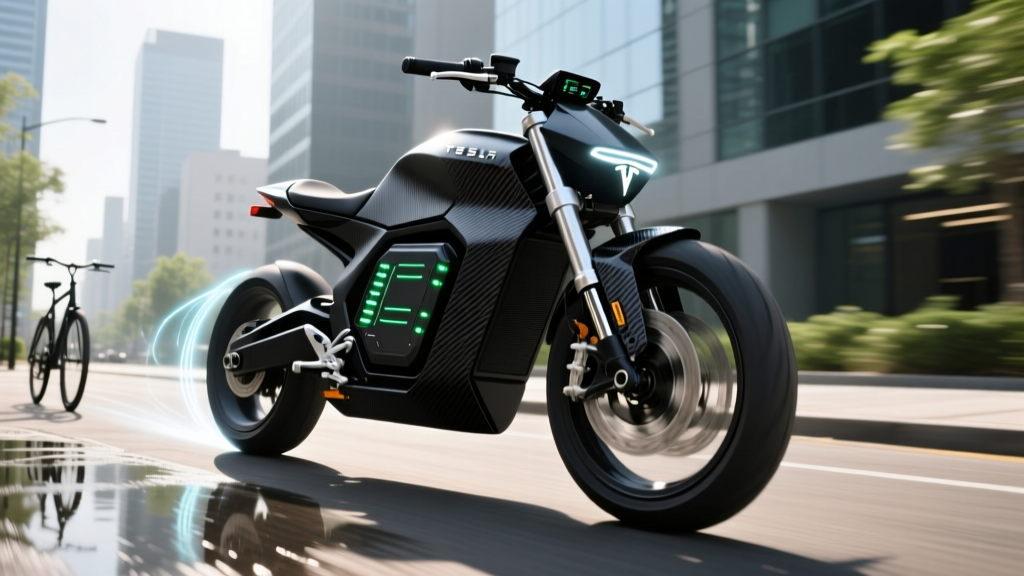
If you have spent any time in EV forums or scrolled through Tesla-focused social media in recent months, you have almost certainly encountered the term Tesla Unibike. It is one of the most searched, most debated, and least substantiated product rumors in the electric vehicle space. Search volumes are climbing, YouTube thumbnails are multiplying, and speculation about a Tesla-branded electric motorcycle — sometimes called the "Unibike," sometimes the "Tesla Model M," sometimes simply "Tesla's two-wheeler" — has taken on a life of its own.
Here at AutoEdgeView, our job is to separate engineering reality from internet fantasy. We have combed through Tesla's investor presentations, earnings calls, patent filings, and official press channels to bring you a comprehensive, data-grounded assessment of what the Tesla Unibikе actually is, what it is not, and what prospective buyers should understand before getting their hopes — or their wallets — too far ahead.
Where Did the "Tesla Unibike" Name Come From?
The "Unibike" moniker appears to have originated in online EV enthusiast communities around 2023-2024, possibly derived from the concept of a single-rider, unified-frame electric two-wheeler. It has no basis in any Tesla trademark filing, product roadmap, or official communication. Tesla's known product lineup — as reiterated in their official blog and recent Q4 2025 earnings materials — includes the Model S, Model 3, Model X, Model Y, Cybertruck, the next-generation Roadster (announced but still not in production), Semi, and the Optimus humanoid robot.
What does exist is a body of Tesla patents related to two-wheeled vehicle dynamics, battery packaging for narrow chassis configurations, and electric drivetrain miniaturization. Patent filings, however, are not product announcements. Major automakers file thousands of patents that never reach production. BMW, for instance, holds patents for electric unicycle concepts that have never seen a showroom floor.
What the Rumored Tesla Unibike Specs Look Like (Entirely Speculative)
Because no official specifications exist, the numbers circulating online vary wildly. Below is a composite of the most commonly cited rumored specifications, assembled from forum discussions, speculative renders, and YouTube analyses. None of these figures have been confirmed by Tesla.
| Specification | Rumored "Unibike" | Zero SR/S (2025) | LiveWire ONE (2025) | Damon HyperSport Premier |
|---|---|---|---|---|
| Status | Unconfirmed / Rumored | Available | Available | Limited production |
| Battery Capacity | 15-20 kWh (rumored) | 15.8 kWh (usable) | 15.4 kWh | 20 kWh |
| Claimed Range | 150-200 mi (unverified) | ~143 mi city / ~80 mi hwy (EPA) | ~146 mi city / ~95 mi hwy | ~200 mi (claimed) |
| Peak Power | 80-120 HP (rumored) | 110 HP | 105 HP | 200 HP |
| 0-60 mph | ~3.0 sec (rumored) | 3.0 sec | 3.0 sec | ~3.0 sec |
| DC Fast Charging | Unknown | Level 2 only (~1 hr full charge) | Level 2 + DC (~40 min to 80%) | DC fast (~30 min to 80%) |
| Price | Unknown / Speculative $15-25K | ~$19,995 | ~$21,999 | ~$25,000 |
This comparison illustrates an important point: even if Tesla were to enter the electric motorcycle market, they would face established competitors with years of real-world product development, dealer networks, and rider safety testing behind them. The electric motorcycle segment is small but growing, and the engineering challenges — particularly around battery packaging, center of gravity, and crash safety — are fundamentally different from four-wheeled vehicles.
Why Tesla Has Historically Avoided Motorcycles
Elon Musk has addressed the motorcycle question directly on multiple occasions. In a 2018 tweet and subsequent comments, Musk stated that Tesla would not produce a motorcycle, citing the disproportionate fatality risk of two-wheeled vehicles relative to cars. According to NHTSA data, motorcyclists are approximately 28 times more likely to die in a traffic crash per vehicle mile traveled compared to passenger car occupants. For a company that markets its vehicles heavily on safety — the Model Y and Model 3 have consistently earned IIHS Top Safety Pick+ ratings — this is a meaningful philosophical barrier.
Additionally, Tesla's core mission, as stated in its master plans, centers on accelerating the world's transition to sustainable energy through mass-market transportation. The company's strategic priority through 2025-2026 has been scaling Model Y production globally, launching the more affordable next-generation platform, ramping Cybertruck, and advancing FSD (Supervised) — its Level 2 driver-assistance system. Diverting engineering resources to a niche motorcycle product would run counter to these stated priorities.
The Patent Trail: What Tesla Has Actually Filed
What makes the Unibike rumor persistent is that Tesla has filed patents that touch on two-wheeled or narrow-vehicle concepts. These include:
- Battery module packaging patents describing slim, vertically stacked cell arrangements that could theoretically fit a motorcycle frame.
- Gyroscopic stabilization concepts for narrow vehicles, which could apply to a self-balancing two-wheeler or enclosed three-wheeler.
- Compact electric drivetrain designs with integrated motor and reduction gear units small enough for lightweight vehicle applications.
However, patent filings serve multiple strategic purposes beyond product development. Companies file patents defensively (to prevent competitors from claiming the IP), as exploratory research, or as components of broader platform strategies. Tesla's battery packaging patents, for instance, may be intended for energy storage products, robotics (Optimus), or compact urban vehicles rather than motorcycles.
What a Tesla Electric Motorcycle Would Need to Compete
If Tesla were to reverse course and enter the electric motorcycle market, here is a realistic framework of what the product would need to deliver to compete with existing options:
Decision Framework: What Would Make a Tesla Motorcycle Viable?
Choose to be excited IF:
- Tesla officially unveils a prototype at a shareholder event or product announcement
- The product achieves at least 150 miles of real-world highway range (the current benchmark set by Zero and LiveWire)
- DC fast charging is included — Level 2 only is a dealbreaker for touring riders
- Price undercuts the Zero SR/S ($19,995) significantly, leveraging Tesla's manufacturing scale
- Tesla's Supercharger network opens a motorcycle-compatible connector or adapter
Remain skeptical UNTIL:
- There is an official Tesla press release, trademark registration, or investor-day reveal
- EPA range certification data appears on fueleconomy.gov
- Pre-orders open on Tesla.com with confirmed delivery timelines
The Tax Credit Question: Would a Tesla Motorcycle Qualify?
This is where many speculative articles mislead readers. The federal EV tax credit under IRS §30D applies specifically to new qualified plug-in electric drive motor vehicles with four wheels and a gross vehicle weight rating (GVWR) of less than 14,000 pounds. Electric motorcycles are categorically excluded from the §30D credit as currently structured.
There is a separate, smaller credit — the §30D alternative motor vehicle credit — that has historically applied to two-wheeled plug-in vehicles, but it has been far smaller (typically 10% of the vehicle cost, capped at $2,500) and subject to different eligibility rules. As of 2026, buyers should consult the IRS clean vehicle credits page for current two-wheeler incentive status, as these provisions have changed multiple times under recent legislation.
The bottom line: even if the Tesla Unibike existed, do not plan your purchase around a $7,500 federal tax credit. That credit is structured for four-wheeled passenger vehicles and light trucks.
Real Electric Motorcycles You Can Actually Buy in 2026
If the Tesla Unibike discussion has you interested in electric two-wheelers, here are real products with real specifications that you can purchase today:
| Model | Battery (kWh) | Range (City/Hwy) | Power | 0-60 mph | Price |
|---|---|---|---|---|---|
| Zero SR/S | 15.8 kWh (usable) | 143 mi city / 80 mi hwy | 110 HP | 3.0 sec | $19,995 |
| LiveWire ONE | 15.4 kWh | 146 mi city / 95 mi hwy | 105 HP | 3.0 sec | $21,999 |
| Zero FXE | 6.3 kWh (usable) | 85 mi city / 50 mi hwy | 46 HP | ~5.0 sec | $11,795 |
| Energica Ego+ RS | 21.5 kWh | 160 mi city / 100 mi hwy | 169 HP | 2.6 sec | $27,990 |
Each of these motorcycles represents years of iterative development, real-world rider feedback, and established dealer service networks — infrastructure that Tesla would need to build from scratch for a two-wheeled product line.
Frequently Asked Questions
Is the Tesla Unibike real?
No. As of early 2026, Tesla has not announced, confirmed, or unveiled any electric motorcycle product. The "Unibike" name is a community-generated term with no official Tesla association. All specifications circulating online are speculative.
Has Elon Musk ever commented on Tesla making a motorcycle?
Yes. Musk has publicly stated that Tesla will not produce a motorcycle, primarily citing safety concerns. Motorcyclists face significantly higher fatality rates per mile traveled than car occupants, and this conflicts with Tesla's safety-first brand positioning.
Would a Tesla motorcycle qualify for the $7,500 federal EV tax credit?
No. The §30D clean vehicle credit applies to four-wheeled plug-in electric vehicles. Electric motorcycles are excluded. A smaller, separate two-wheeler credit has existed historically but is far less generous (up to $2,500) and subject to different rules. Check IRS.gov for current status.
What is the best electric motorcycle I can buy right now?
For sport-touring riders, the Zero SR/S and LiveWire ONE offer the best combination of range (~80-95 miles highway), performance (105-110 HP, 3.0-second 0-60), and charging infrastructure. For urban commuters on a budget, the Zero FXE at $11,795 provides practical city range in a lightweight package.
Could Tesla change its mind and build a motorcycle in the future?
Anything is possible, but it would represent a significant strategic pivot. Tesla's current priorities — scaling affordable vehicle production, advancing autonomous driving capabilities, and expanding energy storage — leave little room for a niche, safety-challenged product category. If Tesla ever does announce a motorcycle, we will update this article immediately with confirmed specifications and availability.
Does Tesla have any patents related to motorcycles?
Tesla holds patents related to compact battery packaging, narrow-vehicle dynamics, and small-form-factor electric drivetrains that could be applied to two-wheeled vehicles. However, patent filings are not product commitments and may serve defensive or exploratory purposes.