Quick Answer: Is an Electric Car Practical in Las Vegas?
Yes — Las Vegas is one of the best U.S. cities for EV ownership, provided you can install a Level 2 home charger. The dry desert climate eliminates cold-weather range loss (a major pain point elsewhere), and Nevada's average electricity rate of ~$0.14/kWh makes charging roughly 60–70% cheaper per mile than gasoline at current prices. Expect to spend $35,000–$55,000 on a mainstream EV before the federal §30D tax credit (up to $7,500 for eligible buyers and vehicles), $600–$1,500 on home charger installation, and $0.04–$0.06 per mile on electricity versus $0.14–$0.18 per mile on gas. The main caveats: summer cabin cooling can reduce range 5–10%, and apartment dwellers without home charging face a tougher ownership equation relying on public DC fast charging at $0.30–$0.48/kWh.
Why Las Vegas Is (and Isn't) an EV-Friendly City
Las Vegas offers a unique EV ownership environment. The metro area sprawls across the Mojave, with typical daily commutes of 20–40 miles and weekend trips to Red Rock Canyon, Lake Mead, or St. George. Most modern EVs with 250+ miles of EPA range handle this easily — even with air conditioning running hard in July.
The advantages are concrete:
- No cold-weather degradation: Unlike EV owners in Chicago or Denver, Las Vegas drivers rarely see temperatures below 40°F. Battery chemistry performs optimally between 60–80°F, meaning your EPA range estimate is more achievable year-round here than almost anywhere else.
- Cheap home electricity: NV Energy's residential rate sits around $0.14/kWh (2026 average), well below the national average of ~$0.17/kWh. Time-of-use plans can drop overnight rates to $0.07–$0.09/kWh.
- Short regional trips: A Las Vegas-to-St. George round trip is 240 miles — doable in most 2026 EVs without stopping, or with a single 15-minute DC fast charge.
- HOV lane access: Nevada's Clean Vehicle decals allow qualifying EVs to use HOV lanes on I-15 and US-95, a tangible commute benefit.
The drawbacks are real too:
- Summer heat tax: Sustained 110°F+ temperatures force the battery thermal management system and cabin AC to work overtime. Expect a 5–10% range hit in July–August versus the EPA sticker. An EPA-rated 310-mile EV might deliver 280–295 miles in peak summer.
- Long-distance gaps: Heading to Los Angeles (270 miles) or Phoenix (300 miles) requires at least one DC fast charge, and stretches of I-15 through the Mojave have limited charging infrastructure compared to urban corridors.
- Apartment charging challenges: If you live in a multi-unit building without dedicated EV parking, you'll rely on public chargers — which cost 3–5× more per kWh than home electricity.
EV vs. Gas Car in Las Vegas: The Real Cost Comparison
The purchase decision ultimately comes down to total cost of ownership. Below, we compare a popular 2026 EV (the Tesla Model Y Long Range AWD) against its closest gas-powered rival (the Toyota RAV4 AWD) over a 5-year, 60,000-mile ownership period in Las Vegas.
| Cost Category | 2026 Tesla Model Y LR AWD | 2026 Toyota RAV4 LE AWD |
|---|---|---|
| Base MSRP | $44,990 | $32,350 |
| Federal §30D Tax Credit | −$7,500 (if eligible) | $0 |
| Effective Purchase Price | $37,490 | $32,350 |
| Fuel / Electricity (60k mi) | $2,700 (home charging) | $6,300 (gas at $3.90/gal, 28 MPG) |
| Maintenance (5 years) | $1,200 | $3,500 |
| Insurance (5 years) | $9,500 | $7,000 |
| Estimated Depreciation | $14,000 | $11,500 |
| Total 5-Year Cost | $64,890 | $60,650 |
| Cost Per Mile | $1.08 | $1.01 |
Note: Federal §30D credit eligibility depends on buyer income caps ($150K single / $300K joint), vehicle MSRP caps ($55K SUVs), and battery critical-mineral sourcing rules. Verify current-year rules at IRS.gov. Insurance premiums for EVs run 15–30% higher on average due to repair costs and parts pricing.
The numbers show the EV costing roughly $70/mo more over five years when factoring in higher insurance and depreciation — but that gap narrows or disappears if you secure the full tax credit, qualify for Nevada's Clean Vehicle HOV decal, or drive more than 12,000 miles annually (which amplifies fuel savings). For higher-mileage commuters doing 20,000+ miles/year, the Model Y actually comes out ahead.
Charging in Las Vegas: Home, Public, and Road Trips
Charging access is the single biggest variable in EV satisfaction. Here's the Las Vegas landscape in 2026:
Home Level 2 Charging (The Gold Standard)
A 240V Level 2 home charger (typically 9.6–11.5 kW) is the backbone of hassle-free EV ownership. In Las Vegas, installation costs break down as follows:
| Item | Typical Cost Range |
|---|---|
| Level 2 charger hardware (48A, NACS or J1772) | $350–$700 |
| Electrician labor (240V/50A circuit run) | $600–$1,800 |
| Permit and inspection (Clark County) | $75–$200 |
| Electrical panel upgrade (if needed, 200A) | $1,500–$3,500 |
| Total (no panel upgrade) | $1,025–$2,700 |
| Total (with panel upgrade) | $2,525–$6,200 |
At 11.5 kW, a home Level 2 charger adds roughly 35–44 miles of range per hour of charging — enough to fully replenish any EV overnight. NV Energy's time-of-use plan can push overnight charging costs as low as $0.07–$0.09/kWh, making a full charge on an 80 kWh battery cost just $5.60–$7.20.
Public DC Fast Charging
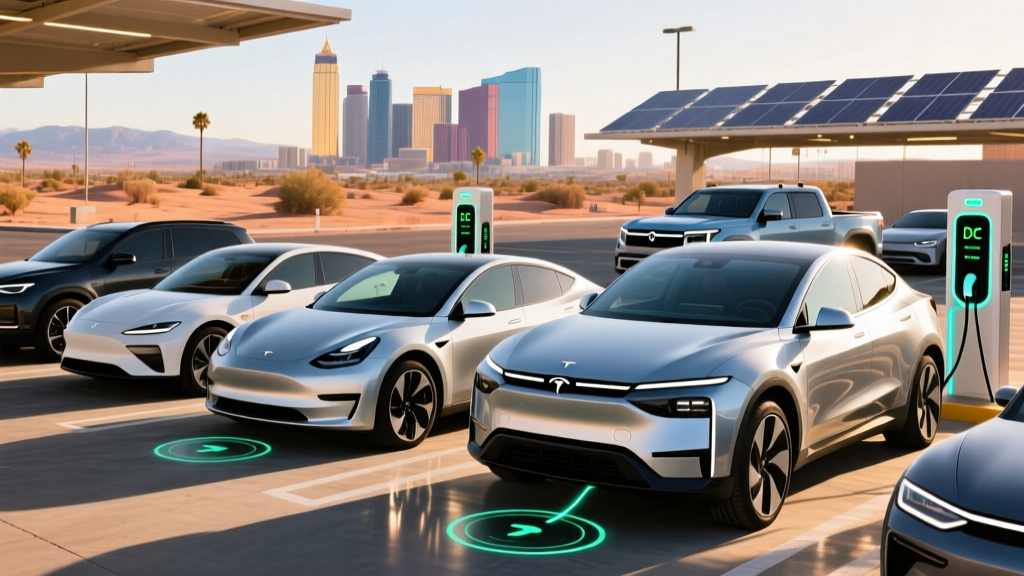
Las Vegas has a solid and growing DC fast charging network, anchored by Tesla Superchargers (now partially open to non-Tesla EVs via NACS adapters or built-in NACS ports), Electrify America stations, and ChargePoint/EVgo locations near major retail corridors.
| Level | Power (kW) | Miles Added/Hour | Typical Use |
|---|---|---|---|
| Level 1 (120V) | 1.2–1.9 kW | 3–5 mi/hr | Emergency/overnight trickle |
| Level 2 (240V) | 7.2–11.5 kW | 25–44 mi/hr | Home/workplace daily charging |
| DC Fast Charge | 50–350 kW | 150–800+ mi/hr | Road trips, quick top-ups |
Important distinction: kW (kilowatts) measures power — the rate at which energy flows into the battery. kWh (kilowatt-hours) measures energy — the total capacity of the battery. A 350 kW charger can theoretically deliver energy very fast, but real-world charging follows a curve: peak speed holds only between roughly 10–50% state of charge (SoC), then tapers significantly above 80% to protect battery health. A vehicle rated for "250 kW peak" might average 100–130 kW across a 10–80% session.
Public DC fast charging in Las Vegas typically costs $0.30–$0.48/kWh. A 10–80% charge on a 75 kWh usable battery (adding roughly 200 miles) costs $15–$27 at public rates — still cheaper than $35–$45 for equivalent gas, but 3–5× more expensive than home charging.
How Desert Heat Affects EV Batteries and Range
Las Vegas summers are the one environmental factor EV buyers should understand. Here's what actually happens:
Range impact: Extreme heat forces the vehicle's thermal management system to cool both the battery pack and the cabin. Unlike cold-weather range loss (which can reach 25–30% in freezing climates), summer heat in Vegas typically reduces range by 5–10%. A vehicle rated at 310 miles EPA might deliver 280–295 miles in July with AC running. Preconditioning the cabin while still plugged in at home (using grid power rather than battery) recovers some of this loss.
Battery longevity: Sustained high temperatures accelerate lithium-ion degradation over years, not weeks. Modern EVs (2022+) use sophisticated liquid-cooling systems that keep battery cells in their optimal 60–95°F range even when ambient temperatures hit 115°F. Battery warranties remain robust: most manufacturers guarantee 70–75% capacity retention over 8 years/100,000 miles. Tesla, Hyundai, and Kia back their packs for 8 years/100,000 miles; some offer 10 years/100,000 miles.
Practical tips for Vegas heat:
- Park in shade or a garage whenever possible — this is the single best thing you can do for battery health.
- Use scheduled preconditioning to cool the car while it's still plugged in at home.
- Avoid routinely charging to 100% in summer — set your daily charge limit to 80% and reserve 100% for road trips.
- Choose a vehicle with active liquid battery cooling (standard on nearly all 2026 BEVs from major manufacturers).
Federal Tax Credits and Nevada Incentives: What You Actually Get
The federal §30D clean vehicle credit offers up to $7,500 for new EV purchases, but eligibility involves several moving parts. As of 2026, the rules require:
- Buyer income cap: Modified AGI ≤ $150,000 (single) / $225,000 (head of household) / $300,000 (married filing jointly)
- Vehicle MSRP cap: ≤ $55,000 for sedans; ≤ $80,000 for SUVs, vans, and trucks
- Battery sourcing: Increasing percentages of critical minerals and battery components must be sourced from the U.S. or free-trade-agreement countries (requirements tighten annually through 2029)
- Point-of-sale transfer: You can transfer the credit to the dealer at purchase for an immediate price reduction, or claim it on your tax return
- Assembly: Vehicle must undergo final assembly in North America
Always verify current eligibility at IRS.gov and check the DOE's qualifying vehicle list before purchasing. Rules change annually, and specific trim/battery configurations may qualify while others do not.
Nevada does not currently offer a state-level EV purchase rebate (the previous Nevada Electric Highway infrastructure program focused on public charging buildout). However, Nevada's Clean Vehicle decal program allows qualifying EVs and PHEVs to access HOV lanes regardless of occupancy — a significant benefit for I-15 commuters. NV Energy also periodically offers rebates on Level 2 charger hardware and installation; check their current residential EV programs for availability.
Common Las Vegas EV Myths vs. Facts
| Myth | Fact (with data) |
|---|---|
| "The heat will destroy the battery" | Modern liquid-cooled packs maintain cell temps at 60–95°F even in 115°F ambient heat. Warranties guarantee ≥70% capacity at 8 yr/100k mi. Real-world degradation for liquid-cooled packs averages 8–12% over 5 years in hot climates. |
| "You can't road trip from Vegas" | LA (270 mi) is reachable with one 15-min DC fast stop at Barstow or Baker Superchargers. Phoenix (300 mi) requires one stop near Kingman. The I-15 corridor to Salt Lake City has chargers every 60–80 miles. |
| "EVs are more expensive to own" | Higher upfront cost is offset by $3,000–$4,000 fuel savings and $2,000+ maintenance savings over 5 years. The gap narrows further with the $7,500 tax credit. Total cost parity depends on mileage and credit eligibility. |
| "The grid can't handle EVs" | Most EVs charge overnight when grid demand is lowest. NV Energy's time-of-use rates incentivize off-peak charging. A single EV adds roughly $30–$50/month to a household electric bill — less than the gas it replaces. |
| "You'll be stranded without a charger" | Las Vegas has 50+ public DC fast-charging locations and growing. With home charging, 95%+ of driving never requires a public charger. Apps like PlugShare and A Better Routeplanner show real-time availability. |
Decision Framework: Should You Buy an EV in Las Vegas?
Buy a Battery EV (BEV) if:
- You can install a Level 2 charger at home (garage, carport, or dedicated outdoor space with 240V access)
- Your daily driving is under 80 miles round-trip (covers 90%+ of Vegas commutes)
- You qualify for the federal §30D tax credit (income and vehicle MSRP within caps)
- You want the lowest per-mile operating cost and minimal maintenance
- You're willing to plan a 15–20 minute DC fast charge on road trips to LA, Phoenix, or Utah
Buy a Plug-in Hybrid (PHEV) if:
- You live in an apartment without charging access and can't install a home charger
- You regularly drive 300+ miles into rural Nevada/Arizona/Utah where DC chargers are sparse
- You want electric-only commuting (25–45 miles) with gas-engine backup for road trips
- You want lower upfront cost and aren't ready to commit to full electric
Stick with a Gas Car or Hybrid (HEV) if:
- You have zero access to home or workplace charging and don't want to rely on public infrastructure
- Your budget is under $28,000 and you can't find a qualifying used EV
- You frequently tow heavy loads (trailers, boats) where EV range drops 30–50%
Frequently Asked Questions
How much will my NV Energy bill increase with an EV?
Driving 12,000 miles per year in an EV averaging 3.5 miles/kWh requires roughly 3,430 kWh annually. At NV Energy's residential rate of ~$0.14/kWh, that adds approximately $480/year ($40/month) to your electric bill. With a time-of-use plan and overnight charging at $0.08/kWh, the cost drops to ~$275/year ($23/month). For comparison, fueling a 28 MPG gas car for 12,000 miles at $3.90/gallon costs about $1,670/year.
Do I need to upgrade my electrical panel for a home charger?
Maybe. Most modern homes with a 200-amp electrical panel can support a 50-amp/240V EV circuit without an upgrade. Older homes with 100-amp or 150-amp panels may need a panel upgrade ($1,500–$3,500 in Las Vegas) if the existing load is already near capacity. A licensed electrician can perform a load calculation to determine this — get a quote before committing to a charger purchase.
Which EVs make the most sense for Las Vegas in 2026?
Top contenders include the Tesla Model Y Long Range (320 mi EPA, ~$44,990, NACS native), Hyundai Ioniq 5 (318 mi EPA, ~$47,500, NACS-equipped for 2026), Chevrolet Equinox EV (319 mi EPA, ~$33,000 base), and Ford Mustang Mach-E (320 mi EPA, ~$42,995). All have liquid-cooled batteries, DC fast charging at 150+ kW, and qualify for at least partial §30D credits depending on trim and buyer eligibility. For budget buyers, the base Equinox EV at ~$33K is the value leader.
Is it safe to charge an EV in 115°F Las Vegas heat?
Yes. EV battery management systems actively cool the pack during charging, even in extreme heat. You may notice the vehicle's cooling fans running loudly during a DC fast charge in summer — this is normal and protective. Charging speeds may be slightly reduced in extreme heat (the system prioritizes battery health over speed), but there is no safety risk.
What about EV insurance costs in Nevada?
EV insurance premiums in Nevada typically run 15–30% higher than equivalent gas vehicles due to higher repair costs, specialized parts, and elevated vehicle values. Average annual premiums for a Tesla Model Y in Las Vegas run $1,800–$2,200, compared to $1,300–$1,600 for a Toyota RAV4. Shop quotes from multiple insurers — some (like Geico, Progressive, and Tesla Insurance) offer competitive EV-specific rates. Factor this into your total cost of ownership calculation.
Can I use Tesla Superchargers with a non-Tesla EV in Las Vegas?
Yes, partially. Tesla has opened select Supercharger locations to non-Tesla EVs equipped with NACS charge ports (standard on 2025+ Ford, GM, Rivian, Hyundai/Kia, and others) or using a J1772-to-NACS adapter. Availability varies by station — check the Tesla app or your vehicle's built-in navigation for real-time access. As of 2026, most new EVs ship with NACS ports natively, making Supercharger access increasingly universal.