The Short Answer on Electric Car Brake Systems
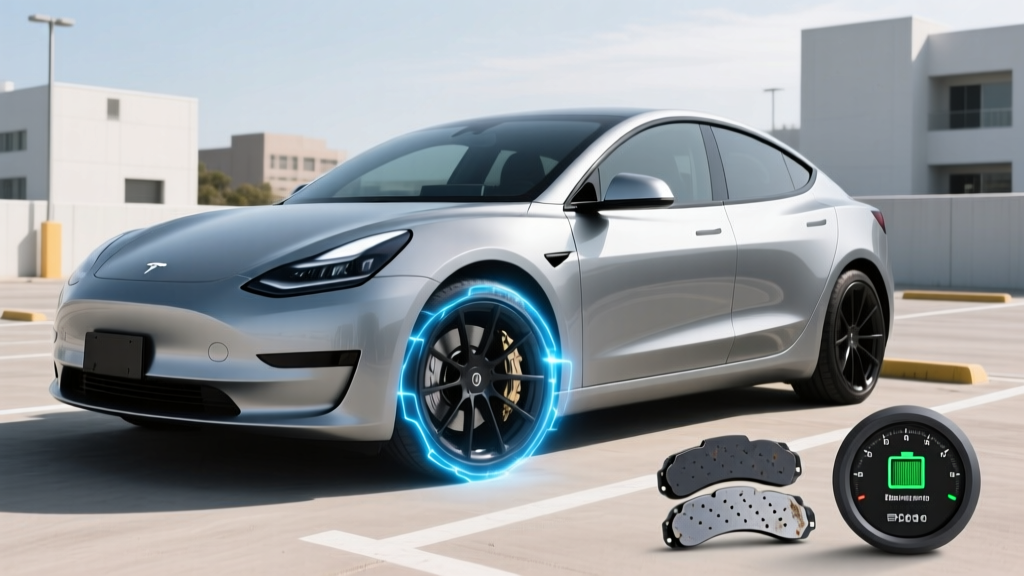
An electric car brake system combines traditional hydraulic friction brakes with regenerative braking — a process where the electric motor reverses direction to slow the vehicle and recapture energy back into the battery. Because regenerative braking handles most daily deceleration, EV brake pads and rotors experience dramatically less wear than gas-car equivalents. Most EV owners report original brake pads lasting 100,000 to 150,000+ miles, compared to 30,000–70,000 miles for typical ICE vehicles. The result: significantly lower lifetime brake maintenance costs, though EVs still require periodic brake fluid flushes and occasional rotor inspection to prevent corrosion from underuse.
How Regenerative Braking Changes Everything
In a conventional gas car, pressing the brake pedal clamps friction pads against spinning rotors, converting kinetic energy into waste heat. That energy is gone forever, and the pads wear down with every stop.
An electric vehicle flips this process. When you lift off the accelerator or press the brake pedal lightly, the electric motor switches from drive mode to generator mode. The motor's electromagnetic resistance slows the vehicle while simultaneously pushing current back into the battery pack. This is regenerative braking — and it recovers energy that a gas car simply wastes.
Most modern EVs allow you to adjust regen intensity. A Tesla Model Y, for example, offers standard regen that provides strong deceleration when you lift the throttle, enabling what's called one-pedal driving in many scenarios. The Hyundai Ioniq 5 lets you select among multiple regen levels via steering-wheel paddles, from coasting (level 0) to near-full one-pedal capability (level 3 or i-PEDAL mode).
The friction brakes in an EV — typically single-piston floating calipers with ventilated front rotors and solid rear rotors — remain fully functional and are required by federal safety standards. They engage automatically during hard emergency stops, when the battery is fully charged (and can't accept more energy), or in extreme cold when battery acceptance rates are limited. But in normal daily driving, regen does the heavy lifting.
Brake Pad and Rotor Lifespan: EV vs. Gas Car
The maintenance difference between EV and gas-car brake systems is one of the most concrete ownership advantages. Here's what real-world data and manufacturer guidance show:
| Component | Typical Gas Car | Typical EV (BEV) |
|---|---|---|
| Brake pad lifespan | 30,000–70,000 mi | 100,000–150,000+ mi |
| Rotor lifespan | 50,000–100,000 mi (often resurfaced once) | 100,000–200,000+ mi (but watch for corrosion) |
| Brake fluid flush interval | Every 2–3 years / 30,000 mi | Every 2–3 years (hygroscopic — same requirement) |
| Average pad replacement cost (axle) | $200–$400 | $200–$400 (same hardware, far less frequent) |
| Estimated 10-year brake maintenance cost | $800–$2,000+ | $150–$500 (fluid flushes primarily) |
Tesla's maintenance documentation has noted that brake pads on the Model 3 and Model Y may never need replacement during typical ownership. Chevrolet reported similar findings with the Bolt EV and Bolt EUV, with owners commonly exceeding 100,000 miles on original pads. Ford's Mustang Mach-E and Hyundai's Ioniq 5 follow the same pattern.
The catch — and this is where real-world ownership nuance matters — is rotor corrosion. Because the friction brakes are used so infrequently, rotors can develop surface rust that, left unchecked, leads to pitting and uneven wear. Many EV owner's manuals (Tesla, Hyundai, Kia) recommend periodically applying the friction brakes deliberately — for example, a few firm stops from 50 mph in safe conditions once a month — to scrub rotors clean. Some newer EVs, including models from BMW and Mercedes-Benz with advanced brake-by-wire systems, automatically apply light friction-brake engagement to prevent corrosion buildup.
The Real Cost Picture: Brake Savings in Context
Brake maintenance is just one line item in total EV ownership cost. Here's how brake savings fit into the broader picture over a 5-year, 75,000-mile ownership period, comparing a 2026 Tesla Model Y Long Range ($44,990 MSRP, EPA-estimated 320 miles range, 117 MPGe combined per fueleconomy.gov) against a comparably priced gas crossover like the Toyota RAV4 XLE ($31,995 MSRP, 30 MPG combined).
| Cost Category (5 yr / 75k mi) | Tesla Model Y LR (AWD) | Toyota RAV4 XLE (AWD) |
|---|---|---|
| Fuel / electricity | ~$3,150 (home charging, $0.14/kWh avg) | ~$8,750 (gas, $3.50/gal avg) |
| Brake pad replacement | $0 (original pads likely last) | $350–$700 (1–2 axle services) |
| Brake fluid flush | $150–$300 (2 services) | $150–$300 (2 services) |
| Oil changes | $0 | $375–$750 (5–10 changes) |
| Tire rotation / replacement | $1,200–$2,000 (heavier vehicle, instant torque) | $800–$1,400 |
| Insurance (avg) | $10,500–$14,000 (higher premiums typical) | $7,500–$10,000 |
| Federal tax credit (§30D) | Up to $7,500 (eligibility varies — see IRS §30D rules) | $0 |
The brake savings alone — roughly $350 to $700 over five years — are meaningful but not transformative on their own. Combined with fuel savings (~$5,600) and eliminated oil changes (~$500), the powertrain maintenance and energy advantage totals around $6,500 over five years. However, higher insurance premiums (often $500–$1,000+ more annually for EVs) and potentially faster tire wear partially offset those gains.
The point isn't that EVs are free to own. It's that the composition of costs shifts: less routine maintenance, higher insurance, cheaper fueling, and more expensive tires. Brake system longevity is one of the most reliable and predictable savings in that equation.
Common Misconceptions About EV Brakes
| Myth | Fact |
|---|---|
| "EVs don't have real brakes — regen does everything." | Every EV sold in the US has full hydraulic friction brakes meeting FMVSS standards. They engage for hard stops, low-battery scenarios, and when regen is limited (cold battery, full charge). |
| "You'll never need brake service on an EV." | Brake fluid is hygroscopic and must be flushed every 2–3 years regardless of pad wear. Rotors need inspection for corrosion. Calipers can seize from disuse. |
| "Regen braking makes EVs unsafe in emergencies." | Friction brakes provide full stopping power. EVs routinely earn top NHTSA 5-star and IIHS Top Safety Pick ratings. Regen supplements — never replaces — the primary brake system. |
| "EV brake repairs cost more because the system is complex." | The hardware (pads, rotors, calipers) is conventional and costs the same per axle. The savings come from dramatically reduced replacement frequency. |
| "Heavier EVs wear out brakes faster." | Despite weighing 500–1,000 lbs more than comparable gas cars, EVs experience less brake wear because regen handles most deceleration. Weight matters less when friction brakes are rarely applied. |
What First-Time EV Buyers Should Know About Brakes
If you're transitioning from a gas car, the brake feel in an EV takes some adaptation. Here's what to expect and how to optimize your experience:
Blended braking feel. Most EVs use a brake-by-wire or blended braking system. When you press the pedal, the car first increases regenerative deceleration. Only when you press harder do the friction pads engage. This transition can feel slightly different from a conventional brake pedal — some drivers describe it as initially "spongy" or "numb" until they learn the pedal's progression. Models from BMW (i4, iX) and Mercedes (EQE, EQS) with advanced brake-by-wire systems have largely smoothed this transition, while some earlier or budget EVs still show a noticeable handoff.
One-pedal driving changes your habits. In max-regen mode, lifting the accelerator provides enough deceleration for most city and suburban driving — you may rarely touch the brake pedal in stop-and-go traffic. This reduces fatigue and, according to many owners, makes driving feel more intuitive after a brief adjustment period. However, you should always keep your foot ready to move to the brake pedal for emergency situations.
Cold weather affects regen. In freezing temperatures, a cold battery cannot accept charge as quickly, which means regenerative braking may be reduced or temporarily unavailable until the battery warms up. Tesla, Hyundai, and other manufacturers precondition the battery when you set a navigation destination to a charger, but on a cold morning commute with no preconditioning, expect the friction brakes to do more work than usual. This is normal and the system handles it automatically.
Plan for rotor maintenance. Ask your service technician to inspect rotors for surface corrosion at every tire rotation (typically every 6,000–8,000 miles). If you live in a region that uses road salt — the Midwest, Northeast, or mountain states — this is especially important. A quick monthly hard-brake application from 50–60 mph in safe, dry conditions keeps rotors clean.
Decision Framework: Does EV Brake Ownership Work for You?
Choose an EV and enjoy minimal brake maintenance if:
- You do mostly city or suburban driving where regenerative braking is most effective (frequent stops and starts maximize energy recapture and minimize friction-brake use).
- You're comfortable adapting to one-pedal driving and blended brake-pedal feel over a 1–2 week adjustment period.
- You have access to a service center familiar with EV-specific brake inspection (rotor corrosion checks, caliper lubrication).
- You want to reduce lifetime maintenance costs and are willing to perform occasional deliberate friction-brake applications to prevent rotor corrosion.
Prioritize friction-brake awareness if:
- You live in extreme cold climates (below 0°F regularly) where regen reduction is frequent and friction brakes do more work — rotor wear may be slightly higher.
- You tow regularly with your EV (towing loads increase kinetic energy and may push friction brakes into more frequent use).
- You drive primarily on highways with minimal stopping — regen has fewer opportunities to operate, and corrosion risk on rotors is higher.
- You prefer traditional, linear brake-pedal feel and find blended braking disconcerting — test-drive multiple EVs, as brake feel varies significantly by manufacturer.
Brake System Specifications Across Popular 2026 EVs
Brake hardware varies by vehicle weight and performance tier. Heavier and more powerful EVs generally use larger rotors and, in some cases, upgraded calipers. Here's a look at current popular models:
| Vehicle (2026 MY) | Curb Weight | Front Rotor Size | Regen Levels | EPA Range | Base MSRP |
|---|---|---|---|---|---|
| Tesla Model Y LR AWD | ~4,398 lbs | 325 mm ventilated | Standard / Low | 320 mi | $44,990 |
| Hyundai Ioniq 5 SEL AWD | ~4,530 lbs | 325 mm ventilated | 0–3 + i-PEDAL | 290 mi (AWD) | $46,750 |
| Ford Mustang Mach-E Premium AWD | ~4,735 lbs | 345 mm ventilated | Whisper / Engaged | 290 mi | $48,995 |
| Chevrolet Equinox EV 3RS AWD | ~4,800 lbs | 325 mm ventilated | On / Off (one-pedal) | 285 mi | $43,400 |
| BMW i4 xDrive40 | ~4,870 lbs | 348 mm ventilated | Adaptive / High / Low | 287 mi | $57,900 |
Note that curb weights reflect the additional mass of battery packs (typically 800–1,200 lbs of the total). Despite this weight, the brake rotors on most EVs are comparable in size to those on similarly sized gas cars — because regenerative braking means the friction system is rarely stressed to its thermal limits. Performance variants (Tesla Model Y Performance, BMW i4 M50) use larger rotors and upgraded calipers to handle track-capable speeds, but these are exceptions.
Frequently Asked Questions
Do electric cars have brake pads?
Yes. Every EV sold in the United States has a complete hydraulic friction brake system with pads, rotors, calipers, and brake fluid — identical in principle to a gas car. The friction brakes are required by federal motor vehicle safety standards (FMVSS) and are essential for emergency stopping, low-battery situations, and when regenerative braking is limited. The difference is frequency of use: because regen handles most deceleration, EV brake pads last dramatically longer.
How often do EV brakes need to be replaced?
Brake pads on most EVs last 100,000–150,000 miles or more under normal driving conditions. Many original owners never replace pads during their ownership. However, brake fluid should be flushed every 2–3 years (it absorbs moisture over time regardless of vehicle type), and rotors should be inspected annually for surface corrosion — especially in regions with road salt or high humidity.
Can regenerative braking stop an EV completely?
In most EVs with strong regen settings (such as Tesla's Standard mode or Hyundai's i-PEDAL), regenerative braking can slow the vehicle to a near-stop or complete stop without touching the brake pedal. However, the friction brakes are always available and will engage instantly if you press the brake pedal or if the system detects an emergency. Regen supplements friction brakes — it never replaces them.
Do EVs have higher brake repair costs because of their weight?
No. While EVs are heavier than comparable gas cars (adding 500–1,000 lbs from the battery pack), the reduced use of friction brakes more than compensates for the additional mass. The brake hardware itself costs the same to replace — a standard pad-and-rotor job runs $200–$400 per axle at most shops. The savings come from needing that service far less often.
Does regenerative braking extend EV range?
Yes, but the impact varies by driving pattern. In stop-and-go city traffic, regen can recapture 15–25% of the energy that would otherwise be lost to braking, according to various manufacturer estimates. On highway drives with minimal braking, the benefit is negligible. This is why EVs often achieve better efficiency in city driving than on highways — the opposite of gas cars. Check fueleconomy.gov for city vs. highway MPGe breakdowns on specific models.
What happens to EV brakes in cold weather?
In temperatures below freezing, a cold battery cannot accept charge quickly, which limits regenerative braking capacity. During the first several miles of a cold-weather drive, you may notice reduced regen and greater reliance on friction brakes. As the battery warms through use (or through preconditioning if you've set a departure time or navigation destination), regen returns to normal strength. This is managed automatically by the vehicle's thermal management system.