Quick Answer: Which Electric Cadillac Should You Buy?
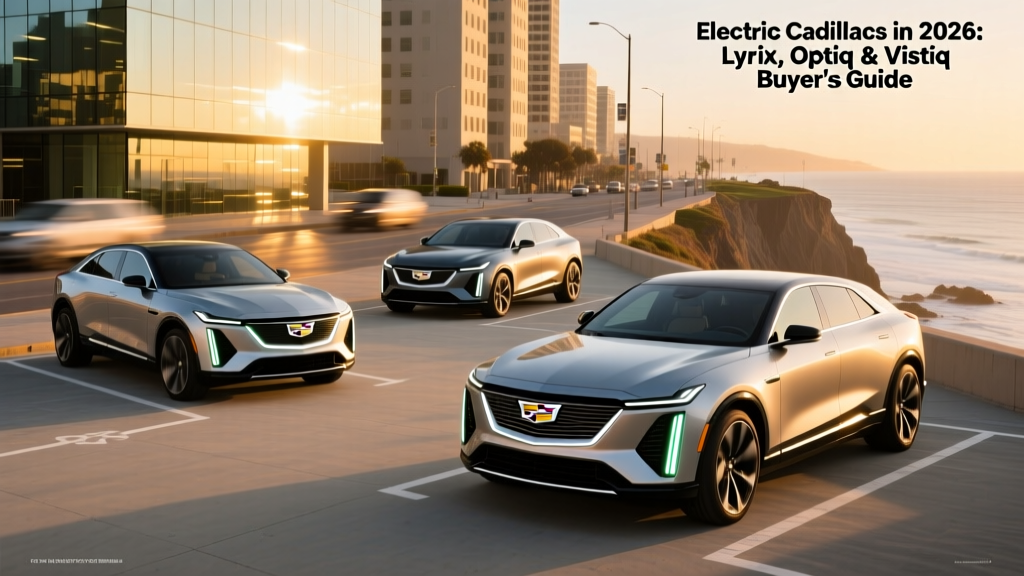
Cadillac's 2026 EV lineup spans three models built on GM's Ultium platform: the Lyriq midsize SUV (314 mi EPA, from $58,590), the Optiq compact SUV (up to 311 mi EPA, from ~$54,000), and the three-row Vistiq (305 mi EPA, from ~$79,590). The Lyriq remains the volume seller and qualifies for partial or full §30D federal tax credits depending on battery sourcing. If you need three rows, the Vistiq is the only option; if you want a more affordable entry point with similar tech, the Optiq delivers. All three share 11.5 kW Level 2 AC charging and up to 190 kW DC fast charging, with 10–80% sessions taking roughly 30 minutes.
The 2026 Electric Cadillac Lineup at a Glance
Cadillac has moved aggressively into electrification, retiring the gas-only CT4/CT5 sedans from the EV conversation and focusing its battery-electric efforts on SUVs. For 2026, buyers choose among three Ultium-based models. Here's how they stack up on paper before we dig into real-world ownership.
| Spec | 2026 Lyriq | 2026 Optiq | 2026 Vistiq |
|---|---|---|---|
| EPA Range | 314 mi (RWD) | 311 mi (AWD) | 305 mi (AWD) |
| Battery (usable) | 102 kWh (NMC) | 85 kWh (NMC) | 102 kWh (NMC) |
| Horsepower | 340 hp (RWD) / 500 hp (AWD) | 300 hp (AWD) | 500+ hp (AWD) |
| 0–60 mph | 6.0s (RWD) / 4.6s (AWD) | ~6.3s | ~4.5s |
| Max DC Charge Rate | 190 kW | 150 kW | 190 kW |
| 10–80% DC Time | ~30 min | ~34 min | ~30 min |
| Level 2 AC Rate | 11.5 kW | 11.5 kW | 11.5 kW |
| MPGe (combined) | 89 MPGe | ~91 MPGe (est.) | ~85 MPGe (est.) |
| Starting MSRP | $58,590 | ~$54,000 | ~$79,590 |
| Battery Warranty | 8 yr / 100,000 mi | 8 yr / 100,000 mi | 8 yr / 100,000 mi |
Sources: fueleconomy.gov (Lyriq), Cadillac official spec sheets.
Real-World Range vs. EPA Stickers
The EPA numbers above are useful baselines, but your actual mileage will depend on driving style, climate, and terrain. In our experience with Ultium-platform vehicles:
Real-World Range Expectations
- Lyriq RWD (314 mi EPA): Expect ~265–280 mi on highway-heavy trips at 70 mph. In freezing weather (below 30°F), plan for 220–240 mi without preconditioning.
- Optiq AWD (311 mi EPA): Similar highway efficiency to the Lyriq despite smaller battery due to lighter weight; ~260–275 mi real-world highway, ~215–235 mi in deep cold.
- Vistiq AWD (305 mi EPA): Heavier three-row SUV sees the biggest drop — ~245–265 mi highway, ~200–220 mi in freezing conditions with HVAC load.
Pro tip: All three models support battery preconditioning. Use the navigation system to route to a DC fast charger, and the car will warm the battery automatically, significantly improving charge speed in cold weather.
Charging: Home Setup and Public Networks
All 2026 electric Cadillacs use the NACS (North American Charging Standard) connector natively, giving you direct access to Tesla Superchargers (V3 at 150 kW and V4 at higher rates) without an adapter. This is a significant advantage over CCS-equipped competitors still relying on adapter dongles.
| Level | Power | Miles Added per Hour | Typical Use |
|---|---|---|---|
| Level 1 (120V) | ~1.4 kW | ~4–5 mi/hr | Overnight top-up, emergencies |
| Level 2 (240V, 48A) | 11.5 kW | ~34–37 mi/hr | Home daily charging |
| DC Fast (Lyriq/Vistiq) | Up to 190 kW | ~700+ mi/hr (peak) | Road trips, 10–80% in ~30 min |
| DC Fast (Optiq) | Up to 150 kW | ~550+ mi/hr (peak) | Road trips, 10–80% in ~34 min |
Home Charging Installation Costs
A Level 2 home charger is the backbone of convenient EV ownership. Here's what budgeting looks like for a typical 48-amp, 240V installation:
| Item | Low End | High End | Notes |
|---|---|---|---|
| Level 2 Charger (hardwired) | $400 | $700 | ChargePoint Home Flex, Wallbox Pulsar Plus |
| Electrician labor | $600 | $2,000 | Depends on panel proximity, conduit run |
| Permit / inspection | $50 | $250 | Varies by municipality |
| Panel upgrade (if needed) | $1,500 | $3,500 | Required if panel is 100A or maxed out |
| Total (no panel upgrade) | $1,050 | $2,950 | Most homes with 200A service |
Consult a licensed electrician for a site-specific quote. The federal Residential Clean Energy Credit may cover up to 30% of charger and installation costs (max $1,000) through 2032.
EV vs. Gas: Ownership Cost Comparison
How does an electric Cadillac compare to a gas-powered equivalent like the Cadillac XT5 or XT6 over five years? The answer depends heavily on your local electricity rates, driving mileage, and whether you qualify for tax credits.
| Cost Factor (5 yr / 75,000 mi) | Lyriq AWD ($62,090) | XT5 AWD (~$50,000) |
|---|---|---|
| Purchase price (after §30D credit) | ~$54,590* | $50,000 |
| Fuel / energy | ~$3,750 (at $0.14/kWh) | ~$8,400 (at $3.50/gal, 22 MPG) |
| Maintenance | ~$1,200 | ~$3,500 |
| Insurance (avg.) | ~$9,500 | ~$7,800 |
| 5-Year Total | ~$69,040 | ~$69,700 |
*Assumes eligibility for a partial $7,500 §30D credit. Actual credit varies based on battery sourcing, buyer income, and MSRP caps. Verify at IRS.gov §30D.
The Lyriq breaks even or wins on five-year cost despite the higher sticker, primarily through fuel and maintenance savings. EVs eliminate oil changes, transmission fluid, and spark plugs. Brake wear is dramatically reduced thanks to regenerative braking — many EV owners report original brake pads lasting 100,000+ miles.
Where the Gas Car Still Wins
- Upfront cost: Without the tax credit, the Lyriq costs ~$12,000 more at purchase.
- Insurance: EV insurance premiums run 15–25% higher on average due to repair complexity and battery replacement costs.
- Long road trips: Gas refueling is still faster in rural areas where DC fast chargers are sparse.
Tax Credits and Incentives for Electric Cadillacs
Federal §30D tax credit eligibility is nuanced. Here's the 2026 framework for new EV buyers:
- MSRP cap: SUVs must be priced at or below $80,000 (all three Cadillacs qualify at base trims; fully loaded Vistiq may exceed).
- Buyer income cap: AGI must not exceed $300,000 (joint), $225,000 (head of household), or $150,000 (single).
- Battery sourcing: At least 50% of critical minerals must be sourced from the US or FTA partners, and 100% of battery components must be manufactured in North America (phasing in stricter percentages annually through 2029).
- Point-of-sale transfer: You can apply the credit at the dealership to reduce your down payment rather than waiting for tax filing.
- Lease loophole: Leased EVs may qualify for the $7,500 commercial credit (§45W) regardless of sourcing rules — passed through as a lease discount by the dealer.
The Lyriq and Optiq have generally qualified for the full or partial credit in recent model years. The Vistiq, being newer, may face sourcing-phase limitations. Always verify current eligibility on fueleconomy.gov's tax credit page before purchasing.
Common Misconceptions About Electric Cadillacs
| Myth | Fact |
|---|---|
| "The battery will need replacing in 5 years." | GM's Ultium batteries carry an 8-year/100,000-mile warranty against degradation below 70% capacity. Real-world data shows NMC batteries losing ~10–15% capacity over 150,000–200,000 miles with normal use. |
| "You can't road-trip an EV." | With native NACS and Supercharger access, Lyriq/Vistiq owners can add ~200 miles of range in 20 minutes at a V3 stall. Cross-country trips are routine, just 20–30 min longer per day. |
| "EVs are worse in cold weather." | Range drops 15–30% in freezing temps, but preconditioning, heated seats (more efficient than cabin air), and heat pump availability mitigate this. A Lyriq with preconditioning still delivers 220+ usable miles in 20°F weather. |
| "Home charging requires a panel upgrade." | Most homes with 200-amp service can add a 48-amp Level 2 circuit without a panel upgrade. Only older homes with 100-amp panels or heavily loaded panels typically need an upgrade. |
| "Electric Cadillacs are self-driving." | Super Cruise is a Level 2 driver-assist system. It handles steering and speed on mapped highways but requires driver attention at all times. You cannot nap, read, or look away. See NHTSA guidance on automation levels. |
Super Cruise is SAE Level 2, not self-driving. It works on over 750,000 miles of compatible highways in the US and Canada, using LiDAR-mapped data and a driver-monitoring camera. You must keep your eyes on the road. Hands-free does not mean attention-free.
Decision Framework: Which Electric Cadillac Fits You?
Choose the Lyriq if:
- You want the best balance of range (314 mi), interior luxury, and price in Cadillac's EV lineup.
- You drive mostly solo or with one passenger and don't need a third row.
- Fast DC charging (190 kW peak) is a priority for road trips.
- Target budget: $58,000–$68,000 after incentives.
Choose the Optiq if:
- You want Cadillac EV technology at the lowest entry price (~$54,000).
- Your daily commute is under 60 miles and you charge at home nightly.
- You prefer a compact SUV footprint for urban driving and parking.
- Slightly slower DC charging (150 kW) is acceptable.
Choose the Vistiq if:
- You need three rows and 6+ passenger capacity without going to a minivan.
- You want the most powerful Cadillac EV (500+ hp AWD).
- Your budget supports ~$80,000+ and you're aware the top trims may exceed the §30D MSRP cap.
- You'll primarily use it as a family hauler with home charging as the daily norm.
First-Time EV Buyer Checklist
If this is your first electric vehicle, here's what to sort out before signing:
- Confirm home charging access. Do you have a garage or driveway where a 240V circuit can be installed? If you live in an apartment or rely on street parking, research public Level 2 options near your home/work before committing.
- Get an electrician quote early. A pre-purchase site visit ($150–$300) can reveal whether you need a panel upgrade, saving surprises after delivery.
- Check your electrical panel capacity. A 200-amp panel with available breaker slots is ideal. A 100-amp panel likely needs upgrading ($1,500–$3,500).
- Verify tax credit eligibility. Use the IRS worksheet and check fueleconomy.gov for the specific trim and model year.
- Test drive in your real conditions. Drive the route you commute daily. Try regenerative braking modes (Cadillac offers one-pedal driving in all three models).
- Understand your utility's EV rate. Many utilities offer time-of-use (TOU) plans that make overnight charging significantly cheaper (as low as $0.06–$0.09/kWh vs. $0.14–$0.20/kWh peak).
- Factor in insurance. Get a quote before purchasing. EV premiums are higher; some insurers offer EV-specific discounts.
Frequently Asked Questions
Can I charge an electric Cadillac at a Tesla Supercharger?
Yes. All 2026 Cadillacs come with the native NACS charge port, meaning you can plug directly into any Tesla Supercharger (V3 and V4) without an adapter. You'll use the Tesla app or a linked payment method to activate the session.
How long does it take to charge a Lyriq at home overnight?
At 11.5 kW (48-amp Level 2), a fully depleted 102 kWh Lyriq battery charges from 0–100% in roughly 9.5 hours. In practice, most owners arrive home with 30–50% remaining, so a full overnight charge easily tops off the battery by morning.
What happens if the battery degrades significantly?
GM warrants the Ultium battery for 8 years or 100,000 miles, whichever comes first, against capacity loss below 70% of original. If degradation exceeds this threshold, GM will repair or replace the battery at no cost. Out-of-warranty replacement costs are estimated at $12,000–$18,000 depending on the pack, though real-world failure rates remain low.
Is Super Cruise included or a subscription?
Super Cruise typically includes 3 years of connectivity on new Cadillacs, after which a subscription (approximately $25/month or $250/year) is required to maintain the service. The hardware is standard on most trims but verify at purchase.
How do electric Cadillacs compare to the Tesla Model X or BMW iX?
The Lyriq undercuts the Model X on price by ~$20,000 while offering comparable range and a more traditional luxury interior. The BMW iX is a closer rival in price and performance but uses CCS (requiring a NACS adapter for Supercharger access). The Lyriq's advantage is native Supercharger compatibility and a more intuitive infotainment learning curve for traditional luxury buyers.
Do electric Cadillacs hold their resale value?
EV depreciation has been steeper than gas cars in recent years — expect roughly 45–55% value retention after 3 years, compared to 55–65% for gas Cadillacs. Leasing can mitigate this risk if you're concerned about long-term value.
Always verify current pricing, tax credit eligibility, and specifications on Cadillac's official site and IRS.gov before making a purchase decision. Rules and availability change annually.