If you've been hunting for a three-row electric SUV that can embarrass sports cars at stoplights, the used Tesla Model X P100D keeps showing up in search results. With a factory-claimed 0-60 mph time of 2.9 seconds thanks to Ludicrous Mode, the P100D remains one of the quickest production SUVs ever built. But this is a vehicle that stopped rolling off the Fremont line years ago — Tesla replaced the P100D badge with the Plaid designation for the 2021 refresh. So in 2026, every P100D you'll find is a used model, most with 60,000 to 120,000 miles on the odometer.
This review breaks down the numbers that actually matter for a used P100D buyer: real-world range versus the EPA sticker, DC fast-charging reality on older Superchargers, battery degradation expectations, and whether the federal used-EV tax credit can apply. Let's get into the specs.
Tesla Model X P100D: Core Specifications at a Glance
| Specification | Value |
|---|---|
| EPA Estimated Range | 289 miles (2017–2018); 305 miles (2019–2020 with Raven powertrain) |
| Usable Battery Capacity | ~100 kWh (NMC lithium-ion) |
| 0-60 mph (Ludicrous Mode) | 2.9 seconds (with rollout subtracted); ~3.2 sec without rollout |
| Horsepower | ~762 hp (combined dual-motor output, peak with battery preconditioned) |
| Drivetrain | Dual-motor AWD (front + rear permanent-magnet / induction motors depending on year) |
| MPGe (Combined) | 83–89 MPGe depending on model year |
| Energy Consumption | ~38–40 kWh/100 mi |
| Max DC Fast Charge Rate | ~120 kW peak (V2 Supercharger limited) |
| Level 2 Charge Rate | 11.5 kW (48A) onboard charger; ~30–34 mi/hr |
| Cargo Volume (behind 3rd row / 2nd row folded) | 25.7 / 88.1 cu ft |
| Seating | 5, 6, or 7 passengers depending on config |
| Battery Warranty (original) | 8 years / 150,000 miles (70% retention minimum) |
| Towing Capacity | 5,000 lbs (when equipped with tow package) |
Real-World Range: What to Actually Expect
Real-World Highway (70–75 mph, moderate climate): ~230–260 miles
Cold Weather (below 32°F, highway): ~180–210 miles
City / Commute with Regen: ~270–290 miles
The P100D's 100 kWh NMC (nickel-manganese-cobalt) battery was the largest Tesla offered at the time, and it delivers strong range on paper. But the Model X is a heavy, aerodynamically challenged vehicle — its falcon-wing doors and tall crossover profile create more drag than a Model S with the same battery.
In real-world highway testing at 70–75 mph in mild conditions, expect the P100D to deliver roughly 230–260 miles on a full charge. Push it to 80 mph or encounter headwinds in mountainous terrain, and that number drops toward 210. Cold weather is the bigger penalty: below freezing, NMC chemistry loses efficiency, cabin heating draws significant power (the P100D uses resistive PTC heating, not the heat pump Tesla introduced in later models), and you can see a 25–35% range reduction.
Critical note for used buyers: battery degradation on a 6-to-9-year-old 100 kWh pack is real. Most P100D owners report 8–14% degradation at 80,000–100,000 miles, meaning your "full charge" now nets 250–270 miles on the dash instead of 305. Tesla's battery management system includes a buffer (roughly 2–3 kWh hidden at the bottom of the pack), so you won't see a cliff-like drop — but you should budget your road-trip charging stops around 200 miles of usable range to stay comfortable.
According to fueleconomy.gov, the 2019 Model X P100D is rated at 89 MPGe combined with a 305-mile range, while the 2017 model received 83 MPGe and 289 miles.
Charging Speed: DC Fast, Level 2, and the V2 Supercharger Reality
| Charging Method | Max Power | Rate / Time |
|---|---|---|
| DC Fast Charge (V2 Supercharger) | ~120 kW peak | 10–80% in ~40–45 minutes |
| DC Fast Charge (V3 Supercharger) | ~120 kW (hardware limited) | No speed advantage over V2 |
| CCS Adapter + Third-Party DCFC | ~120 kW peak | Similar to V2 Supercharger |
| Level 2 (Tesla Wall Connector, 48A) | 11.5 kW | ~30–34 miles per hour; full charge in ~9–10 hours |
| Level 2 (Public 7.2 kW station) | 7.2 kW | ~20 miles per hour |
| Level 1 (120V household outlet) | ~1.4 kW | ~3–4 miles per hour |
Here's the charging truth that surprises many used P100D buyers: despite having a massive 100 kWh battery, the P100D cannot take advantage of Tesla's V3 Superchargers at their full 250 kW rate. The P100D's older battery architecture and contactor design limit peak DC charging to approximately 120 kW. That means plugging into a 250 kW V3 stall delivers the same charge speed as an older 150 kW V2 stall.
The charge curve on the P100D looks roughly like this: from a low state of charge (10–20%), you'll see rates near 110–120 kW, which is solid. But the taper begins around 50–55% SoC, dropping to 70–80 kW, then falling further to 40–50 kW above 70%. The 10–80% charge takes approximately 40–45 minutes on a V2 Supercharger. That's noticeably slower than modern EVs like the Hyundai Ioniq 5 (18 minutes) or even the current Model X Plaid (~27 minutes on V3).
For home charging, the P100D supports up to 48 amps on Level 2, pulling 11.5 kW from a Tesla Wall Connector on a 60-amp circuit. That's a full overnight charge in about 9–10 hours, which is fine for daily use. If you're installing a home charger, budget $800–$2,000 for a licensed electrician to run a 240V/60A circuit, plus $400–$500 for the Wall Connector hardware.
Tesla now sells an official CCS adapter ($250) that lets P100D owners use Electrify America, EVgo, and other non-Tesla DC fast-charging networks. This is valuable as Tesla opens Superchargers to other brands and as route planning benefits from network redundancy.
Performance: The 0-60 Time That Still Shocks
The number that draws buyers to the P100D is its 2.9-second 0-60 mph time in Ludicrous Mode (with the 1-foot rollout subtracted, as Tesla reports it). Without rollout subtraction, expect roughly 3.2 seconds to 60 mph — still brutally quick for a 5,400-pound three-row SUV.
This performance comes from the dual-motor AWD setup producing a combined peak output of approximately 762 horsepower. The front and rear motors deliver instant torque to all four wheels, and the 100 kWh battery can discharge at extremely high C-rates for short bursts. Ludicrous Mode preconditions the battery and motors for maximum output, but it requires the battery to be at a high state of charge (above ~90%) and at optimal temperature.
In everyday driving without Ludicrous engaged, the P100D still delivers a 0-60 time around 4.5 seconds in Sport mode — quicker than most V8 SUVs. The air suspension adjusts ride height automatically, dropping at highway speeds for efficiency and raising for rough roads or steep driveways.
A real-world caveat: repeated Ludicrous launches generate significant battery and motor heat, and the car will temporarily limit power to protect the powertrain. This isn't a track car — it's a drag-strip party trick that works a few times before thermal management intervenes.
Pricing, Tax Credits, and Total Used-Buyer Cost
| Item | Estimated Cost |
|---|---|
| Original MSRP (2017–2020, as typically equipped) | $135,000–$160,000 |
| Used Market Price (2026, 70k–100k miles) | $38,000–$55,000 |
| Federal Used EV Tax Credit (§25E, if eligible) | Up to $4,000 (30% of sale price, max $4,000) |
| Estimated Price After Credit | $34,000–$51,000 |
| Average Annual Insurance | $2,400–$3,600 |
| Estimated Annual Maintenance | $600–$1,200 |
Because the P100D was discontinued after the 2020 model year, you cannot buy one new. The federal new-vehicle EV tax credit (§30D, up to $7,500) does not apply to used purchases. However, the federal used clean vehicle credit (§25E) may apply if you meet all requirements:
- Sale price must be $25,000 or less — this is the critical hurdle. Most P100Ds sell above $25,000 in 2026, disqualifying them from §25E.
- Vehicle must be at least 2 model years old (all P100Ds qualify).
- Buyer income caps: AGI ≤ $75,000 single / $112,500 head of household / $150,000 joint.
- Must purchase from a licensed dealer (private-party sales excluded).
- Vehicle must have a battery capacity of at least 7 kWh (P100D qualifies).
- Credit equals 30% of sale price, up to a maximum of $4,000.
In practice, finding a P100D at or below $25,000 in 2026 is unlikely unless the vehicle has very high mileage, accident history, or a salvaged title. Most clean-title P100Ds with under 100,000 miles list between $38,000 and $55,000 depending on condition, options, and market. This means most buyers will not qualify for the federal used-EV credit. Always verify current rules at IRS.gov and consult a tax professional before counting on any credit.
Some states offer additional used-EV rebates (California's CVRP used incentive, Colorado's state credit, etc.), but these vary by jurisdiction and change frequently. Check your state energy office for current programs.
Interior, Cargo, and Technology
The P100D's interior is defined by its massive 17-inch center touchscreen (vertical orientation, pre-2021 layout), which controls virtually every vehicle function — climate, navigation, media, suspension settings, and regenerative braking levels. There are almost no physical buttons. The instrument cluster is a small digital display behind the yoke-style or round steering wheel (depending on year).
Cargo space is generous for the class: 25.7 cubic feet behind the third row and 88.1 cubic feet with the second row folded. The front trunk (frunk) adds roughly 6.5 cubic feet of additional storage. Legroom is ample in the first two rows (41.2 inches front, 38.4 inches second row), though the third row is tight for adults on longer trips — it's best suited for children or short rides.
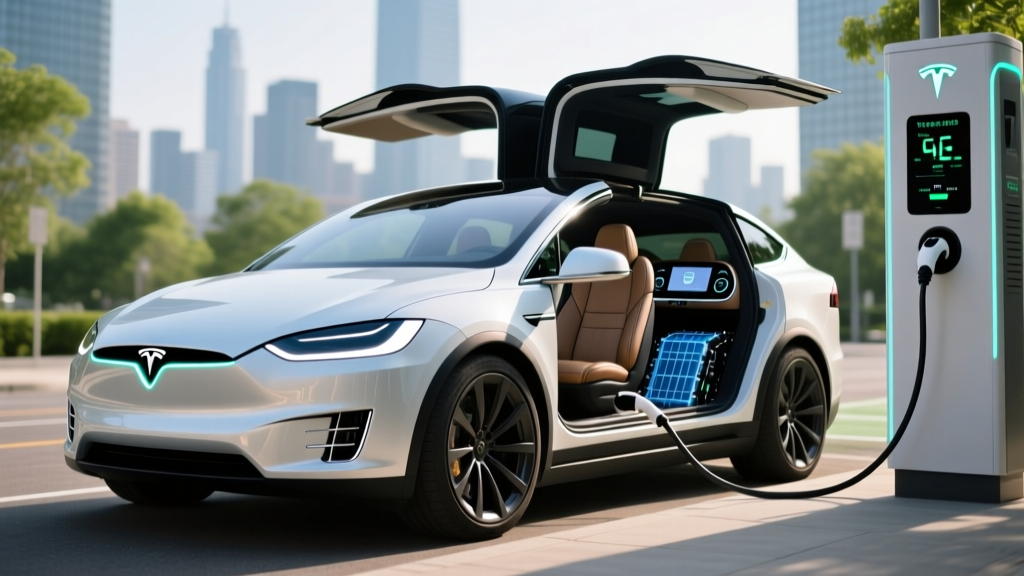
The falcon-wing rear doors are the P100D's most distinctive feature. They open upward with articulated hinges, providing excellent access to the second and third rows in tight parking spaces. However, they're also the vehicle's most common source of maintenance complaints — sensors, actuators, and weather seals have been known to require service. Budget for potential door-mechanism maintenance.
Driver assistance: The P100D comes equipped with Tesla Autopilot (SAE Level 2), which includes adaptive cruise control and lane-keeping assist. Some used examples may have Enhanced Autopilot or Full Self-Driving (Supervised) capability purchased by the original owner. FSD (Supervised) remains a Level 2 system — the driver must remain fully attentive with hands on the wheel at all times. It is not autonomous driving. Only Level 4 services like Waymo operate without driver supervision.
Notable drawbacks include the lack of Apple CarPlay/Android Auto (Tesla uses its proprietary infotainment system), panel-gap inconsistencies common to pre-2021 Tesla builds, and wind noise at highway speeds from the large glass windshield and door seals aging over time.
Pros and Cons: The Honest Verdict
Pros
- 2.9-second 0-60 mph — still one of the quickest SUVs ever made
- 289–305 mile EPA range is solid for a three-row electric SUV
- Access to Tesla Supercharger network (over 50,000 stalls globally)
- Spacious cargo area (88.1 cu ft) with versatile seating for 5–7
- Over-the-air software updates continue to add features
- Falcon-wing doors provide unmatched rear-seat access in tight spaces
- Air suspension with adjustable ride height
- 5,000-lb towing capacity for an electric SUV
Cons
- DC fast charging limited to ~120 kW — 40+ minutes for 10–80%
- No V3 Supercharger speed advantage despite newer stall availability
- Battery degradation on 6–9-year-old NMC pack reduces usable range
- Falcon-wing doors are a frequent maintenance pain point
- Resistive cabin heating (no heat pump) causes heavy cold-weather range loss
- Likely ineligible for federal used-EV tax credit (price above $25k cap)
- No Apple CarPlay or Android Auto
- Insurance costs above average for the segment
- Pre-2021 build quality inconsistencies (panel gaps, rattles)
Who Should Buy the P100D — and Who Shouldn't
Buy the P100D if: You want a used three-row electric SUV with supercar-rivaling acceleration, you primarily drive in moderate climates, you have home Level 2 charging, and you value Supercharger network access for road trips. It's ideal for families who want performance and space without paying new-vehicle prices.
Skip the P100D if: You frequently take long highway road trips (the 120 kW charging ceiling adds time), you live in a very cold climate (resistive heating hammers range), you need the latest driver-assist hardware (Hardware 2.5/3.0 in the P100D is less capable than Tesla's current HW4), or you want federal tax credit assistance on your purchase. In those cases, consider a used 2022+ Model X (dual-motor, CCS-native, heat pump equipped) or a Rivian R1S.
Frequently Asked Questions
What is the real-world range of the Tesla Model X P100D?
The EPA rates the P100D at 289–305 miles depending on model year. In real-world highway driving at 70–75 mph, expect 230–260 miles. In cold weather below freezing, plan for 180–210 miles. Factor in 8–14% battery degradation on a used example, which further reduces usable range.
How fast does the P100D charge on DC fast chargers and at home?
The P100D peaks at approximately 120 kW on DC fast chargers (V2 Superchargers), taking about 40–45 minutes from 10–80%. It cannot utilize V3 Supercharger speeds. On a home Level 2 charger at 11.5 kW (48A), it adds roughly 30–34 miles per hour, with a full charge in 9–10 hours.
Does the Tesla Model X P100D qualify for any federal tax credit in 2026?
The new-vehicle §30D credit does not apply since the P100D is discontinued and only available used. The used-EV credit (§25E, up to $4,000) requires a sale price at or below $25,000. Since most P100Ds sell for $38,000–$55,000 in 2026, the majority will not qualify. Verify current rules at IRS.gov.
Is the P100D worth buying versus a used Model X Plaid or Rivian R1S?
The P100D offers the best value for pure acceleration per dollar in a three-row electric SUV. A used Model X Plaid (2022+) charges faster (up to 250 kW), has a heat pump, and features Hardware 4 — but costs $70,000+. The Rivian R1S offers superior off-road capability and build quality but lacks Supercharger access. If budget is paramount and charging speed isn't your priority, the P100D is compelling.
How long will the P100D's 100 kWh battery last?
Tesla originally warranted the P100D battery for 8 years or 150,000 miles with a minimum 70% capacity retention. Many 100 kWh NMC packs from this era show 86–92% state of health at 80,000–100,000 miles. A full battery replacement (if needed out of warranty) costs approximately $18,000–$24,000 at a Tesla service center.
What are the biggest maintenance concerns on a used P100D?
Watch for falcon-wing door actuator and sensor issues, air suspension compressor wear, drive unit whine or failure (especially the front unit on pre-Raven models), and 12V auxiliary battery replacements. Budget $1,000–$2,000 annually for out-of-warranty maintenance on a high-mileage example.
The Tesla Model X P100D remains an extraordinary machine by any measure — a 5,400-pound family hauler that hits 60 mph in under 3 seconds while offering 289+ miles of EPA-rated range and seating for up to seven. In 2026, it represents strong value on the used market for buyers who understand its limitations: slower DC charging than modern EVs, cold-weather range penalties from resistive heating, and the maintenance realities of complex falcon-wing doors. If those trade-offs fit your use case, the P100D delivers an ownership experience that few vehicles — electric or otherwise — can match.