Quick Answer: What Are Electric Automobile Motors?
Electric automobile motors convert electrical energy from a battery pack into rotational force (torque) to drive the wheels. Unlike internal combustion engines, they deliver maximum torque instantly from zero RPM, require no multi-speed transmission, and operate at 85–95% efficiency compared to a gas engine's 20–35%. The three dominant motor types in 2026 production EVs are permanent magnet synchronous motors (PMSM), AC induction motors, and the emerging axial-flux motors. Your motor type affects range, performance, regenerative braking strength, and long-term service costs — but for most buyers, the battery chemistry and charging speed matter more for daily ownership satisfaction.
How Electric Automobile Motors Actually Work
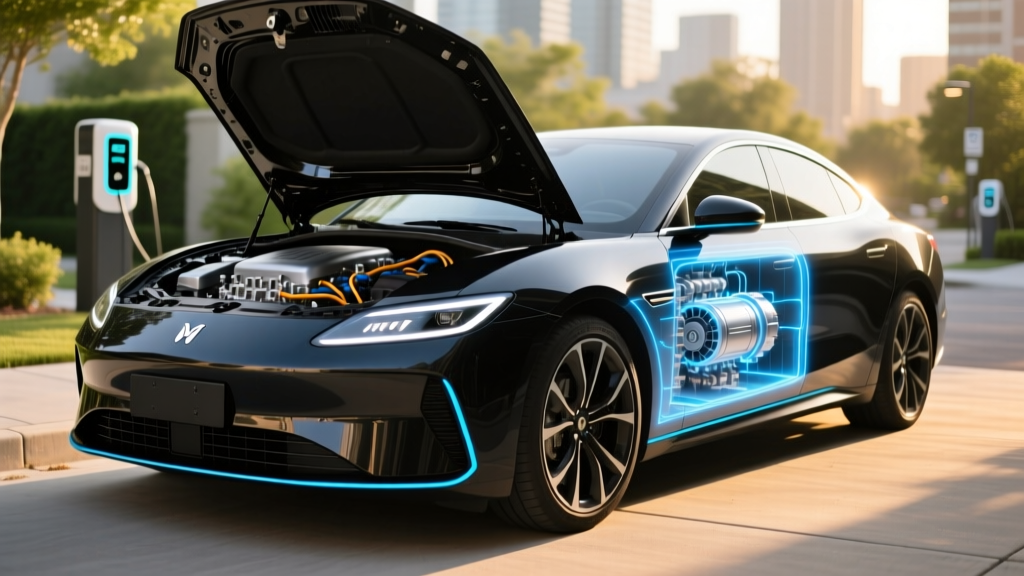
An electric motor in a battery-electric vehicle (BEV) operates on electromagnetic principles: current flowing through copper windings in the stator creates a rotating magnetic field, which pulls or pushes the rotor to spin. That rotation drives the axle and wheels. The power electronics (inverter) convert the battery's DC current into the AC waveform the motor needs, and precisely control frequency and voltage to manage speed and torque.
The simplicity is the point. A typical EV drivetrain has fewer than 20 moving parts in the motor assembly. A gasoline powertrain — engine, transmission, differential, exhaust, emissions systems — has hundreds. This is why EVs eliminate oil changes, transmission fluid swaps, spark plug replacements, and catalytic converter failures.
Most 2026 EVs use a single-speed reduction gear rather than a multi-gear transmission. Because electric motors produce useful torque across a broad RPM band (often 0–15,000+ RPM), a single gear ratio handles everything from launch to highway cruising. The Porsche Taycan and Audi e-tron GT use a two-speed rear axle for optimized highway efficiency and launch acceleration, but this is the exception, not the norm.
The Three Motor Types Powering 2026 EVs
| Motor Type | How It Works | Key Advantage | Key Trade-Off | Example 2026 Vehicles |
|---|---|---|---|---|
| PMSM (Permanent Magnet Synchronous) | Rotor contains rare-earth permanent magnets; stator field pulls rotor in sync | Highest efficiency (~93–95%); compact size; strong regen braking | Relies on neodymium/dysprosium — supply-chain and cost risk | Hyundai Ioniq 5, Tesla Model 3 (rear), BMW i4, Ford Mustang Mach-E, most Chinese-market EVs |
| AC Induction (Asynchronous) | Stator field induces current in rotor cage; no permanent magnets | No rare-earth dependency; robust at high RPM; cheap to manufacture | Slightly lower efficiency (~88–91%); weaker regen; heavier for same output | Tesla Model S/X (front motor), older Audi e-tron variants, some commercial EVs |
| Axial-Flux (Disc-Type) | Magnetic field flows axially (parallel to shaft) between disc-shaped stator/rotor | Extremely high power density; very compact and light | Expensive to manufacture; thermal management challenges; limited adoption | Mercedes-AMG ONE, YASA-equipped prototypes; limited production as of 2026 |
What this means for buyers: PMSM dominates the market for good reason — it gives you the best efficiency and strongest one-pedal driving feel. Induction motors are still used in dual-motor setups as the front "disconnect" motor (Tesla does this: the front induction motor freewheels during light-load cruising to save energy). Axial-flux is promising but remains niche due to manufacturing costs.
Electric Motors vs. Gas Engines: Efficiency and Cost Compared
| Metric | Electric Motor (BEV) | Gasoline Engine (ICE) | Hybrid (HEV/PHEV) |
|---|---|---|---|
| Drivetrain Efficiency | 85–95% | 20–35% | 30–42% (combined) |
| Energy Cost per Mile | $0.03–$0.06 (home L2) | $0.12–$0.18 (gas) | $0.07–$0.12 |
| Maintenance (5-year avg) | ~$1,200–$1,800 | ~$3,500–$5,000 | ~$2,800–$4,000 |
| Moving Parts (drivetrain) | <20 | 200+ | 150+ |
| Peak Torque Delivery | Instant (0 RPM) | Requires RPM buildup (2,000–4,500 RPM) | Varies; electric assist helps |
| Regenerative Braking | Yes — recovers 15–30% of kinetic energy | No — all braking energy lost as heat | Limited (small battery) |
| Typical 0–60 mph (mid-size sedan) | 4.5–6.5 sec | 7.0–9.0 sec | 6.0–8.0 sec |
The efficiency gap is the single biggest ownership advantage. When you charge at home on Level 2 at an average U.S. electricity rate of ~$0.16/kWh (EIA, 2025 data), an EV averaging 3.5 miles/kWh costs roughly $0.046 per mile. A gas car averaging 28 MPG at $3.40/gallon costs $0.121 per mile. Over 15,000 annual miles, that's a fuel savings of approximately $1,125 per year — before factoring in any solar charging or time-of-use rate optimization.
Source: fueleconomy.gov — Electric Vehicle Technology Explained
Real-World Ownership: What Motor Type Means for You
Motor type alone rarely determines whether an EV fits your life. But it intersects with battery chemistry, charging infrastructure, and climate in ways that affect daily ownership:
Cold-Weather Performance
Electric motors themselves lose negligible efficiency in cold weather. The range loss you experience at 20°F comes from the battery — increased internal resistance reduces usable kWh and slows charging. A PMSM motor's strong regenerative braking can feel slightly reduced when the battery is cold and can't accept regen current at full rate. Most 2026 EVs with heat pumps (Hyundai, Tesla, BMW) mitigate cabin-heating energy draw, but expect 15–30% real-world range reduction in sustained sub-freezing driving regardless of motor type.
Regenerative Braking Feel
PMSM motors typically deliver stronger, more consistent regen braking than induction motors. This is why vehicles like the Hyundai Ioniq 5 and Tesla Model 3 (both PMSM rear-drive) offer more convincing one-pedal driving than older induction-based platforms. If you commute in stop-and-go traffic, strong regen means less brake-pad wear — many EV owners report original brake pads lasting 80,000+ miles.
Highway Efficiency
At sustained highway speeds (70–80 mph), the motor operates at high RPM where induction motors historically showed an efficiency advantage due to zero magnetic drag when de-energized. However, modern PMSM designs with silicon-carbide (SiC) inverters have largely closed this gap. The Tesla Model 3 Long Range (PMSM rear) achieves 132 MPGe combined per the EPA, competitive with any induction-based platform.
Motor Longevity and Replacement
Electric motors rarely fail in normal ownership. Bearings and cooling systems are the primary wear points, and most manufacturers warranty the motor as part of the high-voltage drivetrain for 8 years / 100,000 miles (federal minimum; some extend to 10 years). If a motor does require replacement out of warranty, costs range from $3,000–$7,000 depending on the vehicle — far less than a full engine rebuild, but still a meaningful expense.
Buyer Decision Framework: What Should You Prioritize?
Use this framework to match your situation to the right EV platform:
- Choose a PMSM-based EV (most 2026 models) if you want maximum range per kWh, strong one-pedal driving, and the broadest model selection. Best for: daily commuters, stop-and-go urban drivers, efficiency-focused buyers.
- Choose a dual-motor AWD with induction front + PMSM rear if you need all-weather traction but want highway efficiency. The front motor disconnects during cruising. Best for: snow-belt drivers, road-trippers who value range.
- Choose a PHEV (hybrid with plug) if you lack reliable home charging, frequently drive 300+ miles in rural areas, or live where DC fast-charging infrastructure is sparse. You get 25–40 miles of electric driving plus a gas engine for longer trips. Motors are smaller (~100–170 HP electric) but paired with an ICE.
- Wait on axial-flux unless you're buying a high-performance specialty vehicle. The technology isn't yet in mainstream, affordable EVs as of 2026.
Total Cost of Ownership: EV vs. Gas vs. Hybrid (5-Year Breakdown)
| Cost Category | BEV (e.g., Tesla Model 3 LR, $42,490 MSRP) | Gas Sedan (e.g., Toyota Camry LE, $28,855 MSRP) | PHEV (e.g., Toyota Prius Prime, $34,595 MSRP) |
|---|---|---|---|
| Purchase Price (base) | $42,490 | $28,855 | $34,595 |
| Federal Tax Credit (§30D) | Up to $7,500 (eligibility varies — see IRS rules below) | $0 | Up to $7,500 (eligibility varies) |
| Effective Purchase | ~$34,990 (if full credit applies) | $28,855 | ~$27,095 (if full credit applies) |
| Fuel/Energy (5 yr, 15K mi/yr) | ~$3,450 (home L2 at $0.16/kWh) | ~$9,075 (28 MPG, $3.40/gal) | ~$5,200 (blended) |
| Maintenance (5 yr) | ~$1,500 | ~$4,200 | ~$3,400 |
| Insurance (5 yr avg) | ~$9,500 | ~$7,200 | ~$7,800 |
| Estimated Depreciation | ~$18,000 | ~$12,500 | ~$14,500 |
| 5-Year Total Cost | ~$67,440 | ~$61,830 | ~$57,995 |
Key takeaway: EVs cost more upfront and often carry higher insurance premiums (repair costs and parts pricing). But the fuel and maintenance savings compound every mile. Break-even typically occurs between years 4–6 depending on your electricity rate, annual mileage, and whether you qualify for the federal credit. High-mileage drivers (20,000+ miles/year) break even faster.
§30D Federal Tax Credit — 2026 Eligibility Reminders
The IRS §30D clean vehicle credit offers up to $7,500, split into two halves:
- $3,750 if battery components meet North American manufacturing thresholds
- $3,750 if critical minerals meet U.S./FTA-country sourcing requirements
You must also meet income caps ($150K single / $300K joint AGI), MSRP caps ($55K sedans / $80K SUVs and trucks), and the vehicle must undergo final assembly in North America. The credit can be transferred to the dealer at point of sale as a purchase-price reduction. Eligibility changes frequently as sourcing rules tighten — always verify with the IRS or a tax professional before relying on a specific credit amount.
Common Misconceptions About Electric Motors — Myth vs. Fact
| Myth | Fact |
|---|---|
| "Electric motors wear out like gas engines." | EV motors have minimal wear components (bearings, seals). Most last the vehicle's lifetime. The battery degrades; the motor generally does not. |
| "More horsepower always means a better motor." | Peak HP matters for 0–60 times, but sustained power delivery and efficiency at cruise RPM determine real-world range. A 300 HP PMSM often outperforms a 400 HP induction motor in daily efficiency. |
| "Dual-motor AWD is twice as good." | Dual motors add weight and cost. You gain traction and acceleration, but lose 5–10% range vs. single-motor. Only worth it if you regularly drive in snow, rain, or mountain terrain. |
| "EV motors need regular servicing." | No oil, no filters, no belts. Coolant flush intervals are typically every 5 years or 100,000+ miles. Most owners never service the motor itself. |
| "Regenerative braking replaces your brake pads entirely." | Regen handles 80–90% of deceleration, dramatically extending pad life. But friction brakes are still required for emergency stops and low-speed holding. Pads last longer, not forever. |
What First-Time EV Buyers Should Know About Motors and Ownership
1. Motor type is secondary to battery and charging. A PMSM motor paired with a 60 kWh LFP battery and 150 kW max charging will feel limited on road trips compared to an induction-motor EV with an 85 kWh NMC pack and 250 kW charging. Prioritize usable battery capacity (kWh) and DC fast-charge rate (kW) over motor architecture.
2. Home charging is the ownership experience. If you can install a Level 2 home charger (240V, 32–48A, adding ~25–35 miles of range per hour), you'll start every morning with a full "tank." Installation costs range from $800–$2,500 depending on panel capacity and run length. Without home charging, public DC fast-charging becomes your primary refueling method — more expensive ($0.30–$0.50/kWh) and less convenient.
3. kW ≠ kWh. This is the most common confusion. kWh (kilowatt-hours) is the energy stored in your battery — like gallons in a gas tank. kW (kilowatts) is the rate of power delivery or charging — like gallons-per-minute at a pump. A 75 kWh battery charged at 150 kW (peak) does not fill in 30 minutes because charging speed tapers above ~80% state of charge to protect battery health.
4. EPA range is optimistic for highway driving. The EPA test cycle includes low-speed urban segments. Expect 80–90% of EPA range at sustained 70 mph highway speeds, and 70–80% in cold weather (below 30°F). A 310-mile EPA rating realistically delivers 250–270 highway miles in mild weather and 210–240 in winter.
5. Insurance costs more. EVs carry 15–25% higher insurance premiums on average due to higher repair costs, specialized parts, and total-loss thresholds. Get quotes before purchasing — the difference can offset some fuel savings.
Frequently Asked Questions
Do electric motors lose power over time?
Minimally. Unlike gas engines that lose compression and develop wear, electric motors maintain output as long as bearings and windings remain intact. What degrades is the battery — typically 10–15% capacity loss over 8–10 years — which reduces range, not motor power.
Can an electric motor be repaired or only replaced?
Bearings, seals, and cooling components can be serviced by qualified EV technicians. Winding or inverter failures typically require unit replacement. Out-of-warranty motor replacement runs $3,000–$7,000 depending on the vehicle and labor.
Why do some EVs use two different motor types?
Dual-motor EVs often pair a PMSM (rear, primary drive) with an induction motor (front, secondary). The induction motor can be fully de-energized during light-load cruising — creating zero magnetic drag — which improves highway efficiency. The PMSM handles most driving and provides strong regenerative braking.
Are electric motors in hybrids the same as in full EVs?
Similar principles, but hybrid motors are typically smaller (80–170 HP electric-only) because they supplement rather than replace the gas engine. PHEVs like the Prius Prime use a PMSM motor-generator paired with a 13.6 kWh battery for ~39 miles of electric-only range before the ICE takes over.
Will solid-state batteries change motor requirements?
Solid-state batteries (expected in limited production by 2028–2030) offer higher energy density and faster charging. Motors won't fundamentally change, but the ability to sustain higher charge/discharge rates may push motor thermal management designs toward higher sustained-power ratings.